
Fred Hechinger in ‘A Long Winter.’


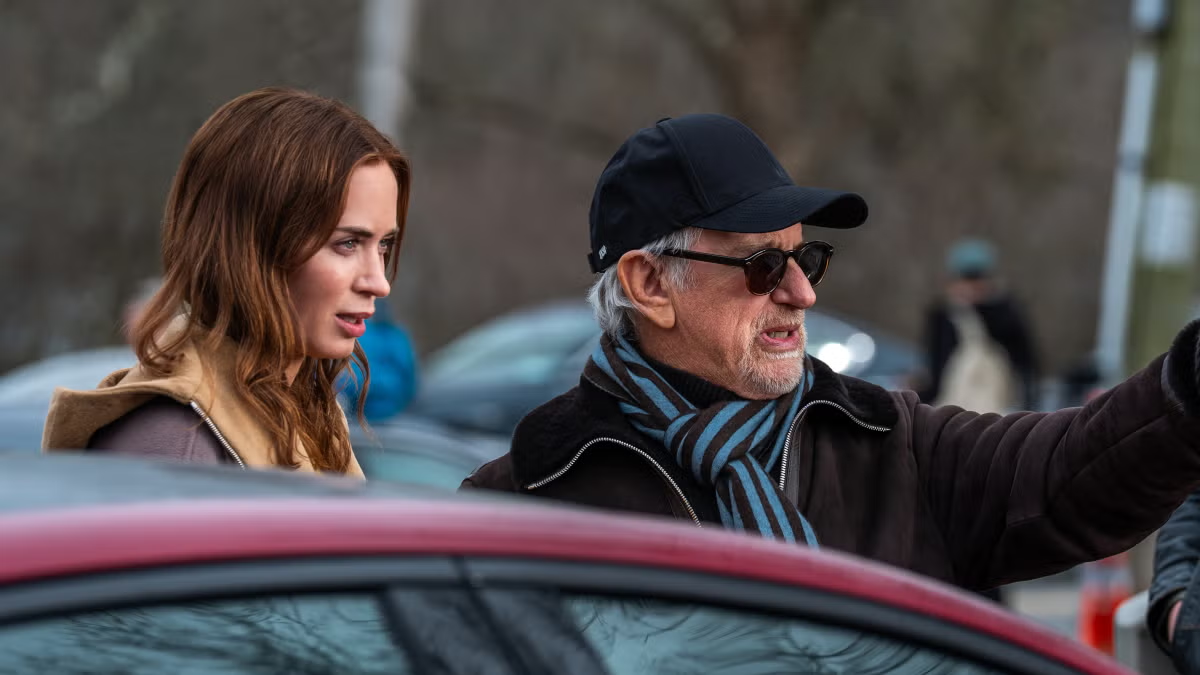
At a time when the box office is being defined by a new generation of storytellers, one of its most hallowed is coming back for another round. For only the second time in the last decade and a half, Steven Spielberg is on the summer movie slate with his original sci-fi thriller, “Disclosure Day.”
Loaded with a cast that includes Emily Blunt, Josh O’Connor, Colman Domingo and Colin Firth, “Disclosure Day” — which is based on an original story by Spielberg — follows two people who, thanks to a mysterious event in their childhood, are the key to unlocking a truth that has been covered up for decades: there are aliens amongst us, and they have been hidden by a powerful secret organization that has been exploiting their technology for themselves.
While critics are divided on whether this film lands somewhere in the middle or in the upper echelons of his filmography, their reviews of “Disclosure Day” have been overwhelmingly positive as it stands with a 90% Rotten Tomatoes score. That might move the needle in presales and tracking over the next couple of days, but for now projections stand at $35-40 million, which means audience word-of-mouth will be vital.

With 39 feature films under his belt as a director — not counting the dozens more he’s produced through Amblin Entertainment like Chloe Zhao’s “Hamnet” — and three Oscars from 24 nominations, the 79-year-old Spielberg has nothing left to prove.
He has three movies — “Jaws,” “E.T.,” and “Jurassic Park” — that became the highest grossing film in box office history at the time of their release. To date, Spielberg has $10.7 billion in combined global box office grosses, a total only rivaled by the $10.5 billion of James Cameron, which sets him as the highest-grossing director in cinema history.
But with all of his success, it is easy to forget that Spielberg has not been the box office titan he once was. Since his 2011 film “The Adventures of Tintin,” only two of Spielberg’s films have grossed more than $100 million at the domestic box office: his 2012 biopic “Lincoln” with $182 million and his 2018 adaptation of the nostalgia-fueled sci-fi novel “Ready Player One” with $137 million.

And while Spielberg contributed to the summer box office in the 2000s with movies like “Minority Report” ($132M domestic/$358M worldwide), “War of the Worlds” ($234M dom./$603M WW) and “Indiana Jones and the Kingdom of the Crystal Skull” ($317M dom./$786M WW), Spielberg only released one summer movie in the 2010s: Disney’s Roald Dahl adaptation “The BFG,” which made just $55.8 million domestic and $194 million worldwide.
Spielberg’s focus in his golden years has largely been on more mature fare, including historical dramas like “War Horse,” “Bridge of Spies” and “The Post,” all of which have earned him critical praise but served more as supplements to the fall/winter awards box office season rather than money-making high-points.
And in the 2020s, Spielberg’s box office presence has been nonexistent even as his work brings in industry plaudits. His 2021 adaptation of “West Side Story” was sidelined by a COVID-19 variant surge that kept Spielberg’s core audience at home, causing it to bomb with just $76 million worldwide.
Then came his far cheaper 2022 autobiographical drama “The Fabelmans,” which earned him another pair of Oscar nominations but made even less with just $45.6 million worldwide, including just $17.3 million from a domestic run that never exceeded 2,000 screens.
So it’s been a while since Spielberg has put forth a film not trying to appeal to discerning cineastes or nostalgic movie nerds, but to a wide audience. And unlike “Ready Player One,” “Tintin,” or “Crystal Skull,” “Disclosure Day” is being sold in a far more old-fashioned way: with cryptic marketing that teases its alien premise while staying light on plot details and focusing more on the film’s gripping car and train action sequences.
With a reported $115 million production budget and marketing spend of around $80 million, a $50 million domestic opening would put “Disclosure Day” on firm ground as the theatrical market heads into the peak of the summer season. Even if it falls short of that, anything higher than $41 million would pass “Ready Player One” as Spielberg’s highest opening since “Crystal Skull.”
But it will be the audience metrics, not the dollar figure, that will provide a better sense of whether “Disclosure Day” will be a theatrical success for Universal. At Spielberg’s behest, Universal has kept footage from the film’s third act out of the marketing material for the film, as he explained at CinemaCon that moviegoers have become smart at recognizing footage from trailers and can get a sense as they watch a film of where a movie is going.
That may put the audience even more firmly under Spielberg’s movie magic, but the risk of a cryptic marketing campaign is that audiences end up passing on it because they either have no idea what it is, or word-of-mouth falters because a significant chunk of the opening weekend audience gets the wrong impression from the trailers and gives it a thumbs down for not meeting those expectations.

While the aliens Spielberg teases do eventually come, will the masses embrace the human conflict of “Disclosure Day,” where car chases and fierce manhunts are fueled by clashing views on humanity and society’s ability to handle world-altering truths? Will moviegoers be riveted or lost by David Koepp’s sprawling, concept-heavy screenplay all in service of an earnest appeal to empathy?
And at a time when Gen Z has firmly rejected a new “Star Wars” film and a “Masters of the Universe” revival, Spielberg can’t assume a generation that did not grow up seeing “Jurassic Park” and “Indiana Jones” in theaters will faithfully show up.
Spielberg, for his part, has more aggressively promoted this film than many of his recent works, making the podcast rounds, appearing on Bill Simmons’ “Rewatchables” and even doing an event with TikTok personality and filmmaker Reece Feldman to drum up hype with younger moviegoers.
Spielberg’s longtime fans, many of whom are north of 45, will reliably show up even if it’s not on opening weekend. But for Spielberg to reclaim some of his theatrical drawing power, it will come down to whether “Disclosure Day,” an old-fashioned take on alien sci-fi with a modern, action-packed twist, is embraced by the audience that has made “Backrooms” a smash hit.

>

The crux of the current state attorneys generals’ argument against the Paramount-Warner Bros. Discovery merger is that the deal will be bad for movie theaters because a combined Paramount-WBD will be able to dictate terms to exhibitors that will only further hamstrung them. As such, the states believe they’re on the side of the movie theaters.
So why then are the CEOs of the No. 1 and No. 2 theater chains in America taking Paramount’s side?
Last week, AMC Entertainment CEO Adam Aron wrote an op-ed for Variety publicly endorsing the Paramount-WBD merger, writing that the states’ legal challenge must be overcome as soon as possible. “Thanks, but no thanks,” Aron wrote in response to the AG’s help. “Their complaint simply gets the economics of our business backwards.”


Shortly thereafter, Regal Cinemas CEO Eduardo Acuna gave a statement to Deadline saying “it’s time” for the merger to go through and called Paramount and Ellison an “effective steward” of the two legacy studios.
“A long fight in court that extends into spring or summer doesn’t put more films in theaters, and is not beneficial to studios, filmmakers, the guests who go to the movies, or theater businesses like Regal and the people who work for them,” Acuna said. “It just creates more uncertainty and distraction that could be damaging to our industry as we build on our current success. It is time for all parties to sit down and work out how to formalize these commitments.”
Now we have an idea as to why AMC and Regal brass are backing the deal.
Bloomberg reported Monday that Paramount is agreeing to put into writing its commitment to theatrical releases under the merger, and that AMC and Regal are among the chains that are agreeing to a combined Paramount-WBD’s terms.
It’s unclear if the third-largest chain, Cinemark, was also approached. Reps for Paramount, AMC, and Regal did not respond to IndieWire’s request for comment on the report. Previously, Acuna said in his statement to Deadline that Ellison “is sincere in making these commitments, and he has offered to execute a consent decree to the State AGs to that effect.”
The agreement is the same as what Ellison has said publicly time and time again, including at CinemaCon in front of these very theater owners: the combined studio will release 30 movies per year, each wide release film will have a minimum of a 45-day theatrical window until PVOD and a 90-day minimum window until SVOD, and it will commit to this for three years.
It’s unclear however what penalties Paramount would face if it were to break this commitment, and many have expressed doubts that such agreements are actually enforceable.
The timing is peculiar but perhaps not a coincidence. A judge last week set a trial date for March to determine the validity of the merger, a blow to Paramount as it lobbied for a date as soon as November and looks to avoid paying a costly ticking fee of $7 million per day starting October 1, totaling upwards of $1 billion by next spring. An appeals process could stretch this out even longer. Paramount has agreed not to close until June unless a trial concludes before then. And they’d like to do anything they can to move this thing along, sway public opinion, reach a settlement, and move forward.

Cinema United, the trade organization that represents theater owners, including AMC and Regal, however still remains publicly opposed to the merger. The organization’s CEO Michael O’Leary sent a memo to its members last week after Variety published its Aron op-ed. In it, O’Leary wrote that the group met with Paramount leadership in June but hadn’t heard back from Paramount as of July 1, even though it sure sounds like from both Aron and Acuna’s statements that they had and gotten assurances they were looking for.
An individual familiar with the group’s thinking said Cinema United is still open to discussions with all parties and its position hasn’t changed: it wants meaningful guardrails to protect the theatrical industry in the future. A Paramount spokesperson previously in response to O’Leary’s memo disputed Cinema United’s timeline and said the trade group’s counsel “introduced new demands unrelated to the merger.”
All these promises matter little to California AG Rob Bonta. He wrote his own op-ed in Deadline on Monday, August 10, not long after Ellison voiced his perspective in the New York Times in a true battle in the press. Bonta said that no matter how Ellison and company try to spin things (Ellison suggested in his op-ed this whole drama is about CNN and fears over his politics), the states’ lawsuit has to do with antitrust law and will have an impact “that can’t be remedied with a few one-off, piecemeal promises.”
So yes, make all the deals you want with movie theaters or say whatever you want regarding CNN. Bonta is saying none of that matters in the grand scheme of this lawsuit or will make it go away any sooner, nor does it eliminate the states’ concern over cable network consolidation. Does it matter to the public or to the rest of Hollywood? The jury’s still out there too.
The commitment that Ellison has repeatedly made of a 45-day theatrical window is not the biggest concern, even to exhibitors. It’s increasingly getting back to being an industry standard at least for wide-release, major studio tentpoles, even if some of the smaller specialized titles are going to streaming sooner. He’s also promised a minimum 90-day window to SVOD and, if you pressed some theater owners, some of them would say that’s not long enough and that other studios stretch their SVOD window even longer.
The bigger concern is the 30 movies a year. Paramount has pointed out again and again that it has 15 movies in theaters in 2026, as does Warner Bros., and as recently as last year Paramount only had 9 releases. The states have pointed to the steep decline in titles from 20th Century Studios and Searchlight Pictures compared to before 20th Century Fox was absorbed by Disney as precedent for what will happen with Paramount and Warner Bros., and Paramount has done all it can to dispel that notion.
Part of the reason people still don’t believe it is a three-year span for 30 theatrical releases a year can safely cover a ton of movies that WB and Paramount already have in development or in the pipeline. It says nothing of what they’ll do or how many movies they’ll release after those titles have run out.
To the theaters, more movies is always better for as long as they can get their hands on them. You can sympathize with Aron that exhibitors suffered an existential crisis when COVID hit, it slowed any recovery that had been made when the strikes happened, and now you want to hamstrung theaters again with another delay that could impact the output of two studios?
And for the general public, they want options but really only care if the movies are good. Will such an aggressive output harm the quality? No consent decree or court case can promise that.
>
Following the release of his latest film, All of Us Strangers, Andrew Haigh found himself presented with options like never before. The British director, previously best known for gay cult faves like his breakout feature Weekend and HBO’s Looking, met widespread critical acclaim for the wrenching queer drama starring Andrew Scott, leading to his first BAFTA nominations for best screenplay and directing. It became his highest-grossing movie ever at the box office, pushing past $20 million globally. The opportunity to scale up, beyond the intimate character studies with which he’d made his name, couldn’t be ignored.
“When you have a thing that breaks through a little bit, you have to take advantage of it. It does make you take a lot more meetings afterwards, with lots of people sending you things — which is both good and then slightly exhausting,” Haigh says. “Part of me was like, ‘Should I go bigger? I could now go and do this thing over here that’s big and shiny and might get me more visibility.’ But I don’t necessarily need lots of visibility. The slightly more success you get, the harder it becomes to make those choices.”
And so Haigh looked inward. He did not go bigger. Instead, he turned toward the project he’d been trying to make for nearly 20 years — as tender, nuanced and subtle as anything in his oeuvre. A Long Winter feels, first and foremost, like an Andrew Haigh film.
Now 53, Haigh first read Colm Tóibín’s short story “A Long Winter” right around its 2006 publication, before he’d helmed a single movie. The tale follows 20-something Miquel, who lives with his father in a remote snowy village. His brother has just left on military service and his mother has suddenly walked out on the family. Miquel desperately searches for her in the freezing conditions, plumbing new depths of self-discovery in the process.
“Within that story was everything I wanted to make films about — I remember reading it and thinking, ‘This is the perfect manifestation of what I care about,’” Haigh says. This was roughly two decades ago. Then an aspiring filmmaker, Haigh convinced the prize-winning Irish author to grant him the rights to “A Long Winter.” As he built his career, he tried to make the movie, over and over — initially working off of a script set in Spain, as the original text was. “No one wanted to make it,” Haigh says. “I made it harder because I can’t speak Spanish and yet I was saying, ‘I want to shoot it in Spain.’”
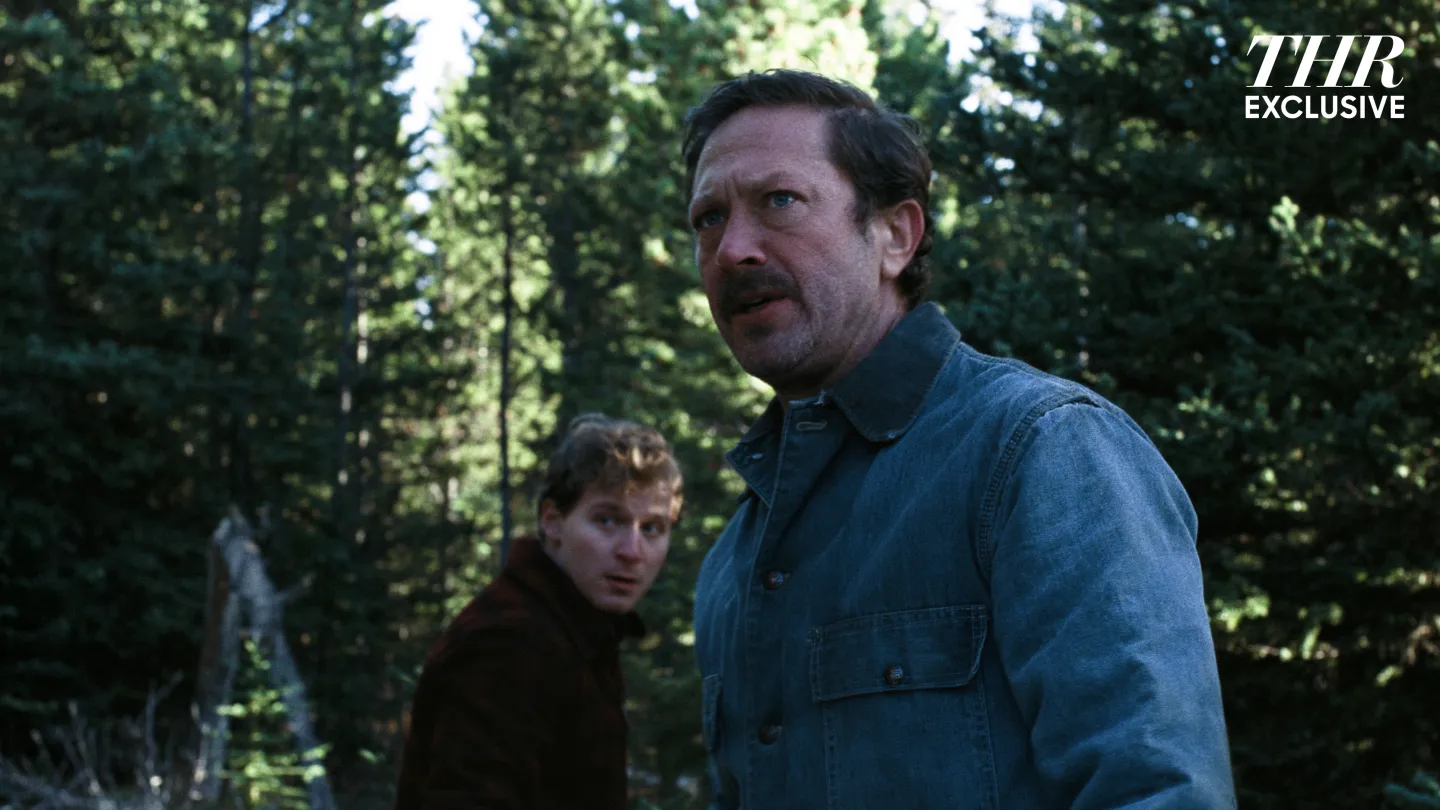
Fred Hechinger in ‘A Long Winter.’
And so the moment finally arrived, in the wake of Strangers’ lauded run and with a revamped adaptation. Haigh’s ultimate film of A Long Winter is slated to screen at the Toronto and New York film festivals before hitting theaters via MUBI later this year. It’s set deep in the Rockies of ‘50s Colorado, with young Mike (Fred Hechinger) navigating a complex relationship with his lonely father, Lester (Ebon Moss-Bachrach), after his brother (Kit Connor) leaves for Korea and his mother (Caitríona Balfe) disappears, running away from a life she’d found unbearably isolating.
“If you look at all of the movies I’ve made, there are these themes bubbling under: longing and trying to deal with loss and trying to understand who you are in the world and how to fit into the world that doesn’t make sense to you,” Haigh says. “Those themes are very inherent in the story, but told in a [similar] way to what I’ve always tried to do with my filmmaking: Excavate the complicated emotions beneath the surface and find a way to get them onto the screen.”
It’s a visually ambitious film for Haigh, the haunting elements of Strangers extending to this rich family portrait. “It’s not a big movie, but we had big ambitions,” the director says. “It’s definitely moving away from the more naturalistic, realistic base that some of my earlier work lived in and finding this more metaphorical place.” As he’s committed to doing lately, Haigh shot on film — “There was no debate about that,” he says — and worked with D.P. André Turpin to execute a more subjective cinematic style.
“The camera follows the awakening of Mike. If you look at the film, it’s a lot more static at the beginning and it starts to breathe,” Haigh says. “The camera starts to open up. It starts to move independently. It starts to move without a character leading it across the frame. To me, the film was about breathing differently. It was about opening your eyes differently.”
A Long Winter shot up in Canada, a little over an hour outside of Calgary — Colorado was “too expensive,” Haigh concedes — and you can feel the intensity of the elements. The family home was an original construction in the woods, overseen by production designer Emmanuel Fréchette, following an extensive location scout. “I can stand in the kitchen window and I can look out and see the mountains — they’re above me, they’re below me,” Haigh says. “It’s still there now six months later, somewhere on the mountainside, surviving the extremes.
“We built that house up on the mountain, inside and out, no studio work, all up in 100-mile-hour winds and the snow,” Haigh continues. “It’s where they shot The Revenant, actually. So this is my version of The Revenant — a slightly more delicate version.”
Caitríona Balfe and Ebon Moss-Bachrach in ‘A Long Winter.’
**
Haigh has been working with his casting director Carmen Cuba for well over a decade, going back to Looking. For the past several years, Cuba has been telling him to cast Hechinger in something. “Since seeing him in The White Lotus’s first season — from that day onward it’s been, ‘You’ve got to work with Fred,’” Haigh says. “She adores him, and I understand why. She sees him as a young, Dustin Hoffman-type of actor.”
Several actors put themselves on tape for the part of Mike, and Hechinger won the lead role. His moving, intricate performance serves as a showcase of what he can do as a lead, following auspicious supporting turns in films like Thelma and Nickel Boys. “If you watch him at the beginning of the film and see him at the end, he even looks like a different person,” Haigh says. “It’s not an easy performance.”
It’s the consistent hallmark of Haigh’s work — the landscape for his characters to grow and change feels immense, even as the script hews to the tighter conventions of real life. Mike begins the film feeling relatively comfortable in the family’s isolated cabin bubble, if only because what lies beyond it feels so alien. His contentment is rocked by his mother’s absence — her yearning for something better. He must now look his devastated father in the eye each morning, seeing all of his pain and resentments and fears. He must consider what led his mother to risk her death to find something different for herself. And he must confront what he himself wants — particularly when a mysterious young man (Reservation Dogs’ D’Pharaoh Woon-A-Tai) begins living with the family to help out around the house.
As in Tóibín’s story, Mike is queer — but Haigh, known for his vividly realistic sex scenes from Weekend through to Strangers, communicates this onscreen with a surprising, impressionistic approach.
“What I love about Mike, and especially how Fred plays him, is he’s this sensitive soul within this world that isn’t sensitive — his sexuality for me is wrapped up in a different way of feeling about the world and seeing the world,” Haigh says. “He needs someone to understand how he sees the world. I’ve put sex in a lot of the films that I’ve done, and I wanted this to be different. Sometimes queerness is framed only within sexual desire and not within something else. But obviously when you are queer, you know that it’s not just about sexual desire itself. It’s more than that.”
Hechinger in ‘A Long Winter.’
In these subtle but intent pushes, Haigh arrived at what felt like the ending of a chapter in his life and career. “I think of this film as a bookend to a lot of things I’ve been exploring over the last 15 years of making films,” he says. “As I’ve grown up and my life has changed — all of these stories that have been me trying to understand my own background, my life, my childhood, absences in my own life and certain losses — I’ve come to terms with a lot. So I feel like this is an endpoint.”
As for what his next chapter might look like? Haigh politely demurs with a laugh: “Well, let’s see what happens.”
Just don’t expect his next era to go the way of tentpoles and blockbusters. Haigh can claim the rare feat of making modestly budgeted, emotionally driven, critically hailed dramas at a steady clip for the entirety of his career — during which time the very future of independent film has been put under existential threat. It has never been easy for Haigh to get his movies made. But this moment, he concedes, feels different — scarier than ever.
“It is a very, very challenging time, and everything is much more expensive. Making a film is so much more expensive than it used to be,” he says. “My first movie, I made it for $65,000. 45 Years was only $1.5 million. You couldn’t make that film now for $1.5 million — it would cost so much more. When I speak to younger filmmakers, it’s a terrible situation for them. It’s even harder for them.”
And yet: “I’m quite happy existing within this budget range. I like to tell these stories. I like to have control of how I tell my stories,” Haigh says. “I can’t be someone else. I can’t make films like other people. I can only make films like I can make them. And so when I tell myself I never want to do this again because it’s too difficult, I remind myself of that. It’s a pretty incredible thing that I’ve been able to do.”
Stay tuned for more exclusive features on this fall’s biggest festival-bound films.
>
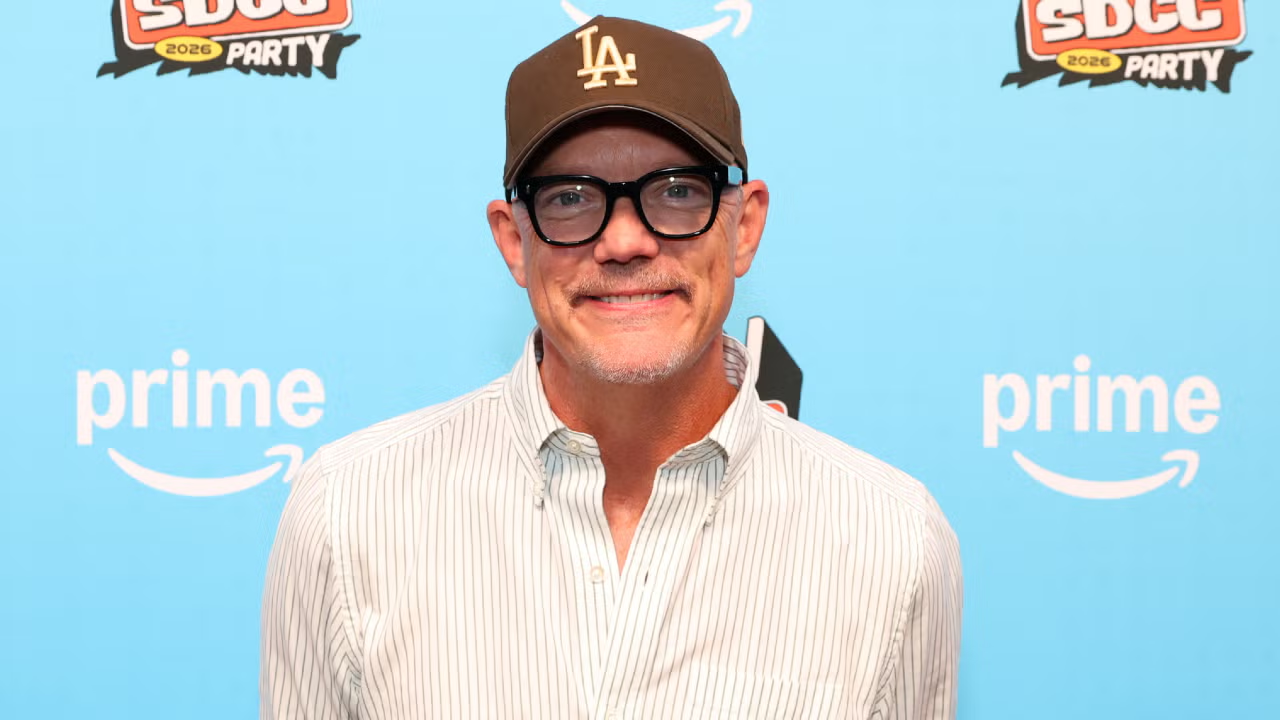
Matthew Lillard had an awkward encounter with a former fan at the Midsummer Scream horror convention in Long Beach, California, this past weekend.
Lillard was in attendance for the convention’s “Scream” 30th anniversary reunion panel. He was joined by several of his fellow “Scream” stars, including Skeet Ulrich, Lee Waddell, Jamie Kennedy and composer Marco Beltrami, for the panel celebrating the iconic 1996 slasher movie’s enduring legacy.
However, during a mid-panel fan Q&A that saw Lillard get up and walk around the floor to talk to attendees, a man stood up and spoke into a microphone to address the 56-year-old actor. The anonymous man recalled a years-old interaction with Lillard.
“I met you a few years ago,” he said, before recalling the time he tried to tell Lillard about his theory that there was a “Scream connection” linking the 1996 slasher movie and the 1995 romance movie “Mad Love,” both of which starred Drew Barrymore as characters named Casey. In response, Lillard allegedly asked the man, “What were you smoking?”
“The way you made me feel … when you told me that, you kind of lost me as a fan,” the man told Lillard, adding, “I just wanted you to know that.”
While most of what the fan said afterward were overwhelmed by the crowd’s reaction, he could be heard telling Lillard in video captured of the moment, “I always had a thing for you. Yeah, you lost me as a fan. Thank you.”
“What a great question,” Lillard quipped in response, while the crowd booed the former fan. Although Kennedy tried to get Lillard to clarify the fan’s comments, Lillard responded, “It does not matter. Next question!”
The awkward interaction comes the same year that Lillard made his quasi-return to the “Scream” franchise in “Scream 7.” Lillard appears in several scenes in the film, reprising his role as one of the franchise’s original Ghostface killers, before it is ultimately revealed that one of the other “Scream 7” characters used AI deepfake technology to “resurrect” Stu in video communications with still-standing Final Girl Sidney Prescott (Neve Campbell).

>


Search For Canadian TV Actor Stewart McLean Now Homicide Investigation


These ’90s fashion trends are making a comeback in 2017
According to Dior Couture, this taboo fashion accessory is back
Model Jocelyn Chew’s Instagram is the best vacation you’ve ever had
Your comprehensive guide to this fall’s biggest trends
9 Celebrities who have spoken out about being photoshopped
Emily Ratajkowski channels back-to-school style
A photo diary of the nightlife scene from LA To Ibiza