
Tech
Meta’s months-old AI unit is a soul-crushing gulag, say the engineers stuck inside it


Anyone who works at Meta or knows anyone who works at Meta will tell you the same thing: it is not a happy place, particularly given the seemingly endless layoffs the company has executed over the last few years — cuts that have only accelerated as the company funnels billions into AI.
Now, a new report in Wired suggests the company’s Applied AI team is on the verge of revolt.
The drama kicked off when someone hijacked a livestreamed, employee-only presentation this week with an expletive-laden meltdown, demanding that attendees tell a senior Meta AI executive that he was “a piece of sh_t.” One presenter reportedly covered their face with their hands.
That outburst, Wired reports, reflects simmering rage inside the three-month-old unit of roughly 6,500 engineers and product managers who have been tasked with supporting the company’s AI research ambitions.
Employees describe being forced into the group with no real choice: join or quit. Many call themselves “draftees.” Their assigned work? Generating puzzles and coding problems to train AI models. “It’s literally the gulag,” one employee told Wired. “Most people find the work soul-crushing,” said another.
Meanwhile, more than 1,600 Meta employees across the company have signed a petition protesting a program that monitors their clicks and keystrokes for AI training data. Even Meta’s chief product officer, Chris Cox, called the current environment “brutal” in a call with employees this week.
TechCrunch has reached out to Meta for comment.
The Applied AI team is led by Maher Saba, who was previously a vice president in Meta’s Reality Labs division, according to earlier reports. The new organization reports up to Meta CTO Andrew Bosworth.
Originally, it was structured in such a way that up to 50 employees reported to one manager.
CEO Mark Zuckerberg, for his part, reportedly addressed the situation in an internal memo Friday, acknowledging that recent changes had “caused distress” and admitting the company had made mistakes that it plans to address. According to Wired, he added in his memo that “Meta’s north star is to be the best place for the most talented people in the world to make an impact.”
>
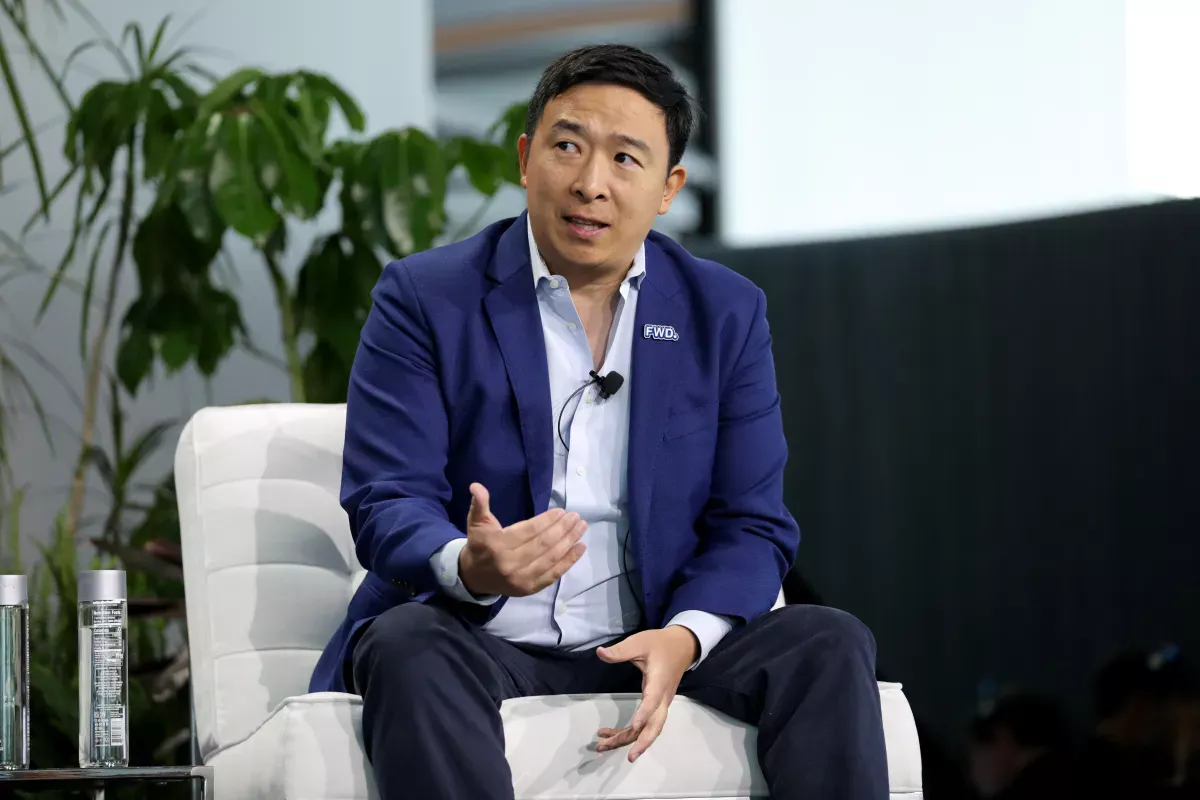
Entrepreneur and former presidential candidate Andrew Yang has a theory about where the next wave of startup opportunity lies, and it starts with a question most founders aren’t asking: what if the business model was giving money back instead of extracting it?
Yang was inspired by Mark Cuban. Not by his wealth, or his celebrity, but by Cost Plus Drugs — Cuban’s startup that sells pharmaceuticals at cost. Yang made a list.
“Housing, education, food, fuel, transportation, media, and wireless,” Yang told TechCrunch on a recent episode of Equity. “The things we all spend money on.”
He picked wireless and last September launched Nobile Mobile, a new mobile virtual network operator that provides cell service for a fraction of what traditional carriers charge and gives customers money back if they use less data.
As AI threatens to compress wages and displace workers, Yang sees a business opportunity in bringing down the cost of living. Cost Plus Drugs, Noble Mobile, dumb phone makers like Light Phone, and even online grocery store Misfits Markets are early examples of an emerging business category where the startup’s value proposition is the margin it gives back to the customer.
“AI is going to suck up a lot of the value and the jobs, and then Americans are going to look up and say, ‘How do I meet basic needs?’” Yang said. He believes meeting people’s needs “less expensively” is “a very rich vein of opportunity.”
That instinct didn’t emerge from nowhere. Yang first launched himself into the public eye during his 2020 presidential campaign, during which he advocated for Universal Basic Income as a means of combating AI-related workforce displacement and wealth concentration. The campaign didn’t succeed but the thesis has only grown more relevant.
Yang is still an advocate for UBI, arguing that the value generated by AI companies needs to be redistributed into the hands of the average American. But whether the government will be the vehicle for that redistribution, or whether it will just use any collected wealth to “plug a hole and do something not terribly productive,” Yang is less certain.
“There is room for a direct connection between the money and the people,” he said.
That’s where the market comes in. Where policy fails, Yang argues, market incentives can step in. Noble Mobile is his attempt to prove the point. Since its launch last September, the company has grown to “thousands and thousands” of customers and is bringing in “millions in revenue.”
“We’re unit profitable per customer, but we just share the profits with our subscribers with the idea that it’ll make you happy, you’ll stay around, and maybe you’ll tell your friends and family,” Yang said.
The pitch is simple. Yang noted that the average monthly savings of $50, invested and compounded over 40 years, could amount to $24,000 — enough for a retirement down payment. And in this economy, who isn’t thinking about little ways they can upgrade their personal finance?
Whether investors will share that enthusiasm is another question entirely. Even if the opportunity is real, capital is concentrated heavily in AI right now, while consumer-facing businesses with thin margins and a social mission are a hard sell.
“I had at least one investor say to me around Noble Mobile, ‘Love you, Andrew, want to work with you — if you could just make this an AI company, we’ll invest,’” Yang said.
The tide might be changing, though, simply because even the most wealthy, extractive companies need an economy in which consumers have enough buying power to purchase their products.
“The value being concentrated in the hands of a handful of folks and firms is just bad for everybody,” he said. “There are some folks I know in Silicon Valley who are open to that for a variety of reasons…[like] they just don’t want to have to hire private security.”
Yang encouraged founders and investors to take on problems they’re passionate about and find a way to build a valuable enterprise on top of it.
“Think bigger and more broadly about trying to tackle problems and don’t subscribe so much to groupthink, because there are some valuable opportunities out there,” he said.
When you purchase through links in our articles, we may earn a small commission. This doesn’t affect our editorial independence.
>
Tech
Anthropic’s safety warnings may have just backfired — the government has pulled the plug on its most powerful AI

The U.S. government on Friday ordered Anthropic to immediately shut off access to two of its most powerful AI models — Claude Fable 5 and Claude Mythos 5 — citing national security concerns. Anthropic announced on X that it has complied, but it made clear it thinks the government got this one wrong.
The directive, which Anthropic said it received on Friday at 5:21 pm ET, forces the company to disable both models for all users worldwide — not just the foreign nationals the government’s export control order was nominally aimed at. Access to Anthropic’s other models isn’t affected.
Why does any of this matter? Mythos is Anthropic’s most capable AI model, one the company previewed in early April and has kept tightly restricted ever since because of what Anthropic described as its exceptional ability to find security vulnerabilities in software. According to Anthropic, Mythos identified flaws in every major operating system and web browser it tested, so rather than release it broadly, the company launched a controlled program called Project Glasswing, sharing it with roughly 50 vetted organizations, including Amazon, Apple, Google, Microsoft, and CrowdStrike, to use for defensive cybersecurity work.
Fable 5, released just three days ago, was Anthropic’s answer to the obvious commercial pressure: a version of Mythos fitted with guardrails that block responses in high-risk areas like cybersecurity and biology, making it safe enough for general release, the company argued. It was immediately the most capable AI model available to the public, according to benchmark tests from Vals AI, a company that tracks AI tech performance.

The government’s directive is framed as an export control action, restricting foreign national access to the models. But in a lengthy blog post, Anthropic says its understanding is that the underlying concern is a claimed jailbreak of Fable 5. So far, the company says, the government has provided only verbal evidence of a “potential narrow, non-universal jailbreak” — one that, as Anthropic describes it, amounts to prompting the model to read a specific codebase and identify software flaws. And by the way, adds the company, it’s a “level of capability” that’s already widely available in other publicly accessible models, including OpenAI’s GPT-5.5. It’s also used routinely by cybersecurity professionals for defensive purposes, Anthropic observes.
Anthropic’s broader argument is that its strongest safeguards operate through independent classifier systems that function separately from the model itself, meaning that even if someone convinces Fable to keep talking past a refusal, the underlying protections against the most dangerous outputs remain in place. The company also notes in it post that a review of recent usage found no evidence of those safeguards being successfully bypassed to produce true, harmful content.
Clearly, none of that was enough to stop the government from acting, and Anthropic isn’t hiding its frustration. “We disagree that the finding of a narrow potential jailbreak should be cause for recalling a commercial model deployed to hundreds of millions of people,” the company wrote. “If this standard was applied across the industry, we believe it would essentially halt all new model deployments for all frontier model providers.”
Anthropic is widely expected to pursue an IPO this year and has staked much of its public identity on being the safety-conscious alternative to its rivals. The irony isn’t lost on observers that the very caution Anthropic displayed in restricting Mythos — which it promoted as a model so dangerous it couldn’t be released publicly — has now apparently attracted exactly the kind of government scrutiny that could disrupt its business most.
OpenAI’s Sam Altman must be enjoying this, at least. In April, he told podcaster Ashlee Vance that Anthropic’s handling of Mythos amounted to “fear-based marketing.” “It is clearly incredible marketing to say, ‘We have built a bomb. We were about to drop it on your head. We will sell you a bomb shelter for $100 million,’” Altman said. Altman, whose company is also widely expected to pursue an IPO as soon as possible, didn’t predict a government shutdown, but he identified something that has come back to bite Anthropic for now, which is that when you spend months telling the world your AI is uniquely dangerous, the world — the U.S. government included — tends to listen.
When you purchase through links in our articles, we may earn a small commission. This doesn’t affect our editorial independence.
>
Tech
Chinese cybercrime operation that used AI to scam ‘hundreds of thousands of victims’ sued by Google

Google is suing to dismantle the infrastructure behind an alleged massive AI-powered cybercrime operation.
On Friday, the tech giant announced a lawsuit against an alleged Chinese cybercrime network called Outsider Enterprise, which Google says uses AI in its campaigns to send scam text messages impersonating Google and other brands to steal passwords and credit card numbers.
Outsider Enterprise has financially scammed “hundreds of thousands of victims” with losses “estimated in the millions.” The group deployed 9,000 fake websites, one million fraudulent web domains, and 2.5 million texts sent to Android users in a two-week period, according to Google.
The company said, “55,000 spam texts were flagged by Android users in just two weeks this past May — that’s more than two text spam complaints a minute.”
Google said it uses “AI-powered tools to fight AI-powered scams,” which enable the company to detect scams and alert users of suspicious calls and text messages, leading to the interception of more than 10 billion scam messages a month.
The company said it has been collaborating with AT&T, T-Mobile, and Verizon to block the scam text messages, and said it is coordinating with the FBI.
An FBI spokesperson told TechCrunch that the bureau, in coordination with Google and Lumen’s Black Lotus Labs, seized several domains used by the cybercriminals, as well as Shopify storefronts and accounts used to test the operation’s phishing service.
The spokesperson said that since July 2023, Outsider Enterprise’s phishing platform enabled cybercriminals to steal “at least an estimated 3,870,000 stolen credit cards and a corresponding estimated $1.9B in losses.”
Inside Outsider Enterprise
In its complaint filed as part of the lawsuit, Google laid out the evidence it gathered against people involved in the Outsider Enterprise operations, whom the company said are foreign-based cybercriminals whose real identities are unknown. This group “built, maintains, and uses a turn-key, online software suite that enables criminals, regardless of technical skill, to publish fraudulent websites designed to rob victims and enrich themselves,” according to the complaint.
Google said this “phishing-for-dummies” software called Outsider, which costs $88 per week or $200 per month, allows operators to create fake websites with the help of AI platforms, including Google’s own Gemini. The fake sites impersonate several services and companies, such as telecom providers, financial institutions, government agencies, and retailers.
To lure people to the fake websites, the cybercriminals collaborate with one another to send victims malicious text messages, or purchase ads. The common goal is to steal passwords and corresponding multi-factor codes as well as financial information, which the scammers can do by receiving the data that victims input into the fake websites, with the information being transmitted through Outsider’s platform in real-time.
“Part of the Outsider software’s appeal is the ease with which someone with limited technical expertise — like many members of the Enterprise— can purchase the software, execute various phishing attacks, and, upon purchase, meet other members of the Enterprise who are proficient in other areas,” Google wrote, referring to Telegram channels where the cybercriminals can collaborate, train each other, discuss strategies, and develop phishing attacks. “The Enterprise brazenly coordinates its efforts in open and largely uncoded discussions on Telegram.”
According to Google, the Outsider platform allegedly offers cybercriminals “more than 290 pre-built templates that mimic the legitimate websites” that generate replicas of real websites “in minutes,” along with guides on how to “weaponize AI-generated code,” as well as a dashboard to track how progress of phishing campaigns. The cybercriminals have allegedly used Google Drive and Google Cloud infrastructure to host the phishing websites.
“The Outsider software has been used to create over a million phishing websites to swindle innocent victims out of millions of dollars,” Google wrote in the complaint.
To give an idea of the scale of Outsider Enterprise’s operation, Google said that over a five-month period, from November 14, 2025 to April 14, 2026, the company detected more than 1.59 million URLs connected to it.
Google said the Outsider Enterprise operation is made up of several groups of cybercriminals: those who develop and maintain the phishing software and website templates; those who supply lists of targets curated from public records, social media, and data breaches; a “spammer group” that provides tools and the infrastructure to send scam texts in bulk, which includes smartphone banks, SIM cards, and modems; and those who monetize the stolen credentials and launder the stolen money.

The cybercriminals have stolen “at least 36,000 payment cards issued by financial institutions in 95 countries,” according to Google.
The company accused the people behind Outsider Enterprise of impersonating Google and its brands, of infringing its copyright, of racketeering activities, of committing wire fraud, and false advertising. With the lawsuit, Google is seeking compensatory and punitive damages, and an order to stop the criminals from carrying out their activities.
This story was originally published at 10:26 a.m. PDT and has since been updated with new information from Google’s complaint, and the FBI’s comment.
When you purchase through links in our articles, we may earn a small commission. This doesn’t affect our editorial independence.
>

World Cup predictions: Brazil vs Morocco, Haiti vs Scotland and rest of matchday 3

Chicago Fire pursuing Leon Goretzka deal

New stat shines light on how Giants pitchers are (or aren’t) making batters feel uncomfortable

-

 Fashion9 years ago
These ’90s fashion trends are making a comeback in 2017
-
Fashion9 years ago
According to Dior Couture, this taboo fashion accessory is back
-
Fashion9 years ago
Model Jocelyn Chew’s Instagram is the best vacation you’ve ever had
-
Fashion9 years ago
Your comprehensive guide to this fall’s biggest trends
-
Fashion9 years ago
A photo diary of the nightlife scene from LA To Ibiza
-
Fashion9 years ago
Emily Ratajkowski channels back-to-school style
-
Fashion9 years ago
9 Celebrities who have spoken out about being photoshopped
-
Fashion9 years ago
The tremendous importance of owning a perfect piece of clothing
