
Tech
Apple Watch Glucose Monitoring Apps: What Works Now and What Needs Your iPhone


The Apple Watch can make glucose checks quicker, but it does not measure blood sugar on its own. Real wrist readings require a continuous glucose monitor, or CGM, plus an app that sends those readings to your devices.
Once connected, the watch gives you a wrist-based way to track glucose levels and receive alerts. App support is important because some CGM systems use the watch as a companion display, while others send readings more directly after setup.
I put this list together for Apple Watch users comparing CGM apps because watch support can get confusing fast. I broke down what each option actually does on the wrist, what still happens on the iPhone, and what to know before you rely on it.
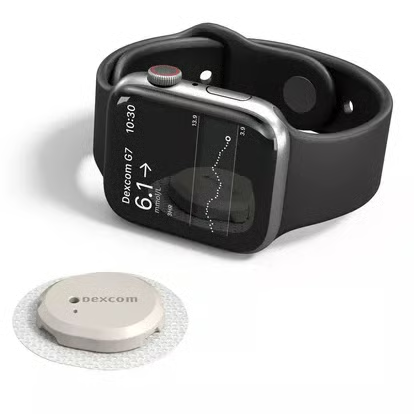
Dexcom G7 gives Apple Watch users the most independent watch experience among these CGM apps. After setup, the G7 sensor sends readings directly to a compatible Apple Watch over Bluetooth, so your glucose reading stays visible even when your iPhone is not close.
Short stretches away from your phone are where that setup helps most.
Apple Watch can show the current glucose reading, trend direction, and alerts from Dexcom G7. The trend arrow adds context by showing whether glucose is rising or falling.
Direct to Apple Watch uses a sensor-to-watch Bluetooth connection after setup. Dexcom says a cellular Apple Watch plan is not required for that link.
Before you choose Dexcom G7
Setup still starts on a compatible iPhone. You use the app to pair a new sensor and manage settings before readings move to the watch on their own.
According to Dexcom, Direct to Apple Watch requires:
Watch alerts also depend on notification settings, including the option to mirror iPhone alerts from the G7 phone app.
Libre by Abbott: Best for FreeStyle Libre users
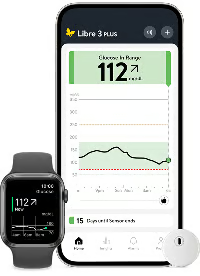
People who already use FreeStyle Libre sensors can use Apple Watch as a wrist display for glucose data. Watch support lets users check readings without opening the phone app every time.
How Libre works on Apple Watch
The Libre watch app shows your current glucose value, a trend graph, and notifications from the phone app. Widgets and complications can also keep glucose information visible on the watch face.
Tapping a complication opens the watch app when you want a closer look at your readings.
Food review happens back on the iPhone. Abbott provides Libre Assist as a phone-app feature for reviewing meals alongside glucose patterns, while Apple Watch remains focused on readings and notifications.
Before you choose Libre by Abbott
Libre watch support depends on the iPhone staying close enough to connect the sensor and Apple Watch. Watch notifications come from the phone app.
The app works with FreeStyle Libre 2, Libre 2 Plus, Libre 3, and Libre 3 Plus systems. It requires Apple Watch Series 4 or later running watchOS 10 or higher.
Existing Libre users may need to update the Apple Watch app before wrist features appear.
Abbott advises using the watch app to view glucose information, not to make dosing or treatment decisions.
Must-read Apple coverage
Eversense: Best for long sensor wear and on-body vibration alerts
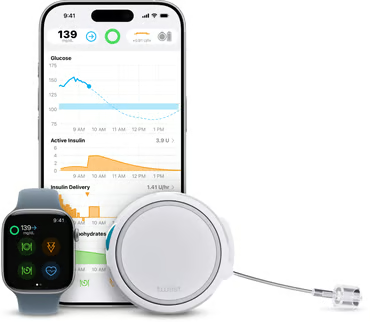
Unlike Dexcom G7 and Libre, Eversense uses a small sensor inserted under the skin, with a removable smart transmitter worn over it.
Eversense E3 lasts 90 days, while Eversense 365 lasts one year.
How Eversense works on Apple Watch
Glucose data and alerts from the Eversense app can appear on Apple Watch. Watch use depends more on the iPhone than Dexcom G7’s Direct to Apple Watch setup, but readings still appear on your wrist.
The transmitter is rechargeable and can vibrate on the body to alert to high and low glucose levels. Physical alerts help during sleep, exercise, work, or any moment when you are not looking at your wrist.
Before you choose Eversense
Setup takes more work than a patch-style CGM. Eversense instructs users to have a healthcare provider insert and remove the sensor, while the user wears the transmitter over it with a daily adhesive patch.
Calibration is part of the system. Eversense E3 requires more fingerstick calibration than Eversense 365 after the early setup period.
Apple Watch support adds wrist viewing, but the implanted sensor and wearable transmitter carry the decision. This option suits users who are comfortable with provider insertion and want fewer sensor changes.
The right CGM makes Apple Watch more useful
Apple Watch features can help narrow your choice, but they should not be the only factor. Check compatibility, sensor availability, insurance coverage, and your healthcare provider’s guidance before relying on any setup.
If you want the most phone-free Apple Watch experience, Dexcom G7 is the strongest fit. If you already use FreeStyle Libre sensors and mainly want readings on your watch face, start with Libre by Abbott. If you want longer sensor wear and physical alerts you are less likely to miss, Eversense is the better match.
The best choice is the one that fits your daily routine, not just the one with the most features.
Learn more about Apple Watch’s role in diabetes management, including the features that help and the limits users should know.
>

Nintendo is facing a potential incident after a threat actor claimed to have stolen nearly a decade’s worth of internal corporate data and demanded a $2 million ransom to prevent the information from being released publicly.
While the gaming giant has not confirmed the alleged breach, Cybernews researchers reviewing samples of the leaked data say portions of the material appear credible.
“The sample contains HR data, such as pulse surveys and questionnaires about how employees are feeling at work,” researchers noted after examining files published by the threat actor.
Key takeaway from the breach
- A threat actor known as ShadowByte$ claims to have stolen approximately 859MB of Nintendo data and is demanding a $2 million ransom to prevent its release.
- The leaked samples allegedly contain employee names, corporate email addresses, workforce surveys, internal reports, performance metrics, and planning documents.
- Researchers found indicators suggesting portions of the data may be authentic, including employee survey records dating back to 2016 and references to current Nintendo employees.
- It remains unclear whether Nintendo was directly compromised or whether attackers gained access through a third-party provider such as employee engagement platform TinyPulse.
- The incident highlights the growing security risks associated with third-party business applications that store sensitive corporate and workforce data.
Inside the alleged Nintendo data incident
The threat actor, operating under the name ShadowByte$, posted the allegations on a cybercrime forum, claiming to possess approximately 859MB of internal Nintendo data and demanding a $2 million ransom to prevent its release.
According to researchers who reviewed samples published by the actor, the dataset may contain employee names, corporate email addresses, workforce engagement surveys, internal analytics, organizational performance metrics, exported reports, and planning documentation.
Researchers find signs the data may be authentic
While the full scope and authenticity of the alleged breach remain unverified, researchers identified several indicators suggesting that at least portions of the data may be legitimate.
The samples reportedly include employee engagement surveys and workplace feedback records dating back to 2016, supporting the threat actor’s claim that the stolen information spans a ten-year period through 2026.
Researchers also identified references to individuals who appear to still be employed by Nintendo, lending additional credibility to parts of the leaked dataset.
Furthermore, metadata for some exported files reportedly showed creation dates of Jan. 28, 2026, suggesting that at least some records may have been accessed or exported more recently.
Questions remain about the source of the data
Despite these findings, questions remain about how the data was obtained.
Researchers said the available samples do not provide enough evidence to determine whether Nintendo was directly compromised or whether attackers gained access through a third-party service provider that handled employee-related information.
Adding to the uncertainty, ShadowByte$ referenced TinyPulse, an employee engagement platform used by organizations to collect anonymous workforce feedback and measure employee satisfaction.
If accurate, the incident could highlight the ongoing risks associated with third-party vendors that store sensitive corporate data. As organizations increasingly rely on cloud-based business platforms, a compromise involving a trusted provider can expose information across multiple customers.
Nintendo has not publicly confirmed the threat actor’s claims at the time of publication.
Must-read security coverage
How to reduce third-party risk
Although Nintendo has not confirmed the alleged breach, security teams can use the incident as a reminder to review controls surrounding employee and HR-related platforms.
- Conduct regular security assessments of third-party HR, workforce management, and employee engagement vendors to identify and address potential risks.
- Enforce strong access controls, including multi-factor authentication (MFA), least-privilege permissions, and routine user access reviews.
- Monitor HR and SaaS platforms for unauthorized access, unusual activity, and large-scale data exports that could indicate data exfiltration.
- Implement data loss prevention (DLP) controls and encryption to protect sensitive employee information, internal reports, and organizational data.
- Minimize the collection and retention of employee feedback, survey responses, and other sensitive workforce data to reduce potential exposure.
- Establish continuous monitoring of vendor integrations, API connections, and SaaS configurations to detect security gaps and misconfigurations.
- Test incident response plans through tabletop exercises and breach simulations, including scenarios involving third-party vendor compromises.
Together, these measures can help organizations reduce their exposure to third-party risks while building resilience against future incidents.
Editor’s note: This article originally appeared on our sister publication, eSecurityPlanet.
>

The U.S. government’s enforcement letter to Anthropic, which effectively forced the company to pull its latest AI models offline just before the weekend, should be a wake-up call for any U.S. tech company — AI lab or otherwise.
To catch you up on the news blitz: On Friday afternoon, the U.S. Commerce Department sent Anthropic a letter invoking an obscure export control directive that banned non-Americans, including Anthropic’s employees, from accessing Fable 5 and Mythos 5, citing an unspecified national security concern. Anthropic said it believes the letter is related to a bypass of the model’s guardrails, but isn’t sure because the letter doesn’t provide specific details. The letter has not been made public.
In response, Anthropic shut down both of its top models to all customers to ensure that it complied with the directive. The result was that the U.S. government successfully forced a tech company to pull its models offline with a swift and unilateral action that didn’t appear to require court approval.
Friday’s intervention by the Trump administration shows that the AI industry is not immune to government interference. It’s also a warning to the wider tech industry: comply, or we can shut you and your products down.
Citing sources, Axios described a tense situation over the weekend between the two major players, saying that the “personality differences” between Anthropic and the Trump administration led to the export directive, rather than a technical issue with the AI products.
New details about the issue that emerged over the weekend now cast further doubt on the government’s already shaky reasoning.
Katie Moussouris, a cybersecurity veteran and researcher who founded Luta Security, said in a blog post that Anthropic recently shared with her a private copy of a paper written by security researchers describing an alleged guardrail bypass in Fable 5. (The Wall Street Journal reports that the paper’s authors are security researchers at Amazon.) Moussouris said that Anthropic reached out to ask for her take on the paper.
Moussouris’ blog post described how the researchers triggered the guardrail bypass, but said that the bypass itself “should never have triggered an export control.” The difference is largely between asking an AI model to “review code for security issues” versus asking it to “fix this code.” The end result is largely the same, even if the questions are posed slightly differently.
“The behavior described in the paper cannot meaningfully be fixed, and any attempt would only weaken the model for defense,” said Moussouris, who criticized the export control directive as hasty, heavy-handed, and misguided.
Moussouris and dozens of other top security researchers and experts have since called on the Trump administration to revoke the export control order, calling the move to pull advanced cybersecurity capabilities from network defenders in the U.S. as “dangerous.”
Past administrations have made sweeping decisions on knowledge gaps. For instance, language used by the U.S. government during the 2010s to fix export law covering cybersecurity tools that could also be used for cyberattacks was so broad that it inadvertently near-outlawed legitimate security and vulnerability research.
However, the Trump administration’s directive appears retaliatory.
Justin Hendrix, the editor of Tech Policy Press, said the Trump administration’s move is “likely to raise alarms in foreign capitals about the reliability of American AI for critical applications.” The message is that AI companies in the United States can’t be trusted to operate without interference from the U.S. government.
The Trump administration hasn’t confirmed why it invoked its export control directive. Did the officials misread the report and freak out? Did Amazon CEO Andy Jassy say something to senior government officials that prompted the reaction, out of caution or spite? Was something lost in translation, or was this a way to pressure Anthropic, with whom the administration already has a fractious relationship? It’s possible that the White House was unaware of the far-reaching consequences of the letter’s demand and officials are scrambling to undo the damage of their own making.
To quote Hendrix, “the climate is one of a cloud of suspicion that senior officials are picking favorites based on personal and political factors.” The aftermath is that the government has set a dangerous precedent about how much control it intends to wield over the release of American-made software.
This time the government took issue with Anthropic; tomorrow it could be with anyone else.
When you purchase through links in our articles, we may earn a small commission. This doesn’t affect our editorial independence.
>

Fox is buying its way deeper into the streaming interface.
The TV corporation is adding another free streaming platform to its roster with the $22 billion purchase of Roku. Announced on June 15, the deal combines Roku, which has 100 million subscribers on its ad-supported The Roku Channel video streaming service, with Fox’s Tubi, another ad-supported service with close to 100 million subscribers.
Fox also gains control of the leader in the smart TV device market, with 32% market share in the US connected TV market ahead of Amazon, Apple, and Samsung, according to Pixalate. This brings in a new revenue stream for Fox, as a key distribution platform for TV shows, movies, and streaming platforms, and could allow them to promote their own programming ahead of rivals.
Roku’s ad platform is the real cash cow
Roku may be best known for its connected TVs and streaming sticks, but those products accounted for less than a quarter of the company’s revenue in 2025.
Amazon, Google, and Xiaomi have flooded the market with cheap streaming sticks — for under $40 — making it hard for Roku to generate consistent revenue. The main segment, which brought in $4.1 billion in 2025, comes primarily from ads sold on The Roku Channel, as well as sponsored placements on the Roku interface.
This is what Fox is paying so much for, as ad-supported streaming platforms have grown rapidly over the last few years. Consumers are looking for cheaper ways to watch TV shows and movies, with Netflix, HBO Max, and Disney+ all introducing cheaper ad-supported subscription tiers. Roku and Tubi compete with YouTube, TikTok, and other freemium video services.
What’s hot at TechRepublic
Roku and Tubi to remain separate… for now
Even though The Roku Channel and Tubi are very similar, Fox has said it will not merge them.
“If you look at Tubi and the Roku channel together, they are incredibly complementary services,” Fox Corporation CEO Lachlan Murdoch said on an investor call, per The Hollywood Reporter. “There’s about a third overlap between the audience, between the two of them, so that they’re not identical audiences. Bringing the two of them together effectively triples the reach of the combined service.”
That said, sentiment can change quickly. When Disney originally acquired most of Hulu, it said the two platforms were complementary, but it has been itching ever since to fully take over Hulu and merge the two to create a streaming powerhouse. The same may happen to The Roku Channel and Tubi over time.
Even though it is unlikely to face the same regulatory heat as the Warner Bros, Netflix, and Paramount buyout drama, especially in the current political climate, there will still be a period for both sides to file antitrust and competition filings. With Roku holding a dominant position as a streaming distributor, Fox may need to sign agreements allowing rivals to be featured on the platform and to retain some access to Roku’s physical remote control buttons.
Fox expects to close the deal in the first half of 2027.
Related reading: Google made a similarly massive bet on cybersecurity earlier this year, agreeing to acquire cloud security firm Wiz for $32 billion in the largest tech deal in Israeli history.
>

Frederik Oldenburg Makes ‘Love Island USA’ Debut To Host Challenge Tied To Telemundo & Peacock’s World Cup Coverage

'It's changing the game' – the impact of hydration breaks

Nintendo Alleged Data Breach: Threat Actor Demands $2M Ransom

-

 Fashion9 years ago
These ’90s fashion trends are making a comeback in 2017
-
Fashion9 years ago
According to Dior Couture, this taboo fashion accessory is back
-
Fashion9 years ago
Your comprehensive guide to this fall’s biggest trends
-
Fashion9 years ago
Model Jocelyn Chew’s Instagram is the best vacation you’ve ever had
-
Fashion9 years ago
A photo diary of the nightlife scene from LA To Ibiza
-
Fashion9 years ago
Emily Ratajkowski channels back-to-school style
-
Fashion9 years ago
9 Celebrities who have spoken out about being photoshopped
-
Fashion9 years ago
The tremendous importance of owning a perfect piece of clothing
