
Tech
The AI layoff wave is becoming a powder keg


Something strange is happening in tech right now. Companies are posting record profits and revenue while laying off tens of thousands of people, citing AI as the official explanation. So far this year, there have been an estimated 363 layoffs at tech companies this year, affecting nearly 150,000 people — a pace of about 974 people per day, 44% faster than last year — according to TrueUp, a tech job board and recruiting platform that also runs one of the most widely cited tech layoff trackers.
Tech layoffs hit their highest single month in two years last month, with nearly 40,000 cuts, and AI was the most-cited reason for layoffs across every industry for the third month running, according to outplacement firm Challenger, Grey & Christmas.
There’s growing skepticism that AI is really the culprit, though — that it’s more of a convenient cover story than the actual cause. Few examples illustrate the pushback better than what happened at Block earlier this year. After getting hammered over laying off nearly half of Block earlier this year, citing AI as the reason, Jack Dorsey denied the cuts were a sign of trouble at the payments company, insisting AI tools “are enabling a new way of working which fundamentally changes what it means to build and run a company.” He also acknowledged, when pressed by commenters on X about the bloat he’d created during the pandemic, that Block had, in fact, over-hired.
Other voices have also begun to weigh in, including famed VC Marc Andreessen, who recently called AI the “silver bullet excuse” for layoffs that are really about pandemic-era overhiring. In conversation with podcaster-investor Harry Stebbings, Andreessen said, “Essentially, every large company is overstaffed. It’s at least overstaffed by 25%. I think most large companies are overstaffed by 50%. I think a lot of them are overstaffed by 75%. Now they all have the silver bullet excuse: Ah, it’s AI.”
What happened earlier this month at Uber captures the ambiguity well. The company cut about 23% of its people division — the unit HR and recruiting — affecting less than 1% of its 34,000 employees, it said. A company spokesperson specified that the cuts had nothing to do with AI. But the announcement came roughly one month after Uber’s CTO offered that the company had burned through its entire 2026 AI coding budget in four months and had to cap individual engineers’ spending on tools like Cursor and Claude Code; whatever Uber said publicly, it’s hard not to connect those dots.
What makes this combustible: at the very moment that tens of thousands of workers are being shown the door, a small cohort of AI insiders is becoming wealthy on a scale that’s hard to comprehend.
Early last month, AI chipmaker Cerebras Systems closed its first day on the Nasdaq up 68% from its $185 IPO price, giving the chipmaker a market cap of roughly $67 billion — the largest US tech IPO since Snowflake’s 2020 debut. By the close, co-founders Andrew Feldman and Sean Lie were billionaires. (The company’s shares have since fallen 30%.)
SpaceX meanwhile went public on Friday and enjoys, as of this writing, a $2.1 trillion market cap, turning Musk into a paper trillionaire and potentially minting an estimated 4,400 millionaires, and around 400 centimillionaires in the process, assuming the shares hold up. Anthropic and OpenAI are quickly inching toward the public market, too, both at valuations of roughly $1 trillion or more.
Set against that backdrop, Mark Zuckerberg’s latest purchase takes on new meaning. In early March, he purchased a $170 million mansion on Miami’s “Billionaire Bunker” — setting the all-time record for the most expensive home sale in Miami-Dade County history. Two months later, Meta announced it would lay off 8,000 people, or roughly 10% of its workforce.
It isn’t just Zuckerberg or the other tech titans who routinely shell out jaw-dropping sums on their real estate portfolios. But these extremes come at a moment when many Americans are getting squeezed harder than they have been in year.
Workers with employer-sponsored health insurance face premium increases of about 6% to 7% this year, more than double the rate of inflation, the cost of private health insurance has roughly doubled since 2008, and median home prices have climbed 28% since early 2020, while mortgage rates have nearly doubled.
In a January 2026 New York Times/Siena poll, 65% of voters said a middle-class lifestyle is out of reach, and a May 2026 CNN/SSRS poll found 76% of Americans now name cost of living as their top economic concern, up sharply from 58% a year earlier.
Taken together, this isn’t just a story about job losses in isolation. It’s tens of thousands of laid-off tech workers hitting an unusually unforgiving cost environment at the same time that tens of thousands of AI insiders are seeing once-in-a-generation paper wealth materialize.
It isn’t hard to find a precedent for what happens when that divide gets wide enough. In 2008, a financial crisis that began with loose lending and over-the-top risk-taking on Wall Street ended with bailouts for the banks that caused it, while millions of Americans lost jobs and homes in the Great Recession that followed. Three years later, that anger crystallized into Occupy Wall Street.
That could look quaint in comparison. Occupy Wall Street emerged from a crisis — banks needed rescuing, and the public anger was, at its core, about who paid for the cleanup. This time, there’s no crash to point to. Companies are profitable, AI itself is minting a new class of overnight fortunes, and the layoffs are happening anyway, with AI cited as the reason. If the optics of 2008 were, “We’re bailing out the people who broke the economy while you lose your job,” the optics here could end up being, “We’re getting richer than ever, off the very tech we’re using to replace you.”
As we’ve seen with Block, Atlassian, Cloudflare and others, tech companies have watched their stocks surge when they point to AI, so the strategy is understandable. Still, they might want to consider whether that’s really the message they want to send to the people they’re laying off, and to everyone else now watching.

When you purchase through links in our articles, we may earn a small commission. This doesn’t affect our editorial independence.
>

The Apple Watch can make glucose checks quicker, but it does not measure blood sugar on its own. Real wrist readings require a continuous glucose monitor, or CGM, plus an app that sends those readings to your devices.
Once connected, the watch gives you a wrist-based way to track glucose levels and receive alerts. App support is important because some CGM systems use the watch as a companion display, while others send readings more directly after setup.
I put this list together for Apple Watch users comparing CGM apps because watch support can get confusing fast. I broke down what each option actually does on the wrist, what still happens on the iPhone, and what to know before you rely on it.
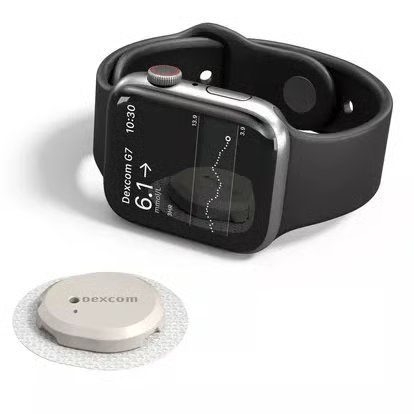
Dexcom G7 gives Apple Watch users the most independent watch experience among these CGM apps. After setup, the G7 sensor sends readings directly to a compatible Apple Watch over Bluetooth, so your glucose reading stays visible even when your iPhone is not close.
Short stretches away from your phone are where that setup helps most.
Apple Watch can show the current glucose reading, trend direction, and alerts from Dexcom G7. The trend arrow adds context by showing whether glucose is rising or falling.
Direct to Apple Watch uses a sensor-to-watch Bluetooth connection after setup. Dexcom says a cellular Apple Watch plan is not required for that link.
Before you choose Dexcom G7
Setup still starts on a compatible iPhone. You use the app to pair a new sensor and manage settings before readings move to the watch on their own.
According to Dexcom, Direct to Apple Watch requires:
Watch alerts also depend on notification settings, including the option to mirror iPhone alerts from the G7 phone app.
Libre by Abbott: Best for FreeStyle Libre users
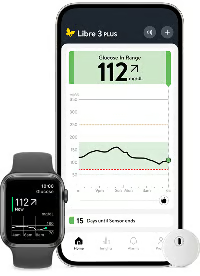
People who already use FreeStyle Libre sensors can use Apple Watch as a wrist display for glucose data. Watch support lets users check readings without opening the phone app every time.
How Libre works on Apple Watch
The Libre watch app shows your current glucose value, a trend graph, and notifications from the phone app. Widgets and complications can also keep glucose information visible on the watch face.
Tapping a complication opens the watch app when you want a closer look at your readings.
Food review happens back on the iPhone. Abbott provides Libre Assist as a phone-app feature for reviewing meals alongside glucose patterns, while Apple Watch remains focused on readings and notifications.
Before you choose Libre by Abbott
Libre watch support depends on the iPhone staying close enough to connect the sensor and Apple Watch. Watch notifications come from the phone app.
The app works with FreeStyle Libre 2, Libre 2 Plus, Libre 3, and Libre 3 Plus systems. It requires Apple Watch Series 4 or later running watchOS 10 or higher.
Existing Libre users may need to update the Apple Watch app before wrist features appear.
Abbott advises using the watch app to view glucose information, not to make dosing or treatment decisions.
Must-read Apple coverage
Eversense: Best for long sensor wear and on-body vibration alerts
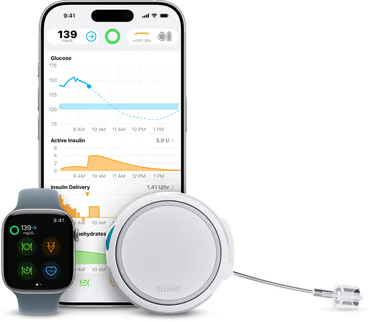
Unlike Dexcom G7 and Libre, Eversense uses a small sensor inserted under the skin, with a removable smart transmitter worn over it.
Eversense E3 lasts 90 days, while Eversense 365 lasts one year.
How Eversense works on Apple Watch
Glucose data and alerts from the Eversense app can appear on Apple Watch. Watch use depends more on the iPhone than Dexcom G7’s Direct to Apple Watch setup, but readings still appear on your wrist.
The transmitter is rechargeable and can vibrate on the body to alert to high and low glucose levels. Physical alerts help during sleep, exercise, work, or any moment when you are not looking at your wrist.
Before you choose Eversense
Setup takes more work than a patch-style CGM. Eversense instructs users to have a healthcare provider insert and remove the sensor, while the user wears the transmitter over it with a daily adhesive patch.
Calibration is part of the system. Eversense E3 requires more fingerstick calibration than Eversense 365 after the early setup period.
Apple Watch support adds wrist viewing, but the implanted sensor and wearable transmitter carry the decision. This option suits users who are comfortable with provider insertion and want fewer sensor changes.
The right CGM makes Apple Watch more useful
Apple Watch features can help narrow your choice, but they should not be the only factor. Check compatibility, sensor availability, insurance coverage, and your healthcare provider’s guidance before relying on any setup.
If you want the most phone-free Apple Watch experience, Dexcom G7 is the strongest fit. If you already use FreeStyle Libre sensors and mainly want readings on your watch face, start with Libre by Abbott. If you want longer sensor wear and physical alerts you are less likely to miss, Eversense is the better match.
The best choice is the one that fits your daily routine, not just the one with the most features.
Learn more about Apple Watch’s role in diabetes management, including the features that help and the limits users should know.
>


Nearly 750 million people face hunger today, according to the U.N. World Food Program. And by 2050, global demand for food is expected to increase by 50 percent from 2010 levels, the World Resources Institute says.
A smart agriculture special-issue report recently released by the IEEE Smart Agri-Food Initiative says meeting the demand will require technology to expand food production. The report highlights research, case studies, and new ways of applying technology to inform farmers, engineers, and policymakers.
Leading the initiative is IEEE Fellow John Verboncoeur, chair of the smart-food program and professor of electrical and computer engineering at Michigan State University, in East Lansing.
“Food security is becoming a systems-engineering problem,” Verboncoeur says. “We’re no longer talking only about tractors and irrigation. We’re talking about sensing, communications, computation, automation, and sustainability all working together.”
Although not formally trained as an agriculture scientist, Verboncoeur’s first involvement with smart agriculture was as an undergraduate at University of Florida in 1985-86, where he helped develop an SmartAg aeroponics system for NASA for the International Space Station. It used mist to spray the plants’ roots and lightweight pneumatic structures to hold the vegetation in place.
He has also chaired the executive committee of Michigan State’s SmartAg Initiative since it launched in 2017. He chaired the program’s leading interdisciplinary efforts to apply engineering and digital technologies to farming and food systems.
Verboncoeur connects the shift of using engineering as a force multiplier for farming to lessons learned from the IEEE Smart Village program, which supports projects and organizations bringing electricity and educational and employment opportunities to remote communities. Agriculture, he argues, requires the same systems-level mindset.
“The challenge isn’t just inventing technology,” he says. “It’s making systems practical, affordable, and deployable.”
From digital twins to autonomous harvesting
A central theme across the Smart Agri-Food Systems report is the convergence of automation, data analytics, and sustainability.
One paper, “Smart Agriculture, Precision Agriculture, Digital Twins in Agriculture: Similarities and Differences,” addresses the confusion regarding how researchers and practitioners define and apply the technologies to farming.
The paper was written by Dilan Onat Alakuş, a research assistant in the software engineering department at Kırklareli University, in Türkiye, and Ibrahim Türkoğlu, a software engineering professor at Fırat University, in Elazığ, Türkiye.
Unclear terminology can lead to inefficient investment and poor adoption of the technologies, the two authors say. They note that agricultural methods based on traditional practices and intuition lack a thorough analysis of their environmental and economic impacts.
They describe how three technologies can benefit farmers:
• Smart agriculture systems integrate sensors, artificial intelligence, robotics, and analytics to improve efficiency and sustainability at scale.
• Precision agriculture focuses on location-specific decisions. Farmers use GPS-guided equipment to map fields, deploy drones to monitor crop health, and install field sensors that track soil moisture and nutrient levels in targeted zones. The tools allow farmers to apply water, fertilizer, and pesticides only where needed—which can reduce waste and lessen environmental impact.
• Digital twins create virtual replicas of an agricultural area. The resulting models simulate the farmstead, crops, and irrigation systems, allowing growers to test scenarios and predict outcomes before implementing changes.
The authors emphasize that the categories overlap in practice. A digital twin might draw data from precision agriculture systems and feed recommendations into smart agriculture platforms.
Clearer distinctions help farmers select appropriate tools and avoid unnecessary complexity and costs, they say.
“This study contributed to conscious agricultural practices by differentiating agricultural technologies,” they wrote, adding that clearer definitions can increase productivity.
The report shifts from theory to application in a paper describing bustani, which means my garden in Arabic. The Bustanica project in Saudi Arabia is an automated hydroponic vertical farming system developed by researchers at the Prince Mohammad Bin Fahd University, in Al-Khobar, Saudi Arabia. The “Bustani: A Microcontroller-Based Automated Hydroponic Vertical Farming Solution” paper was written by Hussah Alotaibi, a computer engineer at Saudi Aramco, the country’s national oil company; Abul Bashar, Widad Karsou, and Shehvar Khan, researchers in the university’s computer engineering and computer science department; and Salahudean Tohmeh from the university’s robotics laboratory.
The Bustanica system combines hydroponics with aeroponics, in which plant roots hang in the air and receive nutrients through a misting system. Together, the approaches allow crops to grow in compact indoor environments, using far less water than traditional methods.
The method integrates IoT sensors that continuously monitor water chemistry and reservoir conditions.
The system grows crops in controlled indoor environments. A closed-loop design recirculates water to reduce waste. Sensors measure pH levels, nutrient concentration, and water levels. An Arduino Mega processes the sensor data. A NodeMCU ESP8266—a low-cost, open-source IoT platform—handles Wi-Fi communication and cloud connectivity.
The system sends the data through Google’s Firebase cloud platform, which acts as a real-time bridge between sensors and control systems.
A mobile app lets users monitor and control the system remotely. It displays real-time data on lighting, nutrient levels, and water pump activity. When conditions move outside optimal ranges, automated dosing pumps adjust the levels as needed.
Engineering can’t solve all the world’s problems. But it absolutely has a role to play in helping the world feed itself.” —John Verboncoeur, chair of the IEEE Smart Agri-Food initiative
The system operates as a feedback loop, collecting data, transmitting it to the cloud, analyzing the conditions, and automatically triggering adjustments.
LEDs simulate sunlight. Ultrasonic sensors measure water levels. Electrical conductivity sensors track nutrient concentration. During testing, the system maintained stable environmental conditions and adjusted dosing dynamically as readings changed.
The authors describe the outcome as “a fully functional and automated vertical sustainable farm that creates desirable growing conditions, along with an Android application that provides real-time monitoring and notifications.”
Beyond automation, bustani reflects a broader shift toward merging agriculture with consumer technology and smart-home systems. Future plans include integrating the Amazon Alexa virtual assistant and machine learning tools for plant disease detection and growth analysis.
Robotics and labor challenges
The “Toward an Efficient Tomato Harvesting Robot” paper addresses autonomous harvesting, a long-standing challenge in agricultural robotics. Tomatoes in the field vary widely in size, shape, and ripeness, and they can bruise during handling. The paper was written by IEEE Senior Member Hyoung Il Son—a professor of biosystems engineering and robotics at Chonnam National University in Gwangju, South Korea—and his graduate students Jongpyo Jun, Jeongin Kim, and Jaehwi Seol.
The paper describes how robotics is increasingly being used to target crops once considered too delicate or variable for automation.
The researcher combined 3D machine vision, robotic arms, suction-based grippers, and rotating cutting tools to build a harvesting machine capable of operating in unstructured outdoor environments. The system aims to reduce reliance on manual labor while improving harvesting efficiency and consistency.
Agriculture as a systems problem
Verboncoeur says the developments highlighted in the papers reflect a broad transformation in how engineers view the agricultural industry.
“Agriculture used to be seen primarily as managing the challenges of planting, watering, and fertilizing plants, and using machines to make the process less labor-intensive,” he says. “Now it’s also a data problem, a communications problem, an energy problem, and a resilience problem.”
Another featured paper, “Sustainable and Smart Agriculture: A Holistic Approach,” examines how technology can address environmental and demographic pressures. The paper was written by Surender Singh and Sannihit , researchers at the computer science and engineering and the civil engineering departments at Chandigarh University, in Mohali, India.
Farmers must increase food production while reducing environmental damage from depleting water resources, overapplication of fertilizer, deforestation, and greenhouse gas emissions, the authors say. They describe smart farming as “a revolution in food production” that can allow farmers to generate higher yields from existing resources through connected technologies and data systems.
The authors highlighted the issue of rapid urbanization. By 2050, they report, nearly 70 percent of the global population will live in cities, increasing pressure on food supply chains and distribution systems.
Wireless sensor networks will play a central role in the transformation, the researchers say. The networks use small, connected devices to monitor soil moisture, temperature, humidity, light intensity, and crop conditions. The system transmits the data to cloud platforms, where machine learning models analyze trends and recommend actions.
The authors emphasize that decision support, not automation alone, drives the greatest value of crop harvest. Farmers can integrate the information into crop management strategies to improve productivity while reducing their environmental impact.
They also note increasing collaboration between industry leaders such as Caterpillar, CNH, John Deere, and Kubota and technology companies including Bosch, Google, Intel, and Microsoft. Challenges remain, however, in communication reliability, sensor cost, and scalable data infrastructure, the authors say.
SmartAg beyond the farm
The implications of the tech advances that make farming more efficient extend beyond agriculture. Many of the same technologies—remote sensing, wireless sensor networks, AI analytics, and cloud platforms—support transportation, energy, and industrial systems.
The convergence explains IEEE’s growing involvement. Modern agriculture now combines electronics, communications, computing, and control systems.
Agriculture requires that integration, Verboncoeur says: “The challenge isn’t just inventing technology. It’s making systems practical, affordable, and deployable.”
What’s next for smart agriculture?
The special issue marks an early stage for the IEEE Smart Agri-Food initiative, which plans to develop standards; create structured ways for farmers, researchers, governments, and agribusinesses to work together; and devise deployment strategies for smart systems.
Future research is likely to focus on interoperability between platforms, data sharing, and scalable deployment models. Digital twins are expected to play a larger role as computing power and sensor density increase. Simulating agricultural systems before applying changes in the field will become commonplace, experts predict.
Adoption depends on more than technical capability, though. The central tension moving forward lies between innovation and practicality.
“Farmers face challenges in adopting such technology due to cost, electricity availability, communication infrastructure, and vulnerability of connected devices,” Singh and Sannihit wrote.
Smart agriculture offers improved efficiency, in addition to reducing the inputs of water, fertilizer, and time that would otherwise be spent on tasks machines can handle autonomously. But the benefits matter only if systems function reliably across diverse environments—from industrial farms to small, family-run operations in food-insecure regions.
For IEEE, agriculture now sits within core engineering domains. The stakes extend beyond technology itself, Verboncoeur says.
He adds that: “Food insecurity affects stability, health, education, and economic development. Engineering can’t solve all the world’s problems, but it absolutely has a role to play in helping the world feed itself.”
From Your Site Articles
Related Articles Around the Web
>

SpaceX has captured the attention of media, investors, and the public for years now — interest propelled by the company’s reusable rocket launches, the rise of its Starlink satellite network, and of course, for its founder and CEO Elon Musk.
But in its 24-year history, nothing quite compared to its initial public offering. Everyone seemed interested — perhaps because of the sheer size of the IPO. The company priced its 555.6 million shares at $135 each to raise $75 billion, making it the largest IPO in history and turning Musk into the world’s first trillionaire.
TechCrunch has followed SpaceX’s start, struggles, and successes from the early days. And we’re here for what happens next too. Here is your go-to landing page for all the relevant SpaceX IPO news, including notable updates now that the company is public.
SpaceX is now public. What’s next?
On its first full day of trading, SpaceX shares pushed even higher. As of 2:30 pm ET, SpaceX shares were up more than 15% to $186.15.
The latest on the SpaceX IPO
SpaceX shares opened June 12 at $150 on the Nasdaq public exchange, an 11% pop for the most anticipated debut in history. And it has continued to rise. The shares kept rising too. In midday trading, SpaceX shares soared 30%. SpaceX shares closed at $160.95, up 19%.
There has been heavy trading volume, as expected. Robinhood said it has seen “record-breaking traffic on its trading platform in the hours after SpaceX’s historic public markets debut.
SpaceX COO Gwynne Shotwell was interviewed by CNBC on June 12 and among the many interesting comments she made, here is one that might get the attention of Tesla shareholders. At one point in the interview, Shotwell said a “merger between SpaceX and Tesla might make Elon’s life a little easier.”
Among the winners are the banks, which have brought in about $500 million in total fees. The big winners are Goldman Sachs and Morgan Stanley, per the WSJ.
Musk took to X, the social media company he owns, to share his appreciation of SpaceX employees as the stock rose. “I love the incredible people of SpaceX beyond words,” he wrote Friday afternoon. He also reposted a number of SpaceX IPO related posts, including a photo of insiders all wearing green shoes in what appears to be a nod to “the green shoe option.” This is a provision in an IPO underwriting agreement that lets underwriters sell up to 15% more shares than originally planned if demand is strong.
To get a deeper look into what happened, and all the far-ranging implications of SpaceX now being a publicly traded company, Senior Reporter Sean O’Kane and AI Editor Russell Brandom sat down for a special episode of our Equity podcast, which you can listen to right here or via your podcast player of choice, or queue it up on YouTube here.
How to track the SpaceX IPO
With an offering this large, there is a lot of financial machinery operating behind the scenes — so the first question is just when the stock makes it to the market to start trading. SpaceX is debuting on Nasdaq and you can see the official Nasdaq listing here, which will have the price of record as soon as there is one. Nasdaq also has video of the SpaceX crew ringing the bell, if that’s your thing.
But the price is just part of the picture. For the most up-to-the-minute information, your best bet is still financial press outlets like Bloomberg and CNBC, both of which have liveblogs running and will have close coverage of any hiccups that happen in getting the stock to market.
The SpaceX IPO, by the numbers
Here we look at some of the bigger numbers, the consequential figures, and the eyewatering amounts that make up the company’s S-1 form.
For instance, SpaceX lost $4.9 billion on revenues of over $18 billion in 2025. That’s only a fraction of the more than $37 billion lost since SpaceX’s inception.
As CEO, Elon Musk holds about 85.1% of the company’s voting power. You can read more about that in the next section “Who wins and who doesn’t” — and we’ll continue to drop interesting numbers in here.
Here is another figure that caught our attention… 4,400. That’s the number of SpaceX employees who could become millionaires, according to the NYT.
Elon Musk can’t hear you over the sound of his $1.75 trillion IPO: The Equity podcast weighs in on the IPO.
Who wins and who doesn’t
SpaceX is the world’s largest IPO in history and means a big payday for some investors, employees, and of course, Elon Musk.
Elon Musk becomes the world’s first trillionaire after SpaceX’s historic IPO: The SpaceX IPO has boosted Musk’s paper wealth to more than $1,000,000,000,000 at a time when he is more hated — and powerful — than ever.
How Elon Musk will increase his power through the SpaceX IPO: Musk, who will have more than 50% of the voting power, will have a monarchical grip over the publicly traded version of SpaceX — control that goes far beyond what other tech founders enjoy.
Who will benefit most from SpaceX IPO? Mostly Elon — and a few from his inner circle: Elon Musk has the largest stake in SpaceX by billions of shares, but others also stand to win. Here’s the rundown of who owns what.
SpaceX SPV investors won’t know their true holdings until post-IPO lock-ups lift: After SpaceX makes its public debut, lower-tier SPV investors face hidden fees, lengthy payout delays, and the risk of outright fraud.
What’s in the S-1
The S-1 registration document gave the world an unprecedented look inside SpaceX, including its financials and its various businesses. The S-1 continued to be amended as the IPO date approached, and we were on it. Here is what we found.
The SpaceX IPO filing is filled with AI bets, Starship dreams, and Elon Musk at the center: The contents of the SpaceX IPO details a business dominated by its Starlink satellite internet offering, more than $37 billion in losses, and future business prospects through its xAI division.
Starship’s path to reusability looks murky after SpaceX’s S-1: SpaceX’s IPO and Starship rocket test flight delivered two big data points that offer a realistic vision for the coming years — and one that may disappoint both the company’s boosters and its critics.
SpaceX warns investors of future dilution, adding fuel to Tesla merger rumors: The company added new language to its S-1, a warning to prospective investors that a major dilution could be in the cards after it goes public.
Pre-IPO deals and events
Leading up to the IPO, SpaceX locked in a string of deals, mostly selling off compute to improve its balance sheet.
Anthropic will pay xAI $1.25B per month for compute: Initial coverage of the Anthropic deal on May 20.
How long is Anthropic’s lease with SpaceX? Opinions vary: Elon Musk keeps downplaying the duration of SpaceX’s contract with Anthropic.
Google will pay SpaceX $920M per month for compute: A Google representative described the deal as a short-term deal addressing unexpected demand for its recently launched AI products.
This article originally published at 10 a.m. ET, June 12, 2026. It has been updated with new coverage of the SpaceX IPO, share price, and other related events.
When you purchase through links in our articles, we may earn a small commission. This doesn’t affect our editorial independence.
>

Reds’ Elly De La Cruz will go on a rehab assignment before being activated

How ‘A Knight of the Seven Kingdoms’ Costume Designer Depicted Armor

Alex Borstein To Star In Dramedy Turn The Lights Back On From Dave Pantano
-

 Fashion9 years ago
These ’90s fashion trends are making a comeback in 2017
-
Fashion9 years ago
According to Dior Couture, this taboo fashion accessory is back
-
Fashion9 years ago
Your comprehensive guide to this fall’s biggest trends
-
Fashion9 years ago
Model Jocelyn Chew’s Instagram is the best vacation you’ve ever had
-
Fashion9 years ago
A photo diary of the nightlife scene from LA To Ibiza
-
Fashion9 years ago
Emily Ratajkowski channels back-to-school style
-
Fashion9 years ago
9 Celebrities who have spoken out about being photoshopped
-
Fashion9 years ago
The tremendous importance of owning a perfect piece of clothing