
Anime
The Ghost in the Shell Legacy Edition Box Set Manga Review – Review


Does The Ghost in the Shell franchise even need to be introduced? For fans of my generation, after Akira, the 1995 movie adaptation was one of the main gateway drugs into the anime medium. Dark Horse Comics brought the manga to English readers during the same period, and those eight floppy comics that serialized that first, incredible volume remain on my bookshelves. Until now, I’ve felt no drive to replace them with a subsequent edition. However, with this Legacy Edition box set, current publisher Kodansha US has blown every previous English-language release out of the water. This is now absolutely the version to buy.
Shirow, once best known for his hit series Appleseed and Dominion, began serializing Ghost in the Shell in Kodansha‘s Young Magazine between May 1989 and November 1990, before its collection in tankobon form with bonus chapters in October 1991. This was what formed the basis for Mamoru Oshii‘s seminal 1995 film adaptation. A two-page, very explicit lesbian cybersex scene was censored, at Shirow’s own insistence, for the initial English-language Dark Horse version, released in 1995, which was flipped to read left-to-right.
Shirow subsequently published a pair of sequel chapters of what he intended to be Ghost in the Shell 2: Man-Machine Interface, in September 1991 and June 1992. Chapters three and four didn’t appear until November 1995 and June 1996, respectively. For whatever reason, Shirow abandoned this storyline, and the chapters were only collected together years later as an incomplete tankobon volume (along with an “e-manga” version on PC CD-ROM), renamed as Ghost in the Shell 1.5: Human Error Processor. This didn’t make its way to English-language audiences until Dark Horse localised it in 2006-2007, this time maintaining the original right-to-left reading orientation.
In 1997, Shirow returned to the drawing board with a completely different take on Man-Machine Interface. A prototype version of this second attempt was published in 2000, in Japan, as part of the Solid Box, which contained a CD-sized art booklet, a Fuchikoma figure, a poster, a hardback edition of the first GitS volume, along with a hardback Man-Machine Interface collection which is now referred to as the “short cut collection”. This version included another extremely explicit sex scene, this time a particularly nasty, graphic rape. Shirow revised Man-Machine Interface in 2001, adding a new 24-page full-color epilogue, while revising another twenty pages. He removed the rape scene himself, and it has never appeared in any subsequent editions, whether in Japanese or in English. Dark Horse published its first floppy comic English edition of Man-Machine Interface in 2003, and Shirow retouched the flipped pages personally.
All of Dark Horse‘s releases were translated by the dream team of Frederick Schodt and Toren Smith, who consulted with Shirow directly regarding some of his more esoteric jargon. Reportedly, Shirow himself couldn’t recall what some of his more obscure terms were supposed to mean. All subsequent English-language versions, including the Legacy Edition, continue to use Schodt and Smith’s excellent translation, which is probably as accurate as it’s humanly possible to get.
Presentation-wise, every volume in the Legacy Edition is unflipped, therefore reading in the original right-to-left Japanese page orientation. Compared to the early Dark Horse editions, the sound effects are now unretouched, remaining in the original Japanese, with literal translations appearing either between panels or in the page margins. Many of Shirow’s lengthy notes no longer have their own dedicated pages at the end of each volume, and instead entire paragraphs are now crammed in tiny letters at the foot of many pages, or between panels. It’s absolutely not recommended to even attempt to decode these on a first read-through, as it’s thoroughly disruptive to the storytelling experience. Old buggers like me who are starting to need varifocal lenses may need to use a magnifying glass to read the minuscule text.
Enjoyers of improbably splooshy, moist lesbian cybersex scenes will be pleased to discover that, like Dark Horse‘s well-out-of-print 2004 second edition, the two previously removed explicit pages have been reinserted into the first volume. This adds absolutely nothing to the narrative, and the fact that their previous absence went essentially unnoticed by any readers who were unaware of their previous existence perhaps confirms how unnecessary they are. As this version of Man-Machine Interface is based on the later, expanded 2001 edition, the horribly distressing rape scene is thankfully left on Shirow’s cutting room floor. I do not miss it. Human Error Processor never contained any sexually explicit material to begin with.
In terms of paper quality, the Legacy Edition boasts far superior stock compared to Kodansha USA‘s recent, censored, 3-in-1 hardback Fully Compiled edition. It’s much thicker, with minimal bleed-through. These are hefty, sturdy, individual hardback editions with stunning color reproduction, especially for some of Man-Machine Interface‘s incredibly vibrant digital artwork.
For the extras that are exclusive to the Legacy Edition, I’m most excited by the reproductions of the hard-to-find 1997 Cyberdelics poster set. I’ve had these on my wishlist for almost three decades, and I’m delighted they’re now available in all of their gorgeous, shiny glory. In the box are twelve 7×10-inch posters, one of which is double-sided, containing explanations from Shirow about his work process for producing the images on the other posters. Several of the posters are foil-embossed and incredibly shiny.
As is typical for Shirow’s art pieces, they all depict young busty women in various states of undress, or at least with metallic figure-hugging clothing. They’re probably not suitable for framing and displaying in one’s living room. I doubt very much my wife would let me display any of these anywhere in my house, but at least I can unroll them now and then and bask briefly in their sparkly, luminescent beauty. Probably in the dark, when she’s not looking.
Lastly, there’s a sheet of 24 Fuchikoma mech stickers, in a wide range of colors from the more common red all the way to green, purple, and even shocking pink. I’m tempted to dance and spin around my home, giggling giddily, as I gaily plaster them over every available flat surface, but I suspect my wife would only be marginally more understanding of that compared to the aforementioned shiny busty lady posters, i.e., not at all.
I realise I’ve been wittering on now for over twelve hundred words and barely mentioned anything about the actual story or art of the manga itself. I suspect that most Ghost in the Shell fans have probably already read the manga and have at least some of it at home. This box set’s recommended retail price is, at US$140, not to be sniffed at, considering the Fully Compiled edition contains the same material for about a third of the price. This is a premium product for those who already know what they’re getting, and it’s absolutely the best way to acquire Ghost in the Shell in English, despite the cost. Due to its expense, I can’t recommend it to newbies or to the merely curious.
Ghost in the Shell‘s manga is famously obtuse, dense, and not anywhere near as accessible as many of its animated adaptations. Many people attempt to read it and bounce off Shirow’s impenetrable dialogue and muddled storytelling. None of the volumes can be fully absorbed in a single reading. I’ve read each one multiple times over the years, and I still find new things every time.
Shirow’s first volume is his most influential, mainly because Oshii’s movie takes the vast majority of its plot and scenes from it (along with one or two elements from Human Error Processor ). Even Stand Alone Complex cribs a great deal of its more impactful events from the manga, although it reinterprets them to fit a completely different storyline. Where Oshii’s movie follows the first volume’s overarching plot, or at least its bare bones, Shirow’s original is far less cold and clinical. Protagonist Major Motoko Kusanagi of Public Security Section 9 is a terrifyingly competent soldier, in both physical and cyberspace realms, yet she also has a sense of humor and a whimsical, goofy side sorely missing in many of her animated incarnations. Her professional relationships with hulking, cybernetic-enhanced eye-sporting Batou, crotchety old man boss Aramaki, and greenhorn rookie Togusa are established here and form the series’ core.
Characterization isn’t always Shirow’s strong point, though. His emphasis is almost always on building ultra-intricate fictional worlds, and he’s willing to sacrifice pace and clarity to get his philosophies and info-dumps across. This can be difficult enough to endure in the relatively restrained first volume, but it becomes a liability in Man-Machine Interface, which we’ll get to later. The first volume’s “Puppeteer” plot is justifiably iconic, with its fascinating ideas about digital transcendence and evolution coming well before their time, perhaps by decades. Likewise, the technology Shirow depicts in his version of 2029/2030 Japan remains disturbingly plausible. We probably won’t have functioning cyberbrain technology in the real world within the next three years, but I’m sure it can’t be that far away. The development of advanced artificial general intelligence probably won’t be that far behind either.
For integral plot-related purposes, Kusanagi essentially disappears almost entirely from the narrative following the end of the first volume, appearing in only a single chapter of Human Error Processor , and that’s by far the best of that volume’s four chapters. The rest are fairly by-the-numbers detective stories with poor resolutions and plot points that progress nowhere. It’s interesting as a kind of precursor to the kind of structure the TV show Stand Alone Complex would embody, but it’s overall not that interesting. I can kind of understand why Shirow abandoned it; he seems to struggle to know what to do with his characters or how to progress his ideas.
Man-Machine Interface reads like a different series altogether. Ditching Section 9 and the police procedural structure entirely, Shirow focuses on an abstracted digital character calling herself “Motoko Aramaki”, whom we assume has some kind of link to the first volume’s Major. To reveal more would be a massive spoiler. Familiar characters like Batou and Chief Aramaki appear only for the briefest of moments in the prologue and epilogue, while the rest of the story is nigh on incomprehensible. I’ve read the whole thing through at least six times now, and I’ve no idea what’s going on, or why, most of the time. It’s clear that by this point, Shirow was writing only for himself, with little interest in telling a coherent story for anyone else not in his exact headspace. I don’t think I struggle with Man-Machine Interface‘s storytelling because I’m dumb; I think I struggle because it’s bad.
Man-Machine Interface also reflects a major change in Shirow’s use of digital assets in his art. His early monochrome work has a pleasantly organic, scratchy, almost home-grown aesthetic to it. Over time, he refines it to the point that this basic style reaches its pinnacle in Human Error Processor and Man-Machine Interface, with some stunningly detailed cityscapes and mechs. But it’s his color work that evolves the most, with decidedly mixed results.
The first two volumes do feature more traditionally painted pages full of vibrant color, with only the occasional digital asset used for things like ocean surfaces. With Man-Machine Interface, it’s like he’s a child who has just discovered Photoshop and decides to use every single feature for his school project. Some images are incredible, amazing pieces of art that wouldn’t look out of place in a gallery, yet others look clumsy and dated, like early 1990s CG cartoons. Reading through these pages now, several decades later, it’s these images that don’t hold up anywhere near as well as his more natural analog work.
Shirow has always enjoyed depicting the female form, often in very compromising poses, and this reaches an embarrassing crescendo in Man-Machine Interface, where barely a page passes by without egregious butt and crotch shots, with improbably exposed underwear where every vulval crease is lovingly sculpted by his leering pen. It’s bizarre that the preceding Human Error Processor features hardly any female characters and almost none of this cheesecake material. For many fans, they’re attracted to Shirow’s art precisely because of his predilections, yet I think they’re likely to be off-putting to an even larger number of readers. I’d almost suggest that for the majority of readers, sticking with the first volume and perhaps also the second is sufficient. There’s very little of value, other than pretty colors and strikingly beautiful art, in Man-Machine Interface. Certainly, with no interesting characters or plot to speak of, it functions best as an attractive art book for flicking through and gawping at the gorgeous pictures. Reading the accompanying words often does not bring extra illumination.
I have a troubled relationship with the manga incarnation of Ghost in the Shell. I greatly admire Shirow for his incredible artistic skills, for his prescient world-building, and for his enduring characters. But I can’t help but consider that his work here has been superseded by others who have utilised his basic story-building blocks and built something really special with them. Oshii’s movie. Kenji Kamiyama‘s Stand Alone Complex TV show. Junichi Fujisaku’s novels and manga. None of these would exist without Shirow’s original, and they owe him a great debt, and I’m thankful it exists. The Legacy Edition is aptly named, for it preserves a remarkable legacy within the medium of manga. It’s best used as something to dip in and out of, to savour slowly over time, and to recognise its value, alongside its flaws. It’s possible to love something wholeheartedly while still acknowledging its imperfections. This box set is most certainly the best way to facilitate that.
>
Anime
‘Mujikaku Seijo wa Kyou mo Muishiki ni Chikara wo Tare Nagasu’ Unveils Additional Staff, Third Promo

 The official website for the television anime adaptation of Almond‘s Mujikaku Seijo wa Kyou mo Muishiki ni Chikara wo Tare Nagasu: Imadai no Seijo wa Ane dewa Naku, Imouto no Watashi Datta Mitai desu (The Oblivious Saint Can’t Contain Her Power: Forget My Sister! Turns Out I Was the Real Saint All Along!) light novel unveiled additional staff and the third promotional video on Monday. The anime series is scheduled to premiere on June 30 at 10:00 p.m. on AT-X, followed by Tokyo MX, BS11, and other stations.
Staff
Prop Design, Sub-Character Design: Ayame Enomoto (Tensei Kizoku no Isekai Boukenroku animation director)
Art Setting, Art Director: Hisashi Ikeda (Gunslinger Girl)
Color Design: Nami Inomata (Saikyou Tank no Meikyuu Kouryaku)
Director of Photography: Kouhei Yamamoto (Chiyu Mahou no Machigatta Tsukaikata)
Editing: Emi Onodera (Maid-san wa Taberu dake)
Sound Director: Hajime Takakuwa (Kanojo, Okarishimasu)
Mitsutaka Noshitani (Saikyou Tank no Meikyuu Kouryaku) is directing the anime at Magic Bus and Picante Circus. Touko Machida (Loop 7-kaime no Akuyaku Reijou wa, Moto Tekikoku de Jiyuu Kimama na Hanayome Seikatsu wo Mankitsu suru) is handling the series composition and Taihei Nagai (Saikyou Tank no Meikyuu Kouryaku: Tairyoku 9999 no Rare Skill-mochi Tank, Yuusha Party wo Tsuihou sareru) is designing the characters. SUPA LOVE (Maou-sama, Retry! R) is composing the music.
Almond began penning the fantasy romance story on the Shousetsuka ni Narou website from July 2020 to May 2022. Earth Star Entertainment published the novel in four volumes with illustrations by Yoshiro Ambe from June 2021 to June 2023.
A manga adaptation illustrated by Yona Etou began serialization through the Comic Earth☆Star website in April 2022. The seventh volume shipped on October 10.
J-Novel Club licensed both the manga adaptation and light novel in English in September and November 2023, respectively. The fourth and final volume of the light novel was released in October 2024, and the sixth manga volume shipped on December 24 last year.
PV 3
Source: Comic Natalie
>

NHK announced on Tuesday that it is producing a live-action series of Yuki Kodama‘s Ao no Hana Utsuwa no Mori (Blue Flower, Forest of Vessels) manga that will premiere on NHK‘s “Yorudora” programming block this fall. forrmer SKE48 and Nogizaka46 idol Rena Matsui (Ultimate Otaku Teacher, seen below) will star in the series.

© NHK
Yoshihiro Fukagawa is directing the series, with scripts by Yōko Izumisawa.

© Yuki Kodama, Shogakukan
The manga takes place in Hasami, a town in Nagasaki prefecture famed for its pottery, and centers on Aoko, who is a ceramics painter, and her romance with a young man named Tatsuki who visits her studio.
The manga launched in Shogakukan‘s Flowers magazine in March 2018, and ended in March 2022. Shogakukan published the manga’s 10th and final compiled book volume in August 2022.
Kodama (Tsukikage Baby, Chiisako no Niwa) launched her nine-volume Sakamichi no Apollon (Kids on the Slope) manga in Flowers in 2007, and ended the series in March 2012. Shogakukan published a one-volume spinoff manga titled Sakamichi no Apollon: Bonus Track in November 2012.
The Kids on the Slope manga inspired a television anime on Fuji TV‘s late-night Noitamina programming block in April 2012. Crunchyroll streamed the anime as it aired under the title Kids on the Slope, and Sentai Filmworks released the series on home video in 2013.
The Kids on the Slope manga also inspired a live-action film that opened in Japan in March 2018.
Kodama launched the Wolf’s Daughter: A Werewolf’s Tale (Ōkami no Musume) manga in Flowers in October 2022, and it is still ongoing. Shogakukan published the manga’s 10th volume on April 10. Seven Seas is releasing the manga in English, and it released the third volume on April 14.
Sources: NHK, Comic Natalie
>

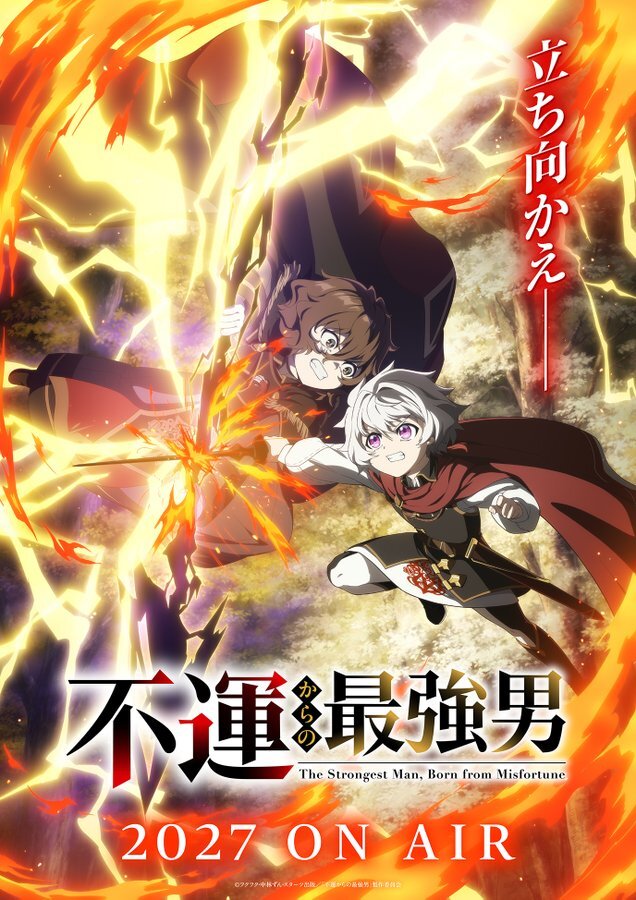 Production company Asmik Ace opened an official website for a television anime adaptation of Fukufuku‘s Fuun kara no Saikyou Otoko (The Strongest Man, Born from Misfortune) light novel on Tuesday, revealing the main staff, the image song, and a teaser visual (pictured). The anime series will premiere in 2027.
Staff
Director: Shigetaka Ikeda (Future Card Buddyfight)
Series Composition, Script: Aki Mizuki (Sorairo Utility (TV) script)
Character Design: Yumiko Hara (Mairimashita! Iruma-kun 2nd Season), Yuuki Osada (Jiisan Baasan Wakagaeru animation director)
Studio: East Fish Studio
Voice actor Shouya Chiba (Tamon-kun Ima Docchi!? theme songs) will perform the image song “Luck Out.”
Fukufuku originally penned the isekai fantasy series on the Shousetsuka ni Narou website in 2017, later beginning a revised version in November 2020. Starts Shuppan began publishing the novel in March 2022, featuring illustrations by Zun Nakabayashi. The fourth volume was released in March 2025.
Nakabayashi began drawing a manga adaptation on the Comic Glast web service in October 2021. The ninth volume was published on March 27.
MangaPlaza licensed the manga for digital release in English in December 2023.
Official site: https://fuunsaikyo.asmik-ace.co.jp/
Official X: @fuunsaikyo
Source: animate Times
>

Webtoon’s Sydney Bright On ‘Lore Olympus’, Anime & ‘Perfect Addiction’

Aston Villa’s tussle with football’s financial restrictions is exposing the system’s shortcomings

Bucks agree to trade Giannis Antetokounmpo to Heat for Tyler Herro, Kel’el Ware, more
-

 Fashion9 years ago
These ’90s fashion trends are making a comeback in 2017
-
Fashion9 years ago
According to Dior Couture, this taboo fashion accessory is back
-
Fashion9 years ago
Model Jocelyn Chew’s Instagram is the best vacation you’ve ever had
-
Fashion9 years ago
Your comprehensive guide to this fall’s biggest trends
-
Fashion9 years ago
A photo diary of the nightlife scene from LA To Ibiza
-
Fashion9 years ago
Emily Ratajkowski channels back-to-school style
-
Fashion9 years ago
9 Celebrities who have spoken out about being photoshopped
-
Fashion9 years ago
The tremendous importance of owning a perfect piece of clothing