
Janssen with Vanity Fair’s John Ross at Malta’s Mediterrane Film Festival on June 25, 2026, as a clip from Martin Campbell’s GoldenEye plays on the big screen.
Courtesy of Mediterrane Film Festival


As the casting process heats up to find a new 007, Famke Janssen, who starred opposite Pierce Brosnan in 1995’s GoldenEye, has recalled her nerve-wracking audition to land the part as Xenia Onatopp in the iconic James Bond franchise.
“I became one of three, maybe four, finalists, and I was flown to London for a screen test with Pierce Brosnan. I remember being so nervous because I’d never done a screen test in my life, and this was a Russian character with an accent,” Janssen, 61, explained during a masterclass conversation with Vanity Fair’s John Ross during the Mediterrane Film Festival in Malta last week. She landed the audition as she had been filming a role in Clive Barker’s Lord of Illusions for Bond studio MGM, and studio executives had been impressed with her dailies. “I didn’t sleep the whole night. … I just sort of surrendered, and everything [my acting coach Harold Guskin] taught me, I took with me. And the rest is history.”
Janssen with Vanity Fair’s John Ross at Malta’s Mediterrane Film Festival on June 25, 2026, as a clip from Martin Campbell’s GoldenEye plays on the big screen.
Courtesy of Mediterrane Film Festival
It was a pivotal moment for the franchise as Brosnan was stepping into the lead role for what would be his first of four 007 installments, and the first Bond film following a six-year hiatus. Brosnan took over from Timothy Dalton (and paved the way for Daniel Craig). It was also a coup, to say the least, for Janssen, a Dutch talent who started her career as a model before moving to New York to study creative writing and literature at Columbia University. Prior to landing the Bond gig, she had done only a handful of bit parts in films and TV shows, including Fathers & Sons (her breakout role), Melrose Place and Star Trek: The Next Generation.
“I grew up watching Bond movies because my dad was a very big fan of them,” continued Janssen, who was born in Amstelveen, Netherlands. “So I had seen what they were, but I also was very aware of how women were portrayed in that genre. As a Dutch woman coming out of a family of very strong women with female empowerment being something that was very [important to me], it’s really kind of colored my life in every way. I put so much pressure on myself in this role because I thought, I don’t want to be one of those women. That’s not how I want to start my career. I wanted it to be a launching pad for a career that has longevity where I can do different things. So, I worked hard.”
Speaking of, Ross asked Janssen about the steamy bathhouse scene during which Xenia and Bond face off in an encounter that is both flirty and ferocious.
“From the moment I got the part, I thought just thought, ‘I’m going for broke. I don’t care. I am going to give it my all and work as hard as I can on making sure this character is going to be as memorable as possible.’ So I threw myself into it,” she explained, adding that her fearlessness came as a bit of a surprise considering how she grew up “as a very, very shy” kid who would often run and hide under a bed when guests came over to visit. “That scene was very difficult but also very liberating.”
And also very painful.
“I did break my ribs during that scene, by the way,” she revealed. “The walls were padded, and Pierce was meant to throw me against the wall. I told him, ‘Pierce, it’s so hard to act out this pain so just throw me against the wall.’ He said, ‘No, no, no. I don’t want to hurt you.’ I said, ‘Don’t worry about it, the walls are padded.’ Famous last words.”
Brosnan then threw Janssen up against the wall, she says, at which point she sustained broken ribs, though it wasn’t until months later that she realized the extent of the injury. “I couldn’t speak at that point. They had to stop filming for a moment because they didn’t know what was going on. I couldn’t breathe. I couldn’t do anything. I didn’t learn, by the way, until I came back to New York — we shot for six months — that I had broke a rib. We just continued filming. They didn’t know.”
Janssen said that filmmakers had hired a “pseudo psychic person” to work on her body, and the specialist wasn’t able to determine that she had broken ribs but did have a vision of a particular filmmaker she would eventually work with.
“She predicted that I was going to work with Woody Allen, which is so crazy. She said, ‘I can see Woody Allen smiling at you,’ and then probably within a year or two, I worked with him,” said the veteran star who landed a role opposite Kenneth Branagh in the auteur’s 1998 film Celebrity.
Back to Bond. Janssen said joining the franchise also delivered a steep learning curve. “You learn very quickly from day one that there is a publicity machine behind a Bond movie that is like no other franchise, not even like the X-Men,” said the actress, who went on to play Jean Grey in that blockbuster franchise. “Over all these years, they know how to promote something. On our first week of filming — I hadn’t even been on set yet — they had a press conference for 800 [journalists] like a junket with round tables. It was with the British press and they’re notorious. I love you all but they are notoriously difficult. Right away, I was, like, ‘Oh my God, this is it. This is what we’re going to be dealing with.’ [I was playing] such a specific character who was a foreigner and I was being catapulted into this big machine. There was a whole stigma about it.”
Janssen said it was tough navigating “stigma to stigma” as a model-turned-actress-turned-Bond girl.
“I was, like, on my God, what am I doing to myself and my career? I kept having to climb out of every box I was being put in. After [GoldenEye] came out, it really put me in the spotlight in a way that I had never experienced, and it gave me visibility and choices,” she said, though she was very choosy. “I turned down everything that had a gun, that had a ‘this,’ that had a ‘that.’ I waited until this one project came along called City of Industry with Harvey Keitel, and that was the one I liked because it was down and out.”
Janssen and Ross on stage inside the festival hub in Valletta during Malta’s Mediterrane Film Festival presented by the Malta Film Commission.
Courtesy of Mediterrane Film Festival
Janssen speaks inside the festival hub in Valletta during Malta’s Mediterrane Film Festival presented by the Malta Film Commission.
Courtesy of Mediterrane Film Festival/Shutterstock
>

Dawson’s Creek fans have been excited about the Katie Holmes–Joshua Jackson reunion at the heart of Holmes’ latest film Happy Hours since the first paparazzi photos emerged of the two actors walking down a New York City sidewalk.
But there was something broader that sparked Holmes’ idea for her latest work as a writer and director, which premiered earlier this month at the Tribeca Festival: the increased social isolation that many people have felt since the COVID-19 pandemic.
When asked what she hoped audiences grappling with those feelings of loneliness and a struggle to connect emotionally could take away from the film, Holmes told The Hollywood Reporter that she hoped people would “feel a sense of compassion for themselves and others and a sense of hope and that we can have fun again.”
Jackson added, “And that love is possible; life is long; there’s no given path; there’s no shelf life, and you’re going to be OK. It feels like knowing that you can take a deep breath and be OK right now is more important than it’s ever been.”
In putting together the cast for the film, Holmes didn’t just rely on her familiarity with Jackson, she also looked to the actors she’d worked with in the 2024 Broadway production of Our Town. Castmembers John McGinty, Donald Webber Jr. and Sky Smith were all part of the company of the Broadway production. McGinty had also worked with Jackson on Children of a Lesser God, describing joining Happy Hours as a “natural progression.”
Webber recalled how he and Holmes “became close friends” through their work on Our Town, and he was intrigued at the prospect of working with her on a project she wanted to direct.
“I thought there’s no way that this incredible person, incredible actress, incredible everything is also going to be an incredible director. And it turns out she was also an incredible director. I think people will see in the film,” Webber said. “I’m proud of the things that she’s able to get out of us because I think she’s an actor’s director.”
Indeed, as Holmes explained in a post-screening conversation with the cast and Tribeca Festival director and senior vp, programming Cara Cusumano, she and Webber would discuss the progress of this film during their time on Our Town.
“After the death scene every night, we would chitchat on the stairs,” Holmes said, addressing Webber. “You really pushed me to keep going, and you’d be like, ‘How’d that pitch go? And I’d be like, ‘Waiting to hear,’ or, ‘We’re going to keep trying.’”
Earlier, in her introductory remarks, Holmes spoke about how the film reflects the value of interpersonal connections and community.
“This film was made in the spirit of what Tribeca Film Festival is all about. What you’re about to see is a beautiful community of artists who inspire one another and support one another and who said yes to this experience,” she said. “Collaborating is not only fun but also essential and quite magical. We had a truly magical time making this film. And I thank everyone for sharing this vision with me. … Tonight is about this cast and crew. I truly love each and every one of you and I really wanted the camera to echo the light in each of you. Josh, thank you for sharing this space with me again. You created the ideal creative experience for me years ago and again on this film. This film is about connection and reconnection and our individual experiences that shape how we come together.”
For other actors, like Joe Tippett and Jack Martin, who plays the younger version of Jackson’s character and is part of the ensemble cast of Hulu’s Not Suitable for Work, it was the script that drew them to what Holmes envisions as a trilogy in the spirit of Richard Linklater’s Before films.
“It was one of the best scripts I’ve ever read,” Martin said. “It was phenomenal. I love romance movies — they’re some of my favorite movies, that genre. And this was just beautifully written, very authentic dialogue, incredible relationships, it really moved me emotionally reading it, which is rare for me. And Katie’s such a talent; she’s so incredible. It was one of those things where every single day that I was a part of it was better than the last. Everybody was just so kind and generous.”
Martin, Tippett and castmember Chloë Kerwin all spoke to Holmes’ supportive approach as a director.
“She’s just so encouraging and makes you feel like you’re on the right track always,” Kerwin said.
And Tippett joked, “She knows how to talk to actors and convince you you’re coming up with all of the ideas when they’re really hers.”
McGinty adds of Holmes, “She’s like a collaborator really. She’s amazing because she’s so open to so many different ideas, and it wasn’t like there was one way to do anything. She would ask what my ideas were, how to bring the character into life and think about what it would look like on the screen. Every time I work with her I learn about her as a person, as a human, on an intellectual level, on every level. I’m just so grateful.”
But, the reunion with Jackson is still of the most interest to fans.
Webber offered a slight tease, “Everybody asks me, ‘Do they get together in the movie? Do they stay together?’ Without giving anything away, all I can say is it was a reunion that’s worth the wait.”
And castmember Constance Wu shared her thoughts on why people are so eager to see the Dawson’s Creek alums together again.
“History between two people, which is kind of what this movie is about, that’s something that you can’t fake,” she said. “There is such a richness to their history, even by virtue of the time that they’ve known each other. They saw each other grow up, and that is a beautiful thing. And to look at that and appreciate that is very worthy of the big screen.”
>

The Karlovy Vary International Film Festival (KVIFF) is back for its 60th edition in what is its 80th year since its foundation. Double anniversary alert!
A deep dive into the long history of the Czech fest can unearth all sorts of special memories and surprises among the winners of its main Crystal Globe award and beyond.
We don’t have time to go through it all. But in honor of the 60th edition of KVIFF, running July 3-11, THR decided to shine a spotlight on six of the hidden, and not-so-hidden, cinematic gems that have won the main festival award.
In 1954, the Hollywood blacklist and Salt of the Earth came to town
In a sign of the Karlovy Vary festival’s early interest in looking beyond Eastern Europe, it programmed Herbert J. Biberman’s drama about Mexican workers at a zinc mine who call a general strike.
During the time of the Eastern Bloc, it surely helped that the movie focuses on social issues. After all, it is all about the solidarity and resolve of the workers and their families. But in fact, the film was made entirely outside the traditional studio system by three blacklisted Hollywood figures, with Biberman joining forces with screenwriter Michael Wilson and producer Paul Jarrico.
The film even won the main award, with the KVIFF website listing it as sharing the Grand Prix with True Friends, directed by Mikhail Kalatozov from the USSR.
In 1970, Ken Loach took Karlovy Vary
‘Kes’ film still, courtesy of KVIFF
British auteur Ken Loach also brought his social lens to the Czech film festival, screening his widely celebrated Kes there.
Young star David Bradley later won a BAFTA Film Award for playing the lead role of a working-class English boy who spends his free time caring for and training his pet kestrel. Colin Welland also earned a best supporting actor BAFTA for his work in the film.
Loach himself got nominated at the BAFTAs but didn’t win. He did, however, leave KVIFF with its top honor for Kes.
In 1978, Jiří Bartoška’s breakthrough film came out on top
‘Shadows of a Hot Summer’ film still, courtesy of KVIFF
For more than 30 years, until his death last May, Jiří Bartoška was known as the president and public face of KVIFF. But Czechs also knew him as an actor for decades.
One visit to Karlovy Vary, long before his fest leadership, led him to being cast by director Frantisek Vlácil in the thriller movie Shadows of a Hot Summer, a project that, as it turned out, launched his film career.
The film also went on to KVIFF and ended up winning its main award, shared with, you guessed it!, a movie from the USSR, namely Stanislav Rostotskiy’s White Bim Black Ear.
In 2001, Karlovy Vary fell in love with Amélie
‘Amélie’
Audrey Tautou is Amélie in Jean-Pierre Jeunet’s movie. But you knew that!
Despite being caught in her imaginative world, the titular young waitress decides to help people find happiness, leading her on a journey that may allow her to find true love. But you knew that, too!
What you may not know yet is that Amélie won the Crystal Globe at Karlovy Vary in 2001, as listed on its website.
In 2006, Maggie Gyllenhaal and Sherrybaby won big
‘Sherrybaby’ film still, courtesy of KVIFF
Laurie Collyer’s drama Sherrybaby stars Gyllenhaal as a young woman who gets released from prison and is recovering from a heroin addiction. But trying to rebuild her life on the outside, and especially repairing her relationship with her young daughter, is harder than she hoped.
Gyllenhaal is back at KVIFF this year to receive the fest’s President’s Award. But did you know she received a statuette at the Czech festival before?
Her return this year comes 20 years after Sherrybaby left Karlovy Vary with its Crystal Globe award and Gyllenhaal herself was won the best actress honor for her work in the film.
In 2007, Icelandic Noir left its mark
‘Jar City’ film still, courtesy of KVIFF
A murder and brain illness feature in Icelandic filmmaker Baltasar Kormákur‘s Jar City, which he brought to KVIFF.
“A desperate man is trying to locate the genetic origin of his little daughter’s brain illness,” read the ominous synopsis on the fest’s website back in the day. “A solitary detective is investigating the murder of an old eccentric whose eventful past changes this seemingly ordinary case into a bizarre mystery. Both storylines gradually become intertwined in Baltasar Kormákur’s latest film – the biggest Icelandic box-office hit of all time.”
The movie stars Ingvar Sigurdsson (Everest, The Northman) and Ágústa Eva Erlendsdóttir (Justice League), among others, and it showed the appeal of Nordic noir before it continued its triumphant march around the globe. After all, Jar City won the Crystal Globe at KVIFF in 2007.
>
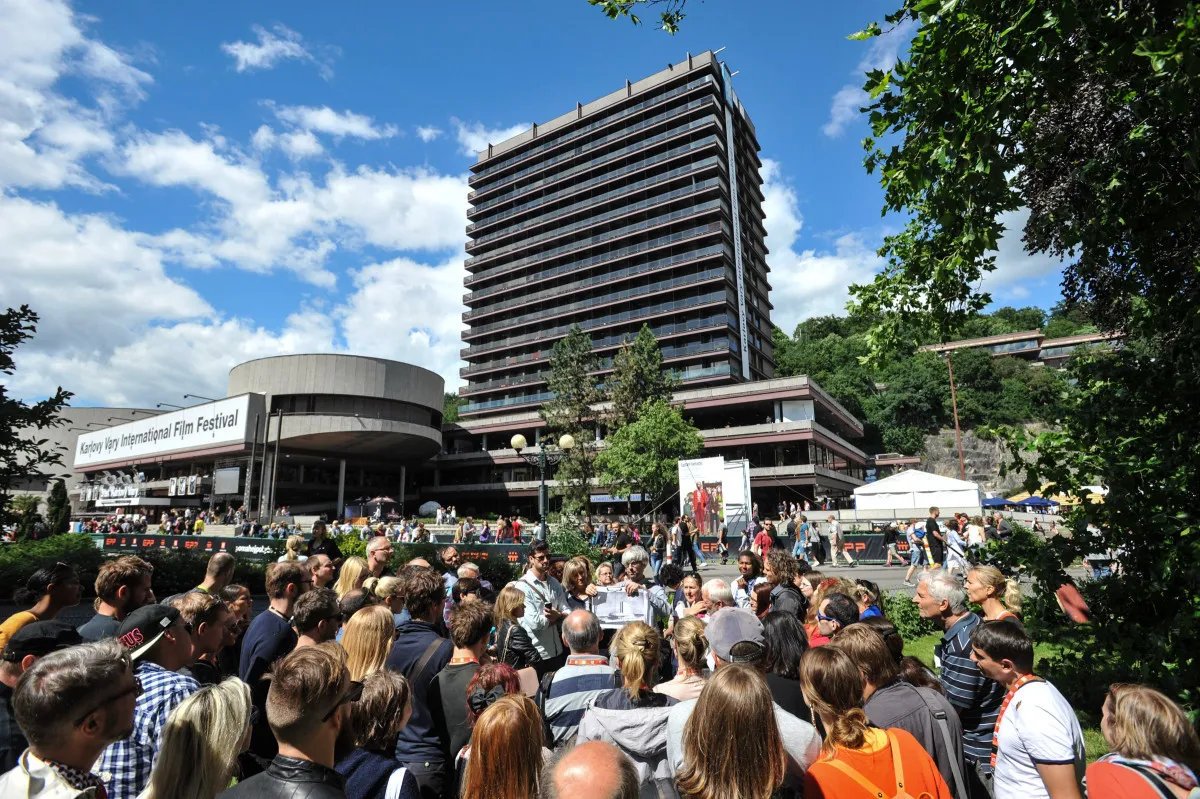
Just like in many parts of life, making a film is a team effort. And so is putting together the lineup of a big film festival. Just ask Karel Och, the artistic director of the Karlovy Vary International Film Festival (KVIFF).
“I don’t think I’ve ever used a singular whenever I talk about the selection, because I would be ashamed to use the singular, because clearly, from day one until the moment we share the movies with the audience, this is teamwork,” he tells THR. “The beauty of this teamwork is that, if you are lucky, you have a team full of strong individuals, just like I do.”
Which means that “the discussions are amazing, because you learn from your colleagues, from the emotionality of your colleagues, from the intelligence of your colleagues,” Och explains. “Sometimes, they convince you that their suggestions are better for the festival and for the program. I’m 52, so I’m the oldest, but the youngest member of our team is not even 30 years old, and it works perfectly.”
For the double anniversary of the fest’s 60th edition in its 80th year of existence, he and his programming team have scoured the globe for new movies from established filmmakers and first features from new voices alike.
While the KVIFF team has a global focus and international experience, it added Italian programmer Lorenzo Esposito last year. “I’m very happy to say that in the history of Karlovy Vary, which is now 80 years old, this is the first time we have a foreign collaborator who is more than a programming consultant,” Och tells THR. “Obviously, we’re really happy about our consultants, but we’re not working with them throughout the year on a daily basis. Lorenzo is the first foreign-language-speaking member of the programming committee in the history of the festival.”
That means that Och and his team added the Italian to their WhatsApp group. “There are seven of us, and we speak English, even though six of us are Czech,” he shares. “That actually makes you think about how you express yourself about the movies. I think it’s a gift to be forced to articulate yourself in English with your colleagues who are Czech to find new ways to express yourself thoroughly.”
Only time will tell which films in the 2026 KVIFF selection will become big surprises, major discoveries or arthouse gems. What THR can, however, already present to you is a look at the worker bees of the big Czech festival who help Och make all the cinema magic happen.
Meet key members of the KVIFF programming team here.
Anna Kořínek
Program Coordinator
Anna Kořínek
Courtesy of Film Servis Festival Karlovy Vary
When did you start working for KVIFF, and how did you get hired?
I started in 2010 in an administrative position in the program department. I was appointed Program Coordinator and a member of the selection committee in 2016.
What did you do before working for the festival?
I was working for the Queer Film Festival Mezipatr in the positions of production coordinator and program coordinator. I was also partly involved in some other Czech film festivals.
Do you have any specialty or focus?
As a programmer, I am focused on the German-speaking countries, the Middle East and Iran. I am also curating the program Future Frames: Generation NEXT of European Cinema, the program that aims to promote young European directors and help them to build a bridge from film school to the film industry.
Do you have any favorite or particularly special KVIFF moment or experience?
It is difficult to pick only one moment, but if I had to choose one specific category of experiences, it would be the opportunity to give a voice to filmmakers who are silenced in their own countries, mostly for political reasons. One of the regions I focus on as a programmer is the Middle East and Iran. Iran is an incredibly fascinating country in terms of film, where many independent filmmakers who reject censorship are currently active. Of course, this means they can never screen their films in their home country. So for me, screenings where filmmakers can be present, see their films, show them to the audience, and speak freely about them are a truly special experience.
So I’ll never forget when an Iranian director, then in exile in France, saw his film for the first, and perhaps last, time on the big screen in Karlovy Vary via a video call from his journalist friend – and what followed: a long round of applause and shouts of support from the audience, and tears of emotion not only from the filmmaker but also from his friend.
What is one of the many things you love about KVIFF?
If I had to answer this question with the first thing that comes to mind, it would be the annual return to the summer camp that we all love so much. It’s a familiar place with people we might not see for an entire year – people who take time off from their day jobs to work with us during that one special week we’ve been preparing for all year. It’s the joy of finally getting to meet the filmmakers whose films we’ve been discussing with colleagues for months, and cheering about the moments when these films were confirmed for the program.
I thoroughly enjoy introducing films, when I can tell the audience why we in the programming department consider this particular film to be exceptional and worthy of being shown on the big screen in Karlovy Vary. I’m always thrilled when I walk past a theater where a film has just ended and see audience members leaving, discussing the film they’ve just watched. Perhaps it’s all also due to the energy that the entire team has throughout the festival – positive energy, where everyone does their utmost to ensure the festival runs perfectly while maintaining a good mood and a sense of humor.
Sandra Hezinová
Programmer
Sandra Hezinová
Courtesy of Film Servis Festival Karlovy Vary
When did you start working for KVIFF, and how did you get hired?
I started working for the festival while pursuing my Master’s degree in the Department of Film Studies at Charles University in Prague. That was in 2015. Back then, KVIFF’s programming department was looking for students to provide administrative support during the busiest months leading up to the festival. I became a programmer three years later.
What did you do before working for the festival?
Mainly studying, though I organized a student film festival before that. By the time I joined the KVIFF team, I was already a programmer for the Queer Film Festival Mezipatra, where I remained until 2019.
Do you have any specialty or focus?
When it comes to territories, my primary focus from the beginning has been Scandinavian cinema, alongside Canadian cinema. In recent years, I have also been responsible for the cinemas of Latin America, Spain, and, to some extent, Portugal. As my previous answer suggests, I also have a strong interest in queer cinema.
Do you have any favorite or particularly special KVIFF moment or experience (out of the many)?
The 53rd edition was undoubtedly one of the most memorable for me, as Sébastien Pilote’s The Fireflies Are Gone was screened in the Crystal Globe Competition. I discovered the film and brought it to the festival after seeing it in Montreal at screenings organized by Telefilm Canada.
What is one of the many things you love about KVIFF?
Scouting new films and projects, and welcoming the filmmakers behind the films we select for the program. Those experiences make my work rewarding and enriching every year.
Vojtěch Kočárník
Programmer
Vojtěch Kočárník
Courtesy Film Servis Festival Karlovy Vary
When did you start working for KVIFF, and how did you get hired?
Like many people who work for KVIFF today, I used to come to Karlovy Vary as a student. I remember the moment when I saw Cairo Station in the Grand Hall – after the introduction, part of the programming team sat down on the floor in the aisle and watched the film together with the audience. That was the first time it occurred to me that there were real people behind the festival, and I became curious about how film festivals work.
A little later, as a journalist, I interviewed Karel Och, KVIFF’s artistic director. Not long afterward, I contacted him again to ask whether he might know of any opportunities to work for the festival. He was generous and offered me a position as a pre-selector, which several years later turned into a full-time programmer role.
What did you do before working for the festival?
I graduated in Media Studies, Journalism, and European Politics from Masaryk University, and later also studied Film Studies at Charles University. I started working for KVIFF while still at university, and I now also work in film distribution.
Do you have any specialty or focus?
As a programmer, I focus primarily on the Central and Eastern European region and Africa, and I am responsible for docs from all over the world.
Do you have any favorite or particularly special KVIFF moment or experience (out of the many)?
The moments I remember most fondly are those spent with young, often emerging filmmakers. At the same time, I also vividly remember introducing the documentary film 2000 Meters to Andriivka last year, accompanied by its creator, Oscar-winning director Mstyslav Chernov. In that moment, I probably felt most strongly both the responsibility and the purpose of my profession: to broaden people’s awareness and help bring stories and testimonies from all corners of the world – even from the front line of war.
What is one of the many things you love about KVIFF?
The uniqueness of the brutalist building of Hotel Thermal, designed by Vladimír and Věra Machonin. Especially the Grand Hall – its aura, the cinema screen, and the red seats. It remains the most beautiful cinema I know.
Petra Vočadlová
Programmer
Petra Vočadlová
Courtesy of Film Servis Festival Karlovy Vary
When did you start working for KVIFF, and how did you get hired?
I started working for KVIFF in 2017 during my university studies. I joined the team only for the duration of the festival, working at the Program Department reception desk. In 2021, after completing my studies abroad, I returned and joined the team for part of the year as a member of the Program Department. In 2023, I became a programmer.
What did you do before working for the festival?
Before working for KVIFF, I studied Film Studies. I completed my undergraduate degree at the University of Aberdeen in Scotland and my master’s degree at the University of Groningen in the Netherlands. I did not have much direct experience in the film industry before joining KVIFF.
Do you have any specialty or focus?
As a member of the selection committee, I focus on the Benelux region and English-speaking countries. Together with my colleague Natalia, I also curate the genre section Afterhours.
Do you have any favorite or particularly special KVIFF moment or experience?
There are too many to choose from. If I had to pick one, it would be the two days before the festival officially begins. By then, the core team is already in Karlovy Vary, and in the evenings we gather on one of the terraces of the Hotel Thermal, the festival centee. We have a beer, talk about the fact that it’s all happening again, and enjoy the anticipation – and the calm before the storm – together.
What is one of the many things you love about KVIFF?
So far, I have spent my entire 20s working for KVIFF, and it feels as though it has become part of my DNA. I am grateful that due to the festival, I get to travel abroad and meet people from across the world, discover various events and get to be part of the network. And I am proud to be part of an event that has the power to spark important conversations and connect film lovers and industry professionals across generations and borders. And, of course, it is the ultimate start to the summer.
Natalia Kozáková
Programmer
Natalia Kozáková
Courtesy of Film Servis Festival Karlovy Vary
When did you start working for KVIFF, and how did you get hired?
I started collaborating with KVIFF in 2018 as a program assistant, a position that was offered to students of our school (the film studies department at the Faculty of Arts of Charles University) in an admission process, which I managed to get through. Since then, I also worked as a pre-selector and a jury guide, [before] finally getting to a programmer’s position in 2024.
What did you do before working for the festival?
I started the collaboration with KVIFF during my studies, but for a few years, I also worked as a content creator and coordinator in a children’s radio, a tourist guide and a film critic.
Is there any specialty or focus you have?
I focus mainly on films from the post-Soviet bloc, animation and genre films.
Do you have any favorite or particularly special KVIFF moment or experience?
I have fond memories of meeting amazing people whilst working as a jury guide, who later became my close friends. Otherwise, witnessing standing ovations after the premieres in the Grand Hall is always a heartwarming experience.
What is one of the many things you love about KVIFF?
The cinephile audience.
Lorenzo Esposito
Associate Programmer
Lorenzo Esposito, courtesy of Marco Santarelli
When did you start working for KVIFF, and how did you get hired?
I started in 2019 as an Italian consultant between my last year in Locarno and my first year at the Berlinale. I kept this position until 2024, then I became associate programmer in 2025, working with the program department. I also curated two retrospectives: “Another Birth. Iranian Cinema Here and Now” (2023) and “The Wish to Be a Red Indian: Franza Kafka and Cinema” (2024, co-curated with Karel Och).
What did you do before working for the festival?
I was a film programmer for Venice (2001: co-curating the Nuovi Territori section); Turin (2002-2006: member of the selection committee); Rome (2007: Raúl Ruiz retrospective); Locarno Film Festival (2013-2018: member of the selection committee); Berlinale (2020-2024: member of the selection committee).
Do you have any specialty or focus?
During my Locarno/Berlin years, I focused on Mediterranean countries and the Middle East, Portugal, Turkey and Iran. As associate programmer in Karlovy Vary, I’m still [focused] here but work more all around.
Do you have any favorite or particularly special KVIFF moment or experience?
The happiness I felt in them and the gratitude from the young independent Iranian directors and producers of the 2023 retrospective.
What is one of the many things you love about KVIFF?
Freedom in programming and the audience.
>


These ’90s fashion trends are making a comeback in 2017
According to Dior Couture, this taboo fashion accessory is back
Model Jocelyn Chew’s Instagram is the best vacation you’ve ever had
Your comprehensive guide to this fall’s biggest trends
A photo diary of the nightlife scene from LA To Ibiza
Emily Ratajkowski channels back-to-school style
9 Celebrities who have spoken out about being photoshopped
The tremendous importance of owning a perfect piece of clothing