
Tech
OpenAI launches its new family of models with GPT-5.6


OpenAI unveiled its newest family of models on Thursday, introducing a new set of heavyweight programs into an increasingly crowded field of AI offerings.
GPT-5.6 comes in three variants: Sol (considered its workhorse), Terra (a more intermediate option), and Luna (its budget friendly option). These models expand what users can do across a variety of fields — with the company promising powerful capabilities in enterprise work, coding, and even scientific research.
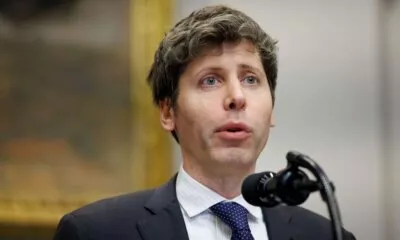
CEO Sam Altman has promised that his company’s newest models are orders of magnitude more efficient and cost-effective than previous versions, recently telling CNBC that Sol is 54% more token efficient when it comes to AI coding tasks.
Most notably, the company calls 5.6 its “strongest cybersecurity model yet, achieving frontier performance with significantly fewer tokens.”
Indeed, much hubbub has been made about the model’s cyber capabilities, as the Trump administration previously sought to restrict its rollout, ostensibly due to fears of how the model could be misused. GPT-5.6 supports defensive activities, including threat modeling, code review and patching, and blue teaming (simulating an attack on your own systems to find weaknesses before real hackers do).
OpenAI also released a new tool called ChatGPT Work, which — just as it sounds — is designed as a workplace companion for enterprise teams, running on desktop, web, and mobile, that can help with daily clerical tasks, like drafting documents, spreadsheets, and presentations.
OpenAI’s newly announced family of models follows on the heels of similar releases this week from competitors SpaceXAI and Meta.
However, GPT-5.6 and its attendant marketing seems most designed to take aim at OpenAI’s primary opponent, Anthropic. Anthropic has managed to make itself the likable underdog of the AI race, focusing fixedly on enterprise customers and winning a growing share of support as a result.
Not to be outdone, OpenAI cites the Artificial Analysis Coding Agent Index, a notable benchmarking metric, to claim that its latest family of models outshines Anthropic’s models at every turn.
OpenAI calls Sol its “best coding model yet,” and has explicitly compared it to Anthropic’s recently released (and much hyped) Fable. Using the Coding Agent Index, OpenAI claims that Sol “sets a new state of the art at 80, 2.8 points above Fable 5, while using less than half the output tokens, taking less than half the time, and costing about one-third less.”
It adds: “That advantage extends across the family: Terra performs just above Fable 5, while Luna outperforms Opus 4.8.”
The company says that 5.6 is now available across ChatGPT, Codex, and the OpenAI API. Availability per million tokens is priced as follows: Sol is $5 input / $30 output, Terra is $2.50 input / $15 output, and Luna is $1 input / $6 output.
When you purchase through links in our articles, we may earn a small commission. This doesn’t affect our editorial independence.
>

There’s something almost too meta about this one, via Bloomberg. Lyzr, a three-year-old, Jersey City, New Jersey, startup that helps enterprises build AI agents, used its own AI agent to raise its own round. The system, SivaClaw, reportedly fielded questions from more than 130 investors, drafted investment memos, and even tracked which slides backers lingered on.
It basically ran point on the startup’s $100 million Series B (at a roughly $500 million valuation) while proving that the product actually works. It’s hard to imagine a cleaner sales pitch.
But the most telling detail, per Bloomberg’s retelling, is how little legwork was involved. Lyzr told the outlet it pulled in $400 million in interest from Silicon Valley, the Middle East, and financial-sector investors without a founder ever needing to fly out and do the traditional laps up and down Sand Hill Road for coffee meetings and warm intros. That may be the real story of this go-go moment: there’s so much capital chasing AI bets that startup founders with traction barely have to leave their desks to raise nine figures.
>

OpenAI is sunsetting Atlas, the AI-powered browser it launched in October with ChatGPT at its core. But it’s not giving up on the idea that AI should help people browse the web. Instead, it’s taking some of the agentic browsing features it tested in Atlas and redistributing them across ChatGPT’s desktop app and a Google Chrome extension.
The move to shut down Atlas comes a few months after OpenAI’s CEO of applications Fidji Simo told the team to cut back on “side quests,” which led to the AI firm shutting down its AI video generation tool Sora.
For much of the past year, the AI industry had been engaged in a war to unseat Chrome as the place where people spend most of their time online. Perplexity launched Comet, The Browser Company launched Dia, and Google and Microsoft have updated Chrome and Edge, respectively, with new AI-powered features.
After a few months of experimenting, OpenAI appears to have concluded that the browser is a feature, not the destination. So it’s folding Atlas’s browser-like agent capabilities into the places people already work — and that includes Chrome.
OpenAI is launching a ChatGPT extension on Chrome that gives it access to the context of the page you’re viewing, lets users ask questions about webpages, summarize content, or start longer tasks all from the browser. It’s a direct competitor to Google’s Gemini Side Panel, which performs several of the same tasks.
OpenAI is also boosting its ChatGPT desktop app by featuring a more robust browser that allows users to browse websites, log into accounts, download files, and interact with web pages without leaving ChatGPT. A separate cloud browser runs remotely on OpenAI’s servers as a place where the app’s agents can complete tasks on a user’s behalf.
Together, the updates turn ChatGPT into a continuous workspace that spans Chrome, the desktop app, and an AI agent.
When you purchase through links in our articles, we may earn a small commission. This doesn’t affect our editorial independence.
>

Should Anthropic trust Elon Musk to host its models? After users on X implied that Musk could wake up one day and simply boot the AI lab from SpaceX’s servers as a way to kneecap a rival, Musk replied with glowing praise for the AI lab. He said that such a trick was “not my style.”
“I was clearly wrong about Anthropic,” Musk wrote on Thursday, referring to his September 2025 post on X in which he said, “Winning was never in the set of possible outcomes for Anthropic.” Of course, even at that time, Anthropic could already be considered a winner; the company was reported to have the biggest AI market share with enterprises.
It seems those anti-Anthropic days are behind Musk — and not just on X. As of July 2026, Anthropic is one of SpaceX’s largest customers.
To recap: Anthropic signed a deal in May to buy 300 megawatts of compute, the entire output of xAI’s Colossus 1 data center near Memphis, Tennessee. (Musk’s xAI merged with SpaceX in February.) Anthropic agreed to pay $1.25 billion per month through May 2029, a deal worth about $40 billion in revenue for SpaceX’s xAI unit. Google, by the way, also signed a deal to rent SpaceX infrastructure through June 2029, for $920 million per month.
Musk insists that this wasn’t a dangerous decision by Anthropic and that he’s full of admiration for the rival.
“They are obviously currently the leader in AI. No company has released a model as good as Mythos/Fable and they will undoubtedly have Mythos 2 ready soon. And I would never cut them off in a way that hurt them badly, even as a competitor. That’s not my style,” he wrote.
He offered as proof of his don’t-squeeze-competitors style Tesla’s decision in 2014 (which was outlined in a now deleted company blog post and now housed under its patent pledge) to not initiate patent lawsuits against anyone who, in good faith, wants to use its technology. He also noted that Tesla opened its Supercharger network and charging port design to competitors.
“SpaceX launches competing satellite systems with no increase in price or use of unfair terms. Even my worst enemies can attack me on this platform,” he wrote, listing another example.
Of course, Musk is not exactly above tactics aimed at rivals, especially those with whom he has a history. He sued OpenAI, for instance.
Anthropic doesn’t have to rely on Musk’s sticking to his “style” though. There would certainly be contractual consequences if Musk suddenly shut down Anthropic’s infrastructure. Not to mention the massive benefits for SpaceX to keep that deal intact. Not only does Anthropic pay handsomely, but SpaceX’s engineers may learn how to build for, and support, Anthropic’s rapidly growing AI , just like Amazon’s engineers do.
That proximity might have other benefits as well. During his trial against OpenAI, Musk acknowledged that AI “distilling” was real — a process in which one model maker sets up many fake accounts to send prompts to a competitor in order to learn how it works. As the New York Times reported, when a lawyer asked him if xAI had ever distilled technology from OpenAI, Musk replied: “Generally AI companies distill other AI companies.”
Anthropic in February, accused three Chinese model makers of doing this to Claude. Presumably, Anthropic and Google feel they have safeguards against SpaceX doing this while they are using its infrastructure. But hosting Anthropic’s compute could still give SpaceX greater visibility into how the company operates than most competitors would ever have.
There appears to be nothing but upside for Musk’s company in this partnership at the moment. As for tomorrow, and as the three-year contracts ages, who knows?
When you purchase through links in our articles, we may earn a small commission. This doesn’t affect our editorial independence.
>

Wichita to join Dayton as men’s March Madness opening-round host site

OpenAI launches its new family of models with GPT-5.6

Kaylee McKeown withdraws from Commonwealth Games in Glasgow with glandular fever

-

 Fashion9 years ago
These ’90s fashion trends are making a comeback in 2017
-
Fashion9 years ago
According to Dior Couture, this taboo fashion accessory is back
-
Fashion9 years ago
Model Jocelyn Chew’s Instagram is the best vacation you’ve ever had
-
Fashion9 years ago
Your comprehensive guide to this fall’s biggest trends
-
Fashion9 years ago
A photo diary of the nightlife scene from LA To Ibiza
-
Fashion9 years ago
9 Celebrities who have spoken out about being photoshopped
-
Fashion9 years ago
Emily Ratajkowski channels back-to-school style
-
 Tech2 months ago
OpenAI CEO apologizes to Tumbler Ridge community

