
Politics
Politics Home Article | Nigel Farage To Resign As MP And Fight By-Election


Nigel Farage speaking at a press conference in 2025 (Thomas Krych/Alamy)
2 min read
Nigel Farage has announced that he is resigning as the Reform MP for Clacton and will fight the by-election that follows.
Speaking on Tuesday afternoon, Farage said the contest would be a “people versus the establishment by-election” that would take place “in short order”.
“It’s a chance to stick two fingers up to the entire establishment, to frankly tell them where to go, and that is why I will be putting my name forward to stand in this by-election. I will fight to win. I will fight to continue the political revolution that Reform UK has started,” the Reform leader declared.
Farage added that the “people of Clacton” would then be “the judges” of his actions, amid increasing pressure on him over recent weeks due to a series of reports about his financial backing before he became an MP.
Over the weekend, The Sunday Times revealed that Farage had failed to declare funding from convicted fraudster George Cottrell.
Farage is also being investigated by the parliamentary standards watchdog after he received £5m from crypto-billionaire Christopher Harborne just weeks before announcing his intention to run in the 2024 general election.
The parliamentary standards commissioner, Daniel Greenberg, is expected to publish his findings before the end of next week.
If Farage is found to have seriously breached the code of conduct, consequences could include suspension from the Commons and a recall petition leading to a potential by-election.
This is a developing story…
>
Politics
The House | Documentary Filmmaker Norma Percy On Boris Johnson, Mikhail Gorbachev And Slobodan Milošević


Credit BBC
7 min read
To document the story of Brexit a decade after the result, the BBC turned to an 84-year-old American. Ben Gartside meets Norma Percy, a battle-hardened veteran of powerful men and the lies – and occasional truths – they tell
Norma Percy only came to these shores because she lacked foreign languages. As a graduate student at Oberlin College in Ohio, she was sent as one of a select five given the chance to study abroad but, unlike the others, could only speak English. Her choices thus limited, she departed for Britain in 1963.
Percy was already fascinated by British politics. In Ohio, she would stand in the library and read about Harold Macmillan in The Economist. Upon arriving in the UK, she abandoned her fledgling academic career and PhD for a job in Parliament, working for John Mackintosh, a Scottish Labour MP considered one of the leading minds behind devolution.
“I had tried for a job in the House of Commons Library, but you had to be British and born British to work there. While I was still at LSE, I ran out of money and needed a job, and miraculously there was this ad in The Times that said a researcher was needed for a professor writing a book based in Parliament,” Percy recalls.
She remembers spending lots of her time trying to find MPs to take her into Strangers’ bar during all-night sittings. Life as a backbencher was “like being a child in a Victorian family”, she says: “You leaned over the banister and saw what the big guys were doing, and you hoped you’d grow up someday to be a government minister too.”
Before long, her grant money to work for Mackintosh had nearly run out and she was trying to find what to do next.
“I had got as far as looking in The Times Guide to the House of Commons to work out who was married, to pick out somebody to set my eyes on to marry, when Brian Lapping arrived and offered me this dream job in television.”
Lapping had been commissioned by Granada to make state-of-the-nation documentaries on Parliament, one of which was following the progression of a bill through the Commons. For the time, the documentary was unprecedented.
“We got permission to follow two clauses of a bill going through led by Geoffrey Howe, who was minister of consumer affairs and putting through a bill to protect the consumer,” she says.
“The concession we had to give is that they could view the film and make any suggestions they wanted for fact. Howe said, ‘Yes! There’s one thing I have to ask you to change and you’ll say it isn’t a fact, but I promised Elspeth I would stop smoking – and every cut away, there’s somebody smoking!’” His request was granted.
After leaving Granada with Lapping, Percy moved on to international documentaries and developed a trademark format: all the key players in the room interviewed, discussing on record what had happened. The format proved successful.
One of the first international documentaries Percy worked on was The Second Russian Revolution, which followed the collapse of communism and glasnost. The series had been shown secretly in Russia and was hugely popular – so popular, Mikhail Gorbachev himself asked to appear.
In 1995 came The Death of Yugoslavia, which won producer Percy a Bafta. The documentary ended up being cited numerous times at The Hague for incriminating statements Yugoslav politburo members had given while on the programme.
The biggest coup for Percy was securing an interview with Slobodan Milošević himself – far from media-friendly, even at this stage. Milošević was ultimately persuaded to appear on the programme first by David Owen, an old friend of Percy’s who was then leading the peace negotiations, and secondly by his wife Mira.
Mira Marković was a fearsome politician in her own right, with her own political party and influence. Angus Roxburgh, the former BBC and Sunday Times Moscow correspondent who worked on the documentary, played matchmaker. He told Percy that she and Mira had plenty in common; she recalls him saying that “these two socialist ladies would get on”.
When Milošević finally agreed to the interview, he pretended to be a staff member rather than himself over the phone. He spoke for close to an hour, she says, yet it was a struggle to find any truth in his claims. “Ethnic cleansing, moi?!” is how she sums up his attitude. And when at last he was on the record, he spent an hour talking without ever coming close to telling the truth on his role in efforts at ‘ethnic cleansing’.
Worse, Milošević’s team only agreed to the interview on the proviso that a full, uncut version of the tape was published as episode seven. Fortuitously, BBC Two had just moved to 24-hour programming and were desperate for any content whatsoever. The full uncut interview would be shown at 4am, to the frustration of an outfoxed Yugoslav government press office.
“The Second Russian Revolution was so popular, Mikhail Gorbachev himself asked to appear”
In spite of Milošević’s lies, the programme would be a success. Luckily for Percy, Borisav Jović, the former president of Yugoslavia, told the truth throughout, including when it came to Milošević’s role. Percy theorised that he was so honest because he was jealous of the acclaim Milošević received from Serb nationalists. She says similar behaviours were present in her new documentary on Brexit.
“I felt a bit like some of the people in Brexit revelled in what they would call their ‘clever strategy’ that won them the referendum. The fact that it took a lie to persuade people to vote for them is not all that different from Jović,” she says.
In Brexit: A Very British Civil War, Percy again gets all the key insiders in the room to discuss the referendum. The programme has a tightly focused frame, beginning at the 2015 general election and ending on 23 June 2016. Interviewees include David Cameron, Michael Gove and of course Boris Johnson, who Percy had already worked with extensively.
“I’d had three experiences with Boris. The first one was on Putin vs the West,” she says, “and he really was good. He went to the Foreign Office library and looked things up, and it was a really good interview.
“When we did a sequel, it was a bit short notice, but his office said yes right away, because they liked it. Boris turned up this time and said, ‘Oh, I’m really sorry, I meant to go to the Foreign Office library but I forgot.’ He sounded just like my husband when he forgot to collect the laundry.”
When Percy approached Johnson for the new Brexit documentary, she says his face lit up. “He said: ‘Now, that, I could really help you with.’ He promised us 90 minutes, and he gave us closer to three hours.”
Another star of the documentary was Marina Wheeler, Johnson’s ex-wife, who spoke factually and clearly throughout. Such was Wheeler’s recall of the period, Johnson told the crew to follow her version of events over his if there were any differences of opinion.
One person who couldn’t be secured, however, was Dominic Cummings.
“We tried everything,” Percy says. “We tried a lot of people who knew his wife.” When they finally got his number, she adds: “The first time we tried, he picked up and said, ‘I’m on top of a mountain! I can’t possibly talk to you now!’, which made us think he might agree when he came down. He said he wouldn’t do it, because everybody lies but him.”
She even enlisted Lord Gove, Cummings’ former boss, to persuade the former Vote Leave campaign director – but it was to no avail.
For Percy, the return to British politics means she has come full circle to nearly 60 years ago, when she worked as a parliamentary researcher. That said, she does not plan on stopping her work imminently.
“My mother retired when she was 87,” Percy says. “I’m now 84. I’ve got a few years left in me.”
Percy still loves politics, and interviewed Nigel Farage comms manager Andy Wigmore as part of the Brexit documentary, who she describes as a “hoot”.
“I have this controversial view of politicians: I think they’re reasonable people.”
>
Politics
The House | The Foreign Office Is Leaderless Amid A Restructuring – And What’s The Strategy?


Foreign, Commonwealth and Development Office, Whitehall (Adrian Chinery/Alamy)
7 min read
The FCDO has been left leaderless in the middle of a restructuring. Both the planned cuts and the department as a whole are accused of lacking strategy. Ros Taylor reports
When Sir Olly Robbins was sacked from his job in April over Peter Mandelson’s security vetting, there was little mourning in the Foreign, Commonwealth and Development Office (FCDO). Insiders deplore the way he was removed, but he left behind an ill-thought-out restructuring plan and a proposed 25 to 30 per cent cut in the department’s wage bill.
The job of permanent under-secretary (PUS) was advertised last month but, for now, the FCDO is leaderless, and Britain waits for a new a prime minister. Meanwhile, the wars in the Middle East and Africa drag on and an unpredictable Donald Trump has years left in office.
The atmosphere is grim. Few staffers are safe from the cull. They describe colleagues in tears as they prepare to re-apply for their own jobs, and probably other people’s too. “It’s like a horrible game of musical chairs,” says one anonymous FCDO official. The PCS union is balloting again for strike action after a previous vote narrowly failed to meet a 50 per cent turnout.
The PCS wants no compulsory redundancies, but some staff have already taken advantage of the Discretionary Exit programme to take up jobs elsewhere. The cuts are part of an evaluation strategy known as ‘FCDO2030’. Its stated purpose is to work out which parts of the department’s activity are fulfilling its aims and which are not. A recurring complaint is that the FCDO has not been clear about which functions and abilities it wants to cut, leading to insecurity and endless speculation. Nor has there been a clear steer on what those aims will actually be over the next few years.
Part of the rationale is that the merger of the Foreign and Commonwealth Office (FCO) and the Department for International Development (DfID) in 2020 did not go well, and that the subsequent deep cuts to the aid budget have made a lot of development work impossible.
“The FCO-DfID merger was not successful, and you need to look again at how you get the department functioning,” says Hannah Keenan, associate director of the Institute for Government. “We have much less ODA [Official Development Assistance] to spend. It needs to be much clearer how we intend to use our soft power in the world.” ODA has been cut from 0.7 per cent of gross national income to just 0.3 per cent.
FCDO2030 was spearheaded by Robbins and there is little love lost for the way he went about implementing it, with some privately suspecting that he relished the task of cutting the size of the department. His management style is remembered as secretive and at times divisive. The FCDO2030 policy paper did not even mention the need for redundancies.
Staff were especially dismayed when they were asked to write a 500-word essay answering the question: “Thinking about the work you do now and have done in your career so far, what skills and capabilities do you currently possess that contribute most effectively to FCDO’s work?” Sarah Champion, chair of the international development committee, asked Yvette Cooper whether this process concerned her: “Basically, if you can write a good essay and you can pitch it in the right terms, you will keep your job?” The Foreign Secretary tried to pass the question to Nick Dyer, the second PUS, but Champion insisted on asking her to summon
Robbins to answer it. He did not appear at the committee before his removal.
Whoever replaces him will take over a febrile department that feels No 10 has been downplaying the diplomatic challenges facing Britain – including the strained relationship with the United States, delicate negotiations with China, the ongoing war in Ukraine and the ambition of closer co-operation with the EU. Ex-diplomats privately expressed concerns that the Starmer government was more interested in spending money on defence. They noted that rearming is far more expensive than maintaining the UK’s reputation for diplomacy, and that the British, American and German aid cuts would not just hurt people in the Global South but create an opportunity for China to step in and build its influence.
Robbins told the committee in November that the impetus for FCDO2030 came from David Lammy, the previous foreign secretary, quoting him as saying: “This is a department that does not feel sufficiently strategic… We are trying, probably, to do a little bit too much of everything, everywhere in the world, all at once.”
The FCDO is also felt to have too many senior staff. “If you talk to our staff,” Dyer told the committee, “they will say that we are too top-heavy, too hierarchical – we are not giving people enough responsibility, we do not invest enough in new technology, and we… are quite dated.” One way the policy paper intends to save money is by using AI to evaluate projects.
“We are trying, probably, to do a little bit too much of everything, everywhere in the world, all at once”
“It’s a very nice place to work,” says the FCDO official. “There’s a significant leadership cohort that doesn’t necessarily match the roles available. The opportunity for more junior members of staff to progress is therefore limited. I think it’s perfectly legitimate for the organisation to seek to rectify that.” The problem is the way it is going about it.
The department-wide rethink means job cuts will come not just from former DfID functions that are no longer viable, because of the reduction in the aid budget, but right across the Foreign Office. “Every bit is under stress. The demand is that every directorate has to take a hit,” says the official. The number of directorates in Westminster will fall from 43 to 34. A year ago, it had 8,152 UK-based staff. Under what Robbins described as a “worst case scenario”, 1,885 of them will lose their jobs. The intention was for those working from the UK to take the brunt, but insiders predict that further job losses among staff based abroad will follow.
“It’s an incredibly sharp amount of cuts and there are all sorts of risks associated with that,” says Keenan. “What is the strategy for who they want to keep in the department and how are they communicating that? We were expecting a civil service strategic workforce plan – it was delayed and delayed again. How do you hold on to specific skills and high performers?”
Dyer has spoken of a new focus on “geoeconomics and economic security”, but where and how? “There’s been a lot of talk of, ‘we’ll be more agile with greater use of tech’,” says the official, who is open to using AI but not convinced it can always replace long-term expertise and judgement: “Precision and accuracy is fundamental.”
Emily Thornberry, the chair of the foreign affairs committee, warned the FCDO was “restructuring in order to restructure, while not looking first and foremost at what the Foreign Office is about, what we should be doing and how we can ensure that we retain the expertise, the knowledge, the connections, the best people, in order to deliver those priorities”. Others fear it risks losing institutional memory and expertise and that it will struggle to cope when the next international crisis hits. And the aid cut, for example, is supposed to be temporary.
In the meantime, faced with uncertainty about the FCDO’s future direction and their own jobs, more staff are jumping before they are pushed. “What do you want us to not do?” asks the official. “Which bits of the world do you want us to not have a future in? And are you going to be honest about it?”
>


6 min read
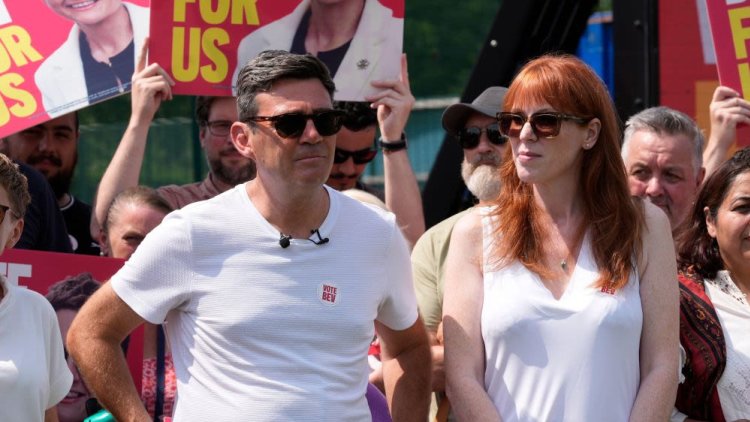
Andy Burnham will put Labour in a stronger position to win back voters it is at risk of losing to Zack Polanski’s Greens, new research for PoliticsHome has found.
The new nationwide survey, carried out late last month by the research organisation Thinks Insight & Strategy, also suggests that the prime minister-in-waiting will help shore up Labour’s right flank against Reform UK.
Ben Shimshon, co-founder and CEO of Thinks Insight & Strategy, said Burnham “definitely opens a window of opportunity” for Labour and “should give the party real hope”.
However, the findings also indicate that the public will expect Burnham to deliver change quickly after he enters Downing Street, which is expected to happen later this month.
The research is based on an online survey of 2,079 people between 24-25 June, alongside four focus groups with people who voted Labour at the 2024 general election but are now considering either the Greens or Nigel Farage’s Reform.
The fieldwork was conducted after both Burnham’s victory in the Makerfield by-election and Prime Minister Keir Starmer’s resignation announcement.
The results, shared exclusively with PoliticsHome, suggest that Burnham is currently well-placed to improve Labour’s electoral prospects as it tries to rebuild support ahead of the next general election.
Burnham will almost certainly replace Starmer in No 10 later this month after securing his return to the House of Commons in emphatic fashion in June.
Among those who voted Labour two years ago, a third (33 per cent) told the survey that a Burnham leadership made them more likely to vote for the party again next time around, while 12 per cent said it made them less likely.
The survey for PoliticsHome found that the former Greater Manchester mayor is particularly popular with 2024 Labour voters now considering the Greens, with 44 per cent of this group saying they were more likely to vote Labour with Burnham as leader.
This is higher than any other group of Labour 2024 voters now considering other parties.
Equal shares of 2024 Labour voters who are considering the Conservatives and Liberal Democrats (both 33 per cent) say they are likelier to vote Labour with Burnham as leader, as did 31 per cent of those now looking at Reform. Thirty-nine per cent of 2024 Labour voters who are currently considering Rupert Lowe’s Restore Britain said they were more likely to stick with Labour under Burnham, though this was based on a small sample.
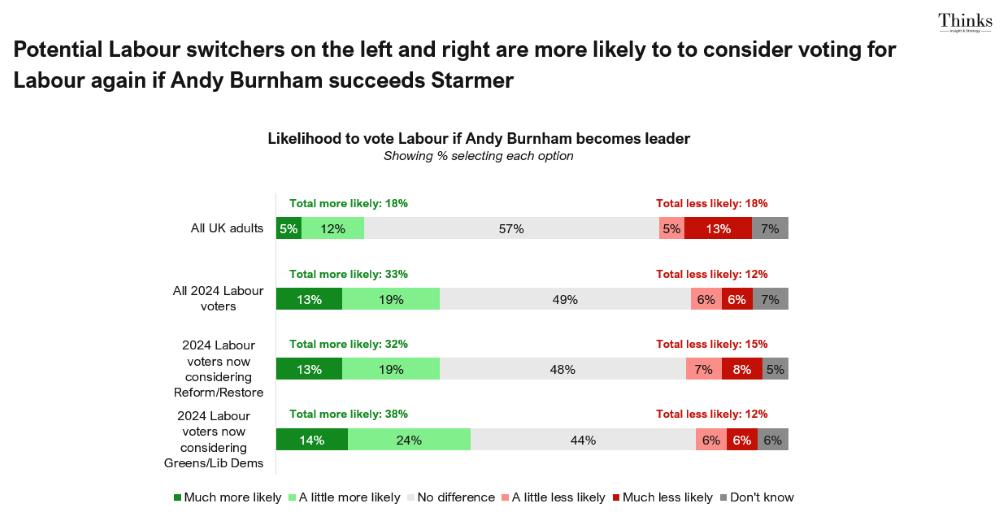
“For Labour, Burnham definitely opens a window of opportunity. Both 2024 Labour voters who are now considering Green, and, to a slightly lesser extent, those who are now considering Reform UK, are more likely than average to say that Keir Starmer’s replacement increases their chance of voting Labour. That should give the party real hope,” said Shimshon.
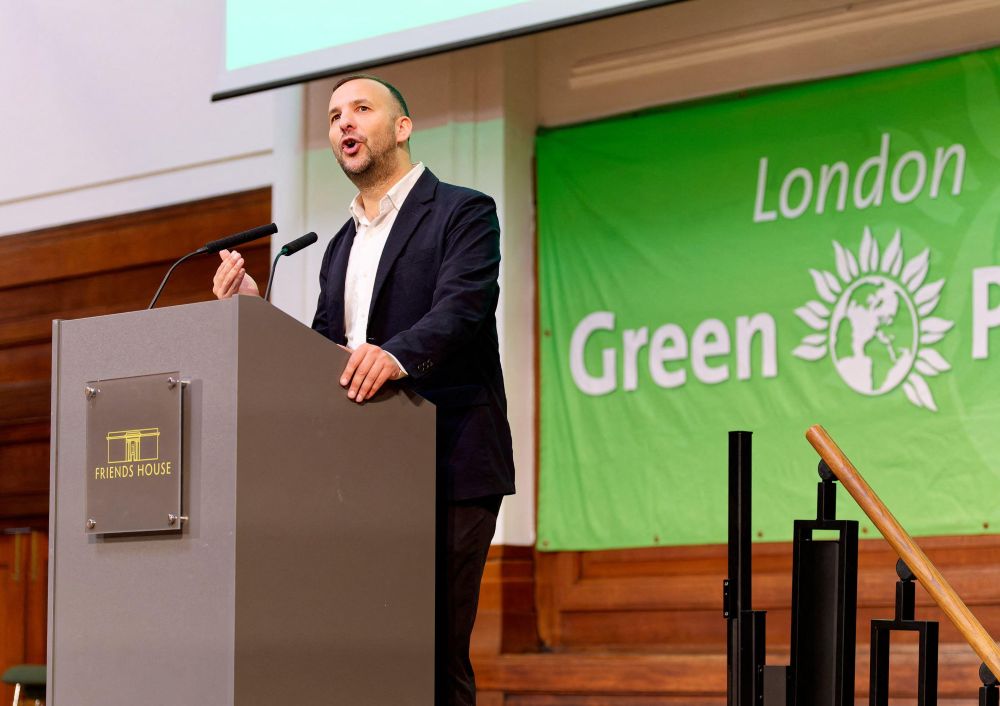
“But it also speaks to the tightrope Burnham needs to walk, as these voters have very different priorities, and want very different things from their government.”
He added: “Across the survey and in the focus groups, the hope is both low-definition and low-patience: voters don’t know much about ‘Andy’ – they like his vibes, his accent and his manner – but they’re not yet convinced he’s truly different.”
If, as expected, Burnham becomes the UK’s seventh PM in a decade later this month, he will be under pressure to deliver results quickly, the findings suggest.
Over half of respondents (54 per cent) said they would know within six months whether a new prime minister was doing a good job, and only 19 per cent said they would give them longer than that. Twelve per cent said they would know straight away. 2024 Green voters were the most patient, while Reform voters were the least patient.
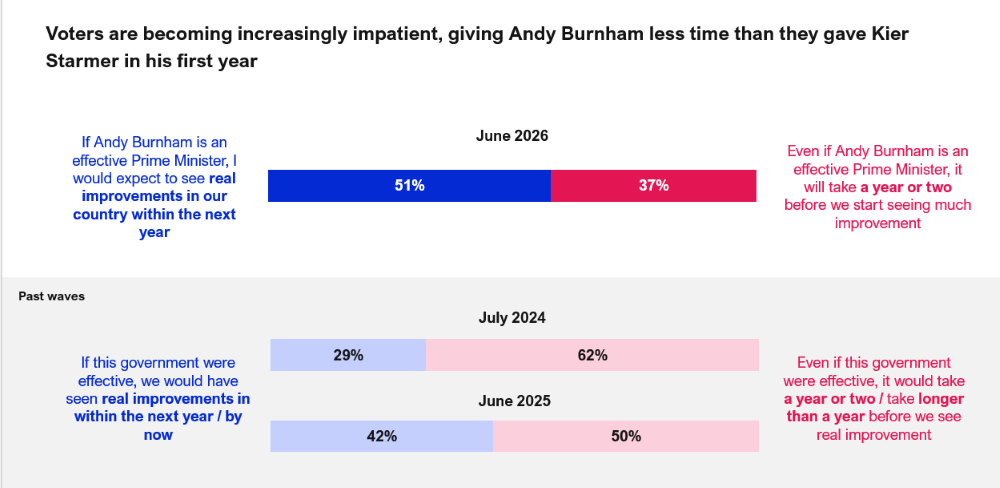
Just over half of respondents (51 per cent) said that if Burnham is effective as PM, they would see real improvements within a year of him entering office, while 37 per cent said it would take at least a year or two.
These results suggest that voters are willing to be less patient with Burnham than they were with Starmer when he first entered No 10 following Labour’s 2024 election victory.
In early July 2024, nearly two-thirds of people (62 per cent) told Thinks Insight & Strategy research for PoliticsHome that even if the Starmer administration was effective, “it will take a year or two before we start seeing improvement.”
On a Burnham premiership, Shimshon added: “The direction of travel needs to be clear within 12 months, and whatever it is, that direction needs to feel like change.”
Farage and Reform have called on Burnham to call a snap election after becoming PM, arguing that he will not have a proper mandate to govern.
Even some on Burnham’s own side have said he should go to the country. Alan Johnson, the former Labour cabinet minister, has said the incoming PM should call a snap election because the mandate he’ll soon inherit was “gifted to him” by Starmer.
On the question of whether Burnham should call a snap election after entering Downing Street, public opinion broadly breaks down along party lines.
Overall, around a third (34 per cent) of people said that a new PM should call a general election as soon as possible after taking office. This was particularly pronounced among 2024 Reform (68 per cent) and Conservative (52 per cent) voters, while just 20 per cent of 2024 Labour voters agreed.
Nearly half of respondents (46 per cent) said the new PM should be bound by the 2024 manifesto, while 35 per cent said they should be free to break from it.
However, the same proportion (46 per cent) told the survey that Burnham must deliver change, even if it means breaking some promises made two years ago.
“In the abstract, voters cleave to the idea that the ‘right and proper’ thing to do is to stick to the manifesto (even though very few among the electorate will ever have familiarised themselves with it),” said Shimshon.
“What this shows is that, when it comes down to it, most voters would trade that off against seeing the change they so badly want actually happen.”
>

Ronaldo’s final bow? One of the worst: Ranking every match at the 2026 World Cup

Inside the Minions & Monsters Box Office Stumble

Politics Home Article | Nigel Farage To Resign As MP And Fight By-Election

-

 Fashion9 years ago
These ’90s fashion trends are making a comeback in 2017
-
Fashion9 years ago
According to Dior Couture, this taboo fashion accessory is back
-
Fashion9 years ago
Model Jocelyn Chew’s Instagram is the best vacation you’ve ever had
-
Fashion9 years ago
Your comprehensive guide to this fall’s biggest trends
-
Fashion9 years ago
A photo diary of the nightlife scene from LA To Ibiza
-
Fashion9 years ago
9 Celebrities who have spoken out about being photoshopped
-
Fashion9 years ago
Emily Ratajkowski channels back-to-school style
-
Fashion9 years ago
The tremendous importance of owning a perfect piece of clothing
