
Politics
The House | Documentary Filmmaker Norma Percy On Boris Johnson, Mikhail Gorbachev And Slobodan Milošević


Credit BBC
7 min read
To document the story of Brexit a decade after the result, the BBC turned to an 84-year-old American. Ben Gartside meets Norma Percy, a battle-hardened veteran of powerful men and the lies – and occasional truths – they tell
Norma Percy only came to these shores because she lacked foreign languages. As a graduate student at Oberlin College in Ohio, she was sent as one of a select five given the chance to study abroad but, unlike the others, could only speak English. Her choices thus limited, she departed for Britain in 1963.
Percy was already fascinated by British politics. In Ohio, she would stand in the library and read about Harold Macmillan in The Economist. Upon arriving in the UK, she abandoned her fledgling academic career and PhD for a job in Parliament, working for John Mackintosh, a Scottish Labour MP considered one of the leading minds behind devolution.
“I had tried for a job in the House of Commons Library, but you had to be British and born British to work there. While I was still at LSE, I ran out of money and needed a job, and miraculously there was this ad in The Times that said a researcher was needed for a professor writing a book based in Parliament,” Percy recalls.
She remembers spending lots of her time trying to find MPs to take her into Strangers’ bar during all-night sittings. Life as a backbencher was “like being a child in a Victorian family”, she says: “You leaned over the banister and saw what the big guys were doing, and you hoped you’d grow up someday to be a government minister too.”
Before long, her grant money to work for Mackintosh had nearly run out and she was trying to find what to do next.
“I had got as far as looking in The Times Guide to the House of Commons to work out who was married, to pick out somebody to set my eyes on to marry, when Brian Lapping arrived and offered me this dream job in television.”
Lapping had been commissioned by Granada to make state-of-the-nation documentaries on Parliament, one of which was following the progression of a bill through the Commons. For the time, the documentary was unprecedented.
“We got permission to follow two clauses of a bill going through led by Geoffrey Howe, who was minister of consumer affairs and putting through a bill to protect the consumer,” she says.
“The concession we had to give is that they could view the film and make any suggestions they wanted for fact. Howe said, ‘Yes! There’s one thing I have to ask you to change and you’ll say it isn’t a fact, but I promised Elspeth I would stop smoking – and every cut away, there’s somebody smoking!’” His request was granted.
After leaving Granada with Lapping, Percy moved on to international documentaries and developed a trademark format: all the key players in the room interviewed, discussing on record what had happened. The format proved successful.
One of the first international documentaries Percy worked on was The Second Russian Revolution, which followed the collapse of communism and glasnost. The series had been shown secretly in Russia and was hugely popular – so popular, Mikhail Gorbachev himself asked to appear.
In 1995 came The Death of Yugoslavia, which won producer Percy a Bafta. The documentary ended up being cited numerous times at The Hague for incriminating statements Yugoslav politburo members had given while on the programme.
The biggest coup for Percy was securing an interview with Slobodan Milošević himself – far from media-friendly, even at this stage. Milošević was ultimately persuaded to appear on the programme first by David Owen, an old friend of Percy’s who was then leading the peace negotiations, and secondly by his wife Mira.
Mira Marković was a fearsome politician in her own right, with her own political party and influence. Angus Roxburgh, the former BBC and Sunday Times Moscow correspondent who worked on the documentary, played matchmaker. He told Percy that she and Mira had plenty in common; she recalls him saying that “these two socialist ladies would get on”.
When Milošević finally agreed to the interview, he pretended to be a staff member rather than himself over the phone. He spoke for close to an hour, she says, yet it was a struggle to find any truth in his claims. “Ethnic cleansing, moi?!” is how she sums up his attitude. And when at last he was on the record, he spent an hour talking without ever coming close to telling the truth on his role in efforts at ‘ethnic cleansing’.
Worse, Milošević’s team only agreed to the interview on the proviso that a full, uncut version of the tape was published as episode seven. Fortuitously, BBC Two had just moved to 24-hour programming and were desperate for any content whatsoever. The full uncut interview would be shown at 4am, to the frustration of an outfoxed Yugoslav government press office.
“The Second Russian Revolution was so popular, Mikhail Gorbachev himself asked to appear”
In spite of Milošević’s lies, the programme would be a success. Luckily for Percy, Borisav Jović, the former president of Yugoslavia, told the truth throughout, including when it came to Milošević’s role. Percy theorised that he was so honest because he was jealous of the acclaim Milošević received from Serb nationalists. She says similar behaviours were present in her new documentary on Brexit.
“I felt a bit like some of the people in Brexit revelled in what they would call their ‘clever strategy’ that won them the referendum. The fact that it took a lie to persuade people to vote for them is not all that different from Jović,” she says.
In Brexit: A Very British Civil War, Percy again gets all the key insiders in the room to discuss the referendum. The programme has a tightly focused frame, beginning at the 2015 general election and ending on 23 June 2016. Interviewees include David Cameron, Michael Gove and of course Boris Johnson, who Percy had already worked with extensively.
“I’d had three experiences with Boris. The first one was on Putin vs the West,” she says, “and he really was good. He went to the Foreign Office library and looked things up, and it was a really good interview.
“When we did a sequel, it was a bit short notice, but his office said yes right away, because they liked it. Boris turned up this time and said, ‘Oh, I’m really sorry, I meant to go to the Foreign Office library but I forgot.’ He sounded just like my husband when he forgot to collect the laundry.”
When Percy approached Johnson for the new Brexit documentary, she says his face lit up. “He said: ‘Now, that, I could really help you with.’ He promised us 90 minutes, and he gave us closer to three hours.”
Another star of the documentary was Marina Wheeler, Johnson’s ex-wife, who spoke factually and clearly throughout. Such was Wheeler’s recall of the period, Johnson told the crew to follow her version of events over his if there were any differences of opinion.
One person who couldn’t be secured, however, was Dominic Cummings.
“We tried everything,” Percy says. “We tried a lot of people who knew his wife.” When they finally got his number, she adds: “The first time we tried, he picked up and said, ‘I’m on top of a mountain! I can’t possibly talk to you now!’, which made us think he might agree when he came down. He said he wouldn’t do it, because everybody lies but him.”
She even enlisted Lord Gove, Cummings’ former boss, to persuade the former Vote Leave campaign director – but it was to no avail.
For Percy, the return to British politics means she has come full circle to nearly 60 years ago, when she worked as a parliamentary researcher. That said, she does not plan on stopping her work imminently.
“My mother retired when she was 87,” Percy says. “I’m now 84. I’ve got a few years left in me.”
Percy still loves politics, and interviewed Nigel Farage comms manager Andy Wigmore as part of the Brexit documentary, who she describes as a “hoot”.
“I have this controversial view of politicians: I think they’re reasonable people.”
>
Politics
Politics Home Article | Labour and Tories Refuse To Stand Candidates In Clacton By-Election


Nigel Farage resigns as the MP for Clacton, triggering a by-election. (Alamy)

2 min read
Labour, the Conservatives and Liberal Democrats all say they they will not stand candidates against Nigel Farage in Clacton by-election.
Farage has triggered a by-election in Clacton after resigning as MP in what he said would be “a people versus the establishment” contest.
The Reform leader is under investigation by the parliamentary authorities over allegations that he did not correctly report a £5m gift from crypto billionaire Christopher Harborne.
He is also facing an investigation over undeclared donations from close friend George Cottrell, who has been convicted of fraud in the US.
On the decision to not stand a candidate in the by-election, a Labour party spokesperson said: “Labour’s ruling body, the National Executive Committee, has decided not to stand a candidate in this circus.
Instead, Labour will remain focused on delivering for working people and holding Reform to account. Farage should let the parliamentary investigation into his finances run its course and face the consequences.”
Conservative leader Kemi Badenoch also confirmed that her party will not stand a candidate in the by-election.
“We will be standing a candidate in the real by-election, which will follow the standards investigation into Nigel Farage’s fishy finances. We will not be standing a candidate in the fake by-election that Farage is causing to distract people from what is happening.
The best thing for him to have done would have been to call a press conference and explain what he did with the money, apologise if needs be, and that would have been the end of it. Instead, he has been running away from scrutiny. No one is bigger than parliament. We all have to register our interests.
We, the Conservative Party, are very focused on uniting the country around sensible policies.”
The Liberal Democrats have also said they will not stand a candidate in the by-election. Party leader Ed Davey said: “If this by-election does go ahead now, we are calling on all parties to stand aside and refuse to give oxygen to Farage’s vanity project.”
Davey also went further in calling on the government to block the election until the parliamentary standard’s commissioner has finished his investigation.
“The people of Clacton should have all the facts before they cast their votes.”
>


9 min read
Nigel Farage has resigned as an MP, triggering a by-election in Clacton in which he says he will stand. How do the locals feel about him after his first stint? Harriet Symonds reports
“We don’t see [Nigel Farage], he doesn’t come here,” say a group of dog walkers on a blustery morning on the seafront in Clacton-on-Sea.
On Tuesday, Farage announced that he would resign as MP for Clacton and trigger a by-election in response to growing pressure over his financial backing. He insisted he has done nothing wrong, and described the by-election as “people versus the establishment”. Over the weekend, The Sunday Times revealed that Farage had failed to declare funding from George Cottrell, a convicted criminal involved in crypto gambling.
After the Reform UK leader was elected MP for Clacton in 2024, accusations that he was rarely present in the constituency became a familiar refrain. Farage has consistently dismissed such claims, arguing that the demands of leading a national political party inevitably limit the time he can spend locally compared with most MPs.
Speaking earlier this year, a spokesman for Farage told PoliticsHome: “There are 78,703 registered voters in Clacton. It would be impossible to meet every single one of them. Nigel’s visits are structured to ensure he visits and helps as many community groups, businesses, charities and constituents as possible.”
He does, however, live nearby. In late 2024, his partner, Laurie Ferrari, purchased a detached property in the area for £885,000. The house sits around seven miles up the road in Frinton-on-Sea — “the posh end,” as one Clacton resident describes it.
Last year, Farage denied accusations that he had avoided £44,000 in stamp duty by placing the property in his partner’s name, insisting she bought it with her own funds.
In Spring this year, PoliticsHome visited the constituency, where the MP’s absence was felt by several Clacton residents who told us they were uncertain whether Farage even held constituency surgeries. Nor, they said, were they sure if he had a constituency office at all.
The constituency office is discreetly located on Clacton seafront. Nearby is XO – Greek, a popular restaurant on the seafront owned by Jason Smedley. The restaurant hosted Farage’s election victory party in 2024, and Farage would drop in roughly once a month to catch up over “breakfast and a coffee”.
“The change has been phenomenal,” Smedley said. “Everyone hated him when he first came in, but now everyone is like ‘I love him’. If he’s in here, people flood in to see him and get a picture.”
He admitted he was initially reluctant to host events for Farage but now allowed the local Reform branch to hold meetings there as well.
Sources said that Reform did not want any branding outside the constituency office when it was set up. “At one point I had a big poster which I put in the door, which had got the Reform logo on it – that was taken away. They don’t really want it to be seen.”
Reform said the office location was kept a secret for security reasons. In 2024, Farage himself cited safety concerns when explaining why he did not hold open public meetings with constituents.
“Do I have an office in Clacton? Yes. Am I allowing the public to flow through the door with their knives in their pockets? No, no I’m not.”
Local government sources said the Reform leader did not hold traditional in-person surgeries, though they had heard of “invitation-only” meetings — including sessions with local business owners.
“Nigel has held surgeries online”, his spokesperson said.
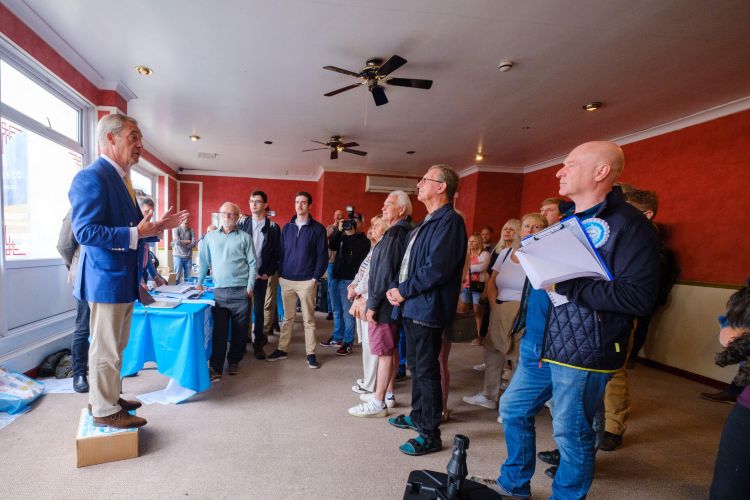
Farage’s social media showed he had visited a handful of local businesses in the constituency since 2024. The business surgeries held with the editor of the Clacton Gazette were also advertised on social media, the local newspaper and community groups online.
Unusually, when PoliticsHome visited his constituency in the Spring, Farage had the lowest total staff spend of all seven Reform MPs of £150,834.40. Farage has repeatedly insisted that his “personal MP expenses” are null.
According to the official staff register, Farage employed five staff to handle his parliamentary and constituency work. Sources familiar with the set-up said Farage’s parliamentary team in London handled his constituency casework, but there was one full-time caseworker based full-time in the constituency.
“Most of it is done by letter and email to be honest,” they said.
Still, some residents said accessing the MP remained difficult.
A local councillor told PoliticsHome they had occasionally taken on casework on Farage’s behalf. “People in my ward have brought issues to me because they’ve not been able to contact the MP,” they said.
“I wouldn’t know where to contact Nigel Farage,” said Vanessa, who had lived in Clacton for six years and had regular contact with the previous MP, Giles Watling.
Watling himself said constituents still occasionally approached him with problems. “People do feel slightly abandoned,” he said. “If it’s being managed at all, it’s being managed at arm’s length.”
Clacton itself presents the familiar paradox of England’s struggling coastal towns: picturesque seafronts and chronic economic malaise. Once a bustling holiday resort, the town now faces entrenched deprivation, high economic inactivity and a declining high street.
Official figures show that parts of nearby Jaywick — within Farage’s constituency — have been ranked the most deprived neighbourhood in England for four consecutive deprivation indices since 2010.
Economic activity in the wider Clacton constituency is significantly below the national average: roughly 60 per cent of working-age adults are economically active, compared with around 78 per cent across the UK.
The constituency is also unusually old. Nearly a third of residents are aged over 65, giving the area one of the oldest demographic profiles in England. Younger people often leave for work elsewhere, while retirees move in from London and the Home Counties.
These conditions have made it unusually receptive to anti-establishment politics. In 2014 the constituency elected Britain’s first UKIP MP when Douglas Carswell defected from the Conservatives and won the resulting by-election. Two years later nearly 72 per cent of voters backed Brexit.
Earlier this year, PoliticsHome did not have to walk far through the town to spot a Union Jack or St George’s flag cable-tied to a lamppost.
“The town looks more scruffy since he’s been an MP”, remarked Vanessa, who moved to Clacton six years ago. “Since [Farage] has been around here, you’re getting more shops being vacant”.
“My daughter is thinking of closing her shop now – she only phoned me yesterday to say I’m thinking of giving it up,” said Janet, another Clacton resident.
Along the high street, empty shopfronts sit beside amusement arcades and fast-food outlets. The town’s landmark pier — refurbished in recent years — remains one of the few clear signs of investment.
“It was on its way there anyway – but I thought [Farage] coming here would have livened it up”, added another resident.
.jpg)
Rachel Goldsmith, who runs the Old Market Café on the high street, said small businesses were struggling to stay afloat.
“It’s a struggle because everything has doubled,” she says. “I counted the other day, and there’s about 13 empty shops here.”
“Our main post office closed down — it’s now flats.”
Some locals complained that the only new businesses opening are nail bars and barber shops — an issue Reform UK has itself highlighted, claiming many such premises are fronts for money laundering and organised crime.
Farage was also known to frequent The Three Jays pub in Jaywick, described by locals as “his favourite pub”, a short drive from Clacton town centre.
“He’s always in the Three Jays having a drink,” chuckles one constituent.
Inside the pub, GB News played on the main television. Above the bar hangs a sign that reads: “Let’s keep the dumbfuckery to a minimum today.”
Union Jack flags hang in the windows, and the building itself is painted in a shade locals jokingly describe as “Reform blue”.
“That’s no coincidence,” said Rob, a regular who moved to Clacton more than 30 years ago and says he has watched the town steadily deteriorate.
Among the pub’s regulars there was little hesitation in expressing support for Farage. Immigration, empty high streets and a sense of national decline dominate conversation. Many saw the Reform leader as one of the few politicians willing to articulate their frustrations.
Yet some pointed out that the town’s current regeneration projects — including government-funded schemes intended to revive struggling high streets — have little to do with their MP.
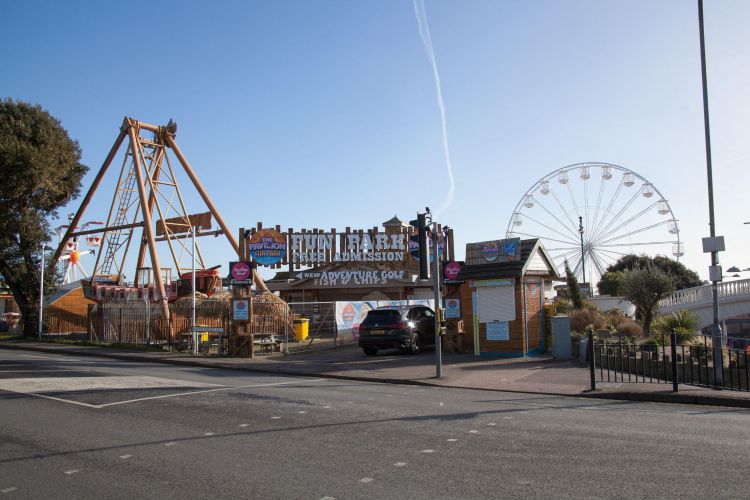
The town has been earmarked for £20m through the government’s “Pride of Place” regeneration funding programme, designed to support a ten-year redevelopment strategy.
A Clacton Town Board was established to oversee the initiative. But Farage — who sits on the board — has not attended any meetings since its creation, according to records, occasionally sending a staff member (George Ivil) in his place.
A spokesperson for Farage said: “Nigel has had a private briefing about the town board from council chief executive Ian Davidson, Council leader Mark Stephenson and the chair of the Clacton town board George Kieffer. He is well briefed on everything that is happening and fully supportive of the Love Clacton campaign.”
However, the complaints about abandonment were a common refrain. “The only time you ever sort of see him is if there’s a photo opportunity,” added another local resident.
Speaking back in the Spring, a spokesperson for Nigel Farage told PoliticsHome: “Nigel Farage is an active Member of Parliament for Clacton and is currently in the constituency as this article is being published.”
They pointed out that he made regular personal donations to charities and good causes, wrote a weekly column for the local newspaper and was the only MP to have ever held a business surgery in the constituency. They also stressed that MRP polls published since the last general election predicted an increased majority for Reform in Clacton.
But the words of some local politicians suggest he’ll be in for a tougher battle this time round than before.
“His excuse always seems to be that he’s the leader of the national party, so therefore he can’t be in the constituency all the time,” said one local councillor.
“But a lot of the time he’s not even in the country.”
>


Nigel Farage speaking at a press conference in 2025 (Thomas Krych/Alamy)
2 min read
Nigel Farage has announced that he is resigning as the Reform MP for Clacton and will fight the by-election that follows.
Speaking on Tuesday afternoon, Farage said the contest would be a “people versus the establishment by-election” that would take place “in short order”.
“It’s a chance to stick two fingers up to the entire establishment, to frankly tell them where to go, and that is why I will be putting my name forward to stand in this by-election. I will fight to win. I will fight to continue the political revolution that Reform UK has started,” the Reform leader declared.
Farage added that the “people of Clacton” would then be “the judges” of his actions, amid increasing pressure on him over recent weeks due to a series of reports about his financial backing before he became an MP.
Over the weekend, The Sunday Times revealed that Farage had failed to declare funding from convicted fraudster George Cottrell.
Farage is also being investigated by the parliamentary standards watchdog after he received £5m from crypto-billionaire Christopher Harborne just weeks before announcing his intention to run in the 2024 general election.
The parliamentary standards commissioner, Daniel Greenberg, is expected to publish his findings before the end of next week.
If Farage is found to have seriously breached the code of conduct, consequences could include suspension from the Commons and a recall petition leading to a potential by-election.
This is a developing story…
>

Joey Cora out as Tigers third-base coach amid ‘philosophical differences’

Pistons trade Caris LeVert to Bucks for Taurean Prince and Gary Harris: Sources

Khris Middleton to rejoin Wizards as part of 6-team trade: Source

-

 Fashion9 years ago
These ’90s fashion trends are making a comeback in 2017
-
Fashion9 years ago
According to Dior Couture, this taboo fashion accessory is back
-
Fashion9 years ago
Model Jocelyn Chew’s Instagram is the best vacation you’ve ever had
-
Fashion9 years ago
Your comprehensive guide to this fall’s biggest trends
-
Fashion9 years ago
A photo diary of the nightlife scene from LA To Ibiza
-
Fashion9 years ago
9 Celebrities who have spoken out about being photoshopped
-
Fashion9 years ago
Emily Ratajkowski channels back-to-school style
-
Fashion9 years ago
The tremendous importance of owning a perfect piece of clothing
