
Anime
Anime Has Left the Building (And Moved Into Yours) – Answerman


ConfusedConfucius asks:
“Now that anime is becoming almost ubiquitous at a global level, what are some of the ways it is seeping into the popular consciousness in ways that were never intended?”
You are right. Anime is flipping everywhere if you move through life with your eyes and ears open. This is not going to be your usual “anime is mainstream now” think-piece; I’ll leave that to whoever is the current head of Crunchyroll Audience Development to post on LinkedIn this week. Yeah, yeah, yeah! Demon Slayer broke box office records, and Beyoncé’s Met Gala gown this year was constituted of all 27 volumes of Ai Yazawa‘s Nana, lovingly handstitched one page at a time.
What I want to focus on is the weird, sideways, nobody-planned-this stuff way anime has infiltrated the mainstream. The moments where anime aesthetics and storytelling grammar slip out of the fandom bubble entirely and start running the show in places its creators never once imagined it would end up.
Exhibit A: the football pitch – mankind’s most favourite shonen tournament arc
I love football. You call it soccer in the United States. That’s fine. I promise I won’t make fun of you for it. Football and anime go together like Milli and Vanilli, and in this USA/Canada/Mexico-hosted FIFA World Cup year, we are clearly seeing the two enjoy their big glow-up moment. It shouldn’t come as a surprise. They have been making football manga and anime since the 1970s.
But before adidas launched its own anime-inspired creative, something fun and truly authentic was happening on the pitch at two of the world’s biggest football leagues. Across the English Premier League and Italian La Liga, strikers have quietly turned goal celebrations into an anime cinematic universe. Antoine Griezmann does Luffy’s Gear 2 pose. Dominic Solanke has built an entire celebration portfolio around Attack on Titan‘s hand-bite salute, Goku’s Spirit Bomb, and – this is the one that got me – Sukuna’s Domain Expansion from Jujutsu Kaisen. Ibrahima Konaté did the Survey Corps chest-salute after scoring against Manchester City. A Barcelona teenager’s first senior goal was marked with Sasuke’s Chidori hand-seal.
Nobody at Studio MAPPA or Toei sat down and said, “Let’s design a marketing pipeline into elite football.” This is pure bottom-up cultural infection; twenty-something professional athletes who grew up watching this stuff on Crunchyroll are now the ones setting the visual language for how sporting triumph gets performed, live, in front of tens of millions of people who’ve never watched an episode of anything. The NFL‘s got its own version too, apparently. Dragon Ball Z touchdown celebrations are a whole subgenre now. Somewhere, a Toei licensing executive should be having palpitations that they didn’t trademark the Kamehameha pose for merchandising.
Exhibit B: your gym bro’s breakup is now a “narrative arc”
Here’s the one that actually fascinates me structurally. Anime hasn’t just exported imagery; it has also exported narrative architecture, and that architecture has become the default framework ordinary people use to describe their own lives. Terms like “Villain arc,” “Final boss energy,” and “Main character energy.” These aren’t fandom in-jokes anymore; they’re load-bearing vocabulary for how Gen Z (and increasingly Millennials trying to keep up) narrate their own emotional lives. Someone goes through a bad breakup, hits the gym, cuts off their ex’s friend group, etc. It’s no longer simply “processing grief,” but has instead become a “villain arc.” A tough presentation at work isn’t a challenge anymore; it’s a “final boss.” The entire shonen structural unit: the arc, the training montage, the power-up, the antagonist you have to overcome to level up. It has become the operating system for how a generation talks about becoming a better version of themselves. We are all living in our own power-level fantasy.
I find it mind-blowing, to be honest with you. Zooming out and surveying the early 21st Century vernacular to discover that serialised Japanese storytelling structure, designed to keep 12-year-olds buying Shonen Jump week to week, has become the default emotional-literacy framework for people who’ve possibly never picked up a manga volume in their life. That’s not just fandom, bro! We are talking about linguistic colonisation, and it happened so quietly that nobody noticed the flag going up.
Exhibit C: high fashion, still not over it
We all know UNIQLO UT sells out every Dragon Ball and Evangelion drop, but the bit that still delights me is watching genuinely elite fashion houses like Louis Vuitton building entire couture concepts around Rei Ayanami’s colour palette, and Gucci putting NERV insignia energy on a runway. Jun Takahashi, the founder and creative director of the Japanese streetwear and high-fashion label UNDERCOVER, treats a 1995 psychological mecha show about a depressed teenager as a legitimate aesthetic reference point, the same way they’d cite Bauhaus or Memphis Design. Hideaki Anno was making an anxious, deeply personal show about his own depression. He was not, I promise you, thinking about how Angel-motif silhouettes would read on a Milan runway three decades later. And here we are!
Exhibit D: the emotional register itself
The one I find genuinely moving, if I can be unfashionably sincere for a paragraph, is how anime’s specific emotional grammar, unguarded, unironic, full-volume sincerity about grief, ambition, loneliness, and connection, has become acceptable in Western media in ways that would have gotten laughed out of a writers’ room fifteen years ago. Western drama had to learn, via anime, that you’re allowed to let a character cry for an uncomfortably long time, or deliver a speech about friendship with zero ironic distance, and audiences will not just tolerate it, they’ll clip it and post it with a crying emoji. That shift in permission, the idea that big, sincere feeling isn’t automatically cringe, didn’t come from prestige TV. It came from thousands of hours of shonen finales normalising catharsis without a safety net of sarcasm.
None of this was planned by anyone in Roppongi or Kyoto. It’s just what happens when a storytelling tradition gets big enough: it stops being a genre and starts being a vocabulary, one that shows up on a football pitch, in a gym bro’s Instagram caption, and on a Paris runway, all without anyone filing the appropriate paperwork.
Do YOU have a question for the Answerman?
We’d love to answer your questions and especially encourage questions inspired by recent news and headlines.
However, READ THIS FIRST:
● CHECK THE ARCHIVES. Over the years, we’ve answered THOUSANDS of questions and might have already answered yours!
● We cannot tell you if or when a show will get another season, nor can we help you get in touch with any producers, artists, creators, actors, or licensors.
● Only submit your question once.
● We take questions by email only. (Tweeted questions get ignored!)
● Please keep your questions within a paragraph length.
●The email address is [email protected].
Thank you!
>

The official website for Yōhei Kameyama‘s Milky☆Subway: The Galactic Limited Express (Ginga Tokkyū Milky☆Subway) anime announced on July 3 a new short anime titled “Milky☆Byway Spring Special: Terror on Chelovin’s Day” (“Milky☆Byway Spring Special: Kyōfu no Chelovin Party”). More details about the short anime will be revealed at a later date.

©亀山陽平/タイタン工業

©亀山陽平/タイタン工業
Ginga Tokkyū Milky☆Subway Kakueki Teisha Gekijō Iki (Milky☆Subway: The Galactic Limited Express: Local Train to the Theater), the re-edited film for Milky☆Subway: The Galactic Limited Express (Ginga Tokkyū Milky☆Subway) anime, opened in Japan on February 6. It sold 109,500 tickets and earned 151,305,440 yen (about US$988,200) in its first three days. Netflix started streaming the film on June 1.
The film is a re-edited version of the anime’s 12 episodes with additional new content.
A new version of the film with added scenes started screening in Japan on June 12. The film’s new version is titled Rinji Zōhatsu Milky☆Subway Kakueki Teisha Gekijō Iki (Extra Service Milky☆Subway Local Train to the Theater and screened in MX4D, 4DX, and 2D formats.
Momoka Terasawa and Anna Nagase returned for the film as Chiharu and Makina, respectively. The anime’s additional cast also reprised their roles in the film. Yōhei Kameyama once again directed, wrote, and produced the sequel, and he also handled the character designs, modeling, animation, editing, and other duties mostly himself. Bit Grooove Promotion is credited as the film’s sound company.
The anime premiered in July 2025 on the Tokyo MX channel and simultaneously streamed on YouTube. The anime’s dubbed versions in English, Portuguese, Spanish, Korean, Chinese, Thai, Indonesian, French, Hindi and Russian, also streamed on YouTube.
The anime’s English website describes the story:
Super human Chiharu and cyborg Makina got arrested for breaking space traffic laws. They’re stuck with a crew of misfits who got caught around the same time: Akane and Kanata, the super human pair; and Kurt and Max, the cyborg pals. Ryoko, the police officer, sentenced them to clean up the interplanetary train – the so-called “Milky☆Subway,” as their community service.
It should’ve been a simple job – until the train suddenly takes off into deep space! The crew scrambles in confusion as chaos unfolds onboard!
No purpose! No principle! No point!
A never-before-seen space-train spectacle, powered by nothing but pure momentum!
The anime’s theme song is “Ginkagei Made Tonde Ike!” (Fly to the Galaxy!), the 1977 song by the girl group Candies.
Kameyama released the original Milky☆Highway short in 2022 as his graduation project for Kadokawa‘s Vantan Game Academy CG Animator major. The English-subtitled version and the original version have 6.75 million views combined.
Mizuki Fumitsuki voiced Chiharu in the original short, while Kana Kobayashi voiced Makina.
Sources: Milky☆Subway: The Galactic Limited Express anime’s website, Anime Hack
Disclosure: Kadokawa World Entertainment (KWE), a wholly owned subsidiary of Kadokawa Corporation, is the majority owner of Anime News Network, LLC. One or more of the companies mentioned in this article are part of the Kadokawa Group of Companies.
>

Bocchiboromaru to perform “Romantic ga Hoshii nara” with 3 Hinatazaka46 members
The staff for the second television anime season based on Yūsei Matsui‘s The Elusive Samurai (Nigejōzu no Wakagimi) manga announced on Friday that Bocchiboromaru will perform the theme song “Romantic ga Hoshii nara” (If You Wish for Romance) with three guest vocalists from idol group Hinatazaka46. The official X (formerly Twitter) account for the anime shared a video of Bocchiboromaru:

© 松井優征/集英社・逃げ上手の若君製作委員会
The new season will begin airing on July 17 at 11:30 p.m. (10:30 a.m. EDT) on the Fuji TV network, and it will also run on AT-X. Prime Video will stream the series.
Asaki Yuikawa stars as Hojo Tokiyuki and Yūichi Nakamura as Suwa Yorishige.
The cast includes:
Yuta Yamazaki (assistant director for Wonder Egg Priority, series director for both Love Rice series) returns to direct for season 2 at CloverWorks, and Yasushi Nishiya also returns (chief animation director for Pokémon the Movie: The Power of Us, Pokémon the Movie: I Choose You!) to design the characters and assume the new role of chief animation director. Shinnosuke Ōta serves as animation director, while GEMBI and Akiyuki Tateyama compose the music.
The anime’s first season re-aired on Fuji TV‘s Noitamina programming block in April 2026, before the second season’s debut on the same programming block.
The anime’s first season premiered in July 2024. Crunchyroll streamed the anime as it aired, and is also streaming an English dub.
Viz Media and MANGA Plus both simultaneously released new chapters of the manga in English digitally as they debuted in Japan.
Viz Media is also releasing the manga in print, and the company describes the first volume:
After the massacre of his family by the traitor Ashikaga Takauji, Tokiyuki flees with the help of a handful of loyal retainers who have also survived the purge. One of them is Suwa Yorishige, an ally of the Hojo clan and lord of Suwa Province. The slightly odd Yorishige also claims to be clairvoyant and foretells that Tokiyuki will one day become the ruler of Japan. But for the moment, escaping from enemy territory is the priority!
Matsui (Majin Tantei Nōgami Neuro, Assassination Classroom) launched the manga in Weekly Shonen Jump in January 2021, and ended it on February 16. The manga won at the 69th Shogakukan Manga Awards in 2024.
Sources: The Elusive Samurai anime’s X/Twitter account and website, Anime Eiga
>
Anime
‘Tetsuryou! Meet with Tetsudou Musume’ Unveils Supporting Cast, Staff, Ending Theme, Second Promo

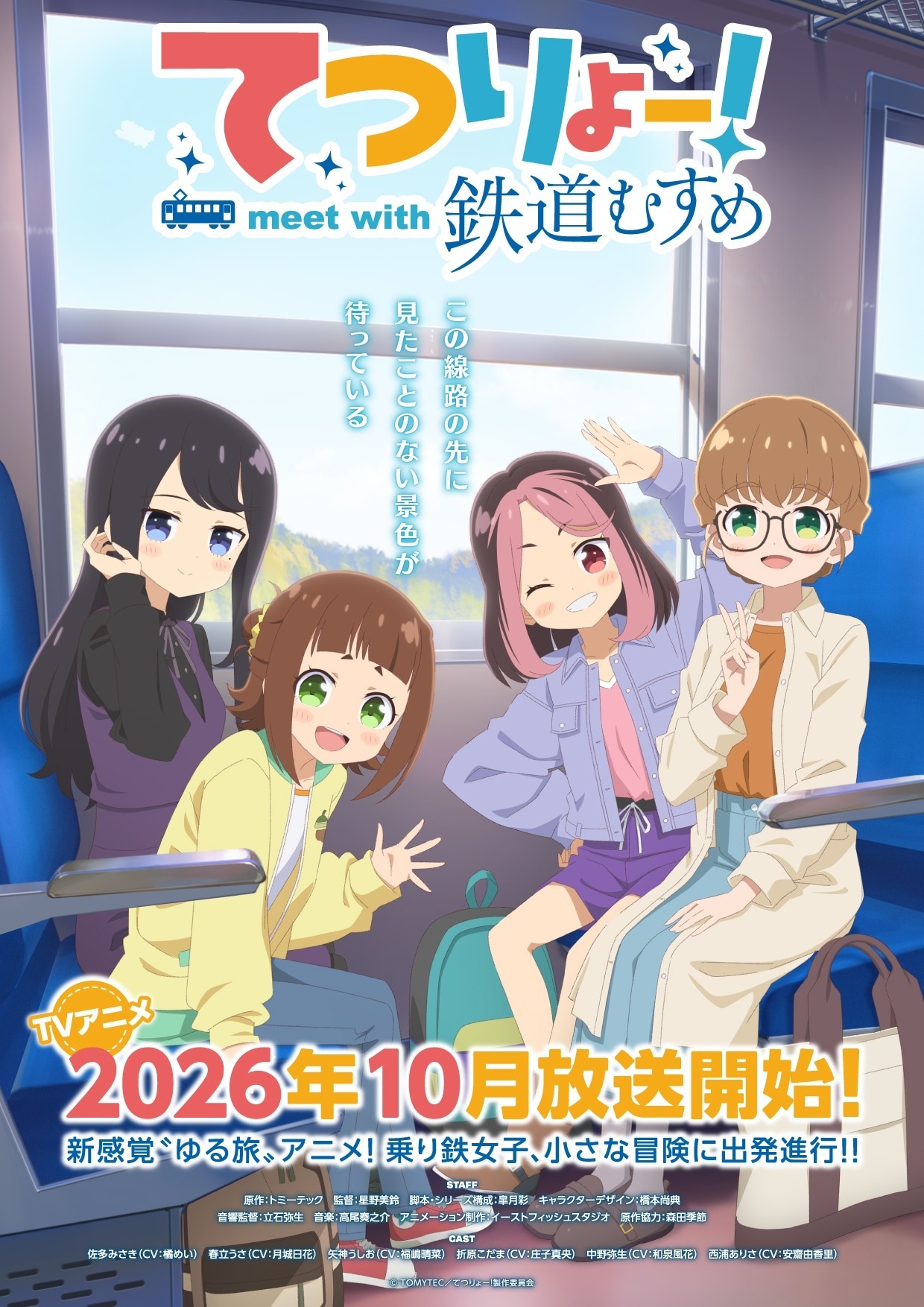 The official website of the Tetsuryou! Meet with Tetsudou Musume (Tetsuryo! Meet with Railroad Girls) television anime revealed supporting cast, staff, ending theme, key visual (pictured), and the second promotional video on Monday. The original anime is scheduled to premiere in October 2026.
Cast
Sakie Ashio: Asami Seto (Shoushimin Series)
Chihaya Asakura: Yuki Nakashima (Hitoribocchi no Isekai Kouryaku)
Shiina Igusa: Hana Hishikawa (Uruwashi no Yoi no Tsuki)
Juri Ookuwa: Ayaka Ohashi (VTuber Nandaga Haishin Kiri Wasuretara Densetsu ni Natteta)
Shia Kasukabe: Hikaru Tono (Chanto Suenai Kyuuketsuki-chan)
Misha Kamii: Yuuki Tenma (Turkey!)
Ibuki Kawagoe: Yurika Kubo (Shikanoko Nokonoko Koshitantan)
Miyabi Kinugawa: Misaki Kuno (Kanan-sama wa Akumade Choroi)
Akana Kurihashi: Mana Kumasaki
Misaki Koujiro: Minami Takahashi (Atri: My Dear Moments)
Minano Sakurazawa: Haruki Iwata (Edens Zero 2nd Season)
Konomi Shibaguchi: Nene Hieda (Kirio Fanclub)
Azami Takashima: Iori Saeki (Egao no Taenai Shokuba desu.)
Izumi Tachikawa: Misa Segawa (Maou no Musume wa Yasashisugiru!!)
Tsukushi Togawa: Suzuka Hara (Kirei ni Shitemoraemasu ka.)
Karen Matsukaze: Kana Ichinose (Witch Watch)
Kinu Watase: Shiori Mikami (Rock wa Lady no Tashinami deshite)
Yayoi Tateishi (Yano-kun no Futsuu no Hibi) is serving as the sound director, while Sounosuke Takao (Haibara-kun no Tsuyokute Seishun New Game) is composing the music.
Tetsuryou Club members May Tachibana (Mahou no Shimai Lulutto Lilly), Hika Tsukishiro, Mao Shouji, and Haruna Fukushima perform the ending theme “Watashi Miraisen,” which is previewed in the promotional video below.
Misuzu Hoshino (Dosanko Gal wa Namara Menkoi) is helming the anime at East Fish Studio. Aya Satsuki (Ojou to Banken-kun) is handling the series composition and script. Hisanori Hashimoto (Tokyo Revengers animation director) is designing the characters.
PV2
Source: Comic Natalie
>

Milky☆Subway: The Galactic Limited Express Anime Gets New Short Anime – News

Chelsea: Xabi Alonso says ‘timings’ took him to Chelsea over Liverpool
Meta Removes Muse Image Instagram Feature After Consent Backlash
-

 Fashion9 years ago
These ’90s fashion trends are making a comeback in 2017
-
Fashion9 years ago
According to Dior Couture, this taboo fashion accessory is back
-
Fashion9 years ago
Model Jocelyn Chew’s Instagram is the best vacation you’ve ever had
-
Fashion9 years ago
Your comprehensive guide to this fall’s biggest trends
-
Fashion9 years ago
A photo diary of the nightlife scene from LA To Ibiza
-
Fashion9 years ago
9 Celebrities who have spoken out about being photoshopped
-
Fashion9 years ago
Emily Ratajkowski channels back-to-school style
-

 Tech3 months ago
OpenAI CEO apologizes to Tumbler Ridge community