
Sports
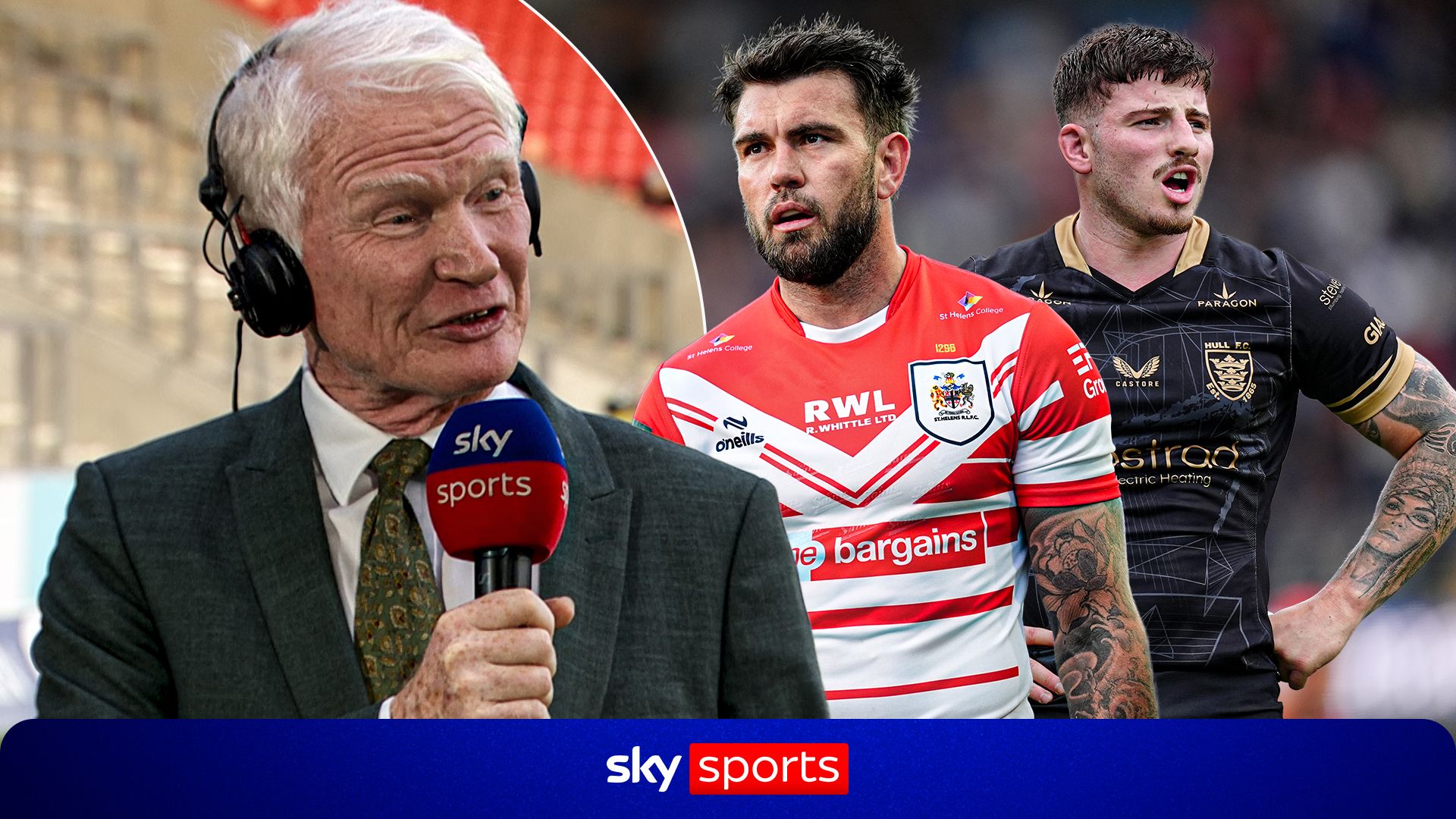
St Helens chairman McManus announces Dublin Super League clash with Hull FC


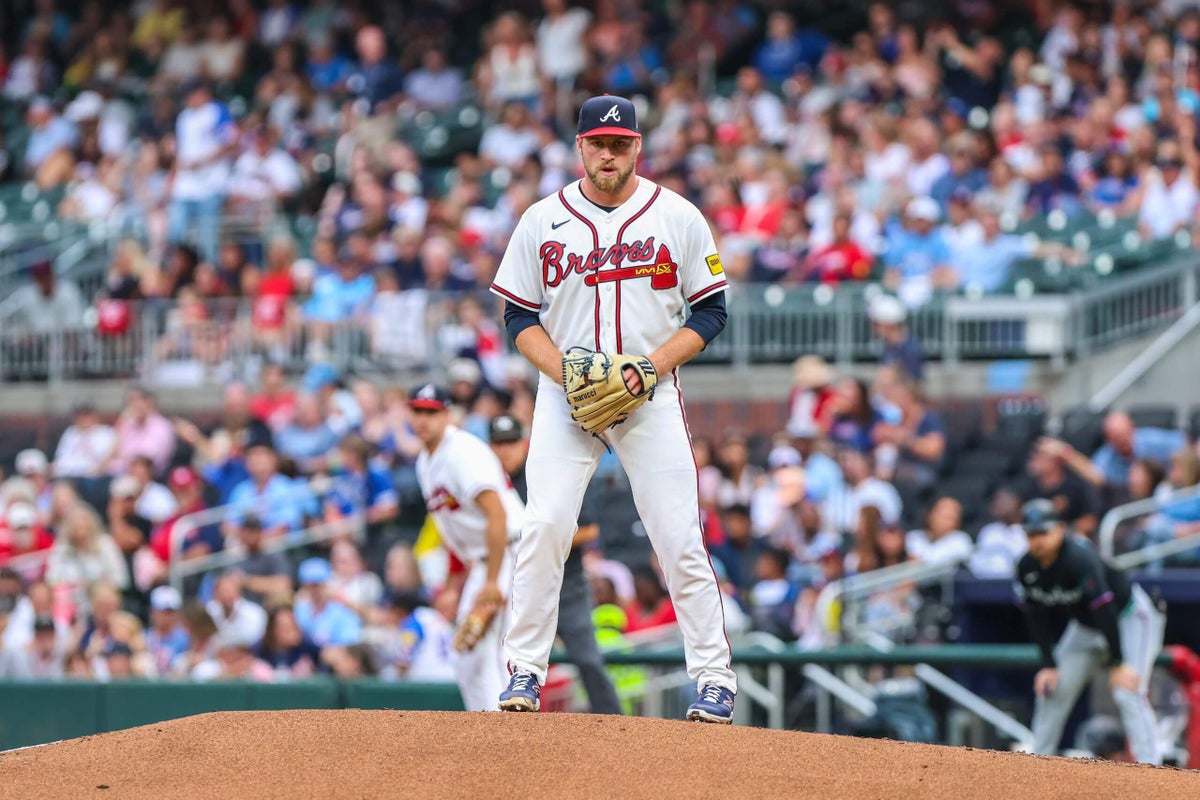
Emotions surrounding the Atlanta Braves’ approach before Monday’s trade deadline remain raw.
Rightfully so. Fans have wanted Atlanta to add another starter to slot in behind ace Chris Sale since the offseason. The need for another piece in the rotation seemingly became more pressing after injuries sidelined additional pitchers.
The Braves, however, were the best team in baseball through the first two months of the season. Even after a rough June and injuries to key members of the lineup, they entered Friday with the second-best record in the majors at 70-45 and an 8 1/2-game division lead over the Philadelphia Phillies.
The Braves are in the midst of an eight-game winning streak and are 15-5 since the All-Star break. The pre-deadline rotation is again a major reason for their success. Ahead of Atlanta’s series opener against the New York Yankees on the road, starters had a combined 2.69 ERA in the second half, the best in the National League.
As a result, the Braves didn’t feel a need to mortgage the future for rentals at the trade deadline. Here is what went into the decision-making, according to a team source who spoke on condition of anonymity for their candor.
How the Braves approached the rotation
Tarik Skubal was at the top of Atlanta’s wish list, and the Braves aggressively pursued him. The Athletic’s Ken Rosenthal reported Friday morning that the Tigers prioritized receiving the greatest overall value in a trade. The Braves were prepared to part with virtually any prospect discussed. As discussions went on, though, Atlanta got the impression the Detroit Tigers were focused on Los Angeles Dodgers outfield prospect Zyhir Hope. The Tigers got him as well as pitchers River Ryan and Brady Smith.
The Braves also went after Texas Rangers ace Jacob deGrom. They had a deal framework in place, but contrary to rumors, it did not include Spencer Strider, the source said. In addition, Rosenthal reported that Atlanta was involved in discussions for right-hander José Soriano and other starters.
The Braves only added Tyler Mahle, whom they were interested in signing before he signed with the Texas Rangers ahead of the 2024 season. Atlanta found the cost — righty Anthony Molina, who had a 3.64 ERA in 54 1/3 innings in Triple A — reasonable for a pitcher it believes can be part of the rotation beyond this season.
It’s fair to question why the Braves didn’t make offers for Casey Mize or Robbie Ray, the two starters acquired by the San Diego Padres, who are on the edges of the NL wild-card race. The Braves had the prospect capital to trade for either. For Mize, the Padres sent their top pitching prospect, Kash Mayfield, and Jackson Wolf, a 2021 fourth-rounder. For Ray, they sent right-hander Miguel Mendez, a top-five prospect, as well as Joniel Hernandez, a 17-year-old shortstop who signed for $1.4 million as an international amateur free agent in January.
Adding either pitcher could have given Atlanta a formidable option behind Chris Sale in the postseason.
But neither Mize nor Ray is perfect. Mize has battled injuries throughout his career, and his velocity dipped in July, reducing some of the swing-and-miss qualities that made him so intriguing. Ray, meanwhile, isn’t the overpowering lefty who won the 2021 American League Cy Young Award. His strikeout rate dropped seven percentage points to 20.9 percent this season compared to last year’s.
The philosophy behind keeping Ha-Seong Kim
Ha-Seong Kim may be enduring the worst season of his career, but the Braves never seriously discussed moving on from him.
Roster decisions extend beyond present-day production. For one thing, his $20 million salary isn’t movable. Also, the Braves still trust in Kim’s track record and value his defensive versatility.
The crunch on the roster — Kim’s return from the injured list coincided with catcher Sean Murphy’s, and the Braves needed to make roster space for Lane Thomas — led to the Braves designating Jorge Mateo for assignment and trading speedster Eli White to the Boston Red Sox.
In moving on from Mateo and White, ranked as the third- and fourth-fastest players in the majors, the Braves sacrificed speed that could have come in handy in the playoffs. But the club has found success adding speed to the roster late in the calendar before, as it did with Terrance Gore on its way to the 2021 World Series. When rosters expand to 28 players in September, Atlanta should have options in the minor leagues in DaShawn Keirsey Jr. (35 stolen bases), Brewer Hicklen (27) and Luke Williams (27).
On the brighter side …
Perhaps the positive to take from the Braves’ approach was that they managed to hold on to the top prospects in their farm system. They believe outfielder Eric Hartman, left-hander Cam Caminiti and infielder Tate Southisene will play significant roles for Atlanta in the future.
Of the players they parted with — right-handers Lucas Braun and Molina, left-hander Connor Holton and third baseman Nacho Alvarez Jr. — none appeared as likely to have a dramatic impact on the organization’s future.
Of course, it’s fair to question the decision to not dip deeper into the farm system, since there is so much uncertainty before prospects reach the majors. But keeping the present system largely intact should give Atlanta more room to pursue better options down the road.
What else to know
• The Braves acquired Thomas, an impending free agent, from the Kansas City Royals to bolster the lineup against left-handed pitching, but they explored a longer-term plan in the outfield. Adding Angels outfielder Jo Adell, who ultimately landed in Cleveland, was on the table. He has more raw power and arguably a higher offensive ceiling. Thomas, however, fit the platoon role the Braves wanted to fill.
• Bullpen help may be on the way sooner than expected. Although a timeline hasn’t been set for reliever Robert Suarez’s return, Reynaldo López has begun light throwing activity since going on the IL with knee inflammation over the weekend.
• As the Braves rattled off wins in the last week, they began to see signs of life from struggling third baseman Austin Riley. He had five RBIs and eight hits in his last 17 at-bats before going 0-for-3 in Thursday’s rain-delayed 11-3 win.
>

The Bounce Newsletter  | This is The Athletic’s daily NBA newsletter. Sign up here to receive The Bounce directly in your inbox.
Here’s the perfect way to start your day: a 17-minute YouTube video called “50 plays from the ’80s that would break the internet today.” Enjoy!
Block or charge?
Let’s examine this confusing NBA rule
It’s the offseason, so it feels like a perfect opportunity to empty my notebook. Today, I want to examine the charge/block rule. It’s one of the most ambiguous and frustrating calls in the NBA. A charge can be a lot different than other offensive fouls.
- We’re NOT discussing when a player pushes off to gain an advantage. People get frustrated when players like Shai Gilgeous-Alexander, James Harden, Luka Dončić and Jalen Brunson utilize this move.
- We ARE discussing those plays in which a player is supposed to be squared up, “not moving” and absorbing contact from an “out of control player” on offense.
- The NBA needs to abolish the pass-and-crash rule. That’s when a player passes and then has a charge drawn against them. This should not be considered a basketball play by the defense.
- I also don’t believe taking charges should be basketball plays by defenders, but we’ve been over that before. I have this wild notion that making a play on the ball should be the goal. Of course, the league would then have to let defenders do more.
So what is the block/charge rule? Here’s the NBA’s rulebook definition from Rule 12, Personal Fouls, Section II. But in layman’s terms, it says a defender must establish legal guarding position, which means they’re in a straight-line path of the dribbler. The dribbler also has to be in control of their body at all times, or it’s an offensive foul.
Before the 2011-12 season, an NBA Rule Authority post stated:
To get into a legal position, the defender needs to establish himself in the path of the offensive player before contact is made, thus “beating him to the spot,” and before he starts his upward shooting motion.
When I’ve talked to NBA officials over the years, they stress where the contact occurs between the offensive player and the defender. If the defensive player is squared up to the offensive player, he’s established positioning.
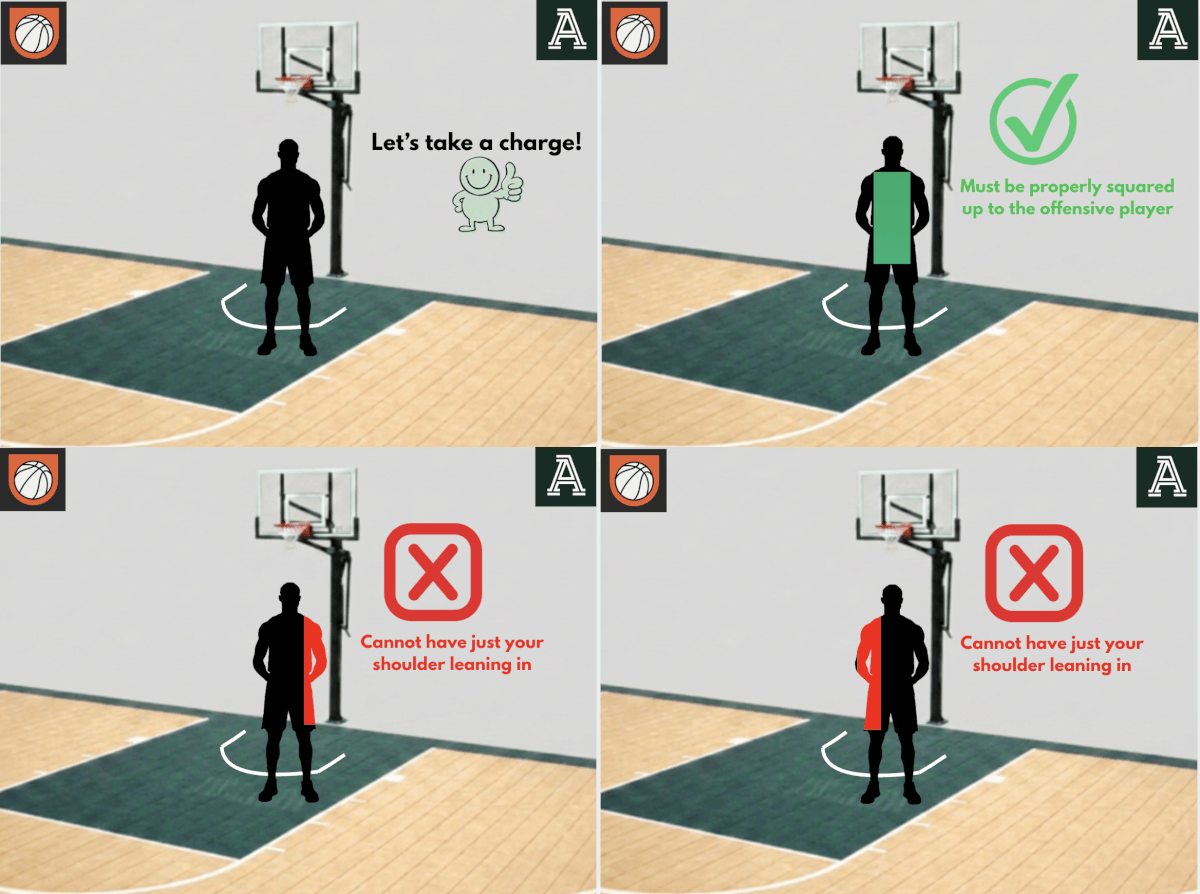
Defensive players can be moving to the side or backwards and still take a charge, as long as they’re outside the restricted area. They just can’t be moving forward. And that’s where things get kind of tricky in those bang-bang moments.
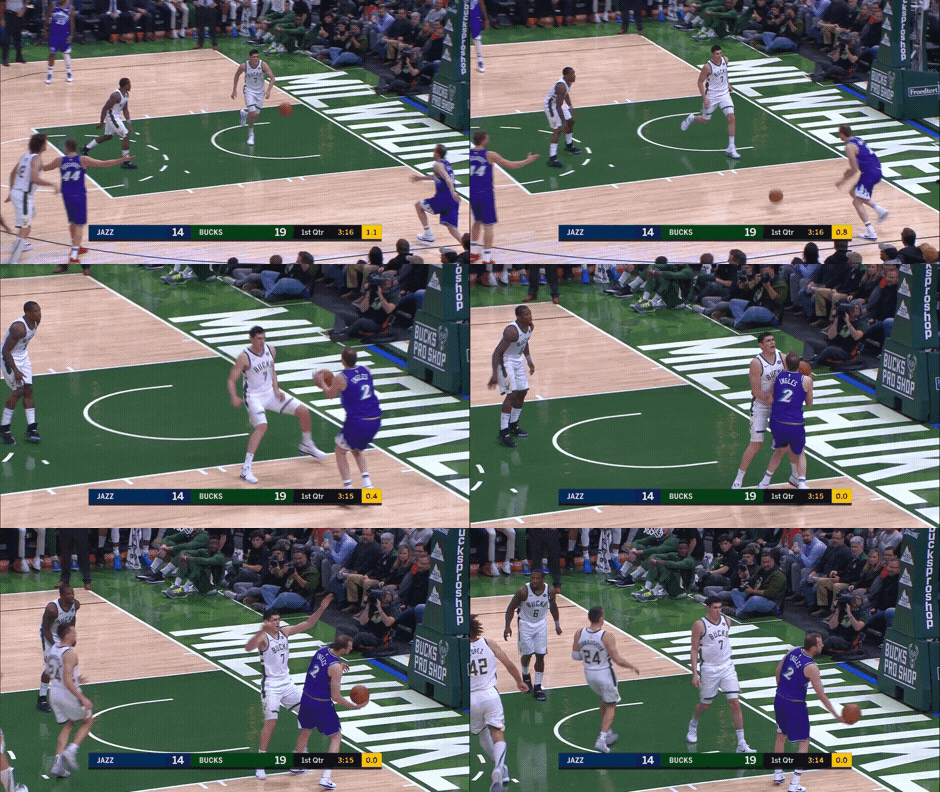
In the above example, Ersan Ilyasova (a master at taking charges) is clearly moving when Joe Ingles makes contact with him. However, he’s in legal guarding position of Ingles’ pathway.
There’s often a lot of ambiguity and judgment within these calls. The key to all of this is that even if a player is still moving (sideways or backwards), they have to be in legal position before the player goes into the upward shooting motion.
That’s where the judgment call comes into play. If an offensive player lowers their shoulder, they’re getting called for the charge/offensive foul almost every time. That’s the whole “being in control of their body” at all times aspect. Where most players, coaches and fans object is when it looks like the defender slides into the pathway after the offensive player has started their ascension. Because … you know … that’s the rule.
Does this clarify anything? I hope so! It will until the next time there’s a terrible call regarding charges and blocks. And you can always email us at thebounce@theathletic.com if you have questions.
The last 24
🏀 New wrinkle. As the Clippers/Aspiration investigation drags on, there’s another interesting revelation: Kawhi Leonard reportedly had another endorsement deal worth millions with the Clippers’ scoreboard maker.
Kawhi Leonard had a sponsorship with Clippers’ scoreboard operator
🏠 Staying put? The Blazers moved closer to getting public funding for arena renovation. Local officials approved a term sheet.
🥇 World Cup! The FIBA Women’s World Cup is set for September in Germany. Team USA has Caitlin Clark and Angel Reese.
KAT call
Knicks’ tough Towns decision
The New York Knicks are still busy celebrating their NBA title and getting ready to defend it next season. But even as they’ve made peace with letting Mitchell Robinson walk and bringing in Andre Drummond to replace him, the Knicks have an even more important big-man decision ahead. Karl-Anthony Towns is eligible for a four-year, $272 million extension. He’s on the books for $57 million this season and has a player option for $61 million in 2027-28.
The Knicks are up against the second apron, which they said they wouldn’t dip into when letting Robinson go. But would that change if it means giving KAT an extension averaging nearly $70 million per season? Or will they hope Towns takes a discounted extension to keep the band together? James Edwards III went through the pros and cons of extending Towns. Here are my biggest takeaways:
- It feels like the Knicks have to give Towns a significant contract extension. I’d be shocked if he’s the guy they let go.
- Remember, the Knicks really took off in the playoffs after they shifted their offense to run through Towns at the elbow.
- From Game 4 against the Hawks through Game 5 of the NBA Finals, he averaged 14.9 points, 10.5 rebounds, 5.3 assists, 1.3 steals and 1.1 blocks and had 54.7/44.4/88.5 shooting splits. The Knicks went 15-1 in those games.
- JE3 mentioned the effect it could have on future free agents. The Knicks have done a lot to turn their reputation around, and paying Towns could be a good sign for free agents down the road, when New York has flexibility again.
But that’s the trouble. When could the Knicks have flexibility again, and would it cost them anybody else?
- Jalen Brunson has a $43.3 million player option in ’28-’29. It’s assumed he’ll be looking for a new deal in 2028, if he doesn’t already have an extension in place.
- OG Anunoby has a $48.3 million player option in ’28-’29. Maybe he’d start taking a discounted extension to help set up flexibility for New York by then?
- Mikal Bridges has a $41.1 million player option, but not until ’29-’30.
- Josh Hart has a $22.3 million team option in ’27-28. Maybe the Knicks pick up the option to keep costs down, but then they try to figure out a new deal with him soon?
The rough projected salary cap in ’28-’29 season is $182.7 million. A lot could change before then, but that would put the second apron around $245 million.
If we go off player option numbers, a “conservative” $60 million starting salary on Towns’ next contract and around $25 million for Hart, then the Knicks are looking at $215 million already for their starting five. That leaves $30 million for the remaining nine spots on the roster. New York is in a great spot to contend now, but the second apron crunch comes for even the richest team.
Poster child
Which Malone wins this battle?
Posters! Remember putting those on the walls in the ’80s and ’90s? I sure do! Having friends come over and be impressed by the posters you had displayed was one of the proudest moments of being a basketball fan. During this summer of The Bounce, we’re putting the old-school posters against each other and having you, The Bouncers, decide the winner.
Last week, Chuck Person’s The Rifleman poster ran away with the vote against Dale Ellis’ Silent Assassin poster! The Rifleman received 68.6 percent of the vote and moved on for future consideration.
Today, we’re sticking in the ‘80s and have the two best Malones (sorry, Jeff) battle it out: the infamous Karl Malone “Special Delivery” poster and the “Moses” poster for Moses Malone.
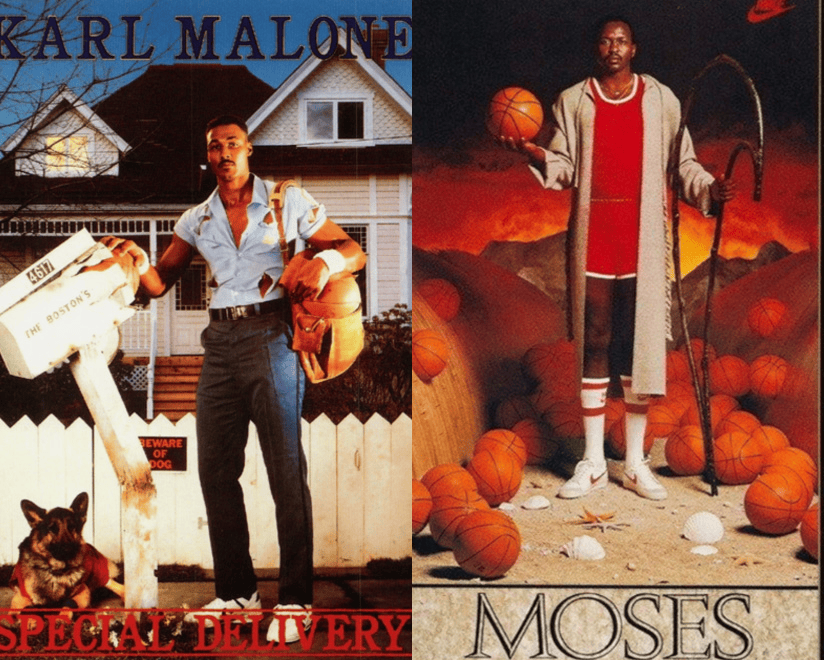
These are two of the greatest players of all time and two of the best posters of the ‘80s. We’ve got Moses versus Karl in a Battle of the Malones. Who you got?
Sound off in the comments.
>
Sports
Celtic: Martin O’Neill out of hospital, but ‘no timeline’ for return, says assistant Shaun Maloney

“Even for the game at the weekend, it’s sort of day-to-day,” he said. “We saw him last night with regards to the preparation for the game and then he wasn’t in today.
“I’ll speak to him this afternoon and then he’ll make a call for tomorrow. And then I’d imagine he’ll make the call for the game at the weekend.
“But, if it’s this weekend, great. If it isn’t, then we’ll prepare for it with that one.”
Maloney admitted it would be “strange” if he has to take charge at Rugby Park.
“We’ll definitely miss him if he’s not there but you also have to respect what’s happened the last few days,” he said.
“The impact that he’s had over, what was it, since October, it’s been nothing short of incredible really – the things that he does with the players and the staff.
“So we will miss him, but we’ll be prepared. We’ve got some brilliant senior players, but we’ll see, we’ll let him make the call.”
Maloney did not expect any new signings to be made, such as the reported bid for Oviedo winger Haissem Hassan, before Sunday’s game and admitted those matters were still exclusively between O’Neill and chief executive Michael Nicholson.
The former Scotland midfielder knew there was interest in midfielder Arne Engels and right-back Alistair Johnston but had no reason to believe they would not be in the squad to face Kilmarnock.
>

Wscripted 12 Finalists For Wscripted 2026 Screenplay List

Explaining how the Braves approached the trade deadline

Airbnb says AI is helping it ship features faster as it tests a new search function
-

 movies3 months ago
Search For Canadian TV Actor Stewart McLean Now Homicide Investigation
-

 Fashion9 years ago
These ’90s fashion trends are making a comeback in 2017
-
Fashion9 years ago
According to Dior Couture, this taboo fashion accessory is back
-
Fashion9 years ago
Model Jocelyn Chew’s Instagram is the best vacation you’ve ever had
-
Fashion9 years ago
Your comprehensive guide to this fall’s biggest trends
-
Fashion9 years ago
9 Celebrities who have spoken out about being photoshopped
-
Fashion9 years ago
Emily Ratajkowski channels back-to-school style
-
Fashion9 years ago
A photo diary of the nightlife scene from LA To Ibiza