
Tech
Spotify will label ‘AI Persona’ profiles and exclude their music from recommendations


Spotify will begin labeling AI-generated artists with “AI Persona” profile tags and ban their music from its editorial and algorithmic recommendations, the company announced on Tuesday.
In mid-September, Spotify users will see “AI Persona” badges appear on some artists’ profiles that signal the artist’s identity is AI-generated, instead of representing a real person. While Spotify will allow artists to identify themselves as AI Personas, the company says it won’t rely on self-disclosure alone.

It will also review artist profiles and identify those where the artist’s name and imagery appear to represent photorealistic AI-generated identities. Spotify said it will begin its review with profiles that have met pre-defined audience thresholds to ensure the more listened-to artists are covered first.
Once labeled, the AI Persona badges will appear on the artist’s profile in the banner and the About section, in Search, and on track rows across playlists.
By default, Spotify won’t include AI Personas in its editorial or algorithmic recommendations, nor will it add AI Personas’ music to users’ personalized recommendations — unless they happen to follow an AI Persona. Only users can choose to follow an artist, so it’s an explicit signal that the user wants to hear more music from that person or group.

The move is the latest expansion of Spotify’s AI policies, which detail guidelines for how AI-generated music appears on its service. First announced in September 2025, Spotify’s current policy identifies and labels AI music using industry-standard techniques, and bans unauthorized AI voice clones and deepfakes from its platform.
Like others in the music industry, Spotify is attempting to balance innovations driven by AI, like its own AI-powered Prompted Playlists, AI DJ and chat, and forthcoming AI remixes, while still managing to thwart the deluge of AI-generated slop — low-quality content that AI has made it easier to mass produce. Allowing slop to proliferate could lead to a poor user experience and subscription cancellations.
Spotify also notes that artists will be able to appeal their AI Persona label if they think it’s been incorrectly applied.

Signaling its understanding of a growing consumer backlash against AI-generated art, Spotify wrote in its announcement that, “while we believe all artists have creative choice in determining how they present themselves, Spotify’s programming is focused on elevating music from authentic artists building careers in music.”
However, the company clarified that an AI Persona is a judgment on the artist’s profile, not the music.
“Although there’s a broad spectrum in how artists use AI as a creative tool, the question of whether a profile represents an actual human is one where Spotify can help make a clear determination. This badge is about the artist’s public identity, not about how the music was made,” the company said.
Information about how the music itself was made will continue to be available through Spotify’s other features, like AI Credits and SongDNA.
In the months ahead, Spotify will also roll out a tool that allows users to report artist profiles that appear to be AI Personas that haven’t yet been labeled.
The addition of the labels will also help Spotify users to differentiate between AI Personas and the forthcoming AI-generated remixes and covers, soon to be permitted by Spotify’s recent licensing deals with labels UMG and Merlin. The latter will allow for fan-made remixes and covers, while still funneling money back to the participating artists.
As for the AI Personas, Spotify says artists will be able to self-disclose starting on August 11, 2026, through Spotify for Artists. The labels themselves will appear starting next month.
When you purchase through links in our articles, we may earn a small commission. This doesn’t affect our editorial independence.
>

In the fusion power world, most of the attention gets lavished on the reactors themselves, where atoms fuse to unleash enormous amounts of energy. But a fusion reactor can’t run for long without a lot of other equipment, and building a fusion reactor is expensive enough on its own. Plenty of startups are happy to let someone else handle the rest.
Among the dozens of companies in the emerging fusion power supply chain, few specialists are bigger than Kyoto Fusioneering. The Japan-based company has raised $121 million in committed capital, according to FusionX. Now it has landed grants from the U.S. Department of Energy and the state of Tennessee to build a prototype fuel breeding device at Oak Ridge National Laboratory (ORNL).
Alongside the announcement, Kyoto Fusioneering exclusively told TechCrunch that it’s moving its U.S. headquarters to Oak Ridge.
The startup has emerged as a key player in the fusion power industry. Over half of fusion startups have said they plan to work with external suppliers like Kyoto Fusioneering on fuel cycle technologies, according to a recent Fusion Industry Association survey.
Kyoto Fusioneering’s forthcoming device, called Unity-3, is being developed with ORNL and will test a fuel cycle technology known as a breeding blanket. Breeding blankets harvest energy from the fusion reactor while also generating fresh fusion fuel.
One breeding blanket design will use liquid lithium, which will absorb both heat and neutrons. As the lithium atoms in the blanket are bombarded with neutrons, they split into helium and tritium, an isotope of hydrogen that’s an important fuel for many reactor designs. The tritium is then separated from the blanket and sent to the reactor, while heat is extracted to generate power.
All of this requires heat-resistant materials, bespoke pumps, and other specialized equipment, and it’s just one slice of a fusion power plant that needs to be developed before it can connect to the grid. Kyoto Fusioneering is also developing systems to heat fusion fuel into a plasma, recycle unburned fuel from the exhaust, and harvest heat to generate electricity.
Unity-3 will test the performance of not just liquid lithium, but a range of other breeding blanket materials, Kyoto Fusioneering told TechCrunch. The device will help researchers and startups validate the data they’ve been generating, so far mostly through computer models.
Other fusion startups, including Realta Fusion, Thea Energy, Type One Energy, and Xcimer Energy, will use data from the Unity-3 experiments to design their reactors. It’s a range of startups — and approaches to fusion power — that should help position Kyoto Fusioneering as a go-to supplier when fusion power is ready for the grid.
When you purchase through links in our articles, we may earn a small commission. This doesn’t affect our editorial independence.
>
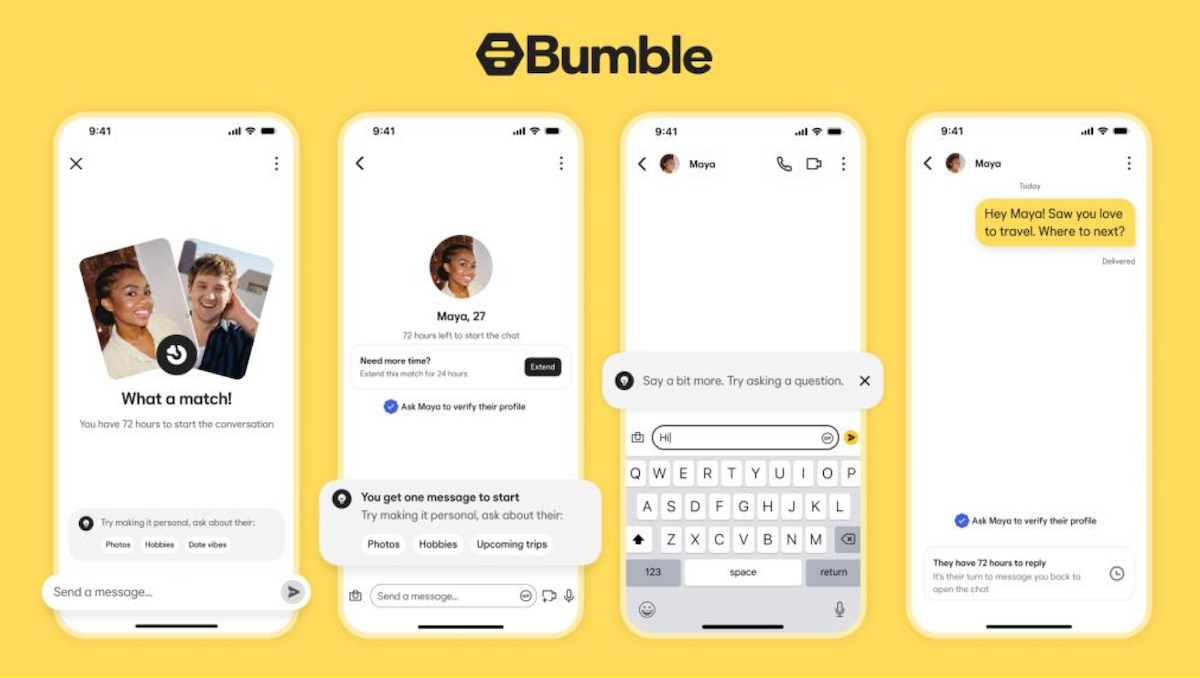
Bumble is officially giving up on the rule that made it, well, Bumble.
The dating app announced Tuesday that anyone in a match can now send the first message, ending the women-message-first requirement that has been one of the company’s defining features for more than a decade.
Bumble is also giving matches 72 hours to respond, up from 24, in an effort to take some of the pressure out of coming up with a response in a short time frame. The longer window gives people more flexibility to reply, rather than feeling like they need to check the app constantly or risk a match disappearing.
The change marks a pretty significant shift for Bumble, which built its brand around putting women in control of heterosexual dating conversations. When the app launched in 2014, Bumble was positioned as the more considerate alternative to Tinder, with women deciding whether a conversation would begin and, ideally, avoiding some of the unsolicited messages and general weirdness that had become synonymous with dating apps.
Bumble founder and CEO Whitney Wolfe Herd framed the new update as an evolution rather than a retreat from the company’s original mission.
“While women making the first move was a radical idea, being women-first was never about prescribing just one way to connect. It was about designing an experience with women’s needs in mind to create better outcomes for everyone,” Herd said in a statement.
And, apparently, plenty of women are ready for this change. According to Bumble’s survey data, 66% of women surveyed said they prefer men to send the first message, with many saying it would make dating feel less stressful. Additionally, more than half of members surveyed said the longer response window improved their experience.
“Today, our community is asking for more flexibility, less pressure, and more opportunities to create real, meaningful connections, and that is what this new experience provides. This evolution isn’t a departure from our founding vision, but the realization of it,” Herd added.
The change also isn’t coming completely out of nowhere. Bumble began loosening its original rules in 2024 with “Opening Moves,” a feature that allowed women to set a question on their profile that a man could answer.
The change also arrives as Bumble tries to turn around a business that has been struggling to regain its footing. The company’s second-quarter earnings report last week showed revenue dropping 15.2% year over year to $210.5 million, while the company expects its number of paying customers to decline in the third quarter.
Over the past several quarters, Bumble has tried to address a broader slowdown in online dating, as the industry wrestles with user fatigue, an increasingly crowded market, and the reality that swiping through hundreds of profiles isn’t necessarily anyone’s idea of a great time. The company recently revealed it’s exploring a swipe-free future, along with more in-person events and AI features to garner more traction, especially among Gen Z users.
When you purchase through links in our articles, we may earn a small commission. This doesn’t affect our editorial independence.
>

The FBI is reportedly investigating how a North Korean was hired to work for a U.S. federal government agency.
News of the investigation was first reported by Federal News Network, citing a senior FBI official speaking at a conference on July 28 in Washington, D.C.. The official confirmed to Federal News Network that the FBI is investigating a North Korean working for an unnamed federal agency.
It’s unclear how the North Korean was hired, but the regime is known for its coordinated and long-running campaigns aimed at fraudulently obtaining employment at private organizations and multinationals. The case marks a rare confirmed instance of a sanctioned North Korean working for a government agency.
There are thought to be thousands of North Korean IT workers who have gained employment with U.S. and European organizations in recent years by exploiting weaknesses in the hiring process. The goal is to use fraudulent identities to gain employment with remote positions and to earn a wage that gets funneled back to the regime, all the while stealing intellectual property and other data, then using that information to extort the companies when they are inevitably caught.
But strict vetting and security clearance practices have largely kept the regime’s hackers out of government — though, not without incident. The Justice Department brought charges in 2024 against a Maryland man who assisted a North Korean hacker to pose as an American to get a remote job as a contractor for the Federal Aviation Administration.
The FBI did not respond to TechCrunch’s request for comment on Tuesday, and it’s unclear which federal agency was affected, and if any data or funds were stolen during the incident.
The U.S. has long warned about the risks posed by North Korean IT workers’ schemes. U.S. authorities have taken several enforcement actions and sanctions to stymie both the networks that operate from Pyongyang, as well as neighboring Russia and China, as well as the American facilitators who set up fleets of laptops that allow the North Koreans to work remotely as if they were in the United States.
North Korea operates more like a transnational criminal gang than a government, and relies on hacks, including thefts of cryptocurrency, to fund its globally sanctioned nuclear weapons program. The Kim Jong Un regime is reportedly responsible for 76% of cryptocurrency thefts, per blockchain forensic firms, netting the regime at least $2 billion during 2025 despite being banned from the global financial system.
When you purchase through links in our articles, we may earn a small commission. This doesn’t affect our editorial independence.
>

Kyoto Fusioneering starts work on key fusion power plant device

Tom McCarthy’s ‘A Statement’ to Make World Premiere at NYFF

Stanley Kubrick Subject of TCM ‘Plot Thickens’ Podcast
-

 movies3 months ago
Search For Canadian TV Actor Stewart McLean Now Homicide Investigation
-

 Fashion9 years ago
These ’90s fashion trends are making a comeback in 2017
-
Fashion9 years ago
According to Dior Couture, this taboo fashion accessory is back
-
Fashion9 years ago
Model Jocelyn Chew’s Instagram is the best vacation you’ve ever had
-
Fashion9 years ago
Your comprehensive guide to this fall’s biggest trends
-
Fashion9 years ago
9 Celebrities who have spoken out about being photoshopped
-
Fashion9 years ago
Emily Ratajkowski channels back-to-school style
-
Fashion9 years ago
A photo diary of the nightlife scene from LA To Ibiza