
Tech
TIOBE Index August 2026: Java Nears C++ as Rust Holds No. 10


August keeps TIOBE’s top 10 in the same order, yet several races inside it remain active.
Java is closing in on C++, C is the lone top-five language with a positive annual rating change, and Rust faces close pressure at No. 10. TIOBE CEO Paul Jansen turns his attention to MATLAB’s continued decline.
The TIOBE Programming Community Index tracks programming language popularity using search results related to skilled engineers, courses, and third-party vendors.
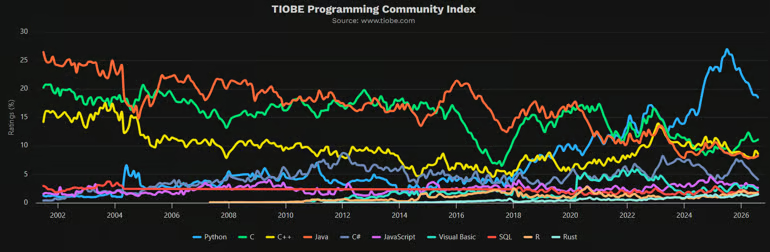
Python leads as C gains over the year
Python records 18.53% at No. 1, with C next at 11.10%. Python remains well ahead of every other language despite a 7.61-point decline in its rating from August 2025.
C has moved in a different direction over the annual period. Its rating is up 2.07 points, making it the only language among the current top five to post a year-over-year increase. C also ranks one place higher than it did last August, when C++ occupied No. 2.
Just 0.37 points separate C++ and Java
C++ takes No. 3 at 8.62%, followed by Java at 8.25%. Just 0.37 percentage points separate the pair, making No. 3 one of the more open spots near the front of the ranking.
C# occupies No. 5 at 4.09%, followed by JavaScript at 2.63% and Visual Basic at 2.18%. A sizable drop from Java to C# divides the first four languages from the rest of the upper tier, even with no changes in rank this month.
SQL, R, and Rust complete the top 10
SQL takes No. 8 at 1.88%, R follows at No. 9 with 1.56%, and Rust records 1.45% at No. 10. All three have climbed in rank over the past year; SQL from No. 12, R from No. 14, and Rust from No. 18.
Rust has made the largest jump of the three, gaining eight places since August last year. Its final top-10 slot is still closely contested, however, with Delphi/Object Pascal at No. 11 on 1.37%. Only 0.08 percentage points stand between them, so No. 10 could change hands quickly.
MATLAB drops to No. 25
MATLAB ranks No. 25 at 0.71%, putting it outside the top 20 for the first time in more than 10 years. Jansen expects the decline to last, citing the language’s paid licensing model as one disadvantage in a field dominated by free alternatives. He notes that Delphi is currently the only language inside the top 20 that still requires a paid license.
Jansen also says MATLAB has evolved more slowly than languages such as Python, C++, and Rust, which continue to add newer features and programming approaches. A return to the top 20 would now require MATLAB to recover at least five places from its ranking this month.
More News: Nearly a third of UK manufacturers report cyber incidents affecting either their own operations or their supply chains.
>
California is drawing a line around how far AI can go in pretending to be a therapist.
Senate Bill 903 would restrict AI firms from marketing chatbots as licensed therapy, block automated systems from making unguided clinical decisions, and require patient consent before healthcare providers use AI for tasks including recording therapy sessions or triaging care. The measure, introduced by state Sen. Steve Padilla, has already cleared the California Senate.
The debate is no longer simply whether AI belongs in mental healthcare. California lawmakers are confronting a harder question: which decisions still require a licensed human professional when chatbots can increasingly sound like one?
California draws the line
California state Sen. Steve Padilla introduced SB 903 in January and has drawn support from the National Union of Healthcare Workers.
Per The Independent, Padilla noted that AI could improve Californians’ lives if used responsibly, but also argued that “AI algorithms are not fit to take over the job of human therapists, who have skills and training that AI is incapable of replicating.”
But the proposal clarifies that it is not a general ban on AI in mental healthcare. Its focus is on AI being presented as a therapist and on clinical uses where the system could make decisions without a licensed professional involved.
The proposal has also drawn opposition from technology industry groups that argue it could restrict legitimate clinical uses of AI.
Robert Boykin, California executive director of TechNet, for instance, called the bill a “clinical bottleneck,” arguing that California is already facing a shortage of behavioral healthcare workers and that AI tools are filling that gap.
Why lawmakers say AI therapy poses risks
The American Psychological Association found that patients are increasingly using AI for mental-health support, self-diagnosis, and treatment assistance, but psychologists remain concerned that chatbots lack the clinical validation, safeguards, and human judgment needed to replace qualified professionals.
The scale of those interactions can be significant. Last October, OpenAI said around 1.2 million users each week sent ChatGPT messages containing “explicit indicators of potential suicidal planning or intent.”
The risks have also moved into the courts. The makers of several popular AI applications, such as Google and Character.AI, have faced lawsuits alleging that their chatbots played a role in youth suicides, adding a legal dimension to concerns that systems designed to sustain highly human-like conversations can respond poorly when users are in serious distress.
That does not, however, establish that a chatbot caused those deaths; the allegations remain claims in litigation. But for California lawmakers, the cases add context to a broader problem.
People are already treating conversational AI tools as mental-health support experts because they sound like one, even though they are not. The lack of consistent standards for evaluating chatbot responses has fueled concerns about relying on general-purpose AI systems for mental-health guidance, particularly during crises.
May be the first of many
California’s move could give other governments another AI policy to study as they work out where the technology should be subject to legal limits.
SB 903 could become an early test of how governments regulate AI when conversational ability begins to resemble professional expertise.
The larger question extends well beyond therapy. If lawmakers decide that some roles require enforceable boundaries between AI assistance and human professional judgment, healthcare may be only the beginning.
Other News: Australia is moving ahead with a world-first ban on social media accounts for children under 16, requiring major platforms to block or remove underage users or face fines of up to AU$49.5 million.
>
The Open Compute Project’s APAC Summit opened in Taipei on Aug. 11 with AI-scale systems management, power, cooling, and server architecture in focus as increasingly dense AI infrastructure changes how data center operators manage hardware at scale.
OCP’s Scalable Cloud Infrastructure Management work targets hardware-management problems in facilities with 100,000 nodes or more. Across Asia-Pacific, that push toward fleet-scale management is unfolding as operators simultaneously contend with rapid capacity growth, denser racks, and tighter access to power.
OCP scales hardware management for AI
OCP’s Scalable Cloud Infrastructure Management, or SCIM, subproject examines how hardware-management data can move across large data center networks and how technologies such as AI and machine learning systems, RDMA, PCIe/CXL, and DDR affect fleet operations. OCP’s SCIM is unrelated to the identity-provisioning standard that uses the same acronym.
The 2026 OCP APAC Summit extends that work across AI infrastructure, including telemetry and management systems that connect facility operations with equipment in the data hall. As GPU clusters expand, networking has become another AI infrastructure constraint, increasing the need for visibility beyond compute hardware alone.
Regional growth adds pressure. Asia-Pacific’s data center development pipeline increased by 7,103 MW in the first half of 2026 to 26,455 MW, according to Cushman & Wakefield. Vacancy fell from 10.9% to 10.3% despite new supply entering the market. In Indonesia, Firmus is planning a 360 MW Nvidia-powered AI data center on Batam, with initial operations targeted for 2027.
GEICO provides an enterprise example of the operational work involved in open infrastructure. The insurer reported cutting compute cost per core by more than 50% and storage cost per gigabyte by more than 60% after deploying OCP hardware across two colocation facilities with more than 1,000 servers, according to its OCP adoption white paper.
The deployment also required new processes and skills for firmware, validation, inventory, and fleet lifecycle management. GEICO’s results are not a regional benchmark, but its experience shows that lower hardware costs can come with higher requirements for in-house infrastructure engineering.
Power constraints reshape APAC deployments
Power availability is increasingly shaping where new capacity can be built. Schneider Electric executive Jean-Christophe Moureau told Computer Weekly in May 2026 that Singapore faced energy constraints on additional data center development through 2028.
Higher-density AI systems compound the problem. AlixPartners says operators may need to plan for rack densities around 135 kW for AI workloads, compared with 15–30 kW for typical cloud deployments. The shift is also making liquid cooling increasingly central to AI infrastructure as operators contend with greater heat loads.
A Feb. 10, 2026, Deloitte report recommends shifting suitable workloads across time or location when energy conditions allow and incorporating storage and operational flexibility into data center design.
Rising rack density is bringing server, network, cooling, and power management closer together. OCP’s standards work is aimed at making those increasingly interconnected systems easier to operate as AI deployments grow larger.
Read more: Australia is confronting a similar infrastructure challenge as rapid AI data center growth puts new pressure on the power grid.
>

TL;DR: UmanWrite is a new tool that translates AI writing into natural, human-sounding copy, and it’s only $79 for a lifetime subscription.
Businesses lean on AI writing tools to move faster, but the drafts often land flat, sound generic, or trip AI detectors. UmanWrite is a simple tool that fixes all that. Instead of manually editing every document, UmanWrite automatically translates AI writing into human-sounding prose, and it’s only $79 to get a lifetime subscription (reg. $1,799).
Make your AI writing sound human
For a team that pushes out blog posts, sales copy, and client emails every week, trimming the time it takes to produce quality content is essential. UmanWrite’s AI humanizer helps you streamline the process by rewriting machine-generated text into natural, human-sounding content. The built-in AI Detector then checks each piece for telltale patterns before you publish. Marketers and freelancers who answer to editors or clients get a cleaner draft and one less thing to sweat over.
One of the most difficult things for AI to get is that every human sounds different. UmanWrite accounts for that by letting you train different Voice Profiles based on writing samples, so future drafts sound like distinct authors. Context-aware writing adjusts each draft for the audience and purpose, whether that’s an SEO article, a newsletter, or a professional document. Every edit teaches the tool how your business writes, so consistency across a content team gets easier to hold.
Unlike subscription writing tools that meter your usage, this lifetime plan runs on unlimited monthly words with 2,500-word requests and no recurring fee. It even has an Advanced Grammar Checker that tidies up your work, all in one clean interface. No more bouncing between tools.
Add some humanity to your AI writing.
Get a UmanWrite Unlimited lifetime subscription for $79.
StackSocial prices subject to change.
>

TIOBE Index August 2026: Java Nears C++ as Rust Holds No. 10

House of the Dragon’s Biggest Book Changes in Season 3

‘Summer House’ Star Bailey Taylor Signs With Gersh
-

 movies3 months ago
Search For Canadian TV Actor Stewart McLean Now Homicide Investigation
-

 Fashion9 years ago
These ’90s fashion trends are making a comeback in 2017
-
Fashion9 years ago
According to Dior Couture, this taboo fashion accessory is back
-
Fashion9 years ago
Model Jocelyn Chew’s Instagram is the best vacation you’ve ever had
-
Fashion9 years ago
Your comprehensive guide to this fall’s biggest trends
-
Fashion9 years ago
9 Celebrities who have spoken out about being photoshopped
-
Fashion9 years ago
Emily Ratajkowski channels back-to-school style
-
Fashion9 years ago
A photo diary of the nightlife scene from LA To Ibiza