
Entertainment
Alex Cooper’s Unwell Valued at $500 Million After Investment From Patrick Whitesell’s WTSL


Alex Cooper and Matt Kaplan’s Unwell is now valued at $500 million following an investment from former Endeavor, WME and TKO executive Patrick Whitesell’s new investment firm, WTSL.
The financial terms of WTSL’s investment were not disclosed, but it marks Unwell’s first outside investment. Cooper, who is the host of the podcast “Call Her Daddy,” founded Unwell with Kaplan in 2023.
More to come…
The post Alex Cooper’s Unwell Valued at $500 Million After Investment From Patrick Whitesell’s WTSL appeared first on TheWrap.
>
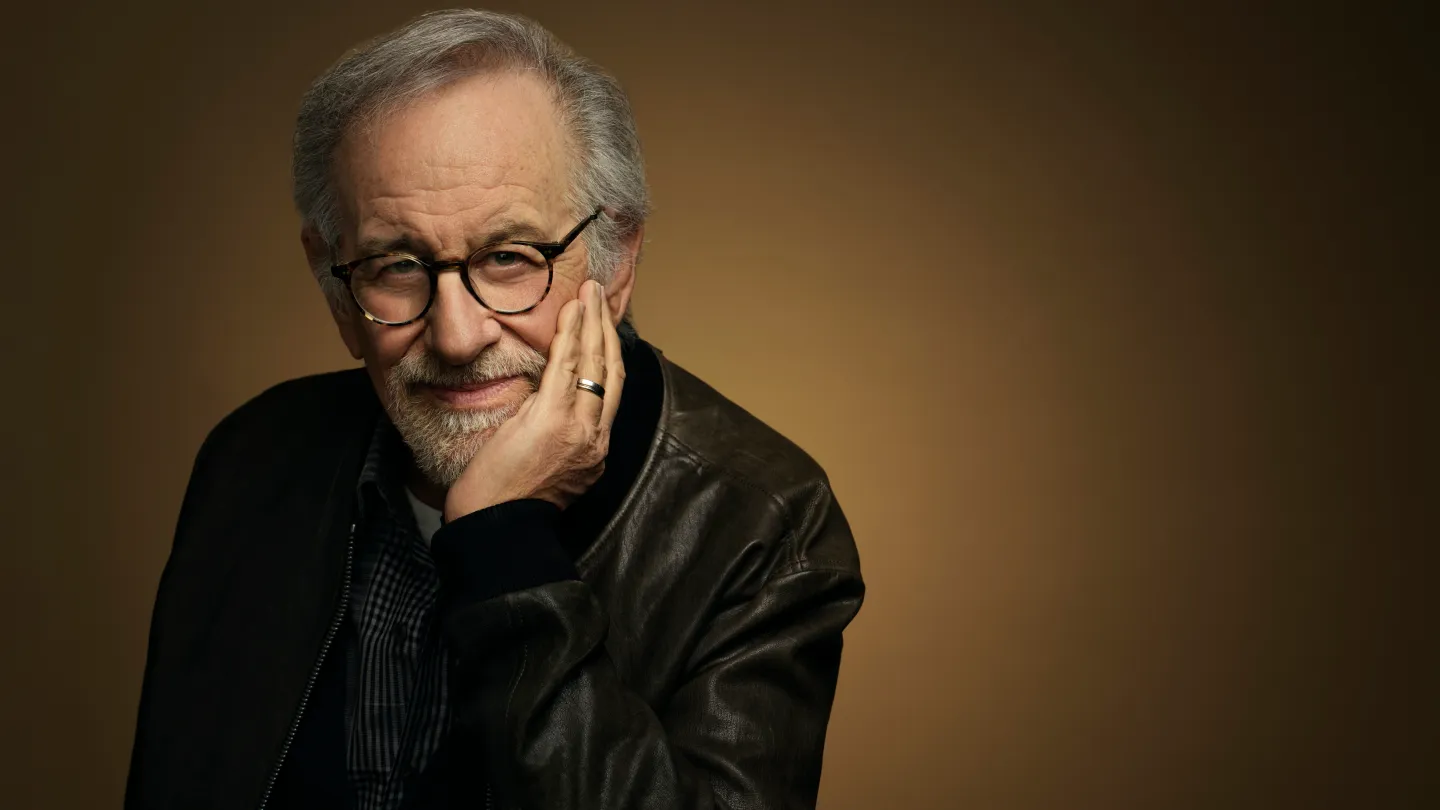
Steven Spielberg will soon have a special night at the museum.
The icon has been chosen as the honoree for the Museum of Modern Art‘s Film Benefit presented by Chanel. The gala will take place at the New York institution on Nov. 12. As part of the honoree spotlight, MoMA will present a screening series toasting Spielberg in the Roy and Niuta Titus theaters. Eight Spielberg films are in MoMA’s collection: 1974’s The Sugarland Express, 1975’s Jaws, 1977’s Close Encounters of the Third Kind, 1981’s Raiders of the Lost Ark, 1982’s E.T. the Extra-Terrestrial, 1984’s Indiana Jones and the Temple of Doom, 1985’s The Color Purple and 1987’s Empire of the Sun.
News of the honor comes on the heels of the EGOT winner’s most recent film, Disclosure Day, starring Emily Blunt, Josh O’Connor, Colin Firth, Colman Domingo, Eve Hewson and Wyatt Russell. He comes to the shine after receiving a dozens of accolades like a Kennedy Center honor, the Irving G. Thalberg Memorial Award from the Academy of Motion Picture Arts and Sciences, a Presidential Medal of Freedom from President Barack Obama, a National Medal of Arts from President Joe Biden, and three Oscars from a record nine nominations for best director and the most best picture nominations as a producer with 14.
“MoMA’s support of Steven Spielberg extends back over a half-century, beginning when we helped introduce him to audiences as part of New Directors/New Films in 1974,” said Rajendra Roy, MoMA’s Celeste Bartos chief curator of film. “Since then, he has repeatedly demonstrated that being an artist and an entertainer can be simultaneous aspirations, though few have mastered the combination as expertly as he has. His global influence is unparalleled, and his dedication to film preservation is inspiring and completely aligned with the Museum’s mission to save and celebrate film history.”
Chanel, a longtime champion of the cinematic arts, has been a sponsor of MoMA’s annual Film Benefit since 2011 and has served as the lead sponsor of film at MoMA since 2021. Spielberg will follow in the footsteps of previous honorees like last year’s, Sofia Coppola, and Samuel L. Jackson, Guillermo del Toro, Penélope Cruz, George Clooney, Laura Dern, Martin Scorsese, Julianne Moore, Tom Hanks, Cate Blanchett, Alfonso Cuarón, Tilda Swinton, Quentin Tarantino, Pedro Almodóvar, Kathryn Bigelow, Tim Burton and Baz Luhrmann.
MoMA’s Department of Film cares for more than 30,000 films and 1.5 million film stills. The fundraiser supports the continued maintenance and growth of the collection in addition to virtual programming and a schedule of film series, premieres, festivals and retrospectives.
>
If the Looney Tunes aren’t the hardest working entertainers in show business, I don’t know who is.
In the last 96 years, Bugs Bunny, Daffy Duck and all their wacky friends have starred in a dozen feature films, 14 original TV shows and more than a thousand cartoon shorts. They won Oscars. They played basketball to amuse the orgy nuns from Ken Russell’s “The Devils.” And, more to the point, they’ve spoofed just about everything there is to spoof. After chucking dynamite at Superman, Robin Hood, the Barber of Seville, “Fantasy Island,” “Ghostbusters,” “Flash Gordon” and “The Rover Boys,” what else could they possibly lampoon? French philosopher Albert Camus’ contemplation of absurdity and self-slaughter, “The Myth of Sisyphus?”
Anyway, “Coyote vs. Acme” is the Looney Tunes version of Albert Camus’ contemplation of absurdity and self-slaughter, “The Myth of Sisyphus.” The film stars Wile E. Coyote as a tragic stand-in for the human condition — which, in fairness, he always was. Every day, he tries to capture the Road Runner, and every day, he fails, in part because the Road Runner is the fastest creature on two legs, but mostly because Wile E. relies on Acme mail-order products, which are always defective and literally blow up in his face. And yet, like the figure in the ancient Greek legend, he never stops rolling that proverbial boulder uphill, no matter how many times it rolls back down and squashes him like a pancake. What’s worse, he has to keep buying from Acme because it’s a monopoly. And its products will always hurt him because monopolies are evil.
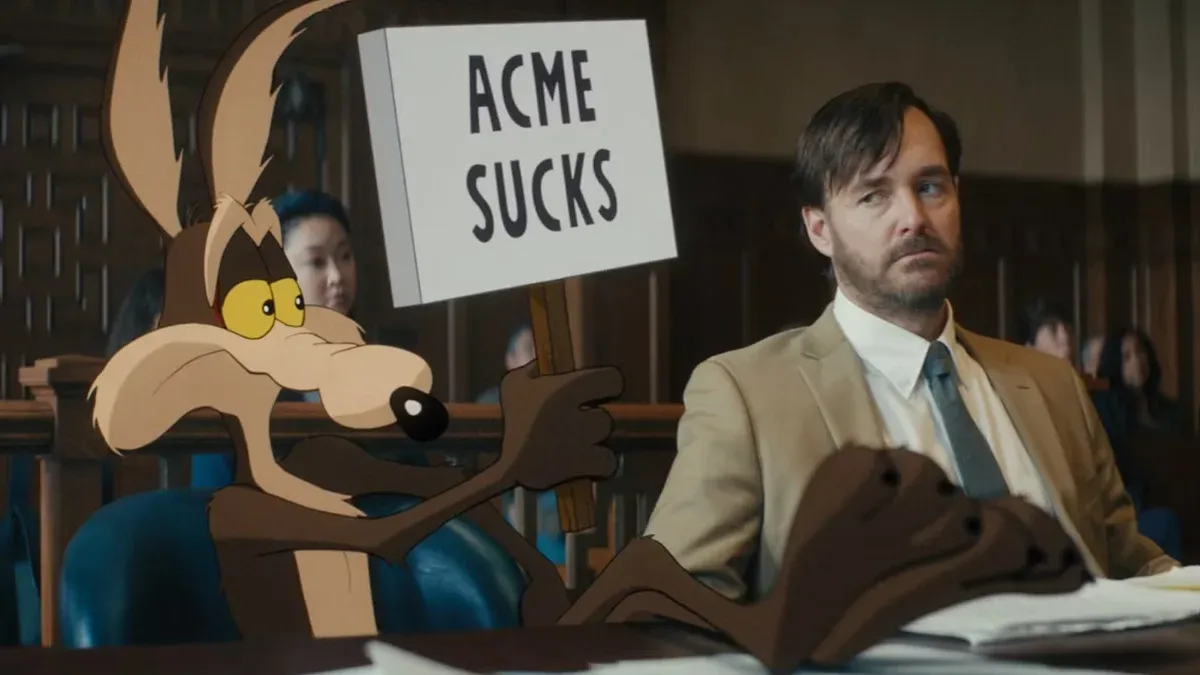
In “Coyote vs. Acme,” Wile E. tries something new. He hires a lawyer, Kevin Avery (Will Forte), to sue the Acme Corporation. Avery gave up on his own boulder decades ago. Now he settles every case without a fight. Besides, what’s the point in fighting the Acme Corporation? They own everything. They own the judges. They write the laws. They’re the boulder, and the boulder always wins.
But you can’t keep a Wile E. down. The voiceless cartoon canine forces Avery to fight the ultimate uphill battle, and the movie won’t stop until he defeats [checks notes] Warner Bros.

Literally. Warner Bros. is canonically a subsidiary of the Acme Corporation. The revelation makes so much sense that, after the studio fought tooth and nail to keep “Coyote vs. Acme” from ever being released — shelving the all-but-finished film for a tax write-off in 2023 — it almost plays like a marketing stunt. Then again, what’s easier to believe: that monopolistic corporations don’t care about anything but money, or that they care so much about telling stories about the little guy that they manufactured a controversy that made them look like garbage for years before finally letting Ketchup Entertainment release their movie instead?
“Coyote vs. Acme” is a film about the futility of nobility and the nobility of futility. It’s the Looney Tunes version of classic courtroom dramas like “The Verdict” and “Erin Brockovich,” and although it parodies those films it also tries, successfully, to make us feel the way those other great underdog stories make us feel. The filmmakers know how hard a person has to fight just to make a corporate entity flinch. They also know that the flinch is, by itself, important. Even if you don’t win. Especially if you don’t win. Nobody can roll a boulder up a hill but if everyone tries, maybe we’ll finally get somewhere.
It’s all very intelligent and moving, but is “Coyote vs. Acme” funny? Yes. “Coyote vs. Acme” is gut-bustlingly hilarious. Dave Green knows these Tunes by heart, and the comic timing on this film’s countless sight gags is on par with some of the best Looney Tunes shorts. That level of hilarity is impossible to sustain uninterrupted for 103 minutes but that’s not objectionable. That’s why the original shorts were short in the first place. Audiences can’t live on madcap wackiness forever.
The shrewd screenplay by Samy Burch (“May December”) — based on a story by Burch, James Gunn and Jeremy Slater and inspired by a 1990 New Yorker article by Ian Frazier — takes the “story” part of its story seriously, which periodically resets the joke-o-meter. All the dramatic beats set up future lunacies while also working consistently as satisfying, albeit ludicrous, drama.

Will Forte lives at the center of these two extremes, adorably sad-sacking his way through “Coyote vs. Acme,” a perfect foil for the world’s most motivated carnivore. Forte ambles from one plot point to another, pre-defeated, eager only to crawl back into his hole. He’s not an antihero because he’s morally conflicted. He’s an antihero because he doesn’t believe in heroism. After all, heroes don’t save the world from corporations. That’s not how heroes work. That’s not how corporations work. (Then again, shelving ingenious, crowd-pleasing movies isn’t how corporations are supposed to work either.)
Jean Luc-Godard said every film is a documentary about its own actors. Somehow, “Coyote vs. Acme” is a documentary about its own, unpredictable future. Green’s film dramatizes all the awful things that were about to happen to itself, and the fact that it’s finally out — and that it was brilliant all along — is an ironically cheerful conclusion to a film about constant struggle.
The fight is always worth fighting. The boulder is always worth pushing. And although Wile E. Coyote will never catch that Roadrunner, his chase inspires us all. Even when he falls off a cliff. Especially when he falls off a cliff.

>
David Robert Mitchell had a breakthrough in 2014 with It Follows, a taut shot of lo-fi supernatural horror that owed its sustained creepiness and visceral scares in large part to its skilled use of practical effects. The writer-director veers in the opposite direction with The End of Oak Street, a batty serve of Mesozoic mayhem in a modern suburban cul-de-sac in which actors spend a lot of time — on occasion, convincingly — fleeing something from the digital toolbox to be penciled in later. “I want to remember this insane, stupid moment!” says Anne Hathaway’s character when faced with the startling sight of two dinosaurs madly humping against the side of a house. Oh, hunny.
That kind of cheeky humor is sprinkled throughout, and the audience at a press-and-public preview was certainly laughing up a storm, both in moments where the comedy was intentional and others where…well, who knows? While it’s mindlessly entertaining in a big-dumb-fun kind of way, this is a movie that doesn’t seem to know what it wants to be, beyond a worshipful homage to 1980s Amblin, canonical Spielberg in particular. But lead producer J.J. Abrams already went there with comparable strengths and weaknesses in 2011’s Super 8.
The End of Oak Street
The Bottom Line
Think Barney with roid rage.
Release date: Friday, Aug. 14
Cast: Anne Hathaway, Ewan McGregor, Maisy Stella, Christian Convery, Jordan Alexa Davis, P.J. Byrne, Anne Gee Byrd, Emily Kuroda
Director-screenwriter: David Robert Mitchell
Rated PG-13,
1 hour 40 minutes
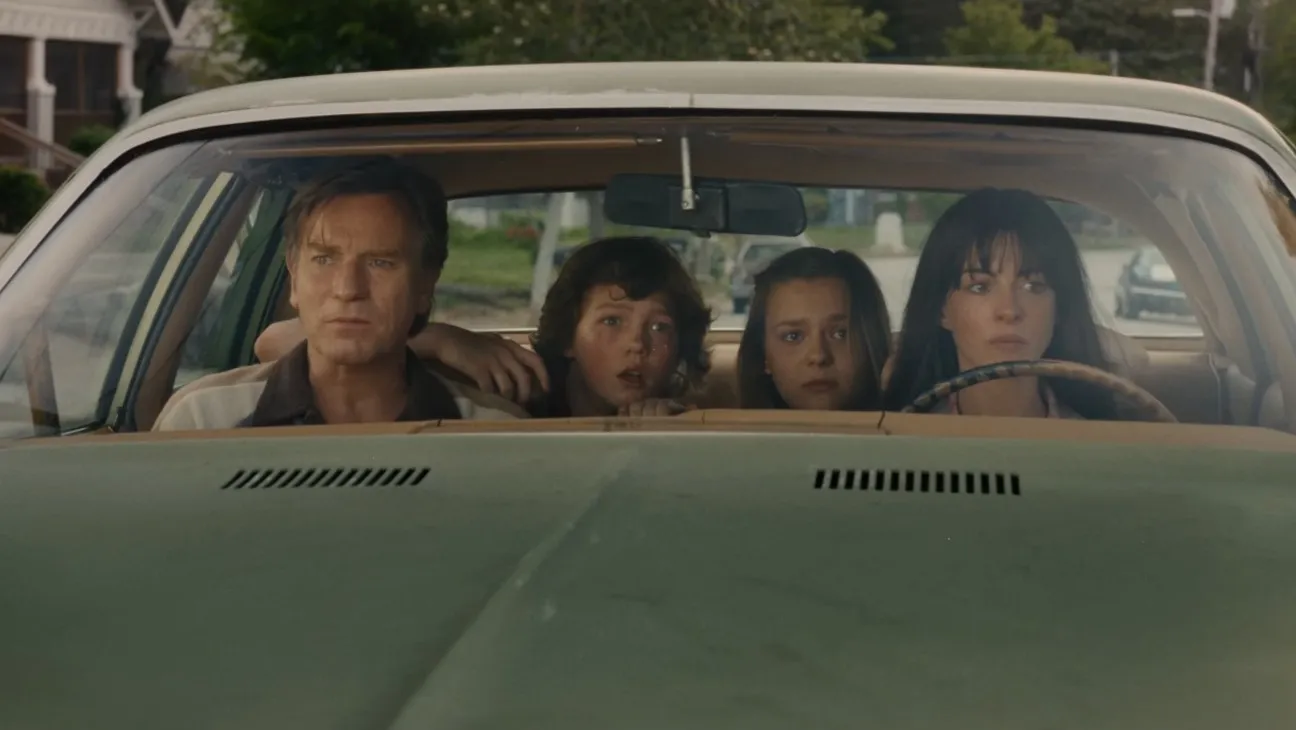
The movie opens on a 1982 summer block party at which frustrated housewife Denise Platt (Hathaway, working below her pay grade) doesn’t hide her irritation with underachieving husband Greg (Ewan McGregor), who has neglected to tell her he was laid off from his job weeks ago. Meanwhile, he’s sneaking slugs of whiskey in the garage and delivering pizzas, like a flaky college kid.
Their daughter Audrey (Maisy Stella, so delightful in My Old Ass) is a smart, mid-teens science and astronomy geek who defies the stereotype by also being cool, with hints of a burgeoning sexuality that departs from the retro popcorn movie norm. She’s protective of her brother Brian (Christian Convery), in his early teens, and sensitive in her reassurances when he worries that tensions between their parents might lead to divorce.
A bit of a whiner, Brian carries a bow and arrow everywhere but might be the most inept archer in the history of kids’ adventure movies, hitting a target only once, when it’s too slow and bulky to miss. In a touch that stretches the reference frame from Steven Spielberg to Stephen King, Brian is one of an inseparable quartet of friends whose makeup is right out of the regulation playbook — two white kids, one of them bullied, a Black kid and a chubster. But since the other three are never heard from again after an early scene, this seems as self-conscious a nod as the shots of Brian zooming around the neighborhood on his bike.
The story’s inciting incident follows mysterious flashes of blinding light in the night sky, accompanied by fierce winds and deafening noise. These unexplained phenomena end just as abruptly as they begin but are sufficiently unsettling to put the Platts’ adorably feisty Australian cattle dog Starbuck on high alert. The morning after one of these events, the street is suddenly cut off from the rest of town, surrounded by bodies of water and thick tropical jungle, with unseasonably steamy temperatures.
Out of this Twilight Zone scenario, prehistoric beasts start emerging from the vegetation, the skies and the water, each of them bigger and more vicious than the one before. These time-travel creatures, along with Hathaway, are the movie’s best asset. Watching them rifle through garbage cans, trample fences, toss cars around like toys or slurp up soft serve from an overturned ice cream truck cannot not be fun. Not to mention seeing them rip apart an annoying neighbor and bite the head off another. The Platts warned you to get inside, lady.
The most distinctive of the dino design features is the densely feathered outer covering of some of them, like emus raised too close to a nuclear reactor. My favorite was a chunky mile-long snake — a Titanoboa, though Fat Bastard would be a better name for it — that slithers around like a sloth until it turns aggressive, exposing a mouthful of spiked teeth. The CG creature work is generally slick, aside from a scene in which the camera gets in a little close to huge, armored herbivores with cartoon eyes that look like they belong on plastic Mattel toys.
Naturally, the struggles of the Platt family to stay alive — much like the Delgados in Netflix’s new streaming original, The Last House — depend on them having each other’s backs, in this case rediscovering a closeness that seemed to be fragmenting early on, before the marauding interlopers crashed their world.
If you’re hoping for a thorough explanation of how two hundred million years or so of distance got smushed together, a few rushed words from Audrey about tremors and time portals is as close as you’ll get. As for the exit strategy — involving large spheres of light, like Glinda’s means of travel in The Wizard of Oz — best not to give it too much thought.
There are wild inconsistencies in the way the kids are drawn, notably Audrey, who one minute is witnessing carnage and spouting scientific theories and the next minute is out in the car, parked in the driveway, weeping while singing along to Steve Winwood on the radio. Are you trying to draw attention, girl? Brian’s heedlessness makes a little more sense when he dashes out to chase his beloved Starbuck.
McGregor, to put it bluntly, is terrible, and not just because his American accent keeps slipping. Admittedly, he’s stuck playing a drip, but even when he’s out on the streets wielding a sledgehammer, there seldom seems to be much at stake in his shambolic performance.
Hathaway, on the other hand, is the essential glue holding the film together. Denise — a name that kept making me wish this were an all-out schlocky B-movie with Denise Richards — is basically an Anne Tyler character in a Michael Crichton novel. She’s a woman looking around now that her kids are growing up and acknowledging her lack of fulfillment, feelings expressed in a novel she’s secretly been writing, in which the protagonist keeps a suitcase packed in the hope she might one day run away from her suffocating life as a wife and mother.
When the situation gets hairier, Denise is the fearless one unloading shotgun bullets into leathery great reptiles, and there’s real enjoyment in watching Hathaway run screaming from a hangry beast in close pursuit. Though how the Platts can be chattering away in someone’s front yard without noticing there’s a monster the size of a house creeping up on them is just one of many risible moments in Mitchell’s script.
That said, there’s no shortage of decent scares, all amped up by Michael Giacchino’s frantic score and sound design that rips through you like a surprise bowel movement. Denise’s arc of coming around to a new appreciation for Greg after almost losing him is strictly by-the-numbers, and the escape from their life-threatening predicament is too laughably easy to be anything but anticlimactic. But the movie has its giddy charms, Fat Bastard the nasty snake chief among them.
Working with his regular cinematographer Michael Gioulakis, Mitchell gives the movie a dynamic visual kick, with lots of vigorous tracking shots, rapid zooms and split diopters. And production designer Maya Shimoguchi has provided him with a playground full of character and period detail in the Platts’ house.
After the early promise of his captivating debut feature The Myth of the American Sleepover and his confident leap into horror with It Follows, the director appears to be slumming it here, dipping his toes into blockbuster waters that inevitably evoke Jurassic Park and all its children, in a half-jokey tone that tends to undermine the terror. It’s been eight years since Mitchell took a critical and commercial bashing with his self-indulgently Lynchian L.A. noir Under the Silver Lake — a movie with plenty of staunch defenders — making this sweetly silly nostalgia exercise seem an underwhelming return. But hey, at least he appears to be having a good time.
>

Steven Spielberg to Be Honored at Museum of Modern Art’s Film Benefit

Nia Liston: The Merciless Maiden Anime Reveals VTuber Tsunomaki Watame as Opening Song Artist – News

PSG vs Aston Villa live updates: UEFA Super Cup latest team news, predictions
-

 movies3 months ago
Search For Canadian TV Actor Stewart McLean Now Homicide Investigation
-

 Fashion9 years ago
These ’90s fashion trends are making a comeback in 2017
-
Fashion9 years ago
According to Dior Couture, this taboo fashion accessory is back
-
Fashion9 years ago
Model Jocelyn Chew’s Instagram is the best vacation you’ve ever had
-
Fashion9 years ago
Your comprehensive guide to this fall’s biggest trends
-
Fashion9 years ago
9 Celebrities who have spoken out about being photoshopped
-
Fashion9 years ago
Emily Ratajkowski channels back-to-school style
-
Fashion9 years ago
A photo diary of the nightlife scene from LA To Ibiza