
Tech
Google unveils Pixel 11 lineup, new AirTag rival, and Gemini features at Made by Google 2026


Google held its Made by Google 2026 event on Wednesday, unveiling the Pixel 11 series, the Pixel Watch 5, and even a competitor to Apple’s AirTag. The tech giant also used the event to show off new Gemini-powered features across its devices.
Gemini gets more useful on Pixel
Google spent a good portion of the event talking about Gemini and other AI features coming to its devices.
One of the more notable accessibility updates is an expansion of “Live Transcribe” to support American Sign Language. Using the Pixel Camera, users can have sign language translated into text, giving people another way to communicate without relying on typing.
Google also introduced “Rambler,” a new voice-input feature designed to better understand the way people actually talk. Rather than requiring carefully phrased sentences, Rambler is designed to handle run-on sentences, filler words, and less structured speech while still figuring out what the user is trying to say.
There are a few smaller additions, too. “Circle to Search” can now be accessed more directly from the Pixel Camera, allowing users to identify objects, search for things in the distance, translate text, or ask questions about what’s around them without leaving the camera experience.
Pixel 11

The standard Pixel 11 gets a redesigned camera bar that is thinner than the one on the previous generation. Google says the new camera bar is more than 40% thinner and now uses an all-glass surface that stretches across the width of the phone. Google is also increasing the base storage to 256GB, doubling the previous starting capacity.
The starting price for the new model is set at $899, reflecting a $100 increase compared to the Pixel 10. This price hike comes with the decision to drop the 128GB storage option. Plus, the ongoing RAM supply shortage plays a part in this increase.
The Pixel 11 will be available in Frost, Hibiscus, Pistachio, and Obsidian.
Pixel 11 Pro and Pro XL

Google is making durability a bigger part of the Pro lineup. The company says the Pixel 11 Pro and Pixel 11 Pro XL have improved drop resistance and a new anti-scratch display coating that provides more than twice the scratch resistance of the Pixel 10 Pro models.
The Pixel 11 Pro starts at $1,099, compared to $999 for the Pixel 10 Pro.
The phones are available in Canyon, Fog, Olive, and Obsidian. Notably, this year’s Obsidian option gets an all-matte finish.
Pixel 11 Pro Fold
Google says the new foldable is nearly 10% lighter and almost 1mm thinner than the Pixel 10 Pro Fold. It also has slimmer bezels, a 48-megapixel main camera, and 30x Super Zoom.
The company is also building on the IP68 water and dust resistance introduced with the Pixel 10 Pro Fold. The Pixel 11 Pro Fold uses a glass-fiber composite back cover designed to better withstand cracking, while a redesigned hinge offers additional protection for the inner display. Google says the changes make the model three times more durable than its predecessor.
The Pixel 11 Pro Fold comes in Olive and Obsidian.
Google takes aim at Apple’s AirTag

Google finally has its own tracking tag. Called Pixel Tag, the small device is designed to help people keep tabs on things such as keys, wallets and luggage. It connects to Android’s Find Hub network, allowing users to see the tag’s location through the Find Hub app (similar to Apple’s Find My).
The tag, priced at $29 (or $99 for a four-pack), can also be located from a Pixel Watch. Pixel Buds users can ask Gemini to find or ring a Pixel Tag, adding a voice-controlled option for tracking something down.
Pixel Watch 5

The Pixel Watch 5 is getting several health-related updates. The Google Health app will provide monthly summaries of blood pressure trends, with the goal of helping users notice patterns over time. It will also provide monthly summaries of insulin resistance trends.
The 41mm Pixel Watch 5 starts at $399, while the 45mm version starts at $429. Google is also offering a Stephen Curry edition for $579, with an exclusive design built for workouts. (This is featured in the image above.)
Meanwhile, the Pixel Buds Pro is arriving in a new Olive color.

When you purchase through links in our articles, we may earn a small commission. This doesn’t affect our editorial independence.
>
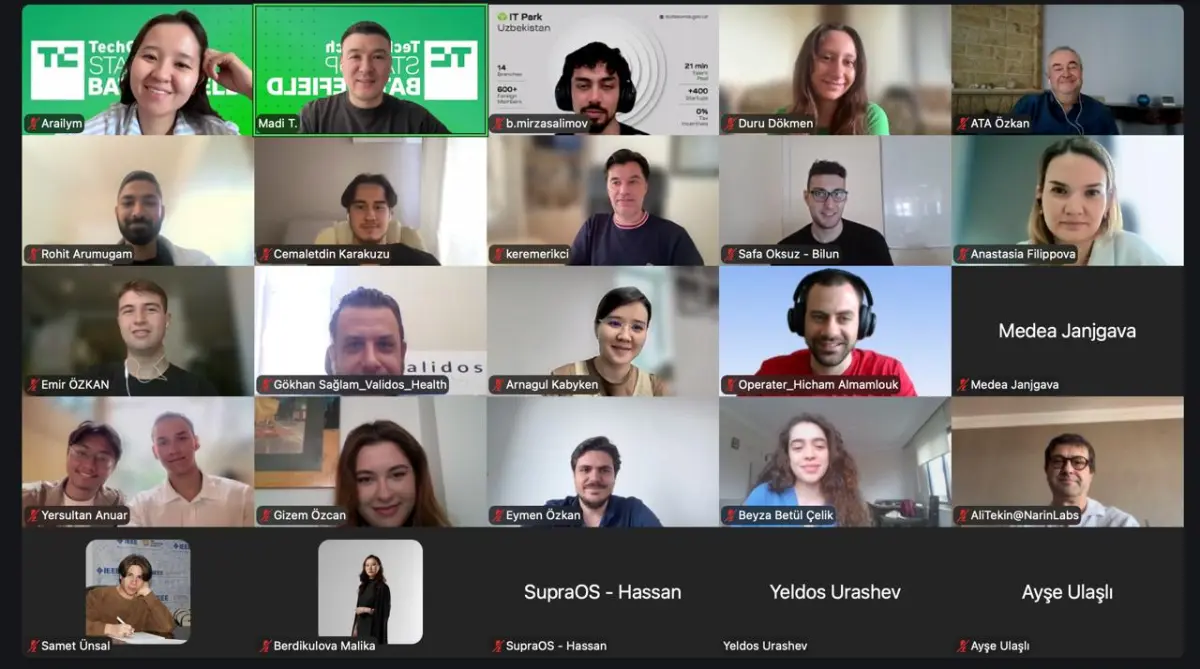
The Road to Battlefield competition, organized by Silkroad Innovation Hub in partnership with TechCrunch, Freedom Holding, Astana Hub, IT Park Uzbekistan, is now in its second year. Its purpose hasn’t changed since it launched: Give founders across Central Eurasia a direct route to TechCrunch Startup Battlefield 200 during this year’s Disrupt from October 13 – 15 in San Francisco.
“For two years now, together with our partners, we’ve been organizing Road to TC Startup Battlefield to give founders in our region a direct line to the top VCs and global ecosystems, one they didn’t have before at this scale,” said Asset Abdualiyev, founder and CEO of Silkroad Innovation Hub. “There’s a lot of talent here the world hasn’t found yet, and that’s exactly who we’re looking for, founders and ideas from every corner of the region who haven’t had their moment.”
The program’s first year, 2025, drew 485 applications from 27 countries, the largest startup pitch event the region had seen at the time. Three startups came out of it to represent Central Eurasia on the global stage: Polygraf AI (Azerbaijan/U.S.), Surfaice (Kazakhstan/U.S.), and Investbanq (Singapore/U.S.).
This year, applications jumped to 726 from 39 countries, which is up nearly 50% in submissions and a dozen more countries than last year. This is a record for the program, spanning Central Asia, the Caucasus, the Middle East, Eastern Europe, and South Asia. Founders pitched online in front of 47 judges from eight countries, drawn from top VC firms, major tech hubs, and founders who’ve scaled their own companies, alongside an AI judge, AI-Dana, as independent jury.
What makes the competition worth watching now, in its second year, is its trajectory. Central Eurasia is now producing one of the fastest-growing startup pipelines in emerging markets, and the numbers back it up.
National rounds for Road to Battlefield 2026 ran online from July 6 to 20. Twenty-two startups came out of it, and they’ll now head to a regional final on August 12. From there, judges will narrow the field to three finalists who’ll represent the region at TechCrunch Startup Battlefield 200.
Meet the Road to Battlefield finalists
Those 22 finalists are MoliyAI (Uzbekistan), Sino AI (Uzbekistan), Deepen (Uzbekistan), Fermopolis (Uzbekistan), Oqim App (Uzbekistan), Cerberus (Uzbekistan), Soup (Kazakhstan), CortexAI (Kazakhstan), Scano (Kazakhstan), 4sell.ai (Kazakhstan), WeGlobal AI (Kazakhstan), ZhanCare.AI (Kazakhstan), Kaptın Kaptın (Türkiye), Pocket eSIM (Türkiye), SeaDar (Azerbaijan), Telagri (Georgia), Admyra (U.S.), Soulward (Kyrgyzstan), Suriy (Mongolia), MVSxAI (Qatar), Looq (Japan), and Defensive Pedal (Romania).
Kazakhstan and Uzbekistan each have six startups in the regional final, a clear sign that these two now stand as the region’s largest startup ecosystems.
“We’re seeing steady growth in AI products, especially from Kazakhstan and Central Eurasia, and that tracks exactly with our vision,” said Magzhan Madiyev, CEO of Astana Hub. “This progress reflects the strengthening of our innovation ecosystem and the tremendous work being done across it. At Astana Hub, our mission is to nurture the next generation of globally competitive founders ready to scale into markets like the U.S., and it’s inspiring to see many of them take the stage, compete internationally, and move one step closer to the world’s leading startup stage.”
In fact, AI dominates the applicant pool: 609 of the 726 startups, roughly 84%, are building AI products, underscoring how quickly the technology has become the default starting point for founders in the region.
“For founders from Uzbekistan and across Central Eurasia, entering international markets is becoming part of their strategy from the very beginning, as more startups build products with the potential to compete and scale globally,” said Azamat Karamatov, CEO of IT Park Uzbekistan. “This reflects the region’s shift toward a more connected and competitive innovation ecosystem. For IT Park Uzbekistan, the priority is to strengthen the pathways that connect high potential startups with international investors, customers, expertise, and leading technology ecosystems. Road to TechCrunch Startup Battlefield contributes to this effort by giving founders from our region the opportunity to participate in TechCrunch Disrupt and the Startup Battlefield stage in the U.S., gain global exposure, build valuable international connections, and engage directly with one of the world’s leading technology markets.”
The competition’s youngest applicant is just 14, and 89 of the 726 applicants, including seven founders from Uzbekistan and Kazakhstan, are under 18. Most applicants are early stage, too: 41.6% at MVP and 38.6% pre-seed, with 14.7% at seed and 4.7% still at the idea stage.
Behind the competition is a wide network of regional partners, supported by leading regional innovation hubs and accelerators across Azerbaijan, Bulgaria, China, Georgia, Kazakhstan, Kyrgyzstan, Moldova, Mongolia, Qatar, Tajikistan, Türkiye, and Uzbekistan: Accelerate Prosperity, Activat VC, Ardventure, Bilkent Cyberpark, Bilişim Vadisi, Caucasus Ventures, CEVF, Doha Business Consulting, Future Laboratory, Future Unicorns, Global Tech Weekend Tbilisi, Hello Tomorrow Türkiye, IT Park Dushanbe, IT Park Mongolia, Khan Tengri Innovation Hub, MOST, Nazarbayev University, SABAH Angels, SABAH Fund, Silkroad Angels, Sofia Tech Park, Startup Moldova, Stanbase, StartupCentrum, and Terricon Valley, with regional media support from TheTech.
This year brought some new stakes to the table, too:
- An $100,000 investment prize pool, split $50,000, $30,000, and $20,000 across the top three finalists, is being funded jointly by Astana Hub Ventures, IT Park Ventures, and Silkroad Innovation Hub.
- The top three winners will get up to $100,000 in OpenAI API credits split the same way, while the rest of the Top 22 finalists will each walk away with $10,000 in OpenAI API credits.
“We’ve been supporting the ecosystem from the very beginning, and this year is no exception,” said Marlen Sikhayev, adviser to the president of Freedom Holding Corp. “What stands out most is how much of it is being driven by AI, solutions built right here in Kazakhstan and across our region that are no longer staying local. They’re being shown to the world, on the same stage as the biggest names in tech. That’s exactly what we set out to support when we backed this initiative, and it’s exactly what keeps us backing it.”
The three eventual winners will also get a fully paid trip and accommodation to TechCrunch Startup Battlefield 200 in San Francisco, along with access to a network of more than 1,000 founders spanning 39 countries.
When you purchase through links in our articles, we may earn a small commission. This doesn’t affect our editorial independence.
>

French publishers have escalated their dispute with Google over AI search, asking France’s competition watchdog to decide whether AI Overviews and AI Mode require separate licensing negotiations. The Alliance de la Presse d’Information Générale, or APIG, filed the complaint on Aug. 11.
Google launched both features in France on July 22. APIG argues the rollout conflicts with commitments requiring Google to negotiate separately over new services, putting the treatment of publisher content in generative search back before French regulators.
The complaint joins other legal and regulatory challenges surrounding AI Overviews, including disputes over publisher compensation and responsibility for generated answers. Google says AI Overviews and AI Mode help users explore complex questions while continuing to provide links to websites.
Google’s publisher commitments face an AI test
France adopted a related-rights law in 2019 that gave press publishers and news agencies protections over certain digital uses of their content. The Competition Authority ordered Google in 2020 to negotiate with publishers in good faith and fined it €500 million the following year for failing to comply with those interim measures.
In June 2022, the Authority made Google’s publisher commitments legally binding. They require good-faith negotiations based on transparent, objective and nondiscriminatory criteria, with a remuneration proposal due within three months of the start of negotiations.
The commitments also require separate negotiations over Google Showcase or any other new Google service, apart from existing uses of protected press content. APIG argues AI Overviews and AI Mode fall under that provision.
Generative AI has already figured into enforcement of the agreement. In March 2024, the Authority fined Google €250 million after finding, among other violations, that Bard, now Gemini, had used publisher and news-agency content to train its foundation model without adequately informing them. The regulator also said it had not determined whether AI uses of press publications fall within France’s related-rights protections.
Publisher controls remain disputed
APIG says Google introduced its AI search features without first opening a separate negotiation with publishers. The complaint follows concern that Google’s AI search expansion could reduce publisher visibility as generated answers occupy more of the search experience.
Google says a Search Console control available in France lets site owners exclude content from generative AI search features without using that decision as a ranking signal for conventional search results.
Pressure over AI content use extends beyond France. The European Commission opened a formal antitrust investigation in December 2025 into whether Google imposes unfair terms on publishers whose content is used for AI Overviews and AI Mode. Separately, publishers have sued Google over Gemini training, alleging existing agreements did not authorize the use of copyrighted works to train its AI models.
The French authority has not announced how it will respond to APIG’s complaint. Any eventual ruling could help determine whether generative search becomes a separate licensing channel or remains part of the long-standing exchange of publisher content for search visibility and traffic.
Read more: Similar tensions are emerging outside traditional news publishing as Reddit reportedly reconsiders parts of its Google AI partnership while AI search changes how users reach source websites.
>

A typhoon gave China’s AI weather models a real-world test — and one system reportedly narrowed down the storm’s landfall days in advance.
Chinese researchers are using AI models to respond to the country’s current weather conditions proactively.
According to Reuters, Shanghai AI Lab’s Fengwu predicted the typhoon’s landfall location and timing five days ahead to within about 30 kilometers and 30 minutes. The result highlights how AI-based forecasting systems could complement conventional weather models by producing useful predictions quickly and with less computing power.
Fengwu is one of several AI weather systems being developed in China, alongside Huawei’s Pangu and Fudan University’s Fuxi, as meteorologists test whether machine-learning models can improve forecasting without replacing traditional physics-based systems or human expertise.
According to The Independent, its developers reported it outperformed Google’s GraphCast on 80% of evaluated weather variables in tests, extending skillful global medium-range forecasting beyond 10 days. That does not mean Fengwu is 80% more accurate overall. The figure refers specifically to the proportion of evaluated variables where it performed better.
Huawei has developed Pangu, while Fudan University has developed Fuxi, giving Chinese meteorologists multiple AI-based systems for forecasting atmospheric conditions.
The models work differently from traditional numerical weather prediction. Conventional systems use supercomputers to solve mathematical equations that represent atmospheric physics. AI models, on the other hand, are trained on vast datasets of historical weather data, enabling them to learn patterns and predict how atmospheric conditions will change.
Once trained, these models can produce forecasts with far less computation.
Why AI weather models are getting attention
The bigger story is not that AI can forecast weather; it is that prediction itself is becoming one of AI’s most practical uses.
The same basic approach can also be applied to problems such as wildfire risk and industrial equipment failures, where identifying a likely future event early can be more valuable than simply describing what is happening now.
Beyond these, there’s also the use of AI in prediction markets like sports and stocks.
Taken together, these give predictive AI a different role from the generative systems that have dominated public attention. Instead of asking an AI to create something, the user is effectively asking it to assess the available evidence and estimate the future.
AI systems aren’t replacing human experts
AI systems can be very good at learning atmospheric patterns from historical data, but weather is a chaotic physical system. Some events are difficult to predict because small differences in atmospheric conditions can produce markedly different outcomes, making it hard for AI models to forecast every weather event accurately.
Besides, AI systems tend to have certain weaknesses, particularly when dealing with edge cases, which are very common in weather forecasting. An unusual combination of weather conditions or a rapidly developing storm can create situations the model may not have encountered often enough during training to make an accurate prediction.
That means AI systems are not replacing the human experts who interpret forecasts. These human experts bring the unique human touch with years of experience to assess uncertainty and identify when an AI prediction may not tell the full story.
What this means for everyone
The clearest advantage of AI forecasting may be speed. Once trained, models such as Fengwu can produce forecasts with much less computation than conventional numerical systems.
If those systems can also maintain useful accuracy farther in advance, that could give emergency officials more time to issue warnings, prepare infrastructure and move people out of harm’s way. For now, the likely future is not AI replacing conventional forecasting, but AI becoming another increasingly important tool alongside physics-based models and human meteorologists.
Other News: Japan is planning a new AI data center in Akita, highlighting the push to expand computing infrastructure beyond the country’s traditional technology hubs.
>

Steven Spielberg to Be Honored at Museum of Modern Art’s Film Benefit

Nia Liston: The Merciless Maiden Anime Reveals VTuber Tsunomaki Watame as Opening Song Artist – News

PSG vs Aston Villa live updates: UEFA Super Cup latest team news, predictions
-

 movies3 months ago
Search For Canadian TV Actor Stewart McLean Now Homicide Investigation
-

 Fashion9 years ago
These ’90s fashion trends are making a comeback in 2017
-
Fashion9 years ago
According to Dior Couture, this taboo fashion accessory is back
-
Fashion9 years ago
Model Jocelyn Chew’s Instagram is the best vacation you’ve ever had
-
Fashion9 years ago
Your comprehensive guide to this fall’s biggest trends
-
Fashion9 years ago
9 Celebrities who have spoken out about being photoshopped
-
Fashion9 years ago
Emily Ratajkowski channels back-to-school style
-
Fashion9 years ago
A photo diary of the nightlife scene from LA To Ibiza