
Tech
Uber Freight reportedly investigating after hacking group claims data breach


A hacking and extortion gang has taken credit for a cyberattack and data breach at Uber Freight, the ride-sharing giant’s logistics subsidiary.
A spokesperson for Uber Freight told Reuters, which first reported the incident, that there was no effect on its business operations and that its systems were running normally (The company did not immediately respond to TechCrunch’s questions about the incident.)
The shipping company is the latest victim in a spate of hacks in recent weeks conducted by the Helix hacking group, which has targeted transportation companies, financial giants, and private equity firms throughout the year. The hackers are known for targeting companies and exfiltrating large amounts of data from their cloud environments, which they then threaten to publish if the victim companies do not pay a ransom.
In a post on its data leak site, which it uses to host the stolen files, the Helix hackers claim to have taken mailboxes, cloud storage drives, files relating to accounts payable and dispatch documents from Uber Freight.
Some of the files seen by TechCrunch appear to show email correspondence between Uber Freight and several of its customers. TechCrunch could not immediately verify the authenticity of the files, which appeared to be dated around mid-June.
Uber Freight has not yet said if it received any correspondence from the hackers, or if it paid the hackers a ransom.
Google said earlier this week that the Helix hacking group is part of a wider umbrella collective of hackers that it tracks as UNC6671. The gang relies on social engineering tactics, such as voice phishing, a tactic that involves calling up IT helpdesks and requesting the reset of employee passwords. Security researchers have long warned that these attacks, while crude and rudimentary, are highly effective at tricking humans into granting access to sensitive systems.
In its blog post, Google said a review of the gang’s bitcoin wallets shows it has made at least $10.6 million in ransom payments between January and May this year.
When you purchase through links in our articles, we may earn a small commission. This doesn’t affect our editorial independence.
>

TL;DR: Dictate emails, notes, and reports as clean formatted text with a Contextli Pro Plus lifetime subscription on sale for $199.99 (reg. $2,450).
Professionals lose hours a week typing out emails, notes, and reports, and most dictation apps hand back a raw transcript that still needs cleanup. Contextli Pro Plus is a new dictation tool that takes voice input and formats it for the task in front of you, and a lifetime plan is on sale for $199.99 (reg. $2,450).
Turn spoken words into finished, formatted text
Speak naturally, and Contextli transcribes what you say, then cleans up and shapes the text based on what you’re writing. Customizable Contexts let a team build repeatable workflows for emails, support replies, documents, code, and marketing notes, so a dictated Slack message reads as a Slack message and an email reads like an email. Streaming transcription shows the words as you talk, so a fast-moving workday doesn’t stall waiting on the software.
This version adds cloud sync across devices for your Contexts, settings, and history, plus priority support when something needs a fast answer. Premium AI models handle complex reasoning and longer-form writing, and 99 supported languages handle teams working across different regions. Global and per-context hotkeys start dictation in a keystroke, and a custom dictionary keeps industry terms and product names spelled right.
Contextli’s lifetime plan includes 48,000 one-time credits, with one credit equal to a minute of cloud transcription, and those credits never expire or reset. Once they run out, Bring Your Own Key mode connects your own provider API keys, or complete offline mode runs local AI and transcription on your device with no credit use at all.
You don’t have to take minutes anymore.
Get a Contextli Pro Plus lifetime subscription for $199.99.

StackSocial prices subject to change.
>

As projects like Pacing the Frontier look to major labs as a way to keep AI research safe, open-source models have become a sore spot for the industry. With free distribution and little control over how they’re used, open-weight models aren’t easily controlled, leading some labs to treat them as downright scary.
But at the Ai4 conference in Las Vegas last week, three of the world’s most respected AI researchers — Nobel Prize winner Geoffrey Hinton, World Labs CEO and co-founder Fei-Fei Li, and Coursera co-founder Andrew Ng — spoke out on the issue. And while they disagreed on particular tactics, all three made a powerful case for keeping AI open.
For the three speakers, the core concern was allowing a handful of major AI companies to control the pace of progress. When a few companies control access to a technology, as Apple and Google do with mobile operating systems, innovation can slow and the companies that control the platforms can influence what gets built on them.
Andrew Ng said that he worried about a similar dynamic emerging in AI. “I don’t want there to be gatekeepers,” Ng said. “That limits how all of us can access AI.”
Companies have an incentive to protect their competitive advantages, including by influencing the rules that govern the industry. That could create a dynamic where only the largest, best-capitalized firms with the resources to build the most advanced AI systems.
Ng’s solution was to maintain multiple providers, with models and companies competing rather than allowing a handful of of players to dominate the field. “If I were to try to give one prescription, it would be to promote openness,” Ng said, “because AI is amazing technology and I want it to be in everyone’s hands.”
But not everyone agreed that open-weight models would help preserve that state of play. Hinton, in particular, drew a distinction between open-source software, which makes the underlying code available for inspection and modification, and open-weight models, which release the parameters of a trained AI model to the public.
“Open source is great. You show people the code, and lots of people look at the lines of code and say, ‘Oh, there’s a bug.’ Open weights means you train a big model and then you give people the weights. That’s very different,” Hinton said. “I was against open [weights] because it makes it so easy for people to take these big foundation models, which are very expensive to train, and for much less money train them to do bad things like cyber attacks.”
But whatever his reservations, Hinton acknowledged that open-weight models are already a permanent fixture of AI. “I think that battle’s been lost. We now have open-weight models, so the barrier to lots of people getting these big models, which was the cost of training foundation models, that barrier has disappeared. It’s too late.”
Yet accepting reality didn’t mean ignoring the risks. Hinton’s position was clear: AI would continue to advance, and he thought that was largely a good thing. He said it would boost productivity and improve education and healthcare. “Worrying about the possible bad effects of AI and the things that intelligent beings might do when they’re smarter than us. I don’t think that’s unfair. I think it is unfair to label anybody who thinks like that as a fear-monger,” Hinton added.
Ng took a different view. The question, he argued, wasn’t whether open models were risky, but who controlled access and who would win the market. Whoever built the cheaper model would have the advantage. If China’s open-weight models gained widespread adoption across Asia, Africa, and/or the developing world, he warned, they could influence how billions of people encountered ideas about democracy, freedom, and human rights.
“One thing I hope we do is encourage American competitiveness and open-source AI. It turns out that AI is a tremendous source of soft power. You can see the way China’s model has tremendous accomplishment with Africa, for example,” Ng said. “But my worry is because of all the lobbying in the U.S. and the fear-mongering, building open-source AI in America is struggling to compete with open-weight models coming out of China, and my worry is that if China figures out a fundamentally more cost-efficient way to build AI, then things that are more cost-efficient have a fundamental business adoption advantage.”
Li pushed back on that framing. “It’s very dangerous to make this a dichotomy between complete openness all the way to complete closedness,” she said. “In complex software systems as well as scientific systems it’s much more nuanced.”
Li used nuclear physics as an example: scientific papers are published openly, but uranium is regulated, while laboratory work falls somewhere in between. The lesson, she explained, was that openness doesn’t have to be an all-or-nothing choice. Different layers of the ecosystem can operate at different levels of openness.
She also highlighted collaborations between public and private institutions, such as the Human Genome Project. The resulting knowledge became a platform that others could build on, she said, allowing pharmaceutical companies to profit, scientists to advance their work and society to benefit.
“So I think we have to use [AI] as that kind of infrastructure,” Li said. “We need some levels of openness, both in scientific discovery, in education, in global partnership, as well as lucrative business models for entrepreneurs. But we also will accept closed-source systems. This debate, especially at the sweeping level of ‘we can only tolerate one,’ is a false debate. We need to get to a level of nuance.”
But everyone agreed that some level of regulation would be necessary to keep AI on the right track. “What we want to do is develop AI in a direction that helps people, and regulation will help us do that,” Hinton said. “You can’t leave it to people like Elon Musk and Mark Zuckerberg to decide how AI should be done.”
When you purchase through links in our articles, we may earn a small commission. This doesn’t affect our editorial independence.
>
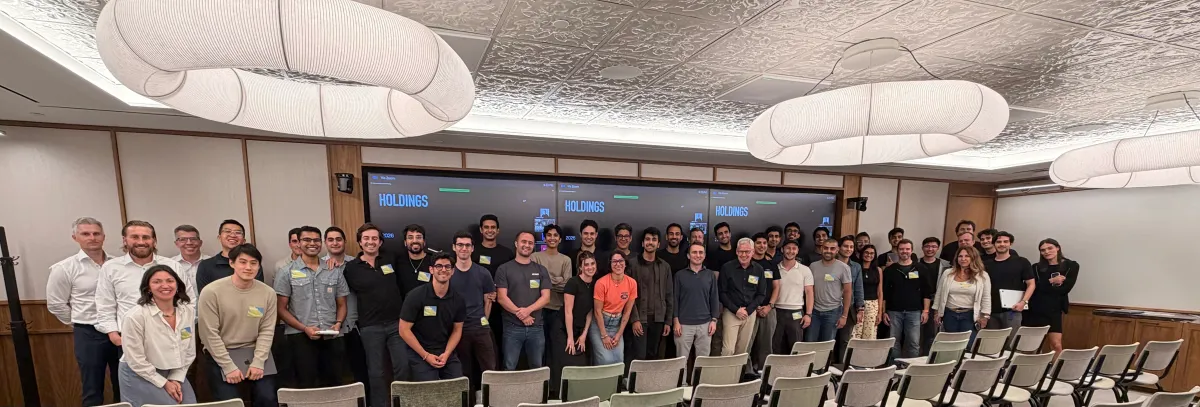
Thrive Holdings has raised $2 billion in new funding at a $12 billion valuation from investors like SoftBank, D1 Capital Partners, and Altimeter Capital.
Thrive Holdings is akin to a private equity firm for AI, buying traditional businesses like accounting firms and implementing AI into their workflows. So far, Thrive has focused on accounting and information technology, but part of Wednesday’s raise will go towards expanding a new vertical in physical assets. Key to that strategy is Thrive’s close relationship with OpenAI.
The New York Times was first to report the news.
The firm is a spinout of Thrive Capital, one of OpenAI’s major investors. In December 2025, OpenAI took an ownership stake in Thrive Holdings. Part of the deal involved OpenAI sending employees to work with Thrive’s companies to accelerate AI adoption.
That hands-on model of AI implementation has become a business in its own right, and may help explain investor enthusiasm behind Thrive’s latest fundraise. OpenAI and Anthropic have both partnered with large private equity firms to launch The Deployment Company and Ode with Anthropic, respectively — billion-dollar ventures that are building teams of elite engineers who embed themselves into enterprises and implement AI solutions into workflows.
The raise comes off the back of proven success for Thrive’s companies, which has surpassed 70 businesses on the Holdings platforms. The company has focused on two pillars to date: Current, its accounting arm with more than 50 firms and more than 2,000 professionals, and Shield, its information technology arm with around 20 companies on the platform.
Current’s self-improving tax agents, dubbed TaxAI, processed more than 7,000 tax returns at 98% accuracy, lowering tax prep times at participating firms by over 30%, according to Thrive. Meanwhile, Shield’s AI products have sped up help desk resolution times by 36x, and the platform has doubled the number of custom AI agents deployed in the last month.
Part of Wednesday’s fundraise will help Thrive launch a third platform focused on regulatory services for the built environment, described by a spokesperson as: “the work required to get physical assets approved, built, certified, and kept in operation.”
“The U.S. needs to build and modernize more critical infrastructure, but projects are often constrained by local, technical, and regulatory complexity,” Anuj Mehndiratta, a founding member of Thrive Holdings, told TechCrunch. “This applies across data centers, manufacturing, healthcare, power, water, transportation, and other physical infrastructure.”
That sort of complexity is where Thrive, well, thrives — large, fragmented, mission-critical, and operationally complex. While Mehndiratta says AI won’t replace field work, local judgement, or professional sign-off, it can help ease manual workflows like research, reporting, permit preparation, inspection documentation, and compliance tracking.
“We think AI partnered with a lot of the experts and practitioners at these businesses can really help compress [regulatory bottlenecks], keep the safety standards high, but also be able to do it with less of a burden to the actual building of that and help it do it more efficiently, lower cost and do it faster,” Kareem Zaki, a founding member of Thrive Holdings, said in a statement emailed to TechCrunch.
When you purchase through links in our articles, we may earn a small commission. This doesn’t affect our editorial independence.
>

‘The Lowdown’ Gets Season 2 Release Date At FX

The Hundred 2026 results: Welsh Fire eliminated after defeat by London Spirit

Transcribe Whole Meetings With This AI Dictation Tool, $199 for Life
-

 movies3 months ago
Search For Canadian TV Actor Stewart McLean Now Homicide Investigation
-

 Fashion9 years ago
These ’90s fashion trends are making a comeback in 2017
-
Fashion9 years ago
According to Dior Couture, this taboo fashion accessory is back
-
Fashion9 years ago
Model Jocelyn Chew’s Instagram is the best vacation you’ve ever had
-
Fashion9 years ago
Your comprehensive guide to this fall’s biggest trends
-
Fashion9 years ago
9 Celebrities who have spoken out about being photoshopped
-
Fashion9 years ago
Emily Ratajkowski channels back-to-school style
-
Fashion9 years ago
A photo diary of the nightlife scene from LA To Ibiza