
Tech
Galbot’s S1 Robot Can Work for Up to 8 Hours and Change Its Own Battery

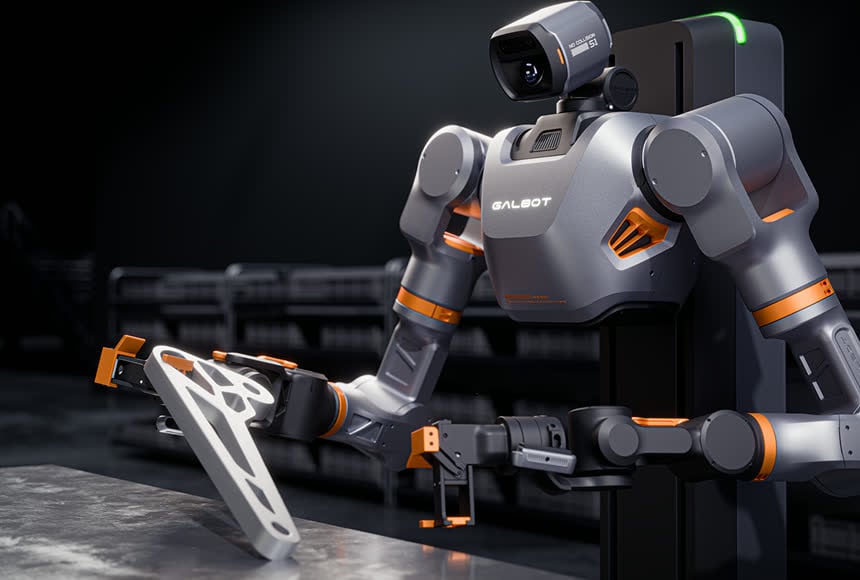
Humanoid robots are getting better at flips, dances, and carefully choreographed demonstrations. Galbot’s S1 is being built for something less glamorous: staying on the job.
The heavy-duty robot is rated for up to eight hours of operation and can autonomously swap its batteries to keep working with minimal downtime. CATL says the S1 has already been deployed on its production lines, where it handles industrial tasks including material transport and picking.
That combination matters because the humanoid robot race is beginning to move beyond what machines can demonstrate and toward a tougher question: Can they work reliably enough to become useful workers?
Galbot S1 is built for heavy factory work
Galbot, headquartered in Beijing, China, designed the S1 for industrial jobs that demand strength and endurance rather than flashy mobility.
According to CATL’s announcement of its partnership with Galbot, the robot features vision-based centimeter-level positioning and 360-degree obstacle avoidance.
Its exact payload capacity is less straightforward. CATL describes the S1 as having a dual-arm payload capacity of 50 kilograms, or about 110 pounds. Galbot’s official S1 specifications, however, list a 15-kilogram capacity per arm and 30 kilograms total, while the same product page separately advertises “up to 50KG payload.”
What the two companies agree on is endurance. CATL says its battery technology enables up to eight hours of continuous operation, while Galbot lists an eight-hour work duration for the S1.
There is an important caveat: Galbot’s technical documentation says that figure comes from laboratory testing conducted at an average speed of 60%. Actual runtime in a factory could therefore depend on the work the robot is performing.
CATL says the S1 has been deployed on its intelligent production lines and is performing what the company describes as extended autonomous operations in battery module and battery pack manufacturing.
CATL says those assignments include material handling and picking, jobs involving repetitive physical work. The company also says the S1 is intended to replace human labor in some high-intensity processes while reducing the physical workload for factory employees.
Eight hours isn’t the S1’s only trick
Battery life is one of the less dramatic limitations facing humanoid robots, but it could become one of the most important.
A robot capable of lifting and moving heavy objects isn’t especially useful if it spends large portions of the day plugged into a charger. For companies considering humanoid robots, uptime can directly affect whether deploying the machines makes economic sense.
Galbot is addressing that problem in two ways.
Alongside its eight-hour runtime rating, Galbot says the S1 supports autonomous hot-swapping of its batteries, allowing the robot to replace a battery rather than waiting for it to recharge.
Galbot markets that combination as enabling “24/7 continuous operation.” That is a manufacturer claim, not independent proof that an S1 can perform every industrial workload around the clock without interruption.
But the feature puts Galbot in interesting company.
Boston Dynamics has also designed its production Atlas robot to autonomously swap batteries. Instead of requiring a human worker to intervene whenever power runs low, both companies are developing robots capable of managing at least part of their own power needs.
That shift may be more consequential than squeezing another hour or two out of a battery.
The goal isn’t simply to build robots that last longer. It’s to build machines that require less human intervention to keep working.
Galbot is putting the S1 through more real-world tasks
The S1’s CATL deployment isn’t its only recent appearance.
At the 2026 World Artificial Intelligence Conference in Shanghai, Galbot demonstrated its robots across retail and industrial scenarios. According to coverage of Galbot’s WAIC demonstrations, the S1 was shown performing factory-oriented work including depalletizing, transporting, and restacking boxes.
The same coverage reported that the robot also demonstrated a more delicate job: identifying small screws, aligning them with holes, and fastening them with an electric screwdriver.
Those tasks illustrate a different side of the humanoid robot race.
Robots that walk, run, or perform acrobatics demonstrate impressive advances in balance and motion control. Factory work presents another challenge: machines must repeatedly recognize objects, manipulate them correctly, respond to changes around them, and perform the same task reliably hundreds or thousands of times.
Those seemingly ordinary jobs can be surprisingly difficult.
A March report from The Guardian examining China’s robotics industry and Galbot’s factory ambitions described engineers working through the complexity of teaching robots something as basic as fastening a screw.
A human worker intuitively finds the hole, aligns the screw, applies pressure, adjusts torque, and knows when to stop. A robot has to perceive and execute each part of that process reliably. That helps explain why industrial humanoid development increasingly revolves around reliability rather than spectacle.
More must-read AI coverage
Humanoid robots are moving from prototypes to coworkers
The Galbot S1 is one example of a broader transition underway in robotics.
For years, humanoid robots were largely research machines and viral-video stars. Now manufacturers are experimenting with robots inside factories, warehouses, and other workplaces.
The appeal is straightforward.
Factories and warehouses are already designed around human workers. Shelves, tools, workstations, and assembly lines generally assume a human will interact with them. Robots capable of navigating those spaces and manipulating the same objects could potentially automate tasks without requiring companies to rebuild an entire facility around specialized machinery.
But “potentially” is still doing plenty of work. A useful industrial robot needs more than impressive hardware. It must perform jobs safely, consistently, and cheaply enough to justify the investment.
Battery life is only one part of that equation. The more significant test for Galbot will be whether robots such as the S1 can keep performing useful work after the conference demonstrations end and the cameras leave.
What this means for everyone else
You probably aren’t deciding whether to put a humanoid robot on a battery production line. But the S1 points toward a technology shift that could eventually affect workplaces far beyond manufacturing.
The important milestone isn’t simply that Galbot rates its robot for eight hours of operation. It’s that companies are designing robots around the mundane requirements of work: shifts, workloads, battery changes, maintenance, downtime, and repetitive tasks.
Autonomous battery swapping is particularly revealing. A machine that can perform a job but constantly needs a person to recharge, reset, or maintain it hasn’t fully removed the need for human intervention. Every task the robot learns to handle for itself potentially changes that equation.
For workers, increasingly autonomous robots could eventually mean fewer physically punishing or hazardous assignments in some industries. They could also reshape jobs that currently depend heavily on repetitive manual labor.
For consumers, the effects may be less visible but still significant. If humanoid robots become economical at scale, they could eventually influence manufacturing costs, product availability, warehouse operations, logistics, and retail.
None of this means the S1 is ready to replace human workers broadly. An eight-hour laboratory runtime and autonomous battery swapping don’t solve the harder problems of reliability, dexterity, safety, judgment, and cost.
But they remove two practical obstacles. And in the race to turn humanoid robots from impressive machines into everyday workers, eliminating those boring obstacles may ultimately matter more than teaching a robot another backflip.
Related reading: For more on the humanoid robot race, read how Tesla is pushing toward an Optimus launch as it works to turn the robot into a real-world product.
>
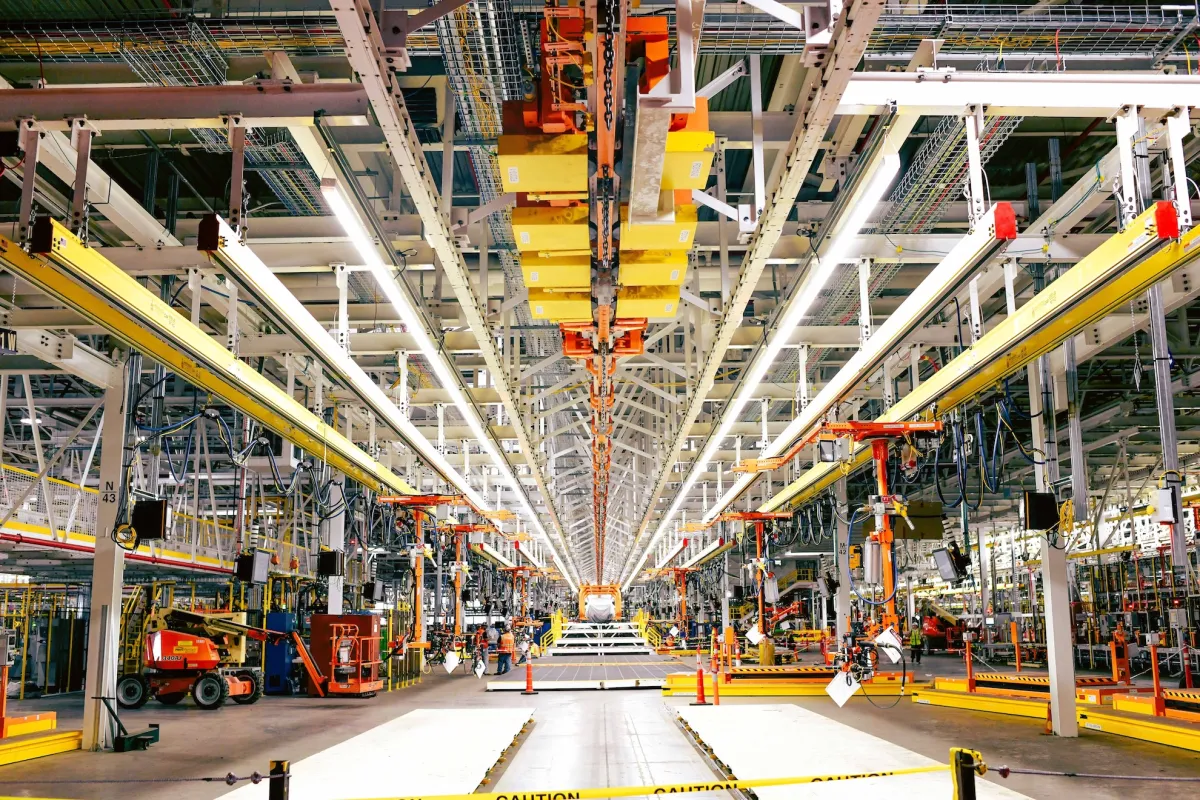
Ford made a $2 billion bet two years ago when it closed its Louisville Assembly Plant in Kentucky and scrapped the assembly line system it had used for more than a century. Its goal was to transform the factory into one capable of making a new generation of affordable EVs.
The auto giant provided an update on Thursday, stating that its factory overhaul is on track and in 2027 will be ready to start producing the Fathom, an all-electric midsize truck that costs less than $30,000 and the first EV built on its new universal platform.
Ford said it expects to begin prototype builds of the Fathom in the first quarter of 2027, with customer vehicles to follow later in the year. The U.S. automaker is already testing production-level tooling ahead of the prototypes.
The stakes for Ford are high. The company’s previous EV efforts were a drag on its profitability, while Chinese competitors and Tesla leapt ahead with vehicles that sell at volume and with a profit margin.
To catch up, Ford ditched the moving assembly line system that its founder Henry Ford launched and turned to a system developed by its skunkworks team led by former Tesla executive Alan Clarke.
This “universal production system,” as Ford calls it, uses a three-branched assembly tree. Ford will use large single-piece aluminum unicastings that use far fewer parts — a technique that Tesla has popularized — and that will allow the front and rear of the vehicle to be assembled separately on two of the branches. The third branch is where the structural battery will be assembled with seats, consoles, and carpeting. The three components will come together at the end of the line to form the vehicle.
As part of the factory rebuild, Ford has also nearly tripled the Wi-Fi coverage density in the factory to 1,080 access points to the kind of high-bandwidth, low-latency connectivity required for software quality checks.
Ford said it will be able assemble the Fathom a net 15% faster than the former vehicles that were built at the Louisville plant.
The company said some employees have already spent months training on the new system at its New Models Program Development Center in Allen Park, Michigan.
When you purchase through links in our articles, we may earn a small commission. This doesn’t affect our editorial independence.
>


If you haven’t already seen a job listing for a “product engineer,” you probably will soon. The job everyone’s suddenly hiring for, this role is like a cross between a product manager and an engineer (as the name suggests). And it’s a hiring trend worth paying attention to.
Companies are opening more of these roles every single month, but they’re struggling to fill them. The reason has almost nothing to do with engineers’ coding skills or years of experience.
The best career move you can make to prepare for these types of roles has almost nothing to do with getting more technical. Instead, it comes down to one of the fluffiest, most overused, and potentially cringiest words in all of tech: mindset.
Stick with me, I promise this goes somewhere useful.
The problem: We were trained to be task-takers
When I started out, my job looked like this:
Drive to an office. Sit through meetings that led to other meetings until a project manager handed me a task they’d already chopped into tiny pieces.
My job was to turn that task into code.
It took years for me to get good at a coding language and tech stack, and once I did, I executed that knowledge against specs that somebody else wrote.
You know what’s freakishly good at that exact job? I’ll give you a hint: It starts with A and ends with I.
Boris Cherny, the creator of Claude Code, recently said: “coding is basically solved,” and “the bottleneck is going to be good ideas.”
So if your entire value is “hand me a task and I’ll build it,” you’re in a footrace with the robots. I don’t like that for you.
The bad news… that is also good news
Many companies are flattening. Middle management is getting stripped out, for better or worse (mostly for worse), which means many of us are doing more with less.
This might sound like purely more work, but it’s also an opening for anyone who cares about what they’re building and can put on their manager hat. Companies are no longer just hunting for the strongest engineer in one narrow domain.
What’s rare, and what actually moves revenue, is an engineer who can spot the thing that’s quietly costing money and either flag it to leadership or just go fix it.
What this actually looks like
Being product-minded has NOTHING to do with your tech stack.
Here’s where to start:
Have an opinion and back it up. As a former engineering manager, the worst thing I ever heard was silence. I’d often ask the team what they thought because I doubted myself and wanted a gut check. I was grateful to the ones who said “nope, bad idea, here’s why.” Pushback is a gift.
Learn the domain, casually. Work for a plumbing company? You don’t need to become a plumber, but spend an hour on Reddit threads where plumbers vent. Now your ideas come from your potential customers.
Make experiments cheap and safe. This is where any engineer has massive leverage. Experiments are not free. A bad one loses customers and frustrates users. Tools like LaunchDarkly and Optimizely let you ship a change to 5 percent of users and roll it back the second it tanks. Learn them, or build a scrappy version yourself. A team that can quickly run safe experiments will out-learn everyone else in the building.
Be data-driven. Stop fighting about button colors. Pick a goal: making money, finding product-market fit, or making the product sticky so people come back. Then measure it. If your gorgeous redesign tanks time-on-site, it failed, no matter how good it looked to you. If the ugly version makes more money, ship the ugly version.
You don’t have to be the ideas person. Maybe you’re not a visionary. That’s fine. Organize a hackathon around an actual company goal. Pull up your company’s quarterly targets and build something against one of them. Don’t know what those targets are? That’s your first assignment.
Good ideas are the new bottleneck—and they always have been
When I was a manager, I asked myself one question every week: What’s the single most impactful thing I could do right now? The answer was almost never “write more code.” It was understanding a gnarly problem nobody had defined yet. Building a deck to spread knowledge that was in one person’s head. Getting the right three people in a room to actually make a decision we’d been putting off.
Code is cheap, and it always has been. We just couldn’t see it, because for decades the typing took so long that it felt like the hard part. It never was. The hard part was always knowing what’s worth building.
— Brian
In January 2025, Siobahn Day Grady launched the first AI research institute at a historically Black college or university. The institute aims to help expand AI skills for all students at North Carolina Central University, where Grady is an associate professor, through both AI research opportunities and skills training. Though the institute is the first of its kind, Grady hopes it could serve as a model for other HBCUs.
Read more here.
AI is increasingly used in the scientific research process. So does publishing need to change to keep up? Jiachen Liu recently co-authored a paper published on ArXiv arguing that the PDF should be replaced with an “Agent-Native Research Artifact” designed with AI in mind. In this interview with IEEE Spectrum, Liu lays out a provocative vision of AI-driven research and an infrastructure that captures—and learns from—details that often get left out of today’s papers.
Read more here.
Astronomers still don’t know exactly what dark matter is, but they can detect it—and so can you. With a small radio telescope and a few other pieces, you can create a DIY setup to gauge how fast hydrogen clouds are moving across the Milky Way. Feed those measurements into a spreadsheet, and you can see the same signals that have baffled the astronomical community for decades.
Read more here.
From Your Site Articles
Related Articles Around the Web
>

X is significantly expanding its open-source codebase, which includes the app’s “For You” algorithm and its core ranking engine, and adding a feature that will let users see if their account or posts have been impacted by any of its ranking systems, the social network said on Thursday.
The company is making the source code for the “For You” timeline, the default feed you see when you open the app, available on GitHub under the Apache v2 license. It’s also expanding its previous efforts to open-source parts of its codebase to add more detail, including the model configuration, filter, and core ranking system details. That means it includes the parameters used to weight different signals — key to understanding which posts are actually displayed. This also makes the codebase roughly 10 to 15 times larger than it was before.
“You’ll get the core ranking code that pulls posts and ranks them for any given user and assembles the feed,” X’s VP of Product, Keith Coleman, told TechCrunch in an interview ahead of the announcement. “You can see the systems that filter out potentially problematic, rule-violating content…And some of those systems, like the ranker and the score, you can even run yourself outside the company.”
“This is this kind of thing that I think people will be fairly shocked that we are releasing,” he added.
In addition to the repository, X is providing tools that will let users see for themselves if and how X’s ranking systems have impacted their account or posts. A new transparency tool is rolling out to an “Under the Hood” page in the app’s settings, which will let users who have posted ten or more times over the past month download their aggregate stats as a JSON file. The file will show if any labels have been applied to their account or posts over the past calendar month.
Non-technical users can take advantage of this information by dropping it into an LLM of their choice, pointing the AI at X’s GitHub repo, and asking for an interpretation.
The company notes this tool will initially be available to a test group of accounts at least a year old as a pilot, before rolling out more broadly.

Ahead of launch, the company previewed its open source codebase to external researchers familiar with recommendation systems, who were able to get the “score,” or the numerical value calculated for every post, up and running outside of X. That was a major milestone for X’s transparency efforts, Coleman says.
From the GitHub repository, developers will be able to submit updates, known as pull requests, which X engineers will consider incorporating into its algorithm. While not all additions will make the cut, Coleman is enthusiastic about the idea.
“That would be amazing to have people submitting code that improves the algorithm…I mean, how cool would it be for the X algorithm to be not just visible to the public, but also, like, by the public?,” he said.
However, a few systems are not included in this release, like those that use Grok to predict whether a post could be violating a rule. This is meant to protect X from bad actors who could use this information to work around the company’s rules to flood the network with spam.
The changes are meant to address continuing concerns about how X’s algorithm influences politics, elections, the spread of misinformation, and more.
The platform has been home to political figures and high-profile individuals for years, and is now owned by a trillionaire who helped President Trump get elected. But Twitter had been under attack over its lack of transparency before it was bought by Musk, too. In earlier years, Republicans in Congress alleged that the California-headquartered social network leaned too far left, and claimed the network had “shadowbanned” their posts — meaning their posts were made invisible or undiscoverable without their knowledge. Twitter consistently denied this was the case.
“Our dream is that anyone in the public can be able to assess how posts are distributed on the platform, vet that it’s a level playing field, and, if they think it’s not, critique it so we can keep improving it and addressing it,” Coleman said.
“That’s the whole goal of this: [the code] can be audited; it can be critiqued. We’re going to listen, and we want to make the system one that people like and trust, and feel is fair,” he said.
Though X may be pushing itself to be more transparent around its code and other features, like its crowdsourced fact-checking system, Community Notes, it has arguably become less transparent overall under Musk, after becoming a private company again. No longer required to report to the SEC, X isn’t as forthcoming in other areas, like its user metrics, growth, revenue, or government takedown requests, which are now less frequently reported.
When you purchase through links in our articles, we may earn a small commission. This doesn’t affect our editorial independence.
>

Xavier Parker agrees new long-term Manchester City contract

9 Best Superhero Shows to Watch on HBO Max

Paramount Primal Picks Up Action Fantasy ‘Tower Defense’
-

 movies3 months ago
Search For Canadian TV Actor Stewart McLean Now Homicide Investigation
-

 Fashion9 years ago
These ’90s fashion trends are making a comeback in 2017
-
Fashion9 years ago
According to Dior Couture, this taboo fashion accessory is back
-
Fashion9 years ago
Model Jocelyn Chew’s Instagram is the best vacation you’ve ever had
-
Fashion9 years ago
Your comprehensive guide to this fall’s biggest trends
-
Fashion9 years ago
9 Celebrities who have spoken out about being photoshopped
-
Fashion9 years ago
Emily Ratajkowski channels back-to-school style
-
Fashion9 years ago
A photo diary of the nightlife scene from LA To Ibiza