CHICAGO — In the supposed dog days of August, the Chicago Cubs returned to Wrigley Field with a record 20 games above .500 and the Milwaukee Brewers in their sights. Mr. T threw a ceremonial first pitch and led the seventh-inning stretch as a crowd of 40,374 gathered for Friday afternoon’s matchup against the St. Louis Cardinals, a historic rival. And roaring sounds from the sky echoed throughout the ballpark during the practice runs for this weekend’s Chicago Air and Water Show.
With momentum on their side, the Cubs are grappling with an issue that would have seemed unthinkable while injuries kept piling up throughout this season: too many good pitchers and not enough open spots.
“It’s certainly better than the alternative,” Cubs manager Craig Counsell said. “Absolutely.”
Good teams are supposed to have this level of internal competition, rolling roster crunches across the 162-game schedule that force the coaching staff and the front office into difficult decisions. There will be more setbacks and unforeseen problems, but the Cubs are nearing that point where everything takes on a different sense of urgency.
Those pressure situations suit Clay Holmes, an All-Star closer with the New York Yankees who remade himself into an Opening Day starter for the New York Mets. And given Kevin Gausman’s impressive resume, Holmes wasn’t even the most accomplished pitcher the Cubs acquired at the trade deadline.
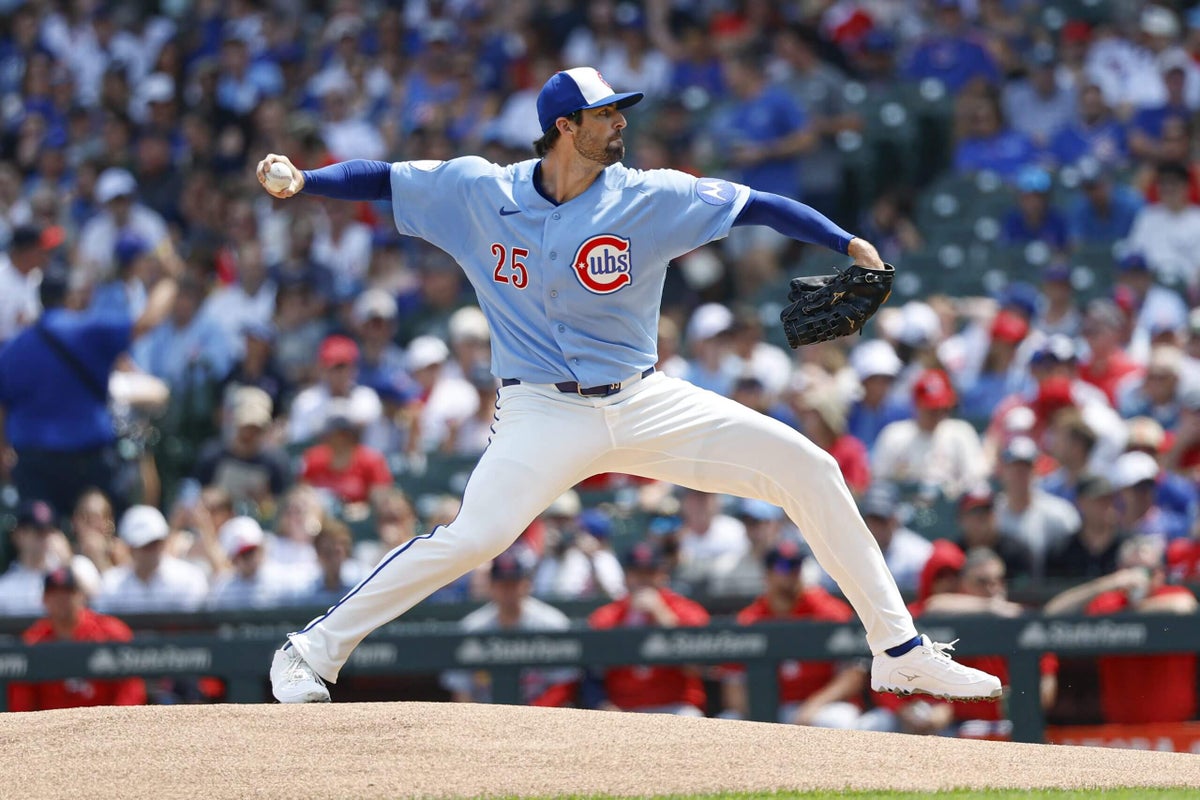
In his first career start at the Friendly Confines, Holmes showed why the Cubs gave up top-100 prospect Jefferson Rojas in a deal with the Mets, taking a perfect game into the sixth inning of Friday’s 3-0 victory over the Cardinals.
Why are baseball catchers getting hit in the… groin so much more often?
Tifo Sports
“That’s what you imagine,” Holmes said. “Pitching at Wrigley with a Cubs uniform on, in a Friday day game, it’s special. It’s iconic. To do it with this team — and these guys that have been so great at welcoming me in — was a lot of fun.”
Holmes projected to be such a good fit for this defense and at this moment that Jed Hoyer’s baseball operations group looked beyond his option to become a free agent after this season, as well as the fractured fibula that sidelined him for almost three months.
As expected, Holmes looked rusty in his first major-league outing since both the May 15 injury and the Aug. 3 trade deadline. He had made three rehab starts with three of the Mets’ minor-league affiliates this summer. But Saturday’s performance on the road — he allowed four runs in four innings and took the loss against the Kansas City Royals — indicated he wasn’t totally in rhythm yet.
Known for his heavy sinker, extensive pitch mix and ability to generate weak contact, Holmes kept the Cardinals off the bases until the sixth inning, when José Fermín lined a one-out single into right field. Over 6 2/3 innings, Holmes gave up only that hit, plus a walk to Jordan Walker, the 22nd and final batter he faced. He exited the game to a standing ovation.
“Coming back from injury, it’s always a process,” Holmes said. “I probably wasn’t as bad as my stat line last time, and I probably wasn’t as good as my one this time. It’s just one of those things where you have to keep finding ways to get better. In between starts, there were some simple things that we worked on (and) tried to nail.
“Step by step, I’ll eventually get back to the pitcher I know I can be. I feel good, and I feel like the stuff’s there, but just getting that final little bit back is the hardest part.”
Holmes and Gausman — added with the idea that they would work at or near the front of the rotation along with Matthew Boyd — should have a runway through the end of the regular season. But looking ahead to the final stages of the playoff race, as well as at the roster possibilities for October, the Cubs will have multiple options.

Seiya Suzuki’s three-run home run in the sixth inning accounted for all of the Cubs’ scoring. (Kamil Krzaczynski-Imagn Images via Reuters Connect)
Edward Cabrera, the club’s signature offseason pitching acquisition, is expected to be activated off the injured list to start Sunday against the Cardinals. That anticipated move will slot Shota Imanaga into Monday and the opening of a three-game series against the Chicago White Sox at Wrigley Field.
Cabrera still has not become the next-level pitcher the Cubs envisioned when the Miami Marlins traded him last winter, posting a 5.10 ERA and a negative WAR rating (-0.8, per Baseball Reference) over 14 starts, leaving much to prove.
Imanaga has been the club’s most durable and consistent starter this year, compiling a 3.74 ERA while leading the Cubs in starts (24) and innings pitched (137 1/3). His late-season drop-off last year — the Cubs avoided using him during their playoff-elimination loss in Milwaukee — also can’t be ignored.
For now at least, Counsell ruled out the idea of using a six-man rotation, which could bump David Peterson into a bullpen that already includes swingmen Javier Assad, Colin Rea and Aaron Civale, and no obvious reliever to clear out with a minor-league option. The Cubs want to get to Cabrera’s start before announcing their plans.
“Five starters is what we have to use here to protect everybody else,” Counsell said. “It just means somebody’s not going to start for at least one time through. And I don’t think we are bound to any of this.”
There’s also the long list of pitchers on rehab programs, most notably Ben Brown, who functioned as a high-leverage reliever and a top-of-the-rotation starter at various points this season, until a chronic neck injury sidelined him in late June.
After completing a bullpen session Friday, Brown estimated he’s “probably three weeks, four weeks away, if all goes well,” while adding a dose of realism to the roster projections.
“There’s no givens here — you don’t just step back into your role,” Brown said. “I’ve been saying the same thing for the last five years I’ve been a Cub: I want to be a major-league starting pitcher. But I just got to get to tomorrow, honestly. That’s priority No. 1: Just keep progressing.
“This is a really talented team. There’s not a lot of spots available on this team. I’ve got to go out there and pitch well to earn my opportunity to pitch in September and in the playoffs.”
That motivation pushes players through the monotony of spring training and the ups and downs in a six-month season. If Wrigleyville is like this during the dog days of August, just picture the neighborhood on crisp October nights.
“You feel the environment,” Holmes said. “You feel the passion they have here. You just feel that they love baseball. They love winning baseball. It’s just fun to be a part of that. It was definitely a warm welcome.”