
Tech
Apple Warns Users in 110 Countries of Mercenary Spyware as iPhone Alerts Get Harder to Miss

Apple’s mercenary spyware warnings are getting harder to miss. The alerts now appear directly on the iPhone Lock Screen and in Settings, putting them in front of targeted users before they even reach their inbox.
On Aug. 13, 2026, Apple confirmed that it sent a new round of threat notifications to targeted users in 110 countries. The alerts do not indicate a mass compromise: Apple describes them as high-confidence warnings that specific individuals were targeted, not proof that spyware was successfully installed.
BleepingComputer confirmed the 110-country figure with Apple. Apple’s threat notification guidance says the company has issued warnings multiple times a year since 2021 and has notified users in more than 150 countries overall.
A warning signals targeting, not a confirmed breach
Apple bases the notifications on its own threat intelligence and investigations. Mercenary spyware campaigns have historically targeted small numbers of journalists, activists, politicians and diplomats, while Apple says the vast majority of users will never face such attacks.
The company does not disclose what evidence triggered a notification or attribute individual alerts to a particular attacker or region. Apple has not identified the spyware behind the Aug. 13 warnings, so there is no basis to link this batch specifically to NSO Group’s Pegasus or another named product.
Past warnings have preceded confirmed infections. Citizen Lab researchers forensically confirmed in 2025 that journalists who received Apple notifications were targeted with Paragon’s Graphite spyware, including one device compromised through a zero-click iMessage attack.
Apple has also experimented with more visible protections in Messages. In July, an iOS 26.6 beta revealed a malicious iMessage warning designed to flag potentially dangerous messages and let recipients report them.
Verify the alert before responding
Recipients can verify a warning by signing in directly at account.apple.com, where Apple says a legitimate threat notification appears at the top of the page. Genuine threat-notification emails will not ask users to open attachments, install apps or configuration profiles, or provide an Apple Account password or verification code.
Apple urges notified users to seek expert assistance. Access Now advises at-risk civil society users not to erase a potentially affected device because doing so can destroy evidence that may be useful for forensic analysis.
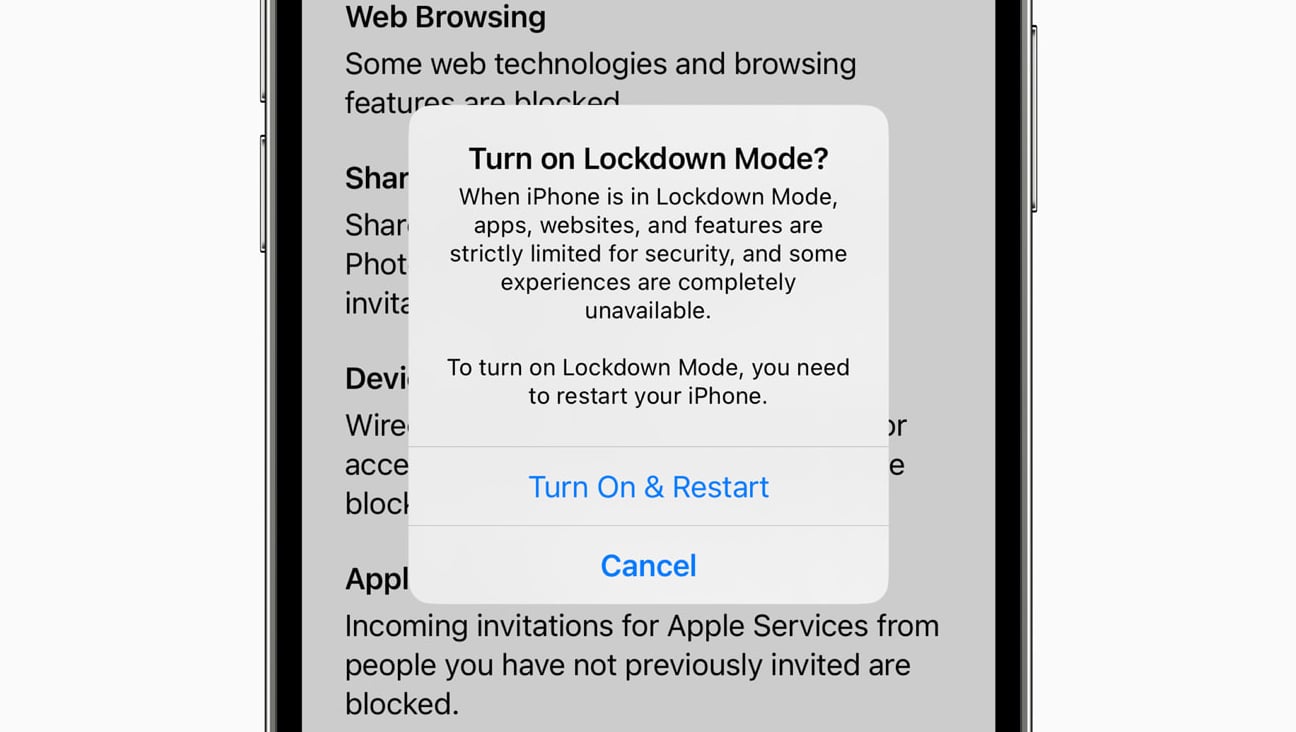
Lockdown Mode is another recommendation. In March 2026, Apple told TechCrunch it was not aware of any successful mercenary spyware attack against an Apple device while Lockdown Mode was enabled.
Keeping devices patched remains important. Apple has been releasing some iPhone security fixes sooner rather than waiting for broader iOS releases, and its July updates patched 194 unique vulnerabilities across iPhones, Macs and other devices.
Organizations supporting high-risk personnel should establish who verifies a warning, who handles escalation and when Lockdown Mode or outside forensic help should be used. Treating mercenary spyware alerts as an incident-response scenario rather than an ordinary user-support ticket can reduce delays when a targeted employee receives one.
Read more: The spyware alerts add to a broader 2026 pattern of Apple security fixes, with zero-days and exploit chains continuing to shape iPhone risk management for organizations maintaining large mobile fleets.
>

Comcast has rolled out a new motion sensing technology to its latest home routers, allowing homeowners to receive notifications about activity detected inside their house while they are away.
The free feature, called Wi-Fi Motion, turns newer Xfinity gateways into motion sensors by detecting interruptions to the Wi-Fi signal of the wireless network, and sends a notification through the Xfinity app.
As first reported by The Verge, the new Wi-Fi Motion feature works for advanced Xfinity gateways XB7 and newer models and is opt-in, which means users can choose whether to switch on the feature in the Xfinity app. As quoted by the publication, customers can use this feature for “motion detection in their home and for a basic level of security.”
There is a privacy trade-off. By enabling the feature, Comcast says it may disclose information generated from a customer’s use of Wi-Fi Motion to outside parties under a broad array of reasons — and Comcast also says it doesn’t have to tell you.
“Comcast may disclose information generated by your Wi-Fi Motion to third parties without further notice to you in connection with any law enforcement investigation or proceeding, any dispute to which Comcast is a party, or pursuant to a court order or subpoena,” reads an Xfinity support page.
That’s something to consider before you switch on the feature, particularly if you’re privacy conscious.
>

Camera-equipped AI wearables today have developed a bit of a reputation problem. Devices like Meta’s Ray-Bans raise concerns about people being recorded without their consent. So the idea that Apple is reportedly preparing to release AirPods with cameras in them seems to conflict with the iPhone maker’s desire to position itself as a privacy-focused tech company.
But Apple’s now-leaked camera-equipped AirPods may not be as creepy as they first sound.
The rumored cameras were reportedly confirmed via video footage found in Apple’s macOS 26.7 RC (short for “release candidate,” or the final test version of the software before it ships publicly). The footage shows a man holding up a book while wearing AirPods and apparently having a conversation with Siri about it.
The audio track accompanying the video says: “With Visual Intelligence, your world becomes savable. See something you like? Just ask me to save it for later.”
The addition of cameras to the popular wireless earbuds is further confirmed through code that references a “Hair Detected” error, which would warn users when their hair is covering the AirPods’ camera. The launch of such a device could very easily backfire on Apple if not done right.
For a company whose brand is built on trust, this is a bigger gamble for Apple than one of its typical hardware refreshes. AirPods currently blend as a simple iPhone accessory that people wear all day without a second thought. A change like this could instead push them to the front of people’s minds, making them wonder whether the person opposite them is secretly recording.
Apple appears to have thought this through, based on prior reporting. According to an earlier report from Bloomberg’s Mark Gurman, the AirPods with cameras won’t be able to record media. As Gurman put it:
“The cameras essentially act as eyes for the Siri digital assistant and aren’t designed to take photos or video. These components — located in both the right and left earbuds — allow the device to capture visual information in low resolution.”
In other words, the goal isn’t to turn one of Apple’s best-selling accessories into a surveillance device (lest they become “pervert pods”). It’s to provide a way for AirPods owners to engage with the newly upgraded Siri AI, which is set to ship in September with Apple’s iOS 27 and other software updates.
That means an AirPods wearer could look at something — like a book, as shown in the leaked video, or perhaps some ingredients they’re preparing to cook, per Gurman’s earlier reporting — and simply ask Siri for help. The feature could also be useful for turn-by-turn walking directions when navigating an unfamiliar city.
For Apple, the bigger strategic bet is that this feature could also push consumers toward, if not a screen-free future entirely, then at least one where there’s less need to pull out an iPhone throughout the day. By baking AI access into a commonly worn and already socially acceptable wearable, Apple’s customers could interact with the world around them in a more natural way than staring down at a glowing screen.
There is one wrinkle, though. Gurman also reported that the new AirPods would include an LED indicator that lights up whenever the device is sharing visual data to the cloud. He questioned the light’s visibility, given the AirPods’ small size, but either way, its inclusion could work against Apple. Though it’s the right thing to do from a transparency and privacy perspective, that LED risks visually lumping AirPods in with other AI wearables already facing public skepticism, like the Meta Ray-Bans, Snap’s Specs, or Google’s new AI glasses. Apple can control what the cameras do, but it’ll have far less control over what people assume they do.
When you purchase through links in our articles, we may earn a small commission. This doesn’t affect our editorial independence.
>

Social networking site Bluesky says its recent day-long disruption was caused by a distributed denial-of-service (DDoS) attack that flooded the site with junk traffic. The social network confirmed the incident in a post on Monday, confirming the attack had taken place over the previous 24 hours.
“We have upgraded our defenses in response, and we continue to monitor the situation,” Bluesky said in a post, without disclosing any more details.
A spokesperson for Bluesky did not immediately respond to TechCrunch’s questions about the attack.
DDoS attacks involve pummeling a website or server with large amounts of junk traffic with the aim of overloading its resources and knocking it offline. These kinds of attacks often rely on using large amounts of hijacked internet-connected devices — enlisted into a residential proxy network or a botnet — to harness their unused internet bandwidth to flood web servers.
Security researchers discussing the attacks in the IFIN public forum report that Iran-backed attackers have claimed responsibility for the attack. Iran has increased its attacks on U.S. businesses and critical infrastructure since the start of the U.S. and Israel-led war earlier this year.
This is the latest large-scale DDoS attack to affect the social networking site in recent months. In April, the site was hit by a prolonged series of outages caused by a similar flood of web traffic. It’s unclear if the attacks are linked.
>

Ken Kao’s Waypoint Strikes First-Look With Watch This Ready

England v Pakistan: A huge challenge, but Joe Root can finish captaincy story

Love After Weight Loss Reality Dating Show Lands at Netflix
-

 movies3 months ago
Search For Canadian TV Actor Stewart McLean Now Homicide Investigation
-

 Fashion9 years ago
These ’90s fashion trends are making a comeback in 2017
-
Fashion9 years ago
According to Dior Couture, this taboo fashion accessory is back
-
Fashion9 years ago
Model Jocelyn Chew’s Instagram is the best vacation you’ve ever had
-
Fashion9 years ago
Emily Ratajkowski channels back-to-school style
-
Fashion9 years ago
9 Celebrities who have spoken out about being photoshopped
-
Fashion9 years ago
Your comprehensive guide to this fall’s biggest trends
-
Fashion9 years ago
A photo diary of the nightlife scene from LA To Ibiza