
Tech
AI isn’t close to curing cancer. This startup says it knows what it will take.

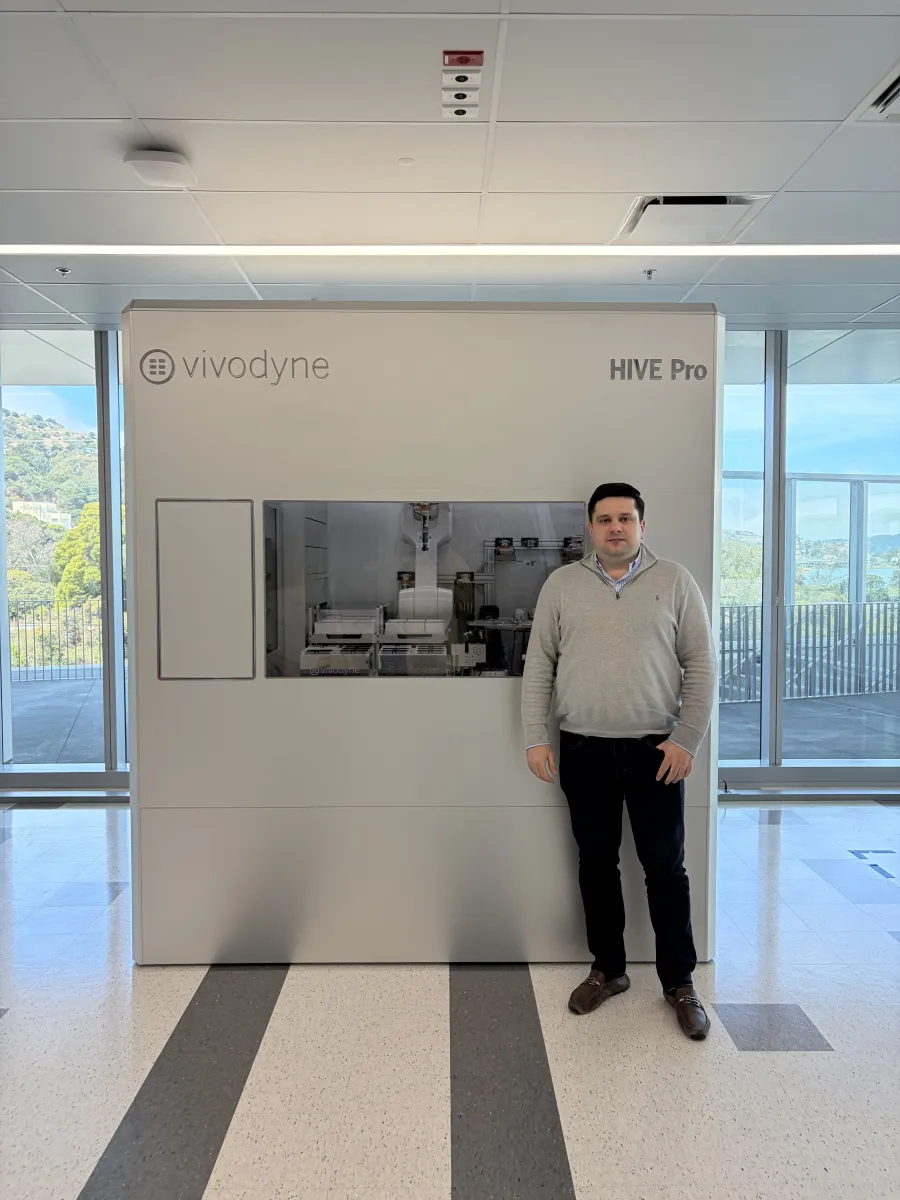
A biotech startup called Vivodyne says the AI drug-discovery industry has a data problem, and that it has built a machine to fix it.
HIVE, modular robotic labs built by the company, can grow 20 kinds of human tissue, then autonomously dose and monitor them, generating the kind of causal biological data that today’s AI models are missing — data that today mostly comes from animal testing, or studies of single cells or proteins, not living tissue.
“Absent human testing, what are these [AI] models going to do?” asks Andrei Georgescu, Vivodyne’s CEO and co-founder. “They’re going to cure cancer in mice.”
Even Anthropic CEO Dario Amodei wrote over the weekend that claims that AI will cure cancer have become more cliche than credible — “the thing that will work is actually curing cancer,” as he put it.
To be fair, the idea that AI will cure cancer is something Amodei himself has tossed out in previous essays; Sam Altman has repeatedly cited curing cancer as a justification for OpenAI’s push toward AGI and ever-larger compute buildouts; and Google DeepMind’s Demis Hassabis said last year that AI could potentially cure all disease within a decade.
The actual results remain tepid. A handful of AI-designed drugs have proceeded into human trials — one as far as Phase III, widespread human testing — but the reality is that the roadblocks aren’t necessarily ones that AI can solve today.
Nobel-prize winning Alphafold was a big advance for understanding the building blocks of life, but it has yet to actually produce a new drug. Isomorphic Labs, founded to build on Alphafold, is expecting its first trials, originally planned for 2025, by the end of this year. In February, the company wrote that true drug discovery will require “highly accurate predictive models, across an expansive range of biochemical properties and interactions.”
Georgescu says the space needs “a sanity check”— that existing models don’t have the data to capture the complexity of human biology. It’s a challenge already facing the pharmaceutical industry, where 90% of drugs that are effective in animal testing to enter clinical trials don’t receive regulatory approval for humans.
Vivodyne’s plan is different. Vivodyne was spun out of the University of Pennsylvania in 2021, after Georgescu received a PhD in bioengineering there. The company says its tissues closely match the behavior of real human organs — that its liver cells have 94% predictive accuracy compared to human trials that test for toxicity, its airway tissue matches the behavior of real human tissue 96% of the time, and its bone marrow has achieved 100% concordance in tests of 20 different chemotherapy drugs.
Last week, the company, which has raised just under $80 million across two rounds led by Khosla Ventures, opened what it calls the world’s largest “human data center” just outside of San Francisco, and Georgescu says his team is already achieving twice the throughput of all the animal trials being held in the US.

The idea is to accelerate the path of drug candidates by having a better idea of what will work before going through the expense of a clinical trial, which typically costs tens of millions of dollars. Though it won’t name its partners publicly, Vivodyne says it is working with multiple major pharma companies to solve a problem that Georgescu compares to automotive crash tests: An automaker is typically confident its car will pass NHTSA requirements before testing it, but drugmakers rarely have that same confidence going into a clinical trial, where the vast majority of drugs fail to win FDA approval.
But there is a larger vision: Georgescu sees his autonomous biology labs as key to generating the kind of causal data that can be used to train new models on human biology. He points to studies like this one, published in Nature Methods last month, that find no clear data scaling laws when training generative AI models on existing cellular data.
“All the training is done on static snapshots of these cells, and the models are not conditioned at all by the how a cell got to that state,” Georgescu told TechCrunch. “In other words, the model learns ‘this is cell state A,’ ‘this is cell state B,’ but never ‘cell state B is the effect of inflaming cell state A.’”
Vivodyne’s HIVE machines, however, are tracking hundreds of thousands of ongoing experiments where diseased tissue is exposed to some stimulus, which Georgescu expects to provide the kind of reinforcement learning that will produce AI models that understand human biology enough to make more meaningful progress in healthcare.
Georgescu believes that will be key not just for today’s medicine challenges, but also for a future where complex diseases require drugs that, unlike the majority of those available today, target multiple pathways.
“If we want combination therapies, the space that has to be searched explodes—it can’t be an experimental approach,” he told TechCrunch. “You have to say, ‘I want this effect to happen, so what cause should I invoke?’ Establishing causality in human biology is the basis of all of this.”
When you purchase through links in our articles, we may earn a small commission. This doesn’t affect our editorial independence.
>

College is a constellation of Venmo requests — your roommate’s cut of the utilities, your half of an Uber ride, the ticket to your friend’s a capella performance that you don’t actually want to go to. On Wednesday, Venmo’s parent company PayPal announced that you will now be able to use its services to pay your tuition.
Venmo and PayPal are partnering with the education payment platforms Illumia, Nelnet Campus Commerce, and TouchNet, which collectively serve thousands of colleges and universities, giving students and families another way to pay their tuition.
Yes, you can make one of the largest payments of your life on the same app where you can see that someone from high school is paying for “leaf emoji, fire emoji, smoke emoji,” whatever that could possibly mean. You might open the Venmo app when your friend gets you a latte, then think, “Oh, right, I haven’t paid my tuition yet! Let me do that real quick.”
“For students and families, tuition is the single biggest financial decision they’ll navigate for higher education,” said Nelnet Campus Commerce president Jackie Strohbehn in a statement. “Every payment option we add, including PayPal and Venmo, is about meeting them at that moment with more flexibility and less friction, so affordability isn’t a barrier to staying enrolled.”
Finally, someone said it! When eighteen-year-olds who make $10 per hour at the campus library confront their five-figure tuition bills, they’re really just wishing that someone would meet them at that moment with more flexibility and less friction.
Kids these days don’t know how good they have it. We used to go into debt via unfamiliar payment portals, but now, you can deplete your bank account within the comfort of the Venmo or PayPal app.
Back in my day, we didn’t have an “integration [that] enables institutions to broaden choice and create a more frictionless payment experience for students and families,” to borrow TouchNet president Jeremy Loch’s phrasing. Gone are the days when students will lack access to “a seamless experience that delivers value for both tuition payers and institutions.”
When you purchase through links in our articles, we may earn a small commission. This doesn’t affect our editorial independence.
>

Data center developers are expected to spend as much as $4 trillion by the end of the decade — and they’re already heavily constrained by both political and power-grid considerations in where they can build. But while most treat the speed of fiber as a given, one company is betting that faster fiber could change the geographical math behind the data center buildout.
On Tuesday, Relativity Networks announced $22 million in SAFE note funding drawn by Rhapsody Venture Partners, Bell Ventures Inc., and Faster Than Glass LLC, among others. A SAFE note, in which an investment transfers into a specific numbers of shares once the company raises its first priced round, is a standard method used for pre-seed and seed rounds. The company also secured a $40 million follow-on order from a leading hyperscaler that declined to be named for this piece.
Relativity Networks deals in hollow-core fiber, a rarely deployed technology that allows data to be transmitted 30% faster than conventional fiber. Where traditional fiber transmits light through fiber-optic glass, hollow-core fiber transmits the same light through a vacuum chamber in the center of the line, bringing it far closer to the theoretical limit of light speed.
The difference is a matter of microseconds. CEO Jason Eisenholz estimates that a signal takes roughly five microseconds to travel one kilometer in conventional fiber. By switching to hollow-core, that figure can be reduced to only three and a half microseconds.
When AI compute occurred across a single rack of GPUs, the fiber latency was easy to ignore — but as scale has grown, so has the physical distance between GPUs. Now, it’s common for a data center campus to sprawl across hundreds of acres and dozens of buildings. Eisenholz sees a particular opportunity for multi-campus deployments, in which pre-existing data centers are knit together to operate as a single unit.
“The largest systems are distributing the compute across multiple campuses to reach the power that exists,” he tells TechCrunch. “They’re moving to where the warm shell is, but they still need to operate as one synchronized machine.”
The result is a way to partially alleviate the harsh spatial logic that has restrained many ongoing data center buildouts. In latency terms, reducing time by 30% is giving developers an opportunity to span 30% larger distances before latency becomes a problem. As compute projects scale ever larger, Einholz thinks it could be a major shift for the industry.
“The first era of AI optimized for compute,” he said. “It was GPU, GPU, GPU. The second era optimized the networking inside the data center to take advantage of that compute. The third era that we see coming is optimizing the geography.”
When you purchase through links in our articles, we may earn a small commission. This doesn’t affect our editorial independence.
>

For as long as anyone can remember, Github has been the de facto code host preferred by a majority of developers. However, in recent times, the platform has struggled with widely reported outages and performance degradation and, as it drops the ball, Cursor is waiting to pick it up.
The AI startup, which is now officially a part of SpaceXAI, launched Origin this week — a new code hosting platform designed to do all of the things that developers typically use Github for: collaboratively work on codebases, browse and edit them, handle pull-requests (edits made by others asking to be added to the main codebase) and store them in repositories.
This seems like a natural next step for Cursor, whose primary focus up until this point has been selling automated web development services through its AI Code Editor. Cursor has also said that “agent native” features will soon be available for Origin, although hasn’t shared many details yet. The company also says it is building a wider “app ecosystem” to support broader coding efforts within Origin.
Interestingly enough, using Origin doesn’t require a user to stop using Github. Indeed, Origin is designed to allow developers to work alongside Github and pass code back and forth between the two in an interoperable manner.
“Your GitHub repos can sit alongside the ones Cursor hosts,” Cursor says in its blog. “Connect GitHub to Cursor, pick your org, and you’ll see the repos you can sync. Select one and Cursor pulls it in.”
The launch of Origin coincides with ongoing frustration over a perceived dip in Github’s services. Indeed, on the same day that Cursor launched its new platform, Github suffered a quite lengthy worldwide outage. For over six hours, the site’s functions were reportedly degraded, with a nearly 20 percent error rate worldwide.
This isn’t the first time in recent times when this has happened either. Earlier this year, after a rash of outages, Github announced new actions to sate unhappy coders as its availability problems seemed to escalate. More broadly, the platform has suffered 257 outages over the past year, a recent analysis by LeadDev states. Such persistent issues have led to “a visible exodus of high-profile users” writes LeadDev’s reporter Charles Humble.
Still, if Cursor wants to compete with Github, it will have its work cut out for it. According to Github’s own metrics, some 180 million developers use its platform as of last October. The platform, which was founded in 2007 and was acquired by Microsoft in 2012, continues to be the largest source code hosts in the world.
When you purchase through links in our articles, we may earn a small commission. This doesn’t affect our editorial independence.
>

England to play Pakistan and Sri Lanka in tri-series this winter

Coventry City sign Fenerbahce forward Sidiki Cherif

Leeds Rhinos’ Brad Arthur eyeing Leaders’ Shield photo finish
-

 movies3 months ago
Search For Canadian TV Actor Stewart McLean Now Homicide Investigation
-

 Fashion9 years ago
These ’90s fashion trends are making a comeback in 2017
-
Fashion9 years ago
According to Dior Couture, this taboo fashion accessory is back
-
Fashion9 years ago
Model Jocelyn Chew’s Instagram is the best vacation you’ve ever had
-
Fashion9 years ago
Emily Ratajkowski channels back-to-school style
-
Fashion9 years ago
9 Celebrities who have spoken out about being photoshopped
-
Fashion9 years ago
Your comprehensive guide to this fall’s biggest trends
-
Fashion9 years ago
A photo diary of the nightlife scene from LA To Ibiza