
Sports
Leeds Rhinos’ Brad Arthur eyeing Leaders’ Shield photo finish

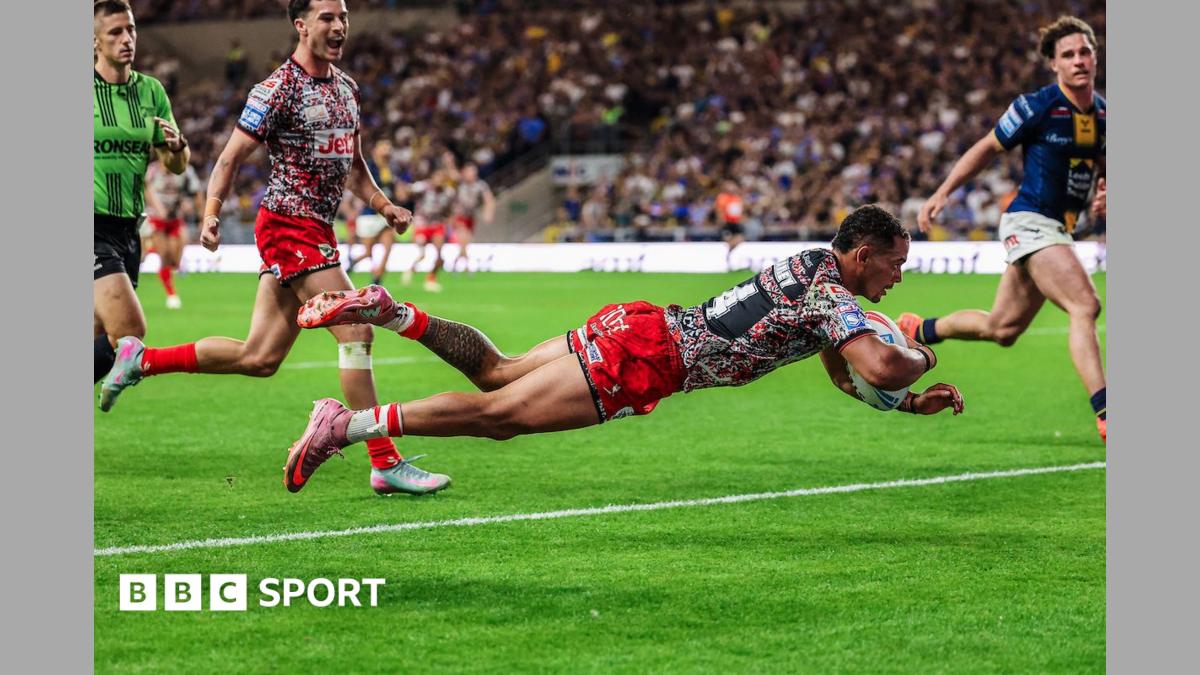
Brad Arthur believes Leeds’s two upcoming away games against York and St Helens will provide the ideal tune-up for a potential League Leaders’ Shield shootout with Wigan.
The two clubs are locked together at the top of Super League on 36 points with four games of the regular season remaining.
The Rhinos’ home slip-up against Leigh last time out means they top the pile only on points difference.
“I think these next three games are really important, the third game being Wigan. It might get to the stage where that game will ultimately decide the result,” the Leeds head coach told BBC Radio Leeds.
“We have some tough games coming up. York have been playing really well. They’re right in for the fight, they’re at home and they’ve got nothing to lose. They’ve done a really good job.
“They’ve been starting their games really well and hanging in there and making teams have to work really hard to beat them.
“And Saints showed on the weekend (winning at Wakefield) that if you take them too lightly and they get a few players back…
“This is what we need. We need to be playing tough games to make sure we’re ready.”
Leeds, who entertain Hull FC in their final game of the campaign, have not won the Shield since 2015 whereas Wigan have won it three times in the past six years.
The Rhinos will travel to York on Sunday without Jack Bird who is working his way through the concussion protocols, but with new signing Matt Lodge set to make his debut off the bench.
The former North Queensland Cowboys prop arrived in the UK on Sunday.
>
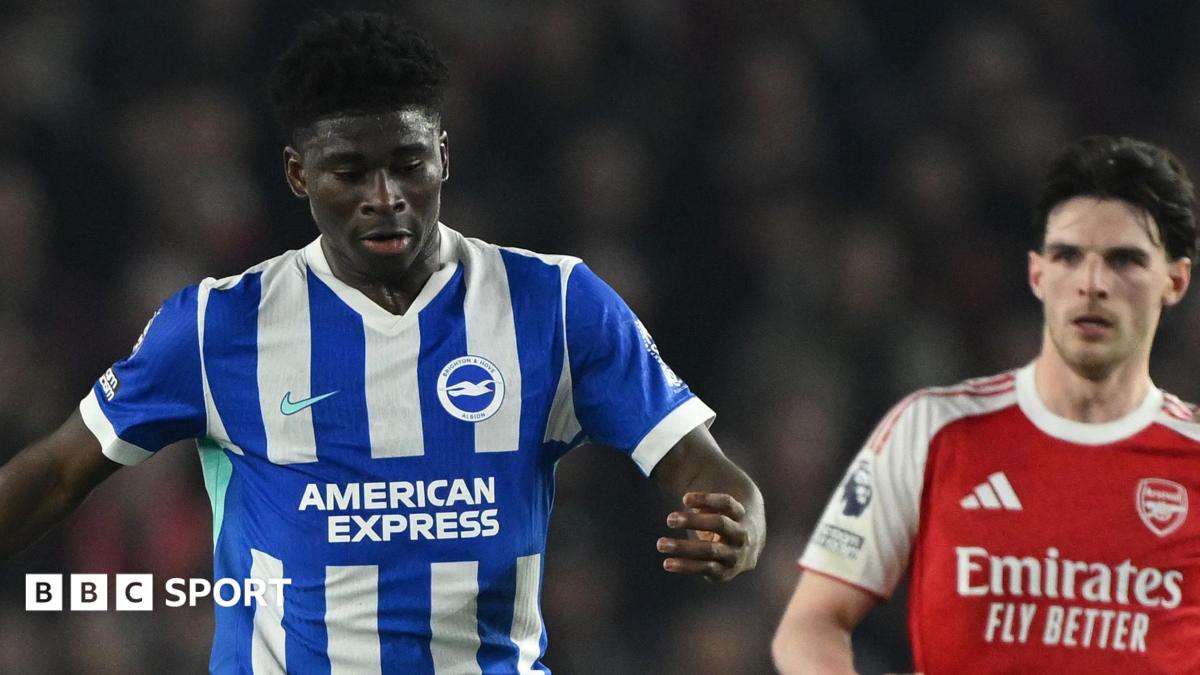
The Baleba situation also highlights a strategic change.
In the past, United have almost trailed the players they want to sign, then spent ages trying to complete a deal – or not.
Barcelona’s Frenkie de Jong was a case in point in 2022. Erik ten Hag felt certain he could do the deal even though United’s recruitment staff were being told it was impossible.
It was well into August before the club admitted defeat; with defeats by Brighton and Brentford triggering the £70m deal for Casemiro.
This summer, there has been stealth behind their work. It suited them for talk around England’s Elliot Anderson to obscure what they were thinking around initial midfield targets as they knew the Nottingham Forest man would be financially beyond their reach.
The Santos deal was wrapped up within a week. The Tielemans one was less than that.
There has been consideration given to Mount being the ‘third midfielder’ because of his exceptional form in the early part of pre-season.
However, although his early exit in the encounter with Paris St-Germain in Gothenburg on 8 August was described as ‘precautionary’, Mount has still to return from the foot injury, which would only have heightened concerns around his injury record.
Baleba was supposedly off the radar as a third midfielder. Tchouameni, Scott, Kone, Berge and Adams were the ones being monitored. Now United have made their move, it would be a surprise if the transfer was not concluded swiftly.
Evidently, Old Trafford’s recruitment plans are now being controlled to a far tighter degree than was previously the case.
>
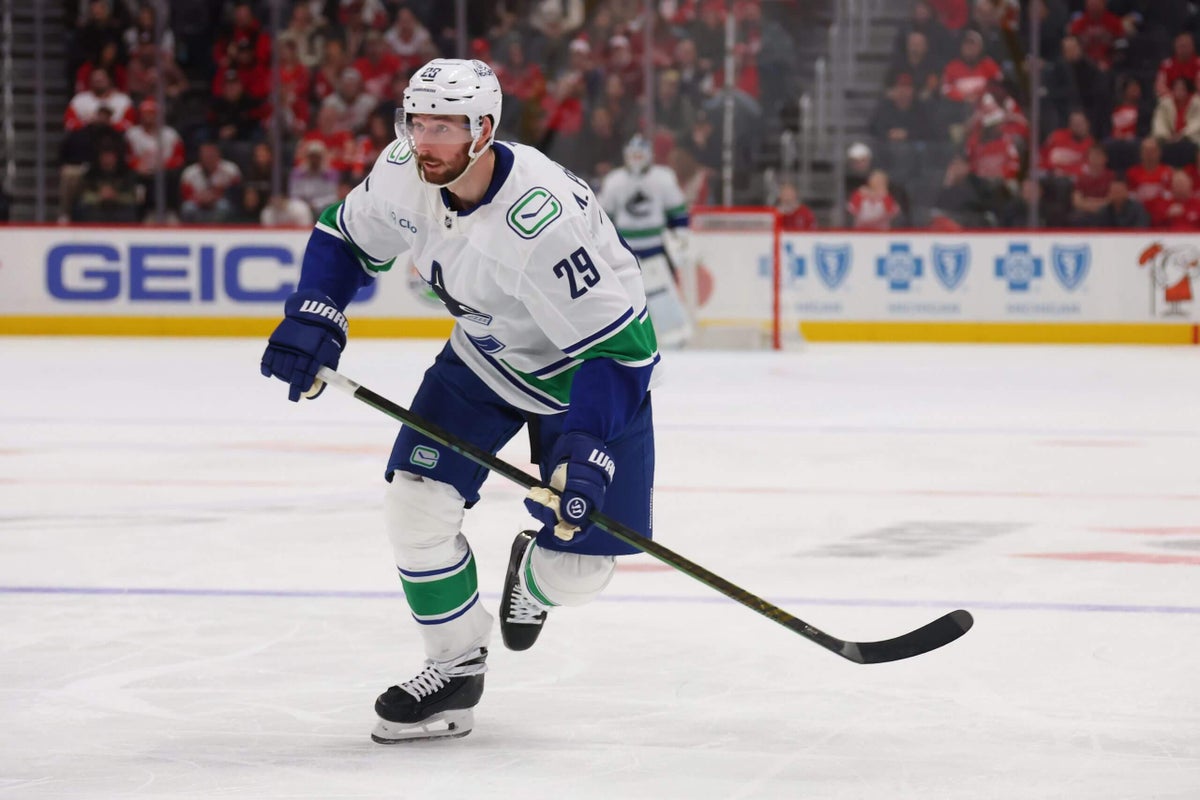
Better late than never, the necessary and long-awaited Vancouver Canucks rebuild arrived this summer.
Over the course of this offseason, Vancouver executed a variety of future-forward moves in an effort to begin to transition this team away from the persistent disappointment of the Quinn Hughes/Elias Pettersson era. The Canucks drafted two times in both the first and second round for the first time in franchise history. They executed a creative trade to maximize their return for Marcus Pettersson. They were even downright disciplined in the free-agent market.
The path back to sustainable relevance promises to be a long and difficult one, and there are valid reasons to be concerned about the organization’s budget-conscious priorities and their inability so far to move expensive veteran players with term and trade protection beyond Pettersson and Nils Höglander. But at the very least, this summer the Canucks finally seemed to put down the shovel and stop digging themselves into an even deeper hole.
Given the context of this summer and the direction being charted under new management, the competitive integrity of this roster has to take a backseat in our analysis. This club is not expected to win — in fact, winning too much would be a setback given the long-term rebuild the Sedin twins and Ryan Johnson are setting up. Nonetheless, the quality of this team and our reasonable expectations for it this upcoming season still matter. There’s still a balance to be struck. You do want to lose, but you want to lose productively in a way that permits you to continue to develop young players and create exchange value.
As September approaches, it’s time for us to wade into the weeds on an annual exercise in which we break down whether this Canucks roster has improved, by how much, and where the most significant holes in the lineup remain using Dom Luszczyszyn’s Net Rating model.
Can the Sedins change the Canucks’ culture?
Sean Gentille and Thomas Drance
Big picture: A minus-13.7 Net Rating
Among the list of meaningful accomplishments from Vancouver’s new-look front office in this first offseason, this one might be the most important: The Canucks look meaningfully less talented as a result of their moves this offseason.
The Canucks shuffled around some bottom-six depth chairs in their forward group, targeted high-character people in trades and free agency, and sent away a fringe top-pair-calibre defenceman while replacing him with a fringe top-four-calibre defenceman who has a similar profile. By prioritizing character ahead of hockey skill, the Canucks have seemingly rather successfully stacked the deck against their own team and first-year head coach Manny Malhotra. Even if this team takes a significant step forward structurally (a low bar given last season) and benefits from sturdier goaltending, and is buoyed by some exponential improvement from some of the younger players on this roster, Vancouver should still be squarely in the mix for the best lottery odds at the end of the 2026-27 campaign.
The Net Rating model effectively viewed the Canucks as among the least skilled teams entering this offseason, and it now rates the Canucks as squarely the least skilled team in the sport.
Now, before we get into specifics, let’s touch on the goal of this exercise and what we’re seeking to break down in particular.
We’re not trying to measure how the Canucks stack up in comparison with their roster 12 months ago or 24 months ago. We’re not trying to linearly chart or analyze Vancouver’s big-picture direction, or the improvement of its prospect system. Our purposes here are more limited than that.
We want a sense of the true talent level of the current roster in comparison with a hypothetical roster if the Canucks had simply signed all of their pending unrestricted free agents and ran back the same lineup we saw finish in 32nd place last season. What we’re trying to weigh is specifically how much the true talent level of Vancouver’s lineup has changed as a result of the decisions the team has made this offseason that affect the NHL roster.
Because of that, we’re not going to assume an older player is necessarily fated to see their effectiveness fall off a cliff, nor will we assume significant improvement from any of Vancouver’s younger contributors. And in any event, given how the Net Rating model works, age-related vacillations in projected value are already baked into the numbers you’ll see in the “Before” and “After” images that will make up the bulk of our analysis.
Additionally, the data contained below is based on an early run of the Net Rating model. There have been no significant ice time adjustments in the data, and as Luszczyszyn tightens up his model closer to the season, it’s possible some numbers will change between now and opening night on Sept. 29.
In reading the charts below, I’d also caution that the numbers that you see may be rounded up or down for simplicity’s sake. Don’t get bogged down by why the total Net Rating number may not reflect the sum of what’s displayed as the Offensive and Defensive Net Rating numbers.
Finally, of course, we acknowledge that hockey is played on an ice sheet, not on a spreadsheet. The game we’re dealing with is a volatile one, contested by elite athletes who are also imperfect human beings. How a team actually performs on the ice will be dictated by a variety of factors that no model could ever possibly project or anticipate. Team chemistry matters, coaching matters (more on that as we go), injuries matters, and so on and so forth.
With that out of the way, let’s take a look at how Vancouver was positioned entering the offseason:

Here’s what the roster looks like once we sub out Höglander, Pettersson, Evander Kane and company, while plugging in Jamie Oleksiak, Luke Schenn, Brendan Gallagher and Paul Cotter:

To summarize the differences: in subtle ways, the Canucks managed to weaken their roster in just about every relevant area. Up front, Vancouver is shallower and less offensively threatening. On the back end, the team has replaced a legitimate top-of-the-lineup option in Pettersson with a solid defensive option in Oleksiak.
Oleksiak is an effective defensive defenceman, but there are levels to the class and quality of top-four blueliners at the NHL level. The gap between Pettersson and Oleksiak is perhaps more significant than fans have realized, and in all areas.
Overall, the model views the Canucks as having taken a massive step back offensively and a small step back defensively, strengthening their case to be the least talented team in the sport entering this upcoming season.
Offence: minus-12.1
The model views the Canucks as significantly worse on the offensive side of the puck, and the bulk of this downgrade comes on the back end.
With the way the blue line was built at the end of this past season, especially with very good or at least decent-enough offensive contributors like Filip Hronek, Tom Willander, Pettersson and Zeev Buium, there was actually some level of below-average-but-reasonable offensive pop on the Vancouver defence corps. By subbing out Pettersson for Oleksiak, and adding Schenn into the equation, the Net Rating model projects the Canucks to be a far less dynamic offensive group from the back end.
Up front, meanwhile, even as the Net Rating model views Teddy Blueger, Höglander and Kane as bottom-six-level contributors across the board, they’re still graded as more offensively threatening than the players we’ve projected as their replacements in Cotter, Max Sasson and Gallagher.
The model strongly expects Vancouver to ice among the most glass cannon offensive team in the league, and to have less offensive pop this upcoming season than it had toward the tail end of last year.
Defence: minus-1.4
Defensively, the changes are more modest across the board, although it’s worth noting that the model is relatively high on Höglander’s defensive impact and doesn’t think the Canucks have replaced that element in their bottom six this summer. Höglander is a reliable play-driver down the lineup, even if his version of defensive impact shows up more frequently in the underlying numbers than it does in the assessment of his coaches.
Oleksiak is a sturdy defensive contributor and should help offset losing Pettersson from the perspective of insulating Vancouver’s younger defencemen, but there is still a sizable gap between what the model projects Pettersson to contribute next season and what it projects from Oleksiak.
What does it mean?
Vancouver was already the most permissive defensive team in hockey, and at least some of the turnstile-level defensive play we saw last year was probably related to the quality of coaching and overall lack of team-level organization.
If you’re thinking to yourself that the model is failing to account for the impact of Vancouver moving on from Adam Foote and bringing in Malhotra, it’s important to note that coaching impacts — to the best of the model’s ability — are already baked into both of the “Before” and “After” numbers above. That said, the Net Rating model itself largely agrees with the notion that we’d be hard-pressed to quantify just how significant the impact of a coaching upgrade could be on what we see on the ice from the Canucks next season.
In a study Luszczyszyn conducted this past spring but hasn’t yet publicized, Net Rating determined that of the 58 new head coaches hired by NHL teams since 2017, Foote had the second-most negative impact on the projected Net Rating of the players he coached in his first year as Vancouver’s bench boss. The only coach that ranked lower than him was Calgary Flames head coach Adam Huska, an output we should take with a significant grain of salt given that he took over from Darryl Sutter, the head coach with the single largest stat-padding five-on-five impact on his teams this century.
Effectively, we can expect the Canucks to get better results this upcoming season than what players, coaches and fans endured over the course of last season. Between regression and improved structural play, the Canucks will be in tough to finish in 32nd place with the same sort of margin they did this past season.
Management, however, has made the necessary moves to weaken this roster even further, and did so while prioritizing bringing in the sort of high-character players who should — in theory anyway — be capable of representing themselves and this franchise with the class and professionalism required to begin to build a winning culture in the midst of the rebuild.
>
EL SEGUNDO, Calif. — Besides a walk-through and a few meetings, the San Francisco 49ers have essentially an off-day at the hotel Wednesday before they play the Los Angeles Chargers in a preseason game Thursday night.
For the defense, that will be more time to reflect on what could not have been a fun film session following Tuesday’s joint practice at the Chargers’ facility.
Los Angeles quarterback Justin Herbert did whatever he wanted, throwing deep to Quentin Johnston and Brenen Thompson, across the middle to Ladd McConkey and even across his body as he scrambled right for another touchdown pass.
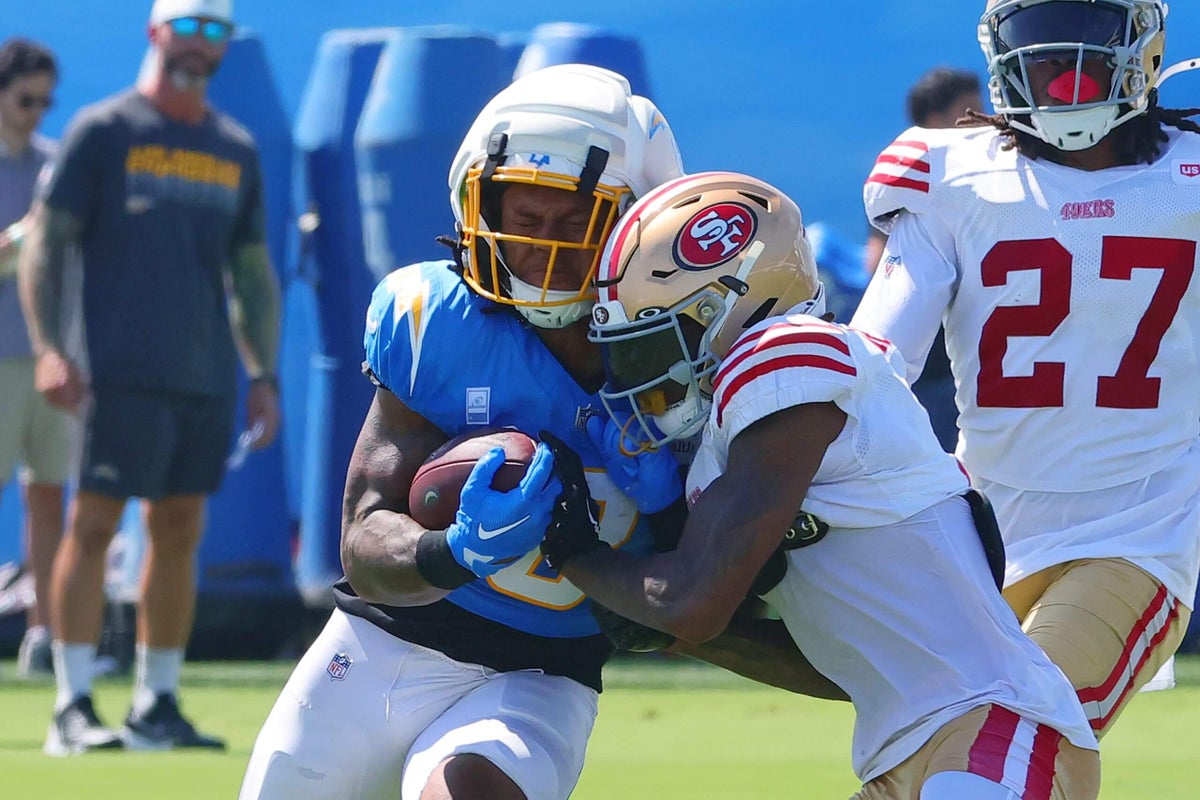
What’s really going to sting the collective pride is running back Omarion Hampton trucking not one, but two 49ers defenders in practice. The speedy Hampton showed his power by sending safety Ji’Ayir Brown and rookie linebacker Jaden Dugger flying on runs.
For the optimists out there, a few of the big plays wouldn’t have happened in real life. The 49ers did get some pressure on Herbert, and sacks aren’t allowed in scrimmages. If they were, defensive tackle Osa Odighizuwa would have had about six.
Trading for the former Dallas Cowboy was one of the best moves the 49ers made this offseason.
“It just seems like he just keeps getting better and better, right?” linebacker Fred Warner said after practice. “I love the mindset, the tenacity, the physicality that he brings to the position and to our defense. We know how important it is to get pressure up front on the quarterback and in the run game.
“I think he’s just gonna continue to get better as we keep going.”
Undrafted rookie defensive tackle James Thompson Jr. built on a strong training camp with some powerful rushes up the middle and a tackle for loss in the running game.
Ogbo Okoronkwo also had what would have been a sack, while cornerback Jack Jones had his daily pass breakup and Renardo Green was solid compared to the rest of the defensive backs …
Enough of the positivity. Here’s a summary of all the carnage on the defensive side:
• The 49ers might have been lulled into a sense of overconfidence coming off last week’s joint practice with the Tennessee Titans. The Chargers are a different animal, starting with their physical offensive line — tackle Joe Alt finished one block on a touchdown after his helmet was knocked off — bazooka-armed quarterback and quick receivers.
The Niners might have known they were in for a long day when they were surprised that Chargers offensive coordinator Mike McDaniel started with unbalanced formations.
• Thompson beat cornerback Deommodore Lenoir and Brown deep right out of the gate, although an Odighizuwa sack would have prevented it in game conditions. Johnston made a one-handed catch deep down the sideline as Lenoir grabbed him and was called for pass interference. Johnston would stop soon after, tweaking his ankle, while center Tyler Biadasz was carted off after sustaining a leg injury, but the Chargers’ offense didn’t miss a beat.
• There were also a lot of soft spots in the middle of the defense, as McConkey slipped free, and Hampton and fullback Alec Ingold each had some big gains on checkdown passes.
McConkey caught a touchdown pass while being held by Jones. He was also the recipient of that ridiculous across-the-body throw by Herbert mentioned above. At that point, the Chargers were scoring on four straight plays during the red zone scrimmage. Tight ends ran free like voodoo-induced kids in a small town after midnight.
• Brown did get revenge on Hampton by lowering his shoulder to hit the running back into the sideline when he tried to turn the corner. That got a rise out of the 49ers defenders, but it was too little too late.
Warner said he didn’t notice if it was that bad for his defense.
“It’s hard to tell, when you’re in the battle, what’s exactly going on,” he said. “You’ve got to see the tape to really see what it looks like. But any time you get to go against another team, it’s a great opportunity to see where you stand.
“Luckily, it was a good test for us.”
And it seems like pass rusher Nick Bosa (knee) might finally be back for Saturday’s practice, while defensive end Keion White (adductor) returned Tuesday. (Coach Kyle Shanahan said, though, defensive end Mykel Williams likely won’t be back by the season opener as he continues to rehab a torn ACL.)
So, things are looking up. Some of the starters will get a chance for some payback Thursday night, as Shanahan said he won’t rest many of them.
>

Man Utd’s pursuit of Brighton’s Carlos Baleba as a ‘third midfielder’

Jean Smart Brushes Off Potential Emmy Record as a ‘Technicality’

Club Kid Trailer: Jordan Firstman Plays Unexpected Dad
-

 movies3 months ago
Search For Canadian TV Actor Stewart McLean Now Homicide Investigation
-

 Fashion9 years ago
These ’90s fashion trends are making a comeback in 2017
-
Fashion9 years ago
According to Dior Couture, this taboo fashion accessory is back
-
Fashion9 years ago
Model Jocelyn Chew’s Instagram is the best vacation you’ve ever had
-
Fashion9 years ago
Emily Ratajkowski channels back-to-school style
-
Fashion9 years ago
9 Celebrities who have spoken out about being photoshopped
-
Fashion9 years ago
Your comprehensive guide to this fall’s biggest trends
-
Fashion9 years ago
A photo diary of the nightlife scene from LA To Ibiza