
Tech
AI was supposed to win people over by now — it hasn’t

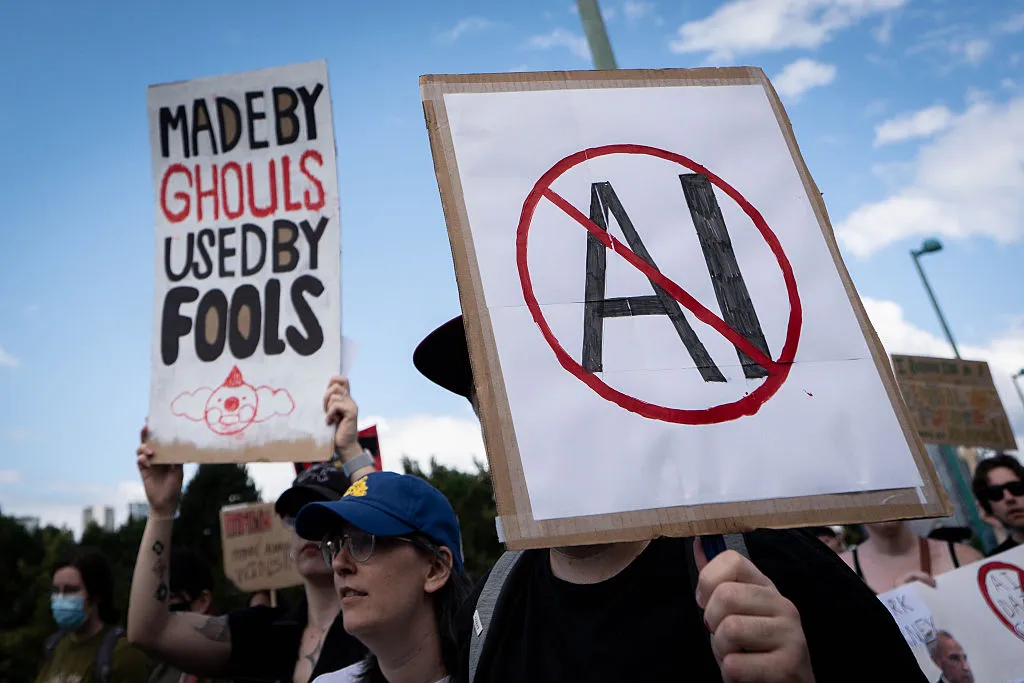
Despite its technological progress, AI’s reputation out in the real world is getting worse. On Wednesday, Axios reported that the National Republican Senatorial Committee sent a memo to top AI companies warning that U.S. data centers are hurting the party’s chances in a key Ohio election. At the same time, Pew Research released a study that found that Americans’ unease about AI is growing — 52% said they’re “more concerned than excited” about the increased use of AI in daily life, up from 37% in 2021.

A recent CNBC poll of 18- to 34-year-olds found that, when given the names of nine top leaders in the AI industry, a majority of the respondents said they don’t trust those people to “act responsibly” when it comes to AI. A May Economist/YouGov poll found that over 70% of Americans think AI is advancing too quickly. The list goes on.

All that discontent is starting to show up on balance sheets. The Wall Street Journal reported this week that tech companies are facing a public relations crisis over their plans to build AI data centers across the U.S., leading them to agree to sweeten the deals — offering job guarantees, clean water investments, and other local perks. (In one case, that even included $50,000 bonuses for teachers in a Louisiana parish.)
The underlying sentiment spanning these stories is that consumers don’t see how AI is making their lives better, but they’re still being asked to absorb the costs. For an industry that has raised hundreds of billions of dollars on the promise of AI’s inevitability, that souring public sentiment is becoming a business problem, not just a PR debacle, and the industry’s own leaders are starting to notice.
Today, many consumers think of AI in narrower terms, like AI chatbots or AI search experiences (like the now AI-transformed Google). They see AI features infiltrating their everyday products, from email to TVs, whether they wanted them or not. They view AI as a tool that’s helping kids cheat in school, including at the college level, raising questions about the value of a degree. They hear of AI bots training on piles of intellectual property belonging to others so AI can be used to create art, videos, music, and writing — things that have historically been the output of humans.

It’s no shock then that AI appears to be facing more consumer backlash than other transformative technologies did, like the iPhone, the personal computer, or even the internet itself, at similar stages of adoption.
Yet there are still those surprised by consumers’ reaction. They assumed AI’s adoption would lead to acceptance, and its ubiquity would ultimately have consumers feeling positively about the technology, as it became a part of the vast majority of tech products and services.
Instead, consumer trends are pointing in the opposite direction. Young people, in particular, are showing interest in adopting retro technology, ranging from dumbphones to point-and-shoot cameras to tape decks and CD players. AI-free, algorithm-free classic iPods are selling for top dollar on eBay. So-called “grandma hobbies” like quilting, knitting, jigsaw puzzles, cards, and games like Mahjong are suddenly everywhere. In-person meetups and activities, like run clubs, are winning out over online dating.

Some in Silicon Valley may think this stems from a messaging problem: that perhaps execs need to explain AI better to consumers, so people can fully understand its benefits.
The reality, however, could be that consumers understand AI well enough as it is, but don’t think the trade-offs are worth it. When the upside offered isn’t automated jobs with increased pay and reduced workweeks, but instead the threat of job loss, paired with AI features consumers find far less compelling — things like summarized web pages, or chatty TVs — that skepticism hardens.
There are those in the industry waking up to this.
On a recent podcast, Airbnb CEO Brian Chesky acknowledged that the AI backlash is real, and that it’s largely tied to the fact that the industry isn’t shipping products that “regular people” like.
“I think part of it’s a narrative issue that we’re not talking about AI correctly,” Chesky said. “But part of it is we need to actually be developing more products that just regular people can use and say, ‘I love AI because AI allows me to have a doctor on demand and I can’t have that. I can’t afford that.’ And so I think we need more regular things.”
Even Anthropic CEO Dario Amodei, one of the industry’s most prominent leaders, admitted in a post on X this week that negative public perception of AI is a “big problem” that’s fundamentally a “crisis of trust.” He said people don’t trust companies, governments, or the tech industry, as they “suspect that we are cooking up some new way to screw them over.”
The solution, he said, was to deliver on AI’s promises — for example, curing cancer.
“I think by far the most accurate criticism of AI companies, including Anthropic, is that we haven’t yet delivered on our big promises to benefit the world. That is totally on us,” he noted.
When you purchase through links in our articles, we may earn a small commission. This doesn’t affect our editorial independence.
>

AI accounting startup Rillet announced a $100 million Series C at a $1 billion valuation on Tuesday, led by Iconiq. Returning investors included Andreessen Horowitz and Sequoia. Rillet, which emerged from stealth in 2024, is quickly becoming one of the hottest AI startups in the enterprise resource planning (ERP) industry.
The company’s software deploys AI to help finance professionals manage a company’s books. It says it can, for instance, automatically and continuously pull data from sources like Salesforce or Brex.
Rillet touts more than 600 companies as customers and says it has doubled its ARR in the past three months. Nicolas Kopp, the company’s co-founder and CEO, said on X that this latest round came together in “less than 48 hours.” The company wasn’t planning to raise, he said, but interest grew because so much had happened since its last round, like an alliance with EY and the jump in ARR and customers.
“A year ago, we backed a bold vision for Rillet: that the general ledger could become more than a system of record and instead the operating system for finance,” Seth Pierpont, General Partner, ICONIQ, said in a statement shared with TechCrunch. “That vision is now reality.”
Rillet last raised a $70 million Series B last year in a round led by ICONIQ and Andreessen Horowitz. Shortly before that round, it announced a $25 million Series A led by Sequoia. The company has raised more than $200 million to date. The rapid growth of AI startups — and how quickly they can raise large sums — shows how feverish investors remain about AI, especially regarding those poised to disrupt legacy SaaS players like NetSuite. Though reports of a SaaSpocalypse might be overplayed, smoke indeed hints at a fire.
>

Sam Altman is headed to the Hamptons, according to Puck. Gwyneth Paltrow is reportedly sending invites for a “private, off-the-record” dinner honoring the tech mogul on August 29th at her home out East.
Paltrow is an actress and founder of the wellness brand Goop. But she’s also a noted investor through her Kinship Ventures, which she launched in 2021 alongside Moj Mahdara. In 2023, reports said the firm was raising a $75 million fund, though it remains unclear whether it has closed. Kinship is also an investor in OpenAI (per SEC filings, her investment in OpenAI dates back to 2023) and other AI companies, including the vibe coding tool Lovable and the AI-powered marketing platform Nectar Social.
We’ve reached out to Goop and OpenAI for comment. Over the past few years, Paltrow has become more outspoken about AI — she’s spoken about how she uses the tools to run her company, and her Goop Kitchen has signed a lease for the ground floor of Anthropic’s San Francisco HQ. Earlier this year, OpenAI hired Charles Porch, whom Vanity Fair called the “celebrity whisperer.”
>

Have we tried turning off society and turning it back on again? We need a complete cultural reset, because there are actually sports betting providers that let people gamble on Little League World Series (LLWS) outcomes.
For the uninitiated, the LLWS is an annually televised tournament where ten- to twelve-year-old baseball players from around the world face off. It’s a pretty wholesome event, though hopefully not too traumatizing for the kids who drop routine fly balls on a global broadcast that everyone they know is watching.
State-regulated sportsbooks and federally regulated prediction markets like Kalshi and Polymarket do not allow bettors to gamble on the LLWS (though Polymarket did offer LLWS bets in 2024). But offshore sportsbooks like BetOnline Sports & Casino don’t have to adhere to U.S. laws, so they can offer the opportunity to gamble on children.
“We offer Little League World Series odds because there’s a massive demand for it,” BetOnline Brand Manager Dave Mason said in a press release, which added that bettors gambled twice as much money in 2025 as they did in 2024. “Our customers request these odds every year, and we’ll take more bets on the LLBWS over the next two weeks than on established markets such as the WNBA, Major League Soccer, pro tennis or golf.”
Mason claimed in a post on X that more users are wagering on a Little League matchup between teams from South Korea and Canada than on certain Major League Baseball games.
Whether it’s technically legal or not, we should be able to agree that this is gross and anyone betting on kids should feel bad.
Last year, the LLWS put out a statement about sports betting, which it reposted on Wednesday as a reminder.
“Little League is a trusted place where children are learning the fundamentals of the games and all the important life lessons that come with having fun, celebrating teamwork, and playing with integrity, and no one should be exploiting the success and failures of children playing the game they love for their own personal gain,” the organization said.
When you purchase through links in our articles, we may earn a small commission. This doesn’t affect our editorial independence.
>

Color rush: Alabama, Tennessee to both wear home uniforms for October showdown

Larry David Recalls ‘Dust-Up’ With Trump Lawyer Alan Dershowitz

Chris Hansen Questions “Hollywood’s Motive” With A24’s ‘Primetime’
-

 movies3 months ago
Search For Canadian TV Actor Stewart McLean Now Homicide Investigation
-

 Fashion9 years ago
These ’90s fashion trends are making a comeback in 2017
-
Fashion9 years ago
According to Dior Couture, this taboo fashion accessory is back
-
Fashion9 years ago
Model Jocelyn Chew’s Instagram is the best vacation you’ve ever had
-
Fashion9 years ago
Emily Ratajkowski channels back-to-school style
-
Fashion9 years ago
9 Celebrities who have spoken out about being photoshopped
-
Fashion9 years ago
Your comprehensive guide to this fall’s biggest trends
-
Fashion9 years ago
A photo diary of the nightlife scene from LA To Ibiza