
Tech
Travis Kalanick kicks off another round of VC bashing: ‘1% are helpful’


Travis Kalanick certainly has had a love-hate relationship with VCs over his career. As the founder of Uber he was a VC darling, raising what was then an unprecedented roughly $15 billion in venture funding during his tenure. Then, a boardroom battle with key investor Bill Gurley of venture firm Benchmark led to him being pushed out in 2017.
Now, he’s back raising mega funds for his robotics company Atoms, which just nabbed $1.7 billion, led by Andreessen Horowitz, with Ben Horowitz joining the company’s board.
In an episode of David Senra’s podcast that aired last weekend, Kalanick made clear he’s still salty about the Uber boardroom battle and that he tells founders not to raise from Benchmark. (His animus hasn’t seemed to have catastrophically damaged the venerable fund. It just raised another $2 billion across two new funds in June.)
His worldview on VCs is generally low, and it’s not based on just one traumatic experience. Kalanick, who has formed numerous companies across his career, warns that “a super high bar for a VC is ‘do no harm,’” yet, in his experience, just 10% of the VCs out there are capable of meeting that bar.
A far smaller percentage —”1%” by his estimate — are actually “helpful,” he told Senra. “But it’s hard. How the f* are they supposed to be helpful? … It’s hard for them to participate because they just aren’t in that deep.” On the podcast, he compared a founder to the “chess master” of the company, while the VC is a “chess enthusiast” that drops in once in a while to check the progress of the game.
The relationship, he suggests, is inescapably complicated. All people want to have an impact in the world, so when a founder doesn’t listen to the investor’s advice, that’s “a hard thing” for many VCs to take, particularly given that “VCs are glamorized, and they do have a seat at the table. And they have certain powers and they can make a mark,” Kalanick said.
Still, Kalanick isn’t telling founders to avoid VC money. In fact, he advises founders to have a pitch so honed that it creates a bidding war among firms to sweeten their deals. For instance, one tip he offers for today’s super hot fundraising atmosphere is to share a modestly detailed plan. Too little detail obviously won’t attract funding. But too much detail is off-putting. When the AI world is moving so fast, no one can predict too far into the future; it comes off as naive.
In his telling, that same instinct toward accountability shapes how he talks about his own board battle. Kalanick doesn’t tell founders to be more careful about who they let onto their cap table. The bigger risk, he says, is falling into a “victim mentality.”
“You have to be really careful not to get into victim mentality,” is his advice. “By that, I mean, what was my part in that dynamic?” he says.
Kalanick believes, for instance, that he didn’t handle all the relationships with disgruntled people well enough. More than that, he now realizes that his management style was an issue.
While he stands by all the decisions he made at Uber and says he broke no rules, he says the optics were a problem. “The problem was I ran too close to the line in too many situations. When you are big and important, the scrutiny and the expectation is that you don’t run that close to the line, even if it’s correct. And that is a thing I definitely did not understand.”
Kalanick says his hard-charging style was a result of his previous startup, Red Swoosh, which was a slog. “First four years, no salary, ran out of money several times, like a super grind, like lose all friends, like everything was just the hardest,” he told Senra. He eventually sold it.
“It was so hard, that I had to be epically precise and hard core just to pay the bills and go to the grocery store the next week,” he said. “That precision and intensity made Uber what it was. But I was running a $70 billion company the way somebody who thought he was going to starve next week would run it.”
Kalanick isn’t the only one revisiting old VC grievances this week. Serial entrepreneur Mark Pincus used the podcast as a jumping-off point on social media to air his own history with Accel, which led an investment in his company Support.com during the dot-com era. Pincus wrote that the firm went on what he called a “jihad” to replace him as CEO over his age and inexperience running a public company. Other founders piled on with their own accounts, naming additional firms they say have pushed out company leaders.
Andreessen Horowitz, which is leading the round in Kalanick’s new company, was quick to amplify the moment, posting a string of tweets this week pointing followers back to the podcast episode. The firm’s enthusiasm isn’t entirely disinterested. Gurley and a16z cofounder Marc Andreessen have their own history of public friction. In a 2015 New Yorker profile, Andreessen called Gurley “my Newman,” a reference to Jerry Seinfeld’s nemesis on “Seinfeld.”
Gurley did not immediately respond to a request for comment.
When you purchase through links in our articles, we may earn a small commission. This doesn’t affect our editorial independence.
>
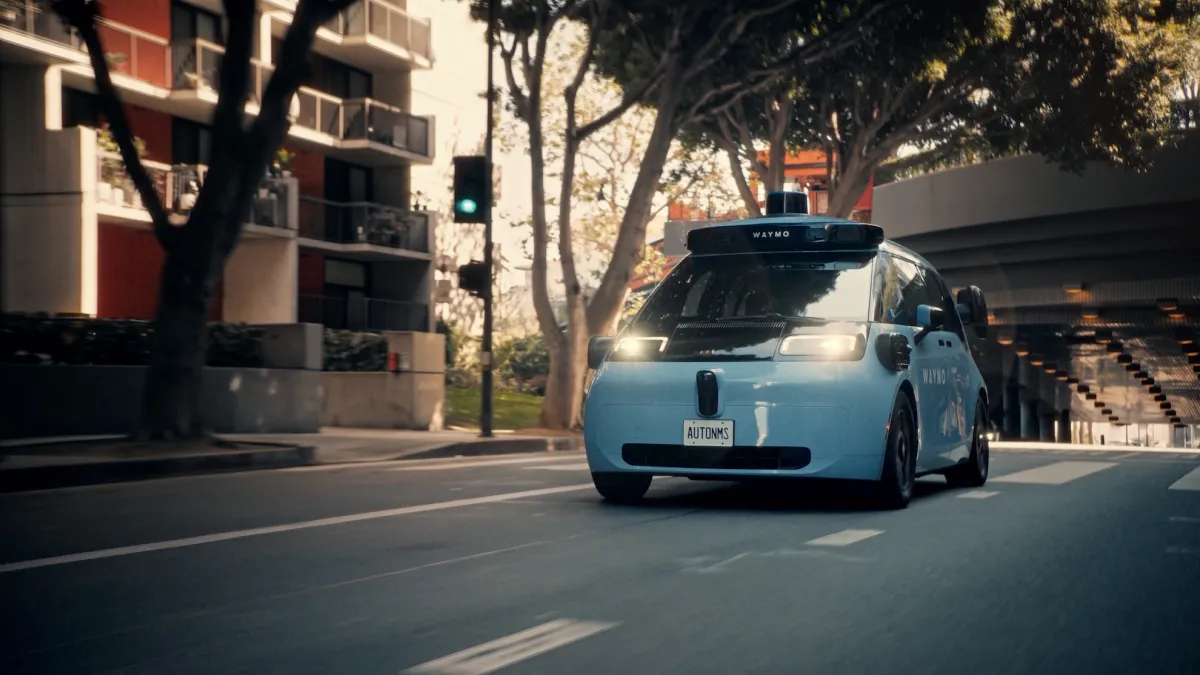
Waymo has opened its next-generation robotaxi to all riders in Los Angeles, Phoenix, and San Francisco — a notable milestone for the Alphabet company as it pushes to expand its fleet with vehicles that are cheaper to build, operate, and maintain.
For now, customers in these markets may be matched with the new robotaxi, called the Ojai (pronounced oh-hi) when they hail a ride. Once Waymo has enough Ojais in its fleet, riders will be able to choose between the new vehicle and the older Jaguar I-Pace robotaxi. Waymo has about 300 Ojai robotaxis in its commercial fleet today, according to a company spokesperson.
The company said Wednesday that it plans to roll out the Ojai in Denver, Las Vegas, and San Diego later this year.
For years, Waymo has relied on the all-electric, modified Jaguar I-Pace for its robotaxi fleet, which now operates in 11 U.S. cities today. While the white, sensor-laden autonomous hatchback has become ubiquitous in markets such as San Francisco, it has been more of a stopgap in Waymo’s longer term push towards mass scale, and eventually, profitability.
The Waymo Ojai robotaxi is meant to deliver on that ambition. The Ojai is equipped with Waymo’s sixth-generation self-driving system, which is critical to the company’s commercial strategy because it’s modular and designed to work across multiple vehicles types. The robotaxi also comes with a redesigned user interface and Google’s Gemini AI, which acts as an in-car assistant for riders.
Strip away that technology, though, and the Ojai is a minivan made by Zeekr, a brand owned by China’s Geely Holding Group. Waymo partnered with Zeekr in 2021 and has spent years testing a prototype, and later a production-intent version of the vehicle. It’s built on Zeekr’s SEA-M platform, an updated version of the automaker’s “Sustainable Experience Architecture,” which the company designed for vehicles like robotaxis and delivery vans. The goal was to create a robotaxi that was attractive and easy for riders to access, but also cheap to build and maintain and durable enough to withstand near-constant use.
The Ojai delivers on many of those goals, though tariffs on the imported vehicles have added cost. Under current U.S. trade policy, vehicles built in China face steep import tariffs, which raises Waymo’s costs for every Ojai it brings into the country. The base Zeekr vehicles ship without any Chinese connected-car technology on board. After arriving in the U.S., they’re sent to Waymo’s Arizona factory, where they are outfitted with the self-driving system.
New York-based research firm MoffettNathanson, which tracks Ojai imports by examining detailed receipts of shipped goods, said Waymo is on pace to bring 5,000 Ojai vehicles to the United States by the end of 2026. That would be more than double Waymo’s current Jaguar fleet, according to the firm. In July alone, 725 Ojai vehicles entered the country, underscoring the scale and pace of Waymo’s expansion efforts.
When you purchase through links in our articles, we may earn a small commission. This doesn’t affect our editorial independence.
>
As AI models have become more powerful, the potential for those models to be misused has grown — as has a clamor for safety guardrails that can stop such abuse from happening. AI companies must now walk a delicate tight rope between respecting their enterprise customers’ privacy while also watching usage for possible issues.
Sensing an opportunity to one-up its rival Anthropic, OpenAI just announced a privacy-centric safety approach to monitoring for misuse. The company is previewing a new service to select customers that it calls Private Safety Processing. This is an automated system that watches for potential abuse while simultaneously retaining none of the customer’s data.
This system clearly runs counter to Anthropic’s recently announced data retention policy. The policy, which has aggravated some customers, enables the AI lab to keep user data (all of their sessions — and the conversations therein) for a period of 30 days, when it comes to “covered models.” Those models include all Mythos-class models and “future models with similar capabilities,” the company says.
This policy, which was announced in July, was designed for the purposes of safety allowing the lab to sift and analyze potential impropriety. However, it has deeply concerned some enterprises that handle large amounts of sensitive data and don’t want it harbored (or inspected) by the AI lab.
OpenAI — like most other AI companies — already afford customers a relative level of privacy by adhering to a policy known as Zero Data Retention. ZDR uses agents within the OpenAI API to monitor for abuse on a per session basis. In this way, customer data isn’t retained by the company but companies are still able to scan for bad activity without the need for human intervention. It’s worth noting that Anthropic also largely abides by ZDR — except when it comes to “covered models,” like Fable.
OpenAI says that Private Safety Processing is a new technology that widens ZDR’s scope. It describes it as a form of long-horizon safety monitoring that assesses the inputs and outputs of multiple conversations — not just one. Again, the monitoring is conducted by an agent, which, if triggered, catches interactions and analyzes them across sessions for signs of potential misuse.
The new tech helps OpenAI detect malicious use of AI that takes place over multiple sessions, a spokesperson told TechCrunch. A bad actor — hypothetically someone trying to engineer malware for a cyberattack — may spread out their requests to avoid detection. Private Safety Processing can analyze those multiple conversations for signs of abuse without human review of a user’s conversations.
In the case where the system is triggered, it may send a “narrowly defined signal” to OpenAI that warns of a specific type of activity, the company says. Based on that signal, OpenAI can then decide whether “enforcement is necessary,” it says. If so, OpenAI will reach out to the customer for more context or to work with them on the issue and a customer may choose to share data with OpenAI at their discretion, the spokesperson said.
By contrast, Anthropic notes that human review of customer data can occur, but only “through a controlled access path” that involves “a small set of approved reviewers.” Every one of those review sessions is “recorded in a tamper-proof log that reviewers cannot suppress or modify,” the company says.
The corporate competition between OpenAI and Anthropic is tense at the moment, with both companies looking for any opportunity to gain an advantage on the other. A recent report showed that OpenAI’s Q2 grew more slowly than Anthropic. Anthropic’s annualized revenue run rate is now reportedly $65 billion. Anthropic investors have said it could IPO at $2 trillion, while OpenAI is also working on its IPO.
When you purchase through links in our articles, we may earn a small commission. This doesn’t affect our editorial independence.
>
Elon Musk’s SpaceX attempted to acquire AI coding startup Cognition as it works to catch up to OpenAI, Anthropic, and Google in the AI race, Bloomberg reported Wedesday, citing sources familiar with the matter.
Cognition CEO Scott Wu disputed the report soon after it published, writing on X that the story was inaccurate and that Cognition “is not for sale,” adding that the two companies haven’t been in talks.
The report comes a few days after SpaceX’s $60 billion acquisition of Cursor, another AI coding startup, whose deal closed last week.
SpaceX acquired Musk’s AI company, xAI, earlier this year. It then went public in a blockbuster IPO in June, with its market capitalization rising to nearly $2.3 trillion at its peak.
SpaceX has sold investors on its AI ambitions, which include eventually building data centers in space. But the xAI business remains relatively early-stage and has fallen behind competitors.
It’s also had to contend with its chatbot Grok’s penchant for controversy, including last year’s “MechaHitler” incident and this year’s nonconsensual sexual imagery scandals, as it tries to win over enterprise customers.
Last week, Musk told SpaceX’s employees that in about “four or five years, AI will be 99% of the value” of the company, but achieving that feat will require SpaceX to pull in much more revenue from AI.
AI-assisted coding has emerged as one of the clearest ways to monetize the technology. Anthropic’s meteoric growth, fueled in large part by Claude Code, is proof of that. Bringing Cursor into the fold was part of that equation, and the companies were already working together before the acquisition closed. This month, Cursor and SpaceX jointly released Grok 4.6, a new model that scores higher on benchmarks for coding and complex multi-step agentic tasks.
Adding Cognition and its coding agent Devin — along with an enterprise customer base that includes Mercedes-Benz, Citi, and Goldman Sachs — would have given SpaceX another way to deepen its push into AI coding and compete for enterprise customers.
Bloomberg reports that the deal talks are no longer active, but that the companies are still discussing working together — potentially with Cognition using SpaceX’s computing capacity, which the company is selling to other AI players like Anthropic until it needs that capacity for itself. Wu didn’t address this specific claim in his denial.
Cognition remains one of the largest independent AI software coding startups that hasn’t yet been gobbled up by a major AI model maker. The company in late May raised a $1 billion round at a $25 billion post-money valuation, and Bloomberg reports it’s now in early talks for new round of funding at a $40 billion valuation.
Cognition made headlines last year when it acquired the remaining assets of competitor Windsurf after Google DeepMind acqui-hired the startup’s CEO and top research in a $2.4 billion deal for talent and licensing rights.
After the merger, Cognition laid off 30 employees and offered buyouts to the remaining 200 Windsurf employees. Those who decided to stay faced strict operational expectations, like an 80+ hour workweek and six days in the office.
That sort of wartime work ethic wouldn’t be out of place in a Musk company. Musk has said he works up to 120 hours a week and often sleeps on office or factory floors.
SpaceX and Cognition did not respond to requests for comment.
When you purchase through links in our articles, we may earn a small commission. This doesn’t affect our editorial independence.
>

‘Star Wars: Starfighter’, ‘Lucky’ finale: Jonathan Tropper Talks All

How to watch Nationals vs. Rangers: TV channel and streaming options for August 19

What we saw from Kyler Murray and the Vikings offense in joint practices vs. Ravens
-

 movies3 months ago
Search For Canadian TV Actor Stewart McLean Now Homicide Investigation
-

 Fashion9 years ago
These ’90s fashion trends are making a comeback in 2017
-
Fashion9 years ago
According to Dior Couture, this taboo fashion accessory is back
-
Fashion9 years ago
Model Jocelyn Chew’s Instagram is the best vacation you’ve ever had
-
Fashion9 years ago
Emily Ratajkowski channels back-to-school style
-
Fashion9 years ago
9 Celebrities who have spoken out about being photoshopped
-
Fashion9 years ago
Your comprehensive guide to this fall’s biggest trends
-
Fashion9 years ago
A photo diary of the nightlife scene from LA To Ibiza