
Tech
ByteDance, Tencent Receive 20,000 Nvidia H200 Shipments


Beijing has finally blinked in its semiconductor standoff, handing tech giants ByteDance and Tencent a combined 20,000 Nvidia H200 AI processors.
The deliveries mark the first meaningful thaw after months of regulatory gridlock, according to a Financial Times report.
ByteDance and Tencent each took delivery of roughly 10,000 units in recent weeks, with several other domestic tech firms slated for similar allocations. The move comes as Chinese developers sprint to keep pace with cutting-edge U.S. systems like Anthropic’s Mythos 5, narrowing the frontier gap following recent model releases from Moonshot, Alibaba, and DeepSeek.
While Washington previously cleared select Chinese firms to acquire up to 100,000 H200 accelerators each, Chinese authorities have kept a tight leash on incoming hardware. The National Development and Reform Commission (NDRC) continues to oversee a case-by-case approval process for all server orders, ensuring that foreign silicon enters only under strict supervision.
Servers equipped with H200 chips are once again being pitched by hardware partners such as Lenovo, but volume remains constrained. The H200 sits at least two generations behind Nvidia’s flagship lineup, yet it remains valuable for complex AI model training where domestic alternatives still struggle. Nvidia currently sits on an estimated 500,000 H200 processors manufactured primarily for the Chinese market, per FT.
The Hong Kong infrastructure squeeze
To protect and promote homegrown chipmakers like Huawei, Beijing has instructed companies to park the lion’s share of their US-licensed allotments in Hong Kong. Because Hong Kong sits outside mainland China’s customs border, engineering teams can legally access compute clusters remotely over cross-border networks.
However, moving the silicon to Hong Kong creates an immediate logistical wall. The territory faces severe power supply and real estate constraints, housing an installed data center capacity of only about 581 megawatts, according to data cited by Tom’s Hardware. Deploying tens of thousands of high-draw, 700-watt processors demands significant electrical overhead that the city cannot readily provide.
“It’s a dilemma. Everyone needs the chips but struggles to find a way to use them in Hong Kong,” a person familiar with the situation told FT. “The hope is for the control to loosen up gradually.”
Beijing’s tactical retreat exposes the hard limits of semiconductor self-reliance. While state policy heavily subsidizes domestic accelerators for routine inference workloads, frontier training still demands the mature software stack and interconnect performance of Nvidia silicon.
By rationing just enough foreign hardware to prevent domestic champions from falling fatally behind U.S. model developers, Beijing is engineering a managed dependency. Yet routing bulk orders into Hong Kong’s power-starved grid reveals a widening rift between trade strategy and physical reality.
Other News: Washington is pressuring Apple not to source memory chips from Chinese manufacturers CXMT and YMTC as the iPhone maker looks for new suppliers amid a global memory shortage.
>

College students in the US can get a year of Google AI Pro without paying the usual $19.99 monthly fee, and the offer includes considerably more than extra chatbot access.
Eligible students get four times the usual Gemini usage limits, Gemini Spark, AI features in Gmail and Docs, 5TB of storage, and Google Health Premium.
Google is also adding tools that can turn class materials into personalized lessons, create research reports, and generate interactive visuals, giving students several ways to use the free subscription throughout the school year.
There is one important catch. A payment method is required, and the subscription starts charging $19.99 per month after the free year unless it is canceled.
What college students get with a free year of Google AI Pro
Google said eligible US college students can claim the 12-month AI Pro offer through December 31, 2026. The subscription normally costs $19.99 per month.
Here’s what students get with that free year and how the features could fit into a typical semester.
Higher Gemini limits and access to Gemini Spark
AI Pro gives students four times the Gemini usage limits available to non-AI subscribers, plus access to Gemini Spark.
The package also brings Gemini into Google apps, including Gmail and Docs, so students can use AI alongside the documents and email they already rely on for coursework.
Study Notebooks, Deep Research, and interactive visuals
Study notebooks let students upload materials such as lecture notes, take a diagnostic quiz to identify knowledge gaps, and receive customized lessons and quizzes. With permission, Gemini will also be able to add exam and assignment dates from a syllabus to Google Calendar.
Deep Research is also coming to Gemini Live, allowing students to request a multi-step research report and return later to discuss the results or ask follow-up questions.
Interactive visualizations will be able to generate material such as a rotatable 3D DNA model, a pendulum showing energy transfer, or an interactive table explaining cash burn rates.
5TB of cloud storage and Google Health Premium
AI Pro includes 5TB of storage and Google Health Premium.
The storage could be useful even for students who do not use Gemini every day, particularly those handling video projects, presentations, research files, coursework, and backups.
Engadget noted that the plan normally costs about $200 per year, making the promotion useful beyond the AI features for students who already rely heavily on Google’s cloud services.
More Google coverage
How students can actually use the AI tools
Here’s how students could actually use these tools during the semester.
Preparing for an exam
A student could upload lecture notes to Study Notebooks, take the diagnostic quiz, and see which topics need more attention. Gemini can then build shorter lessons and quizzes around those weak spots instead of treating every chapter the same.
Researching a paper
For a larger assignment, a student could use Deep Research to explore a topic and produce a multi-step report, then talk through the results in Gemini Live and ask follow-up questions.
Google’s broader back-to-school rollout also includes practice quizzes and additional learning features across Search, Gemini, YouTube, and Classroom.
Understanding a difficult concept
Students who learn better visually could use Gemini’s interactive tools to explore subjects that are harder to understand from text alone. Google’s examples range from rotating a 3D DNA model to watching energy move through a pendulum.
Gemini can also help with organization. With permission, it can pull key dates from a syllabus into Google Calendar, which could save some manual work at the start of a busy semester.
The free year comes with a $19.99 monthly renewal
Students need a valid payment method to sign up, and Google says AI Pro will automatically renew at $19.99 per month after the free period unless canceled. The US offer must be redeemed by December 31, 2026.
Eligible college students outside the US can instead receive a free year of Google AI Plus in supported markets. That plan includes Gemini Omni, twice the normal Gemini usage limits, and 400GB of storage.
For students who qualify, the free year offers plenty of room to see whether Gemini is genuinely useful for studying, research, organization, or everyday coursework. Just make sure the renewal date makes it onto the calendar too.
More on Gemini: Google’s AI assistant just passed a major milestone, with Gemini becoming the company’s 14th product to reach 1 billion monthly users as adoption continues to climb.
>
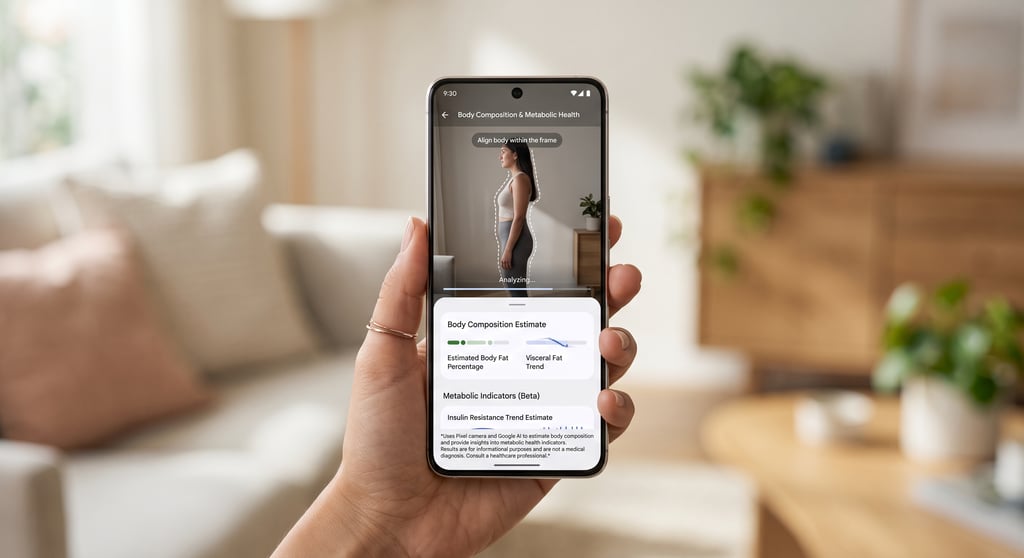
Your next blood sugar insight might come from a phone camera.
Google is testing whether AI can use smartphone images to reveal body-composition clues linked to insulin resistance, bringing a familiar device into a health area usually associated with glucose monitors and smartwatches.
If you track glucose with a CGM or smartwatch, your phone could eventually contribute clues about insulin resistance from a simple set of photos.
Phone photos can reveal clues BMI misses
Google calls the technology PhotoScan. Its AI model analyzes front and side smartphone photos to estimate body-fat percentage and where fat is carried around the body. Pixel phones were used during part of the study, according to Google Research.
Body composition adds information a height-and-weight calculation cannot capture. People with similar height and weight can carry fat very differently, including around the abdomen, where fat distribution is associated with metabolic risk.
Testing found that image-derived measurements improved insulin-resistance prediction compared with a model using age, sex, and BMI. Performance came close to models using clinical DXA body scans. DXA is a standard method for measuring body composition.
Therefore, the comparison shows how closely phone images could approximate information normally gathered with specialized medical equipment.
All the system needs from the phone is its camera. AI extracts the metabolic clues from the images, so smartphone health technology could contribute to blood-sugar risk tracking even without a dedicated glucose sensor.
Insulin resistance tracking is expanding across devices
Eligible Pixel Watch and Fitbit devices are also getting Insulin Resistance Trends, which uses wearable data collected over time to estimate changes in insulin resistance.
A watch and a phone would contribute different kinds of information. Wrist sensors can follow sleep, activity, and physiological patterns over days or weeks. Camera scans, on the other hand, can capture body-composition changes at specific points.
Future versions could pull from more than the camera. Researchers mention wearable data, CGM readings, and routine blood tests as possible inputs for a broader at-home view of metabolic health.
Insulin resistance could change how you track blood sugar
If you check your blood sugar after meals, use a CGM, or keep an eye on prediabetes risk, insulin-resistance tracking could tell you something a glucose graph does not.
A glucose reading shows what your blood sugar is doing at a given moment. An insulin-resistance estimate could indicate how well your body is responding to insulin over time. Paired with phone or watch data, it could help explain patterns that a glucose reading alone cannot.
Judge any future feature by how well it explains the estimate. Look for access to your history and options to export or delete your data. If a system presents an insulin-resistance trend, you should be able to understand what influenced it.
Body-photo analysis has a different privacy profile from step counts or heart-rate tracking. Check whether images stay on your device, whether they are stored after processing, and who can access the resulting health data.
PhotoScan remains a research project. If the work reaches consumer devices, a Pixel phone could eventually contribute metabolic information alongside watch and glucose data.
Other major companies are taking their own routes into blood-sugar tracking. Read more about Apple’s work on non-invasive glucose monitoring and Samsung’s Galaxy Watch AGEs Index.
>
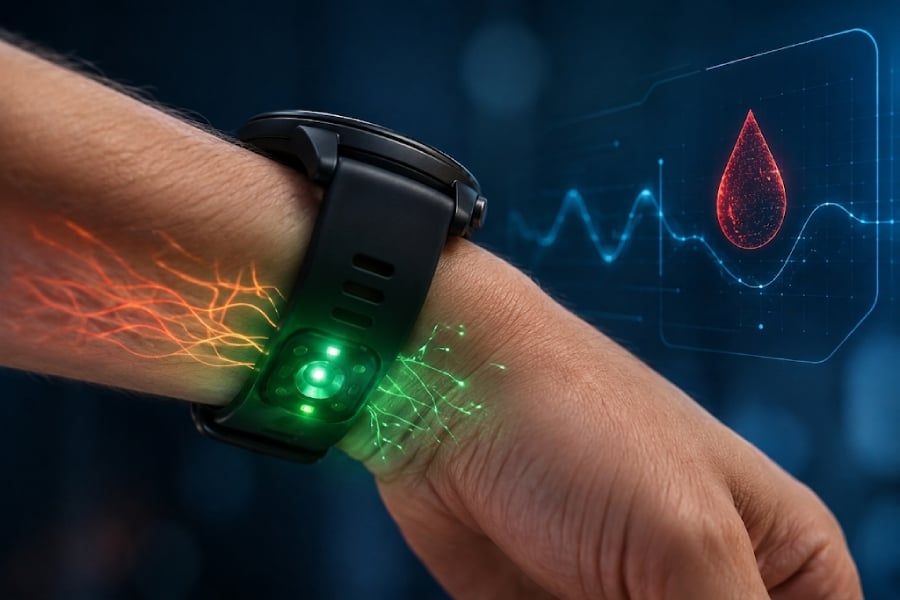
New scrutiny of Garmin’s patent portfolio is revealing how the company is exploring ways to bring blood sugar insights directly to the wrist.
A collection of related patent filings sheds new light on the company’s research into non-invasive HbA1c estimation, including technology for measuring glycated hemoglobin with optical sensors in a wearable device. The research comes as Apple and other smartwatch makers pursue their own approaches to bringing more metabolic health information to wearables.
The latest attention comes from a Tech Advisor report highlighting Garmin’s patent activity around the technology. While patents are no guarantee of a commercial product, they provide a clearer picture of how Garmin researchers are approaching the problem and why the company’s work differs from the real-time glucose monitoring many users might expect.
Garmin’s patents point to HbA1c measurements from the wrist
One Garmin patent application, titled “Determination of a User’s Glycated Hemoglobin Level Using Pulse Spectroscopy,” describes a wearable device that sends multiple wavelengths of light through the skin and analyzes the resulting optical signals.
The system would use those signals to estimate the amount of glycated hemoglobin in a user’s blood. The patent application was published in February 2026.
That distinction matters: HbA1c is not the same thing as a live blood glucose reading.
Continuous glucose monitors, or CGMs, can show glucose levels changing throughout the day. HbA1c instead reflects average blood sugar levels over a much longer period. Garmin’s proposed technology focuses on estimating that longer-term marker rather than telling users how their glucose changes immediately after a meal or workout.
Current Garmin devices can already display readings from compatible Dexcom CGM systems, but the glucose measurements come from the external sensor rather than the watch itself.
Garmin’s patent research explores a different possibility: estimating HbA1c through optical measurements taken by a wrist-worn device.
Garmin is also tackling the ‘too-tight watch’ problem
A related Garmin patent reveals one of the less obvious challenges standing in the way.
The company’s “Pressure Compensation for Wrist-Based Pulse Spectrometry” filing describes technology designed to account for pressure between a wearable and a user’s skin. A watch pressing against the wrist can affect blood vessels and alter optical signals, potentially distorting physiological measurements.
Garmin’s proposed system calculates a pressure metric from photoplethysmography (PPG) signals and applies a compensation factor to physiological measurements. The patent specifically identifies HbA1c as one of the measurements to which the technique could be applied.
The filing does not prove Garmin has solved non-invasive HbA1c estimation. But viewed alongside the company’s dedicated HbA1c patent, it shows researchers examining both the measurement itself and one practical variable that could interfere with optical readings on a real wrist.
Apple is pursuing its own glucose breakthrough
Garmin is hardly alone in trying to extract more metabolic health information from the wrist.
Apple has spent years researching non-invasive glucose monitoring, but it has yet to put a glucose-measuring sensor inside an Apple Watch. TechRepublic has previously examined Apple’s efforts to bring blood sugar monitoring to the Apple Watch, including the technical and regulatory obstacles standing in the way.
The Apple Watch can already display glucose data from compatible CGM devices, including Dexcom devices. Like Garmin’s current watches, however, the device serves as a display rather than measuring glucose independently.
Apple has not publicly announced how or when it might bring independent glucose measurement to the Apple Watch. Reports about the company’s long-running research have nevertheless kept the possibility of non-invasive glucose monitoring in the spotlight.
Garmin’s documented research is not targeting the exact same measurement. Its HbA1c patent centers on estimating glycated hemoglobin rather than providing continuous, real-time glucose readings.
The two companies are therefore exploring different approaches within a broader push in wearable metabolic health: how to extract more useful health information from the wrist without relying entirely on separate sensors.
What’s hot at TechRepublic
The promise of needle-free glucose tracking has generated years of smartwatch rumors, but the terminology can make emerging technologies sound further along than they really are.
Garmin’s patents do not establish that a future watch will continuously measure glucose. They do not confirm that Garmin has completed clinical validation, received regulatory clearance, or decided to ship HbA1c estimation in a consumer product.
They also do not confirm that the technology is coming to the rumored Fenix 9.
Recent reporting has linked Garmin’s patent activity to speculation about its next flagship watch, but there is currently no public evidence directly tying HbA1c estimation to the Fenix 9. Patent filings frequently describe technologies that never reach commercial products.
There is also a significant regulatory barrier.
The US Food and Drug Administration has warned consumers against relying on smartwatches or smart rings that claim to independently measure blood glucose without piercing the skin. The agency has warned that inaccurate readings could lead people to make incorrect decisions about diabetes management.
That makes accuracy more than a specification-sheet problem. Any technology intended for medical use would face a very different standard from familiar wellness features such as step counts or sleep scores.
The smartwatch blood sugar race is getting more crowded
The wearable industry has steadily expanded from counting steps to monitoring heart rhythm, blood oxygen, temperature, sleep, and other health signals. Blood sugar remains a much tougher prize.
TechRepublic’s guide to wearables for blood sugar tracking shows how varied these efforts already are. Some watches display readings from separate CGMs, while companies continue researching ways to extract metabolic information directly from wearables.
The broader shift is already underway, just not through the needle-free smartwatch sensor many consumers might imagine. As TechRepublic explained in its look at the smartwatch blood sugar revolution, today’s biggest advances still largely depend on CGM and tighter integration between medical sensors and consumer wearables.
Garmin’s patents add another approach to that broader push.
Rather than demonstrating that Garmin is ready to replace a CGM, the filings show researchers exploring whether optical sensors could eventually estimate HbA1c from the wrist and how problems such as pressure against the skin might affect those measurements.
Whether that research becomes a commercial Garmin feature remains an open question.
For now, the patents offer a glimpse at another front in wearable metabolic health. Apple and Garmin may be pursuing different measurements and technologies, but both are confronting a formidable challenge: extracting meaningful metabolic information from the wrist without breaking the skin.
Also read: For a broader look at what today’s wearables can already detect, explore five smartwatch health alerts that go beyond blood sugar, from hypertension warnings to irregular heart rhythms and emergency detection.
>

HBO Max’s Jimmy Olsen & Gorilla Grodd ‘Superman’ Spinoff Series Gets Series Order & Title, Reveals Cast

How to watch Angels vs. Rangers: TV channel and streaming options for August 21

New York City Is Now The Capital Of Tech Jobs, Edging Out Bay Area In Annual Survey
-

 movies3 months ago
Search For Canadian TV Actor Stewart McLean Now Homicide Investigation
-

 Fashion9 years ago
These ’90s fashion trends are making a comeback in 2017
-
Fashion9 years ago
According to Dior Couture, this taboo fashion accessory is back
-
Fashion9 years ago
Model Jocelyn Chew’s Instagram is the best vacation you’ve ever had
-
Fashion9 years ago
Emily Ratajkowski channels back-to-school style
-
Fashion9 years ago
9 Celebrities who have spoken out about being photoshopped
-
Fashion9 years ago
Your comprehensive guide to this fall’s biggest trends
-
Fashion9 years ago
A photo diary of the nightlife scene from LA To Ibiza