
Entertainment
Ridley Scott on ‘The Dog Stars,’ Multiple Cameras, and Love Stories


Part of the appeal of Ridley Scott‘s latest film, “The Dog Stars,” is that it gives the audience several movies for the price of one: its story of a mechanic (Jacob Elordi) searching for human connection after a virus has wiped out most of civilization is part dystopian drama, part buddy comedy (in the scenes between Elordi and survivalist Josh Brolin), part Kubrickian horror film, and part kinetic action movie.
In the end, however, “The Dog Stars” turns out to be primarily a love story between Elordi and young widow Margaret Qualley — but because this is a Ridley Scott movie, the love story is subtle and barely consummated. “When I go to Hollywood, they’ll pitch me on a story and say ‘it’s sentimental,’ or ‘it’s melodramatic,’ like it’s a compliment,” Scott told IndieWire on the latest episode of the Filmmaker Toolkit podcast. “I say, ‘Stop.’ Those two words are terrible.”


Scott prefers understated love stories like the one he depicted between Susan Sarandon and Michael Madsen in “Thelma and Louise.” “He was so underrated, Michael,” Scott said. In the scene between Sarandon and Madsen in the hotel room where they say goodbye, or the moments between Elordi and Qualley where they tentatively let their guards down, Scott tries to keep the emotional expression as restrained as possible, something he attributes to his British lineage.
“I think Churchill once said that the English and Americans are divided only by the same language,” Scott said. “You’ve got to earn the emotion. As soon as the music comes up, that means it’s not quite working. [Elordi and Qualley] never consummate the relationship, other than a kiss.”
The biggest difference between Scott’s approach on “Thelma and Louise” and his way of shooting “The Dog Stars” is technical. On “Thelma and Louise” he was covering scenes with only one camera that he operated himself, but for “The Dog Stars” he tended to employ between four and six cameras to cover dialogue scenes — a practice he began after “Thelma” that he has become known for in the years following “Black Hawk Down.”
“I did that for a very brief time as a director in BBC television,” Scott said of his early years before working in advertising and feature films. “There you’re doing live drama with six cameras, so I learned to pre-plan the geometry of the scene with the actors.” After his BBC years, Scott operated the camera on thousands of commercials and now-classic feature films like “Alien,” “Blade Runner,” and “The Duellists,” but after “Thelma and Louise” he decided he would be better served by multiple cameras that he could direct from a bank of monitors.
”Now the camera’s receiving through the viewfinder directly into a monitor, so I can sit there with four monitors, and I can talk to each operator as an operator,” Scott said. “Say, ‘You missed it, you got it, change your lens, you’re too slow,’ et cetera.” By the time he got to “Black Hawk Down,” Scott was shooting massive action set pieces with 11 cameras, which allowed him to get everything in one take. “That would’ve taken two days, but I did it in a morning.”
Shooting with multiple cameras isn’t just about saving time and money, however. For Scott, it’s a way of giving his actors total freedom, so they don’t have to worry about matching their action from take to take, and they don’t have to get exhausted doing the same scene over and over again. Scott arrives on set each day with detailed sketches so that everyone knows the plan. “I’m filming on paper before I get there,” Scott said. “On some sets they’re still arguing at 11 about where the camera’s going to go — I turn over by a quarter to nine every morning.”
That doesn’t mean Scott is rigid about his plan, however. “I’ll leave it on the actor,” Scott said. “Not the cameraman, the actor. If they say, ‘I don’t like it that way,’ I say, ‘What do you want to do?’” The key for Scott is finding a rhythm for the shots so that they work in relation to each other, and in relation to the overall shape of the screenplay. “You need movement, but sometimes I know when to sit still. It’s like sound. Silence is the biggest sound you can have — suddenly you go silent, and everyone starts paying attention.”
“The Dog Stars” is now playing in theaters. To hear the entire conversation with Ridley Scott and make sure you don’t miss a single episode of Filmmaker Toolkit, subscribe to the podcast on Apple, Spotify, or your favorite podcast platform.
>

“Coyote vs. Acme” had a treacherous path to the big screen but it’s finally coming out.
The live-action/animated hybrid film à la “Who Framed Roger Rabbit” was shelved by Warner Bros. years ago despite being completely finished. CEO David Zaslav deemed the film would be better as a tax write-off than a theatrical release. Luckily, Ketchup Entertainment saved the courtroom comedy from disappearing into the vault, and the film is finally coming out.
Here’s where you can watch “Coyote vs. Acme” and when the film is expected to land on a streaming service.

When does “Coyote vs. Acme” come out?
“Coyote vs. Acme” finally arrives on Friday, Aug. 28.
Is “Coyote vs. Acme” streaming or in theaters?
Right now, “Coyote vs. Acme” will only be available in theaters after having been saved from permanent shelving. Streaming details aren’t available yet.
Find showtimes and book tickets for screenings near you in the links below.
Who’s in the “Coyote vs. Acme” cast?
The “Coyote vs. Acme” cast is led by Will Forte and he is joined by Lana Condor and John Cena. Then there are the many Looney Tunes to round out the cast – Wile E. Coyote, Bugs Bunny, The Road Runner and more star alongside the human counterparts.
What is “Coyote vs. Acme” about?
The new real world/animated hybrid film is a courtroom comedy that follows Wile E. Coyote hiring a billboard lawyer to take on the massive Acme Corporation after he gets fed up with the products he buys backfiring on him during his many pursuits of The Road Runner.
Watch the Trailer:

>
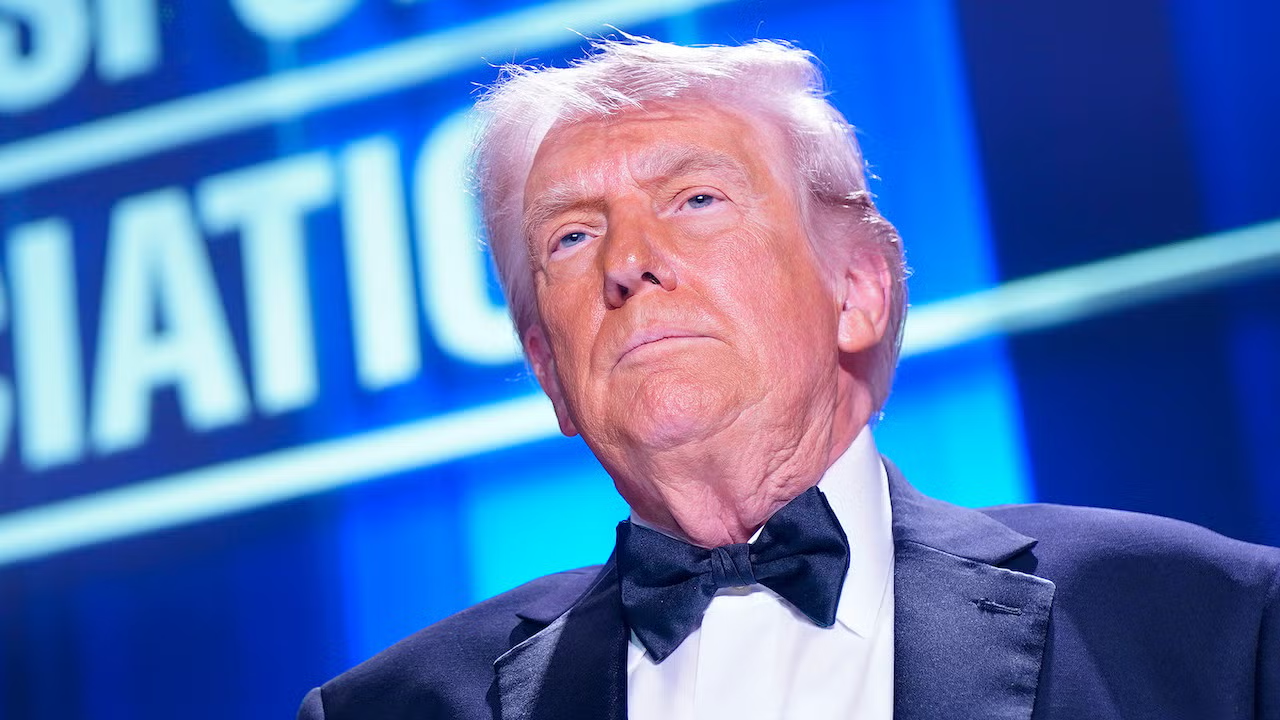
Donald Trump took aim at New York Times journalist Maggie Haberman after she published a story claiming the president planned to skip a 9/11 memorial service at Ground Zero because he would be unable to give a speech.
“Maggot Hagerman, the Fake Reporter from The Failing New York Times, an unattractive person both inside and out, and who knows less about me than most reporters on the beat,” Trump wrote on Truth Social Friday afternoon, “(She’s a SCAMMER!), made up a story that on September 11th, I’m not going to the World Trade Center, in New York City, because they won’t let me make a speech, and I’m going to the Pentagon in D.C., because I’m a featured speaker.”
As the president continued, he blasted the report, which was also written by the Times’ Zolan Kanno-Youngs, Dana Rubinstein and Sally Goldenberg, as “more corrupt news” from the outlet.
“I’ve been to New York many times over the years, and no one ever speaks, it’s a ‘solemn ceremony,’” he said. “I never even thought of what Maggot made up, and besides, I would love not to speak, because I’m speaking all the time, and this is a day to remember the victims, and their beautiful family members.”

Trump then further attacked Haberman, who made headlines earlier this year for the book she co-authored with Jonathan Swan, “Regime Change: Inside the Imperial Presidency of Donald Trump,” which took a closer look at his unrestrained use of executive power in his second term. While Haberman’s reporting work has previously received widespread critical acclaim, including a Pulitzer Prize in 2018, Trump declared the journalist “a phony,” adding that “The New York Times knows it!”
“It will all be revealed in the lawsuit against them, and another lawsuit against the organization which gives out the now discredited Pulitzer Prize, because Maggie got one for her ‘reporting’ on THE RUSSIA, RUSSIA, RUSSIA HOAX, which turned out to be a total CON JOB,” he added. “If she were ever forced to reveal her ‘sources,’ you will find out they either don’t exist, or didn’t say what she reported. She’s been falsely writing about me for years — She’s a stalker, and should be forced to turn over any and all money that she’s made through her fake reporting on me.”
In response to Trump’s criticism, a spokesperson told TheWrap, “The Times’s reporting is based on information from multiple people with knowledge of the discussions and planning around New York’s Sept. 11 ceremony. Our journalists sought comment from the White House communications team, who provided a statement that didn’t contradict what we had learned. The president chose to attack the story 24 hours later, singling out one of the four reporters who wrote it. We are confident in the accuracy of the reporting.”
CNN’s Jake Tapper, who appears with Haberman on his show “The Lead,” came to her defense saying she was “a great person, beautiful inside and out, an incredible mom and wife and colleague, and an amazing journalist.” He also added that the president’s comments were “disgusting and beneath the office.”
I’m not going to repost the filth the president wrote about Maggie Haberman, but suffice it to say she’s a great person, beautiful inside and out, an incredible mom and wife and colleague, and an amazing journalist. The president’s comments are disgusting and beneath the office.
— Jake Tapper 🦅 (@jaketapper) August 28, 2026
This is not the first time the New York Times has been caught in Trump’s crosshairs, as the president sued the publication in September for $15 billion over unfavorable coverage of him ahead of the 2024 presidential election.
At the time, a Times spokesperson defended that the suit had “no merit,” noting, “It lacks any legitimate legal claims and instead is an attempt to stifle and discourage independent reporting.”

“The New York Times will not be deterred by intimidation tactics,” the statement continued. “We will continue to pursue the facts without fear or favor and stand up for journalists’ First Amendment right to ask questions on behalf of the American people.”
Not long after, Judge Steven Merryday, a George H.W. Bush appointee, struck down the lawsuit and said the nearly 90-page lawsuit was “not a protected platform to rage against an adversary.”
“A complaint is not a megaphone for public relations or a podium for a
passionate oration at a political rally or the functional equivalent of the Hyde Park
Speakers’ Corner,” the judge wrote at the time. The judge gave Trump’s attorneys 28 days to file an amended lawsuit, which was refiled in October of 2025.
In July, a federal judge deferred the New York Times’ motion to dismiss the defamation lawsuit and ruled Trump could file an amended complaint before the court considers the motion.
In addition to the Times, Trump has sued the Wall Street Journal, BBC, CBS News, ABC News and The Des Moines Register in the last two years. He’s also called out a number of female reporters since his second term began in January 2025, including Kristen Holmes, Kaitlan Collins, Kristen Welker, Catherine Lucey, Jessica Tarlov and Shannon Bream.

>
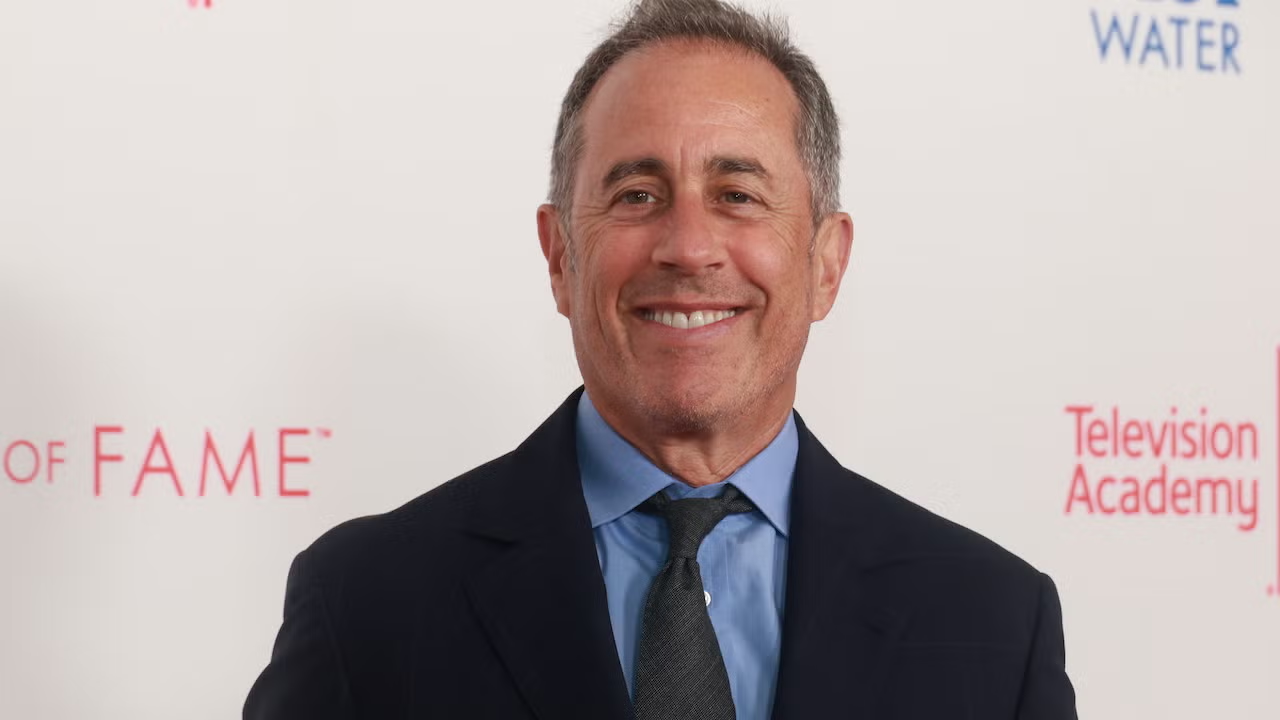
To hear Jerry Seinfeld tell it, he had a major hand in American Express’ creation of its Centurion Card (widely known as the Black Card) in 1999.
As the story goes, when Seinfeld was a spokesperson for American Express in the 1990s, a member of a commercial’s crew asked him if he owned an AmEx Black Card. Not knowing what it was but thinking it was about time he did, he called up the company’s president at the time, Harvey Golub, and said that he wanted one — but it turned out the coveted card for the ultra-rich and famous was just a rumor at that time.
When it was made a reality, Seinfeld said he was the first person to be gifted one.
The iconic comedian first broke out the story on his Netflix’s talk series “Comedians in Cars Getting Coffee” with guest John Mulaney in 2018. But in a recent live audience interview with comic and actor Sebastian Maniscalco to launch his “We Got Company!” podcast, Seinfeld added another layer to the tale.
“I was on the set, we’re shooting a commercial, and one of the guys on the crew slides up next to me and whispers, ‘Do you have the Black Card?’ I go, ‘Well, what’s that?’ He goes, ‘There’s supposed to be a secret Black Card, and only the Sultan of Brunei and the president of American Express has it. And I thought maybe you had it too.’
“I go, ‘No, I don’t have it. But I’m gonna get it,’” Seinfeld continued. “And, the next morning, I called the president of American Express, Harvey Golub at the time, a nice Jewish guy from Brooklyn, and I said, ‘What about the Black Card?’ He says, ‘It’s just a rumor, it’s never existed.’ I go, ‘Let’s do it, let’s make the Black Card.’ He goes, ‘Let me look into it.’ And that’s how it happened.”
When Maniscalco asked Seinfeld to confirm that he was indeed the first person to be presented the American Express Black Card, the comic shared a coda:
“I had the first one, and I threw it out,” Seinfeld said, laughing. “I don’t know what happened to it. But he gave it to me in this nice padded thing, and it was the first one, and I don’t have it anymore.”
For those hoping to follow in Seinfeld’s footsteps and also become an AmEx Black Card holder, CNBC previously detailed in its own account that the main thing needed for such access is a “well-padded bank account.” Kim Kardashian and Oprah Winfrey, the outlet reported, are also said to be among the card’s elite holders.
>

How to watch San Jose State vs. No. 14 USC: TV channel and streaming options for August 29

How to Watch Coyote vs. Acme: Is the Movie Streaming?

‘The Athletic Football Show’ previews the 2026 Dallas Cowboys
-

 movies3 months ago
Search For Canadian TV Actor Stewart McLean Now Homicide Investigation
-

 Fashion9 years ago
These ’90s fashion trends are making a comeback in 2017
-
Fashion9 years ago
According to Dior Couture, this taboo fashion accessory is back
-
Fashion9 years ago
Model Jocelyn Chew’s Instagram is the best vacation you’ve ever had
-
Fashion9 years ago
Emily Ratajkowski channels back-to-school style
-
Fashion9 years ago
9 Celebrities who have spoken out about being photoshopped
-
Fashion9 years ago
Your comprehensive guide to this fall’s biggest trends
-

 Anime3 months ago
Rurouni Kenshin: Hokkaido Arc Manga Takes 1-Issue Break – News