
Sports
The brutal biology of boxers ‘gassing out’ – and why it’s so dangerous


After eight rounds of his first world title fight, against Croatia’s Filip Hrgovic last Saturday, Moses Itauma’s legs somehow carried his 241.7lb, 6ft 4in frame back to his corner.
The 21-year-old British heavyweight had the beating of his more experienced opponent – up on all three judges’ scorecards – but he was exhausted. He’d gone for the kill in round eight, unleashing a salvo of punches designed to result in a stoppage. But Hrgovic had soaked them all up and even sent a few back Itauma’s way.
As Itauma sat on his stool, his breathing was fast and heavy. It stayed that way throughout the 60-second break between rounds. As he got to his feet again, he grimaced.
Hrgovic saw his opportunity, and pounced at the start of the ninth round, marching forward and unleashing heavy shots. Itauma retaliated but his body was no longer his own. The punches were wild swings. The force of those that did land had more of an impact on him than his opponent – sending him staggering backwards into the ropes.

Referee Howard Foster intervenes in the Itauma-Hrgovic fight (Richard Pelham/Getty Images)
With 33 seconds of the round remaining, the referee stopped the fight, just as Itauma’s trainer Ben Davison threw in the white towel. Itauma’s bid to become the second-youngest heavyweight champion in history was over. He was carried out of the ring on a stretcher; his body finally succumbing to complete exhaustion.
The diagnosis from seasoned boxing observers was emphatic: Itauma had ‘gassed out’. But what exactly does that mean? What is it that turns the arms and legs of some of the strongest athletes in sport into jelly beyond their control?
“In the world of exercise physiology, you’ve got two components,” explains Dr Andrew Usher, exercise physiologist and British Boxing Board of Control-licensed coach. “You’ve got your heart and lungs, traditionally classed as your aerobic capacity, and the oxidative capacity of your muscles (the maximum rate at which your muscles can use oxygen to produce energy).
“A lot of coaches are training purely for the heart and lungs, thinking that that is going to get them through the fight. But your heart and lungs are only delivering the oxygen to the muscle. The muscle still needs to be able to extract the oxygen.”
If the muscle can’t do that sufficiently during a fight, the boxer will struggle to recover appropriately between rounds, says Usher, and they will start each one in an increasing deficit. “That means things like gross movement skills will start to deteriorate much quicker.”
Usher has conducted research into the physiological demands of boxing and the speed and pattern at which active muscles consume oxygen during physical activity (also called muscle oxygen kinetics). He says that although developing a fighter’s aerobic engine is important, they also need a better way for their muscular system to utilize the oxygen that’s being delivered.
“That has to be trained much more appropriately than it currently is” says Usher. “Especially in big guys like Itauma, who carry a lot of muscle mass – you’re going to have a lot more oxygen debt than a small super bantamweight.”
What sets Itauma apart from most heavyweights is his speed and explosiveness. But that explosiveness becomes expensive if it’s not managed correctly because with every explosion, the muscle is contracting and using oxygen, which it then has to replace.
“For Itauma, that debt is just stacking up and stacking up”, says Usher, “to the point where the muscle can’t extract enough oxygen and it’s not got enough calcium sensitivity so the muscle can’t contract. That’s why you see fighters having to swing the arm because they can’t contract the muscles to put the glenohumeral joint in the right position, to get the hip into the right place – it becomes handbags at dawn. The problem with that is that it burns even more energy.”
There are various ways of training the muscle’s ability to extract and use oxygen. Usher’s preferred method is supramaximal bike sprints as part of a sprint interval training programme. These are short, all-out bursts of exercise performed at an intensity higher than your maximal oxygen uptake (VO₂ max). It can also be done with boxers via targeted and individually tracked intervals on the punchbag.
The purpose of these sessions, says Usher, is to “generate more mitochondria (tiny structures in the cell that generate energy to power cellular functions) in the muscle, so you have a larger oxygen reserve and energy production. At the same time, you’re improving the muscle’s capacity to extract oxygen and, more importantly, to resynthesize it back into the muscle.”
In endurance sports, “bonking” or “hitting the wall” is a widely known danger that can occur when an athlete’s glycogen stores get depleted. Pace, power and various other functions can all suffer as a result.
At the end of the 2019 London Marathon elite runner Hayley Carruthers was approaching the finish line when her legs stopped working. With the help of race marshals, she crawled to an 18th-place finish. “I started counting my steps and my head was gone,” she told the BBC Radio 1 Newsbeat afterwards. “I think I lost sight in one eye. I just couldn’t lift my legs at all. It was petrifying.”

Hayley Carruthers crawls over the finish line at the 2019 London Marathon (Naomi Baker/Getty Images)
Usher says that what happened to Itauma — and there are other examples from heavyweight boxing history, such as Wladimir Klitschko in his first pro defeat against Ross Puritty, or David Haye versus Carl Thompson — is a form of bonking.
The impact of this on a fighter can be devastating, affecting cognitive capacity and increasing the risks of brain trauma. The 60-second window between rounds is a crucial period here, says Usher, and it’s one that’s tricky to manage.
“The bell goes and it could be four to six seconds before that athlete sits down, then you have to look at how they’re sitting – are they closing over the diaphragm or is the diaphragm open? Depending on where you put ice, it could be having an effect or it could be having no effect. And you’re trying to give instructions to that athlete.
“If they’re not recovering until the last three, four seconds of your 60 seconds, everything that’s happened before it is probably not going into their brain.
“Plus, when you’re breathing heavily, you are hyperventilating, so oxygen is not getting to the brain as quickly. That’s when the higher risk of brain trauma and subcutaneous hematomas comes in.”
The reasons why Itauma reached such a point of exhaustion after eight rounds have been debated endlessly since Saturday. For Usher, who was watching the drama play out from his home in Scotland, a couple of factors were clear: the tension with which Itauma entered the ring, and his inability to pace himself.
“There’s been a lot of pressure on that kid,” says Usher, referring to how the fight was framed as Itauma becoming the youngest heavyweight champion since Mike Tyson. “That pressure is going to increase adrenaline levels, so you’re going to start to burn glycogen much quicker than you would normally.”
Usher uses the word “wired” to describe Itauma as he entered the ring – a complete gear change for a fighter whose demeanour had previously been so calm. That can be used to a fighter’s advantage, but Itauma was simply burning through valuable energy stores before the fight had even started.
After the fight, Itauma’s manager Frank Warren acknowledged that Itauma’s adrenaline levels could have been “controlled a bit better pre-fight. Because I think he looked exhausted before he even got in there.”
Usher explains that “stress starts to create a kind of hormonal boiling pot, so you get epinephrine (also called adrenaline) and cortisol levels starting to increase and that all needs energy to facilitate it.
“If you come out wired and you’ve got seven or eight minutes before you actually box, by the time you go through a ring announcement and anthems, you’re already bleeding energy.”

Itauma is on the receiving end of a fearsome punch from Filip Hrgovic (Richard Pelham/Getty Images)
While other sports allow athletes to refuel glycogen stores once competition is under way, boxers are only allowed water, removing any opportunity to restock glycogen as it starts to deplete.
Itauma started fast, taking the centre of the ring and catching Hrgovic with fast, explosive shots to the head and body. By round three, there were signs that his pace was just starting to slow – a result of the dual impact boxing has on the body. “When you think of energy coming out of the body, you’ve got to think about it two ways,” says Usher. “One: heart and lung, and two: from the muscle.
“And the muscle is king because if the muscle can’t get oxygen from the blood supply, it can’t contract, it can’t perform. Effectively, that’s what happened to Itauma. His muscle reached the point where it couldn’t get enough oxygen back in, and at that time the only thing you can do is swing. That’s where efficiency comes in. That’s when it’s a case of: conserve your energy, hold the centre of the ring, just throw out a jab, keep them busy.”
At 21, Itauma has time to learn, train and understand what went wrong last weekend.
“You could give Moses a good engine, but if he drives it around like a Ferrari the way he did in that fight, it’s not going to last too long,” Usher adds. “That’s part of the learning strategy. But at 21, in a huge fight broadcast all over the world, how much goes to your head?”
>

Test your ball knowledge against today’s Who Am I?, Five in Five and Brainteaser.
>

When Bruno Fernandes stepped up to the penalty spot on Sunday afternoon, all eyes were at first on him. Understandably so: Manchester United’s captain had missed two penalties in pre-season.
But after Fernandes duly converted for the second goal of his hat-trick against Ipswich Town, it was Youri Tielemans’ antics in the background that drew attention.
As Fernandes undertook his trademark run-up, Tielemans mirrored him exactly, sidestepping and stuttering in synchronisation.

Two penalty experts told The Athletic this is not a particularly common tactic — but it is not new to Tielemans.
Here, in a 2025 FA Cup tie against Preston North End for Aston Villa, we see him mimicking Marcus Rashford, who was on loan at Villa at the time.

So what is the point of this odd-looking ghost run-up?
“The obvious one is to time your run for the rebound,” says Geir Jordet, penalty expert and author of the book Pressure, about the psychology of penalty shootouts. “Which is, in a sense, clever, because, particularly with a player like Bruno Fernandes, who often does his stuttered run-up for his penalties, you kind of need to follow him to get the timing right.”
Jordet explains that being already at speed and having momentum when trying to follow up a potential rebound is ideal. But if players other than the taker stray inside the penalty area or penalty arc before the kick is taken, and end up impacting whether the ball ends up in the net — for example, if they turn a rebounded penalty in — they risk the kick needing to be retaken, so timing of a run is crucial.
With a player such as Fernandes, who has a stuttered run-up, mirroring his movements can help Tielemans time his run perfectly.
@premierleague Youri Tielemans 🤝 Bruno Fernandes @Manchester United ♬ original sound – Premier League
“(Fernandes) makes his timing kind of scattered to make it difficult for the goalkeeper. So if you’re doing this type of, let’s call it a conventional rebound run, then you may also get the timing wrong, because you’re not paying attention to what the penalty taker is doing,” Jordet says.
In a clip posted on United’s social media on Thursday morning, Tielemans confirmed he mimicked Fernandes’ run-up to help time his run into the box. He has used the same method to help defend penalties, too, such as here for Andreas Pereira’s spot kick for Fulham against Aston Villa in 2024.

As well as timing the player’s own run, there could be a welcome secondary effect: good old mind games and distraction. As Ben Lyttleton, author of Twelve Yards: The Art and Psychology of the Perfect Penalty Kick, points out, Ipswich Town goalkeeper Kjell Scherpen is trying out some mental manipulation of his own.
“Scherpen adopted a starting position clearly on one side of the goal — he was trying to distract Bruno by leaving one side of the goal open. I’ve seen this work before,” Lyttleton says. “On this occasion, though — and right in Scherpen’s eyeline — Tielemans was mimicking Bruno’s movements.
“I’ve not seen this before and I wonder if it did distract the goalkeeper, even more than if he had been standing centrally. The irony is that Scherpen was trying to get the upper hand himself.”
Jordet notes that just before the kick is taken, United’s Matheus Cunha actually draws Ipswich’s Issa Diop to the other side of the penalty arc, leaving a completely clear line of sight between Scherpen and Tielemans.
“That could of course also be to give Tielemans better access to the space for a rebound,” Jordet says, “or it could be to make him more visible for the goalkeeper. And this is the type of distraction that I kind of like.
“There are enough players who will wave their arms or say something, but it is unusual that someone is doing the same as the penalty taker. So in the corner of the eye of the goalkeeper, this could actually provide a little bit of a disruption.”
A quick trawl back through the archives reveals a few other players who make these ‘ghost’ run-ups. There are a few examples of Dominik Szoboszlai mirroring former Liverpool team-mate Mohamed Salah’s favoured sidestep and approach; Jordan Henderson has previously used a similar strategy.
In the example below, Manchester City’s defenders seem wise to the tactic and aim to prevent Szoboszlai from a clear run into the box.

Tielemans’ former Aston Villa team-mate Amadou Onana also appears to mirror Rashford’s run-up in a game against Manchester City in 2025. There is also an example buried in an FA Cup classic for Coventry City: as Haji Wright scores the penalty that forces extra time against Manchester United at Wembley in 2024, his team-mate Callum O’Hare (now at Wrexham) can be seen shadowing his run-up.
It is a fairly uncommon trick, but should it be?
“If I were a goalkeeper and I had the choice between having opponents either standing still,” Jordet says, “or a series of opponents moving around the box and timing their runs perfectly because they’re basically emulating the penalty taker, I would definitely choose to have stationary opponents every day.”
Footballers are constantly seeking the next gimmick that will help them exploit any fine margins in the game — and the numbers actually reveal penalty rebounds as an area for potential improvement.
In the past five Premier League seasons, there have been 484 penalties, 400 of which have been scored. Of those not converted, 22 have been off target and 62 have been saved by the goalkeeper. Of course, some of those saves will have seen ’keepers hold onto the ball or push it out of play, but others will have presented an opportunity for a rebound. It’s rare for teams to take advantage: only 11 goals have been scored from rebounded penalty kicks in the Premier League over the past five seasons. All but two of those have been scored by the original taker.
Is there a chance for players outside the area to get more creative with their contribution to penalties?
“I’m curious to hear what Tielemans says about it and whether we’ll see it again in the future,” Lyttleton says. “Will a different player do it next time, or two players, one on either side of the penalty-taker? Or a choreographed five-man penalty routine? At what point will the referees have to get involved? I’m always up for new penalty methods but this one could get interesting — or more likely, will be regulated and clamped down quickly. But it was smart and original work from Tielemans!”
“It seems, when you think about it, almost stupid to just stand there,” Jordet says, “when you can do something to more actively position yourself and disrupt the goalkeeper.
“Why not do these things? Teams should be doing more of this. It’s such a critical situation for goalscoring and for the result of these games.”
>
Sports
I worked with Mike Dean. He doesn’t need to embellish stories that harm referees’ reputations
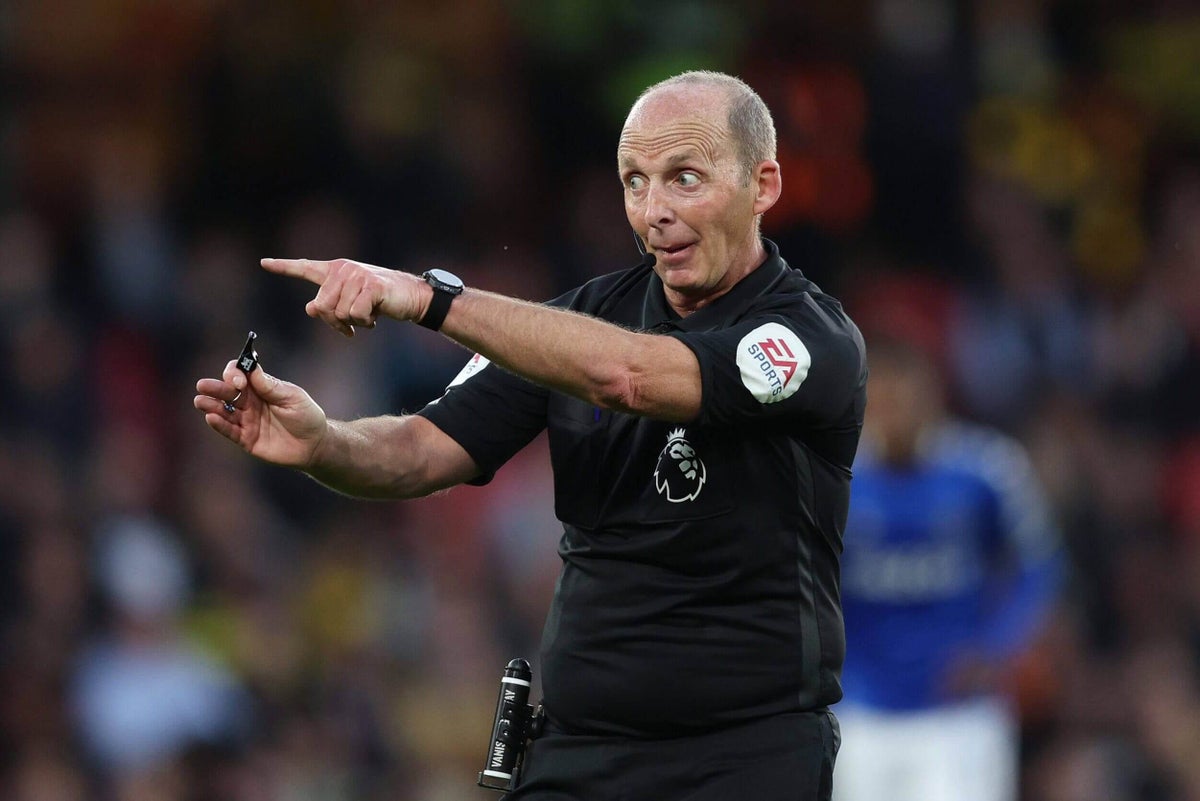
Most people appear to have made up their minds about Mike Dean.
As a referee, he was an arrogant showman who thought himself bigger than the matches he refereed. He wanted to make the game all about him.
This characterisation is understandable and unfair in equal measure, but it is hard to put forward a convincing case that Dean does not covet being the centre of attention when he pursues cheap laughs from footballers without a moment’s thought for the consequences.
In case you missed it, Dean claimed in an interview on a podcast fronted by Jamie Vardy that ‘we’ used to go as long as possible in at the start of a match without giving a free kick and that he would sometimes not leave the centre circle for minutes on end for a laugh. It’s an aside, but the use of ‘we’ grated, even if he was using the royal version as he dragged all the rest of us down with him.
It is impossible to prove a negative, so I cannot be certain that Dean did not do these things at some point during his 553 Premier League matches, but having known him for more than a decade and worked with him around 30 times, I am supremely confident that neither story is true, and that he has embellished both out of all recognition.
All refs have games from time to time that start slowly. Going 15 minutes without a free kick from the start of a match is unusual; 20 minutes is rare, but it happens.
Dean was the kind of ref who might notice and comment to his team about it. He might once have joked in the moment about seeing how long he could extend this anomaly, but there is no chance that he would have set out on this path before kick-off. Maybe he let a ‘soft’ free kick or two pass without whistling, but that would have been the extent of it. Wrong, yes, but let’s not get carried away.

Mike Dean refereed over 500 matches before retiring in 2022 (Adrian Dennis/AFP via Getty Images)
I reckon the centre circle anecdote would have had a similar genesis, as again, all referees occasionally have matches that get stuck in the middle third, meaning we rarely need to stray further afield. It is perfectly plausible that Dean’s irreverence once led him to tell his assistants that the centre circle had become such familiar territory that he would make it his home, and he may well have dallied there momentarily longer than he should. That’s all, folks.
My anger on hearing his interview has since dissipated into sorrow, as I knew the man and enjoyed his company. Our first proper encounter was in 2013, when I was an aspiring Football League referee. Surprisingly, he came across as insecure and shy — nothing like the persona one would expect given his demonstrative on-field style.
The occasion was an FA Cup tie at Southampton. As we gathered a few hours beforehand, he sank low in an armchair in the hotel lobby, sat quietly, and only joined the conversation when asked a direct question, to which there was always a direct answer. His physicality and personality were both much smaller than I had expected.
In public situations — ref meetings, pitches and podcast studios — there was a visual and verbal swagger that was there for all to see and hear. Whether or not this was a coping mechanism is for others with more psychological expertise than me to judge, but anyone watching or listening to him in action would be sure he revelled in the attention.
Fundamentally, Dean is a bright man with a quick wit who would be an entertaining chat-show guest or after-dinner speaker if he told the truth. He does not need to make up stories.
As a referee, he had an innate feel for what was expected in the moment, which worked well for him in the days before video reviews placed more emphasis on precision and consistency.
But for all his common sense on the field, he has shown precious little of it since retiring. Casual comments that harm former colleagues and employers do not disappear when the following day’s newspapers are thrown in the bin, yet hang around forever to cause untold damage to all referees’ reputations.
The clips in which he smirks about not leaving the centre circle or tries to keep a straight face while claiming that he decided to go as long as possible at the start of a match without blowing his whistle will be recycled for years.
There is every chance now that Dean will be remembered more for what he told former Leicester City striker Vardy in less than a minute to get a cheap laugh, than for a career spanning more than two decades during which he broke records, represented English football overseas with distinction, and refereed every major final.
I joined the Premier League list in 2015 and was bewildered by the culture that was permitted and therefore promoted. Plenty were indulged rather than managed, while those of us lower down the food chain were openly told that we had ‘non-speaking parts’ and should count ourselves lucky if we were given a Premier League game.
The refs were professional in some ways, shamelessly amateur in others. Some trained religiously, others occasionally. Mostly, they reffed on their wits and were good enough to get by on their experience, especially as the game was not as relentlessly fast and there was less scrutiny than today.
Thankfully, that culture has gone. Issues remain that a rebrand of PGMO into Pro Ref will not solve, but the direction of travel is better.
Coincidentally, Dean’s career on the pitch was over by the time the current chief refereeing officer, Howard Webb, took over. Webb has been known to overindulge Premier League clubs by being at their beck and call, but he does not indulge his refs. Everyone’s voice is valued, standards have risen on and off the field, and all matches are monitored and recorded in such a way that Dean would not have dared to try to play the class clown.
>

Flex your football brain with our daily quizzes

The ghost penalty run-up: Why did Youri Tielemans mimic Bruno Fernandes?

I worked with Mike Dean. He doesn’t need to embellish stories that harm referees’ reputations
-

 movies3 months ago
Search For Canadian TV Actor Stewart McLean Now Homicide Investigation
-

 Fashion9 years ago
These ’90s fashion trends are making a comeback in 2017
-
Fashion9 years ago
According to Dior Couture, this taboo fashion accessory is back
-
Fashion9 years ago
Model Jocelyn Chew’s Instagram is the best vacation you’ve ever had
-
Fashion9 years ago
Emily Ratajkowski channels back-to-school style
-
Fashion9 years ago
9 Celebrities who have spoken out about being photoshopped
-

 Anime3 months ago
Rurouni Kenshin: Hokkaido Arc Manga Takes 1-Issue Break – News
-
Fashion9 years ago
Your comprehensive guide to this fall’s biggest trends