
Venice Film Festival


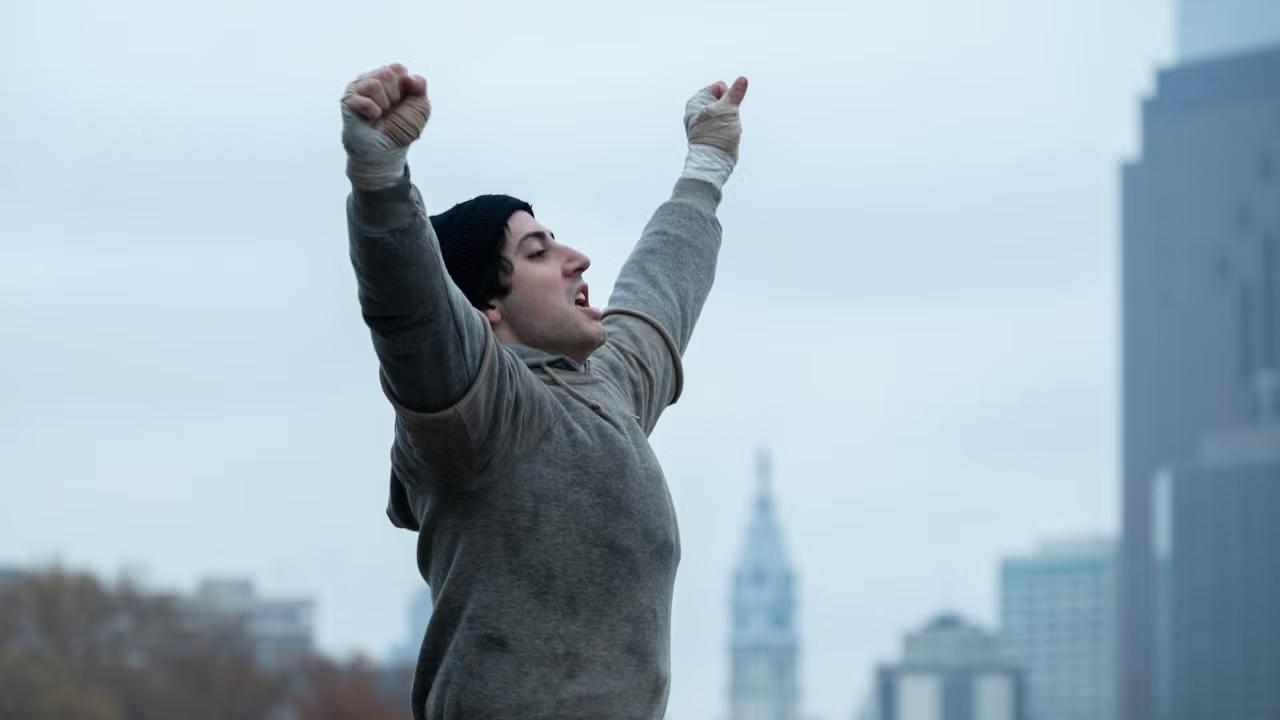
Midway through “I Play Rocky,” Peter Farrelly’s misfire of a movie about Sylvester Stallone and the making of “Rocky,” production is underway on the film that would make its lead a star. But, despite them shooting a key emotional scene, things aren’t working.
Sly (Anthony Ippolito) is pulled aside by the film’s director John Avildsen (Jay Duplass) and told he needs to dig deeper in the next take. There has to be something more, Avildsen says, that this is the moment where he’ll find the “thing,” the emotional why of the entire picture. Without it, the experience — even when the efforts of a dedicated crew moving heaven and Earth to make it work — will be empty.
Unfortunately, while the real Sly found that emotional depth in “Rocky,” the fictional version of him, even when pushed, never does here.
Instead, what we get is a film that’s broadly crowd-pleasing, having fun with some playful jokes about filmmaking here and there, though without a cinematic soul it can call its own. It never uncovers that deeper “emotional why,” reducing the unconventional success story of Stallone to something aggressively conventional and without a greater emotional punch.

It darts around, hitting all the beats you’d expect it to, but never instills them with any greater life. The only blows it lands are when it repeatedly punches itself in the face by insisting on spelling things out, rather than dancing gracefully in the ring.
The disappointment is felt right from the opening moments, when you first see Ippolito as Stallone, down on his luck and struggling to find his footing in New York. When you first hear him speak, taking part in an audition where he’s just meant to be a nameless thug, Ippolito credibly impersonates the voice of Stallone, but the delivery lacks the iconic actor’s soul. He’s occasionally able to have more earnest chemistry with Stephan James as Carl Weathers, who briefly appears before vanishing from the movie, but the rest comes across as shallow.
Much of this falls not on the shoulders of the cast, but on the consistently hackneyed script by Peter Gamble, which is lightly humorous and emotionally inert. It bolds and underlines every development and reference in such a repetitive fashion that it doesn’t feel like you’re even watching a movie as much as a visual representation of a Wikipedia page. We see Stallone leave New York with his wife Sasha (AnnaSophia Robb) to try to make it in Los Angeles, and there’s little time for us to inhabit their lives before, suddenly, they’re a couple and the creaky narrative takes over.
There’s still something occasionally interesting to the film — the story of the making of “Rocky” is genuinely fascinating, with Stallone pouring his heart and soul into his script, then stubbornly refusing to sell it unless a studio agrees to let him star. But again, “I Play Rocky” lacks the passion this story requires, hitting the beats but missing the heart. The narrative comes across as tiresome more than compelling, and the film consistently makes you wish you were just watching “Rocky” instead.

Indeed, in so many ways, “Rocky” is already a perfect expression of Stallone’s underdog struggle. This is merely a simulacrum of it, flatly shot without any visual texture, save for when it tries to emulate the look of the classic film.
In the end, “I Play Rocky” lacks both the courage of its convictions and the creativity of its subject. You only wish someone had sat down with the filmmakers and given them that same pep talk about needing to find that emotional something. The reason for being. The why.
“Rocky” will always remain a triumph, but when this film raises its hands in an attempt to tap into that feeling by replicating its most iconic shot, it’s a painfully hollow victory.
>
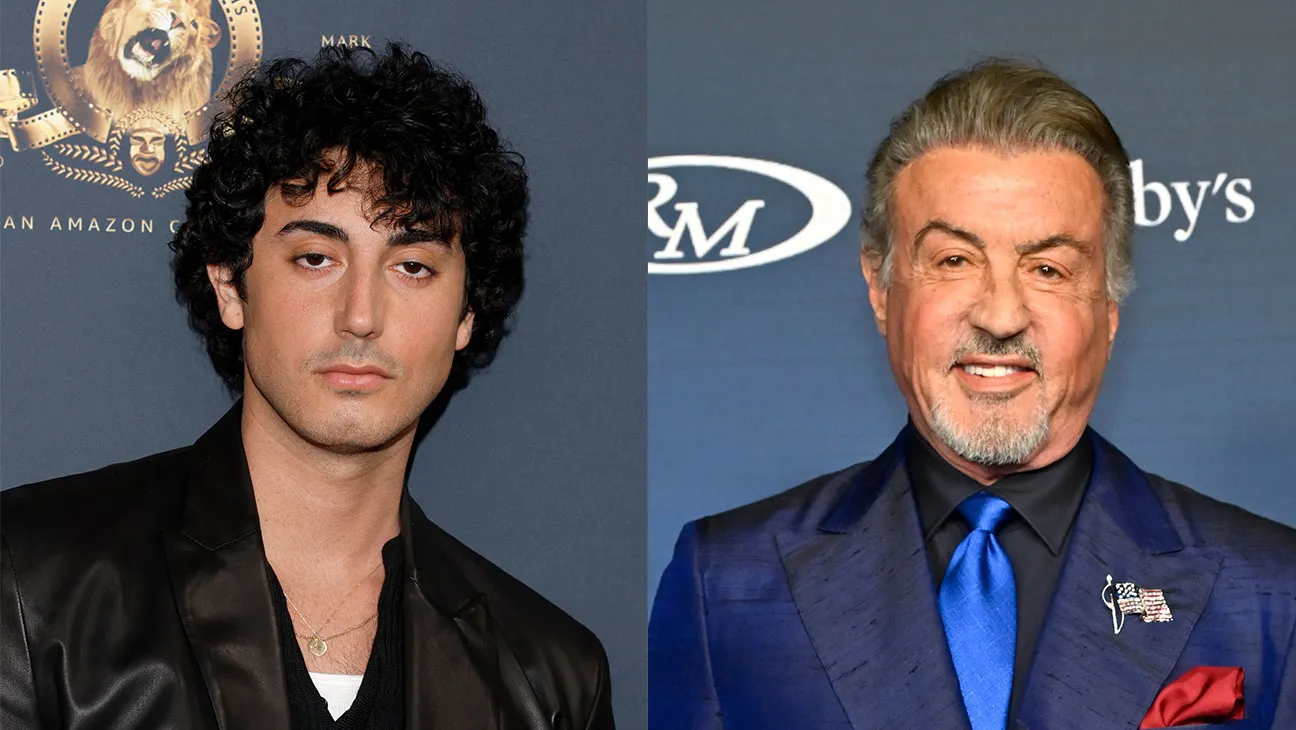
Anthony Ippolito, who stars as a young Sylvester Stallone in I Play Rocky, opened up about speaking with the action star in preparation for the biopic.
The Purple Hearts actor told The Hollywood Reporter at the Toronto International Film Festival on Saturday that talking with Stallone about his life, early career, and the development of Rocky was an “overwhelming” experience. Ippolito plays Stallone in Peter Farrelly’s I Play Rocky, which follows the tumultuous production of the 1976 boxing film that won three Oscars, including best picture.
“ I got to speak to Stallone prior to making the movie. It was a lot to take in because I’d spent over a year, by that point, studying him,” Ippolito said at THR‘s Studio at 1 Hotel during TIFF, presented by sponsor Canada Goose. “It was very overwhelming and daunting. There’s a lot going on in my head, but I was really just trying to listen as much as possible and hear his perspective. Obviously, Rocky’s an underdog story and he’s an underdog in the movie, but Stallone in a lot of ways was an underdog in his actual life.”
Ippolito revealed that he and Stallone chatted about Stallone’s early childhood and many of the difficulties he had to overcome, including paralysis of the lower left side of his face after doctors accidentally severed a nerve during childbirth. The complication gave Stallone his signature voice and look, which became famous when Rocky hit theaters in the ‘70s.
“Since he was born, he had this facial paralysis that kind of made everything difficult,” Ippolito shared. “[The paralysis] obviously made trying to become an actor really difficult. And so, hearing his firsthand account of what that is like; he really just endured a lot and went through a lot. It’s a miracle that this film came to be and that people still celebrate it 50 years later.”
Filmmaker Farrelly expanded on the challenges Stallone faced bringing Rocky to the big screen, adding that the studio at the time put up roadblocks in hopes that they could recast and find another actor to play Rocky Balboa. Stallone wrote the screenplay for the film and insisted he played the lead character.
Distributed by United Artists and later MGM, Rocky became one of the most financially successful sports film franchises of all time, grossing over $1.7 billion globally.
“ I think a lot of people know bits of [the story], but I didn’t know the big picture,” Farrelly said. “All the twists and turns; there are millions. … There’s so many things, like the way the studio — not only were they fighting him, but then once he got on board, they were — I don’t want to say they were sabotaging him — but they were making it hard for him so that if he got behind schedule, they could replace him with somebody else.”
Ultimately, Stallone’s opinion of I Play Rocky is one the cast and crew care most about, Farrelly said. The Rambo star has seen the movie and given his seal of approval, the director added.
“[Stallone] loved it. It’s such a relief. I was afraid because he watched it alone, for one thing, and this plays really well with a crowd,” Farrelly said. “I was nervous — him sitting there alone — and for many other reasons. There’s a lot of stuff in there, especially the beginning when he’s down and out. It’s rough to watch.”
I Play Rocky will open nationwide in theaters Nov. 20 following a limited release on Nov. 13.
>
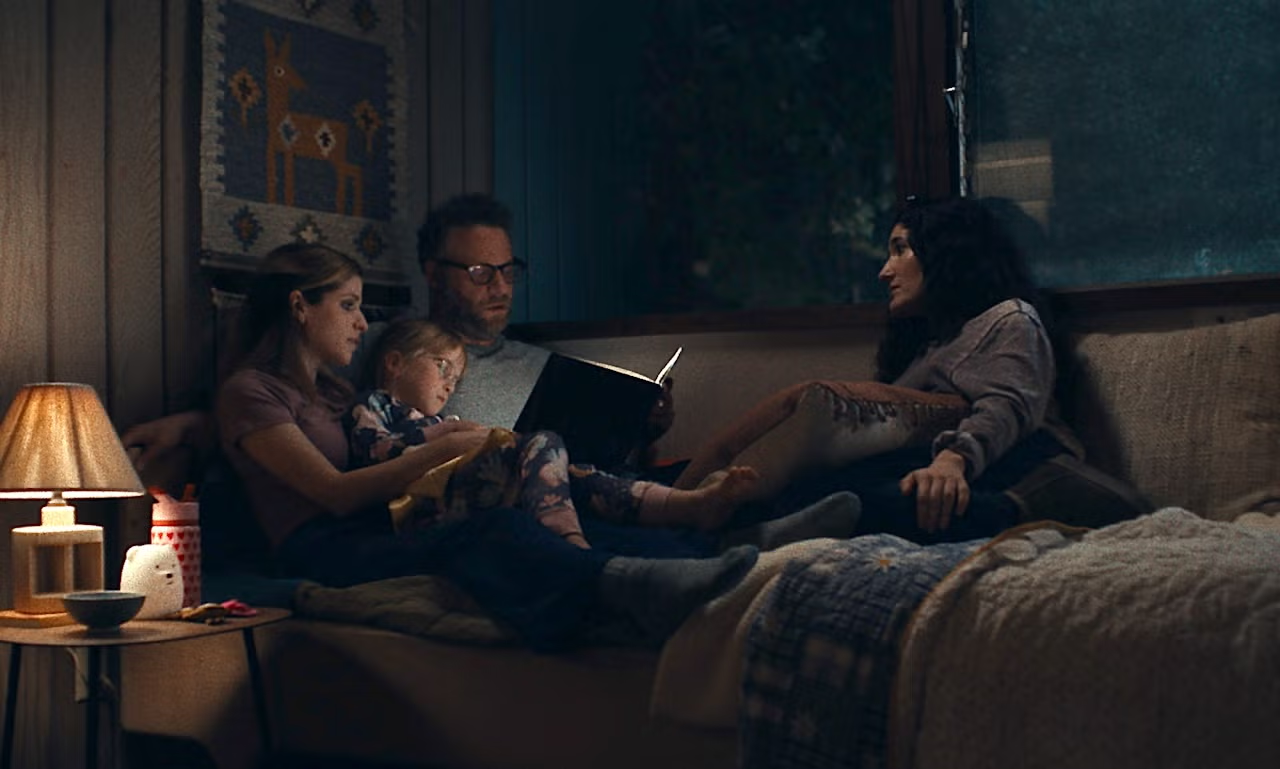
One of the starrier world premieres at the Toronto International Film Festival, “Babies,” as the festival’s program states, “digs deep into the dilemma that comes for every couple: to parent or not to parent?” It stars Seth Rogen and Anna Kendrick as spouses, and the movie was spearheaded by Rogen’s real-life wife Lauren Miller Rogen, who wrote, produced and directed the new comedy. The supporting cast includes Dan Stevens, Kate Berlant, Issa Rae, Ed Helms, Zach Cherry and Sharon Stone.
“As a woman, I’ve been asked the question of if I’m going to have kids a gazillion-and-a-half times throughout my lifetime, and was never quite sure of what that answer was,” Miller Rogen told Casey Loving at TheWrap’s studio at TIFF.
A decade ago, friends of the couple got divorced and one of them needed a place to stay, so they moved in with the Rogens along with their 2-and-a-half-year-old child. They ended up staying for an entire year.
“That experience is not technically what made us decide not to have a child,” Miller Rogen clarified.

But it did help to inspire “Babies,” with Berlant playing Eliza, a woman breaks up with her husband (Stevens) and comes to stay with Annie (Kendrick) and Aaron (Rogen). “Will witnessing the joys and sorrows of parenting up close tip the scales one way or another? Will ambivalence reign until Annie and Aaron simply age out?” reads the official TIFF program.
“I just thought that this is something that I had a point of view on and I had something that could add to the conversation that is happening out there. I thought that the fun way to tell that story would be to use our personal experience of this small child moving in with us, and then incorporate the amazingly beautiful stories that I’ve witnessed over the years from my friends who have become parents,” Miller Rogen explained. “I wanted to include all of the different points of views and experiences that I’ve seen with my friends, and to tell a story that felt like a very current and contemporary look at parenthood.
Seth Rogen has spoken openly about how his decision to not have children is what allows him time to produce projects like “Teenage Mutant Ninja Turtles: Mutant Mayhem,” star in two streaming series (one that he also writes and directs!) and spearhead Houseplant, his lifestyle brand of pot-friendly home goods. He said that the year he spent with the small child was “informative” – and not just for the movie.
“What to me is very interesting about the movie is that the couple is not confronted with an annoying kid or a bad kid. That isn’t the problem. They think kids would be annoying or that they don’t think they could do it. And I think that’s actually what became clear when we had a kid living with us for a long time was like, ‘We could do this,’” said Rogen. “We did have times where we were left with her and we spent a ton of time with her. It wasn’t like, ‘Oh I hate being around a kid.’ That was never the thing for us.”
“What’s nice about that perspective in the film is that I think a lot of people assume that is why some people are conflicted about having kids: they don’t think they could take care of a kid,” Rogen continued. “But what that year showed us was we were still very conflicted about having kids, but those were none of the reasons why. Having a great kid around was actually really informative because you’re like, ‘Oh, this is the best case scenario and I still don’t know if this is for me.’”
Roadside Attractions and Vertical picked up the rights to “Babies” ahead of its debut and will release it in 2027.

>
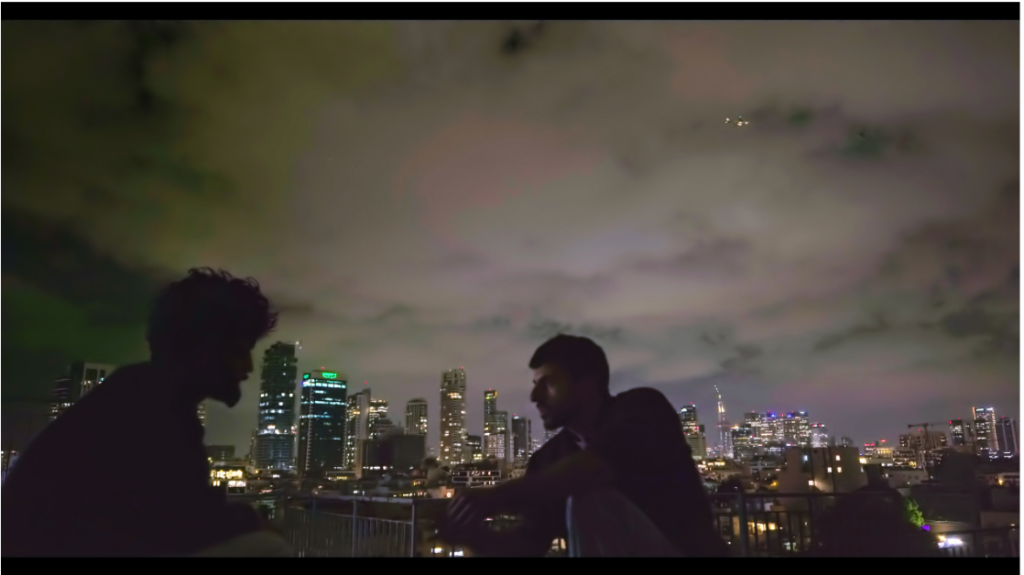
The devastating documentary NAZA, an investigation into Israel’s mass killing of civilians in Gaza, was shot at night on rooftops in Tel Aviv, in part to avoid potential Israeli eavesdropping, presumably, and to facilitate shielding the identities of participants.
Those participants are 24 Israeli military intelligence officers and soldiers who reveal, in almost matter-of-fact tones, chilling details of a program that has caused catastrophic destruction of residential areas in Gaza, and massive loss of life among Palestinian civilians, including women and children. The sources – ‘whistleblowers’ seems an appropriate term – come forward on condition of anonymity; they are filmed in silhouette, and their voices, as noted at the beginning of the film, have been digitally altered to conceal their identities.
One of the participants says that if he doesn’t hide his identity, “Israel will put me in jail for what I expose.”
Venice Film Festival
NAZA, a late addition to the competition lineup in Venice, on Saturday night won the festival’s Special Jury Prize. The film is directed by Israeli Jews Yuval Abraham and Rachel Szor, two of the four directors of the Oscar-winning documentary No Other Land. Abraham appears on camera, interviewing his subjects on the rooftop; they explain that “NAZA” is a Hebrew acronym used by the Israel Defense Forces to signify collateral damage (נזק אגבי or Nezek Agavi, per an interview included in press notes), in other words, an acceptable loss of civilian life incurred while trying to kill suspected Hamas militants. The film suggests the number of “NAZA” considered acceptable in each attack was elastic. In some cases, it would be under a dozen, but in others it could be 200 or even 500 people deemed permissible collateral damage, according to Israeli military personnel interviewed in the film.
Interviewees speak to an attitude they say was prevalent among IDF soldiers that allowed them to view Palestinian civilians as expendable: “We need to erase Gaza… They deserve it,” one source describes as a common refrain among soldiers. Another reports soldiers commonly said, “There are no innocent people in Gaza.”
Filmmakers Yuval Abraham and Rachel Szor
The Guardian/JW Films
According to interviewees in the film, Israeli military intelligence officials made the deliberate choice to attack residential targets in Gaza at night, after concluding it was more likely they could hit a suspected Hamas target while he was at home with his family. Multiple whistleblowers describe vast Israeli surveillance capabilities achieved by tracking cell phones which emit a periodic ping that signals its location.
“We can activate every sensor on the phone,” claims one interviewee. Says another, “I heard the final moments of someone’s life.”
Perhaps most alarming of all, the whistleblowers claim Israeli intelligence used AI to determine human targets. The existence of the Lavender program, as it was called, was first reported by +972 Magazine and Local Call, with additional reporting by The Guardian (The Guardian is one of the producers of NAZA). Up to 70,000 human targets were determined by the Lavender AI system, according to sources interviewed in the documentary.
An IDF spokesperson has responded to the film by saying, “The IDF categorically rejects these allegations… Regarding the allegations concerning the use of artificial intelligence – decisions regarding the selection and approval of strikes in the IDF are made by human personnel only, in accordance with IDF guidelines, and not by artificial intelligence.”
The IDF spokesperson indicates he or she has not seen the film but cites unspecified “publications” which have reported on the content of the documentary.
“According to the publications,” the IDF spokesperson writes, “the film relies on anonymous testimonies from individuals whose identity cannot be verified, including whether they served in the IDF, in what capacity, or whether they were involved in the matters about which the allegations are being made.”
The IDF response continues, “The excerpts cited include claims regarding national and military strategy that are clearly beyond the knowledge of junior-level soldiers. There are references to situations in which IDF Intelligence Directorate soldiers, who were allegedly interviewed for the film, by definition would not have been involved.”
The Israel Defense Forces statement goes on to say, “The IDF operates in the Gaza Strip in order to protect Israeli civilians and directs its military activity against terrorist organizations, foremost among them Hamas, in accordance with international law and the laws of armed conflict. As part of this, the IDF strikes military targets and makes unprecedented efforts to minimize harm to civilians.”
That statement notwithstanding, the Gaza Ministry of Health reports the IDF has killed over 73,000 Palestinians in Gaza and wounded over 173,000 since Israel launched its military retaliation after the Hamas terror attack on Israel of October 7, 2023.
According to some of the Israeli military personnel interviewed in NAZA, Israeli snipers deliberately fired on hungry Palestinians trying to reach food distribution sites. Another says he saw, through drone cameras, dogs eating the corpses of Palestinian victims of Israel military attacks as the bodies lay in the streets. Another whistleblower alleges a political unit of Israeli military intelligence spied on Palestinian victims of war crimes because “they were considered a security threat,” and collected kompromat to be used as needed to impeach the integrity of anyone who went public with allegations against the IDF.
“We called it peace thwarting,” says one source.
Some interviewees hint at feeling remorse, others point to merely completing a “mission” as assigned. One exclaims, “It’s so insanely fun to carry out a mission.”
L-R EP Jonathan Glazer, director Rachel Szor, director Yuval Abraham, producer James Wilson, EP Paul Lewis, co-producer Ekaterina Ochagavia, and EP Harriet Gugenheim attend the ‘NAZA’ premiere at Venice Film Festival.
Carlo Paloni/Getty Images
The perspective of filmmakers Yuval Abraham and Rachel Szor and executive producer Jonathan Glazer on the mass killing of Palestinian civilians can be readily imagined. But moments interwoven among the interviews gesture towards a more astringent critique. One scene shows vehicles stopped in traffic as Israel pauses nationwide to observe Holocaust Remembrance Day. And there’s a shot of Israeli television airing a tribute to Claude Lanzmann, the director of the towering Holocaust film Shoah, which probed how ordinary Germans, Poles and others could look away while atrocities were committed all around them against Jews during World War II.
Abraham and Szor write in a directors’ statement, “The film lets us explore something deeper than we could in our investigative journalism alone: not only the words being said but also those that are not said, the silence. It is up to all of us to break that silence.”
Title: NAZA
Festival: Venice (In Competition)
Directors: Yuval Abraham, Rachel Szor
Production companies: The Guardian, JW Films, Placeholder Films, Unseen Hand
Sales agent: mk2
Running time: 1 hr. 20 minutes
>


Search For Canadian TV Actor Stewart McLean Now Homicide Investigation


These ’90s fashion trends are making a comeback in 2017
According to Dior Couture, this taboo fashion accessory is back
Model Jocelyn Chew’s Instagram is the best vacation you’ve ever had
Emily Ratajkowski channels back-to-school style
9 Celebrities who have spoken out about being photoshopped


Rurouni Kenshin: Hokkaido Arc Manga Takes 1-Issue Break – News


HIDIVE to Stream English Dubs for The World Is Dancing, The Forsaken Saintess and Her Foodie Roadtrip in Another World, The Dangers in My Heart: The Movie Anime – News