
Entertainment
Who Will Keep Paramount Honest About Its Merger Promises?

The public won’t get to choose who buys Warner Bros. Discovery — but audiences and industry workers still have every reason to pay attention to whatever Paramount does next.
Following a contentious bidding war with Netflix this spring, Paramount finally reached settlements with 12 state attorneys general and, separately, the Writers Guild of America earlier this week. The recommended agreement is laid out in a proposed consent decree tied to the controversial $110 billion deal, which was filed in a California federal court on September 21.
The resolution still has to be approved by a judge, but it clears the major remaining legal hurdles that had prevented the merger to this point. The document covers everything from theatrical release quotas and production spending to the practical steps Paramount will need to take while setting up editorial safeguards to protect journalistic integrity at CBS News and CNN.


The filing also calls for several watchdogs in and outside the studio, though not all positions will do the same job or share equal sway over chairman and CEO David Ellison.
The combined company will have an independent trustee, who reviews records and operations externally before reporting back to the states attorney general. There will also be an internal compliance monitor and a special board of journalists tasked with resolving reporting disputes inside the massive Hollywood conglomerate.
Paired with some hefty promises — which IndieWire broke down by the numbers here — these assurances might make some of the merger’s skeptics feel better right away. But moving forward, the real test lies in not only determining that these terms genuinely prevented harm, but that they also created a functional system of checks and balances supported by people who will actually come forward and hold Paramount to their word, if (when?) the need arises.
Here’s how accountability at WarnerMount would work, and where there’s room for doubt.
Who Checks Paramount’s Work? First, Paramount
Raise your eyebrows and, uh, maybe keep ’em there? The first and arguably most essential WarnerMount watchdog would come from inside the contentious new studio. If the merger closes and the decree is approved by the court, the company will have 21 days to appoint an internal compliance monitor — who will report directly to the company’s chief compliance officer.
At the time of filing, Paramount is led by Ellison, while WBD is led by President and CEO David Zaslav. Neither has publicly named WarnerMount’s chief compliance officer, let alone selected a compliance monitor. They also haven’t announced Zaslav’s post-closing role, if any. The widely expected outcome seems to be that Ellison will run WarnerMount solo and Zaslav will exit or help with a short transition, but both Paramount and WBD declined requests for comment.

The decree also says the company would give the internal monitor’s contact information to the State Committee as well as independent trustee, and that their first report would be due within 120 days. That has to be followed by annual updates on Paramount’s compliance for five years: the length of the proposed agreement. The job also includes training for employees and biannual “reminders” informing them that they can report possible violations to the monitor or chief compliance officer without facing retaliation. What form that notice would take isn’t clear (is it an email, an HR training module, what?), and the proposed policy doesn’t require the reminders or any responses to them be published.
So, it is company oversight. But reporting up to company leadership, the internal compliance monitor is very much part of the Paramount team. At the end of each year, WarnerMount’s CEO and general counsel would also have to certify compliance to the State Committee, or identify material failures and explain how the studio plans to fix them. That is one of the many merger commitments Paramount has made, but it does not mean the public gets to see the findings.
The Independent Trustee: An Outside Check, Just Not a Public One
The monitoring trustee is the proposed agreement’s primary check on WarnerMount outside the studio, and within 90 days of the merger closing, the role will be jointly filled by company leadership and the State Committee. Paramount has to fund the trustee’s work (salary, travel and document fees, etc.) — but it cannot hire one of its own employees to do the job.
Limited by some confidentiality protections, the independent trustee will inspect relevant records and review various company facilities to thoroughly establish compliance. WarnerMount can’t interfere with the investigator by law, and their reports are sent to the State Committee twice a year with additional documentation provided when a violation has been alleged.

That gives the states some real receipts. Critically, however, it does not grant the trustee the power to overrule any decisions at the merged company or force leadership to do anything it wouldn’t on its own. Rather, the role is to examine and flag so the matter can continue in court.
The public, meanwhile, doesn’t necessarily get to know about any of this. As proposed, these reports are not required to be released to consumers by WarnerMount, and the mandate expressly excludes the trustee from overseeing news operations: a big limit for anyone hoping at least one external watchdog would take responsibility for the entire corporation.
Who Can Ask to Enforce the Deal? The State Attorneys General
This is the group with the sharpest teeth. California Attorney General Rob Bonta led the 12-state challenge, joined by attorneys general from Arizona, Colorado, Connecticut, Massachusetts, Minnesota, Nevada, New Jersey, New Mexico, New York, Oregon, and Washington. Assuming the decree is approved, any one of those plaintiff states could take Paramount back to court.
New York Attorney General Letitia James said she would “continue to closely monitor Paramount’s activities to ensure they are following this agreement and the law.” That is the key promise here: These are not just recommendations. The states have enforcement power.
The coalition will appoint a State Committee of no more than five attorney general offices. It would receive the independent trustee’s reports and Paramount’s annual compliance certifications, help select the trustee, and keep the larger group of states updated. But it would not be the only gatekeeper: Any plaintiff state could bring an enforcement case.
First, a state would have to notify Paramount in writing about an alleged violation and meet with the company within 30 days. If that goes nowhere, either side could seek nonbinding mediation. The court could then order compliance or grant other relief.

The theatrical release commitments offer a solid example of what enforcement could look like. If WarnerMount misses its annual release mandate, it would have six months to make up the difference. If it misses that second deadline, the company would then have a year to sell its full stake in Miramax as a penalty. It would also owe $30 million for each missing film, which will be donated to worker benefit funds, the Motion Picture & Television Fund, and the National Association of Attorneys General Fund. And that payment would still be due even if Paramount eventually released the missing movies.
Not every promise applies in every state. Colorado opted out of the studio lot and newsboard provisions, while Washington opted out of just the newsboard benefits. The agreement also bars retaliation against people who report possible compliance violations or otherwise cooperate with a company investigation. (It does not make them beneficiaries of the settlement, and a plaintiff can’t sue to enforce on that basis.)
Still, for all the states’ power, the decree creates no public complaint portal or obvious route for filmmakers, exhibitors, viewers, or other concerned parties to get a concern in front of them. Sure, the attorneys general can enforce the deal. But what it will take to grab their attention is less clear.
The Journalists’ Board: Can It Really Resolve Newsroom Disputes?
This is easily the most loaded commitment in the entire decree. The proposed News Editorial Independence Board comes after a turbulent stretch at CBS News under editor-in-chief Bari Weiss, whose leadership has prompted public questions about the network’s direction.
The firing of “60 Minutes” correspondent Scott Pelley only raised the stakes. And by the time WarnerMount closes, the First Amendment question of how much room journalists really have to push back on their employers may not feel so theoretical to tired CBS employees or new CNN staff. Within 180 days of closing, WarnerMount’s directors will appoint five active or retired journalists to oversee the independence of the two newsrooms — which will remain separate.
Each board member must have practiced journalism for at least a decade, including three years with “credentials”L a term the decree doesn’t specifically define. No more than two board members may be affiliated with the same political party, and U.S. government officials cannot serve on the board or approve any of its appointments.
Any company officers, shareholders, and non-journalist employees, or internal contractors are also barred from serving. Members are expected to serve three-year terms and can be removed only for “good cause,” which the decree defines as a fair, honest, good-faith reason.
Big picture, the board will set editorial principles based on CBS News and CNN’s existing standards, as well as resolve conflicts between journalists and management. These could involve alleged merger violations, reporting bias, or other issues of professional ethics. The group’s authority principally covers news and editorial content produced for U.S. distribution.

That’s democratically consequential, especially for a company that may soon control two major U.S. news organizations. Documentary filmmakers have already noted what the dawn of WarnerMount could mean for history, access, education, and culture. But the decree leaves many more basic mechanics to be worked out at a later date in a way that’s quietly alarming.
The proposed News Editorial Independence Board answers to company directors through the chief compliance officer, but not directly to the independent trustee or State Committee. The outline agreement does not explain how employees would submit complaints, explicitly give the board power to publish findings, or say whether its decisions would bind management. It also does not spell out what happens if management simply refuses to follow a ruling.
WGA and Other Oversight: What Falls Outside the State Decree?
The state decree is not the only agreement connected to this messy, enormously consequential deal. It is, however, the one that creates the most legible enforcement system inside the U.S.
The Writers Guild of America also reached a separate settlement with Paramount. The Wrap reported that it includes a $17.5 million contribution to the WGA health plan, legal fees, and five years of layoff protection at CBS News’ broadcast division. That is not a blanket promise against layoffs, and any agreed upon coverage, exceptions, processes, and remedies remain largely unclear. (The state decree has its own labor terms around bargaining, seniority, and displaced workers’ ability to apply for available roles — but those are separate from the WGA deal, too.)

Other regulators handled different pieces of the merger. The DOJ’s Antitrust Division wrapped up its competition review in June and concluded the deal was “unlikely” to harm competition in streaming, linear television, or theatrical film production and distribution. The FCC and Team Telecom addressed a separate question, addressing the risk of foreign investment and any related national security or law enforcement issues.
In Europe, the European Commission secured its own commitments, including a monitoring trustee focused on Paramount’s European theatrical distribution arrangements. And in the U.K., the Department for Culture, Media and Sport will get annual compliance statements on its own public interests. None of those bodies are responsible for enforcing the U.S. decree.
That brings the focus back to the people Paramount and the states still have to appoint. Who becomes the compliance monitor and independent trustee? Who sits on the journalists’ board? What rules will let employees raise concerns? And will any of those cases actually go public?
>

As the first Crystal Lake trailer debuted last week, longtime fans of Jason Voorhees ran wild with online speculation about how the Peacock show approaches his story.
Series creator Brad Caleb Kane recently assured Deadline that although the Friday the 13th prequel does “give certain explanations” about the masked killer, the series is much more “grounded in reality” than fans are giving him credit.
“Listen, it’s hard for me to look at the theories that are bandied about, like, ‘There’s a strange yellow door. Are they making Jason a government super soldier? Is that the route they’re going down?’” he said. “And I just want to tell people that my wife said, ‘Don’t engage yet. Just let them have their theories and do their thing.’ But I don’t want people watching, thinking that we’re doing some sort of Stranger Things, Eleven, government super soldier. It’s not that, it’s its own thing.”
Kane continued, “It’s grounded in more reality. It’s grounded in things that were going on in the 60s and 70s that sort of intersect with the theme of mistrusting our institutions. I don’t want to say too much more because I don’t want to get into spoiler territory, but I didn’t want people to think that we’re doing Stranger Things. This exists in the world of Friday the 13th, it’s grounded.”
Following last week’s trailer, which teased a yellow door in what looks like a top-secret facility, Kane took to social media to poke fun at the speculation. “Everybody chill!” read a meme of Arnold Schwarzenegger’s Mr. Freeze that he shared on Instagram.
Streaming Oct. 15 on Peacock, Crystal Lake stars Linda Cardellini as Pam Voorhees, who struggles to grieve after her son Jason drowned the summer before. As two strangers begin digging into her mysterious past, Pam goes to murderous lengths to keep her secrets buried.
>

>
For a movie about a marriage falling apart, “Handle With Care” is remarkably good at bringing people together. Since April, a single, hand-burned DVD has been traveling across the country — from New York City to Tennessee, Florida, Rhode Island, California, Nevada, and beyond.
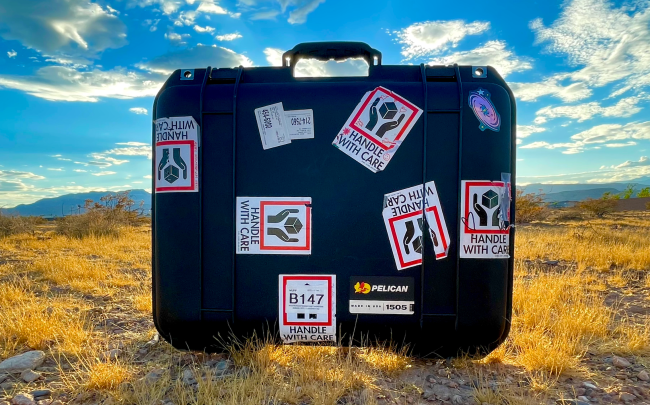
The disc is slowly passing from one viewer to the next inside a heavy black case covered in stickers and names gathered all over the U.S., and its months-long journey isn’t done yet.
“The only thing that I’d be mortified to lose is the notebook,” writer/director Matthew James Thompson told IndieWire. “Everything else can be replaced.”

This strange physical media project looks more like a ransom drop than an indie comedy screener, but that’s the magic of Thompson’s grassroots distribution strategy. Inside the case, custom-cut foam holds the one and only “Handle With Care” DVD. There’s also a portable player, some cables, a remote, special instructions, a grab-bag of collected keepsakes, and handwritten reviews from every person who’s had the oddly delightful divorce film so far.
“It’s kind of a crazy feeling to know you are the only one watching at this exact moment,” one Brooklyn viewer wrote back in July. “It’s just you and the movie.”

Part nostalgia object and part mini marketing campaign, Thompson’s retro DVD Club is an unusually apt emblem for the weird baggage that comes with making a debut feature today. At a time when many indie artists feel pressured to not only impress traditional Hollywood gatekeepers, but also feed online audiences with a constant stream of digital content, “Handle With Care” is touring the U.S. as a whimsical and radically self-assured experiment.
“We really connected over the kinds of stories we want to tell and the kinds of movies — not just what the stories are, but how we think about the audience and how they’re going to live in our world,” producer Ashim Ahuja told IndieWire. “It wasn’t just the business of making movies for us. It was the life and heartbeat of what it takes to truly create something.”

Effectively turning a mostly obsolete media format into a charming vehicle for buzz, “Handle With Care” was written, shot, and edited long before it became a traveling DVD. That said, its quaint exhibition story does resemble several key aspects of Thompson’s lovely narrative effort.
“I personally have found people to be profoundly good, shockingly good,” Thompson said.
Justin H. Min stars as Cole, a newly single copywriter in New York struggling to get rid of some wedding gifts after his short-lived marriage to Reese (Nicole Brydon Bloom) implodes. Witty and fast-paced but still sweetly skeptical of deep connection, the project’s generally snappy script comes alive through Thompson’s impressive ambition and obvious love for strangers.
Facing the same obstacles as countless other indie features right now, “Handle With Care” proved remarkably hard for Thompson, Ahuja, and their team to place on the festival circuit. The producer said competition in those programming spaces can sometimes resemble more of a bracket system than a true meritocracy, and that the shifting definition of “indie” makes it harder to stand out. “More and more, it requires movies that are already on the calendar, already have distribution and stars who are way bigger than would be in a normal indie movie,” he said.

It’s true that costly endeavors featuring major onscreen talent can qualify for “indie” categories and edge smaller titles out of potential deals and press through festival competition. But even knowing that, Thompson found it hard not to take rejection as an objective assessment of his potential. “If you don’t get into Sundance and you don’t have a bidding war all night from A24, it feels like your film inexplicably loses value,” he said. “Suddenly, it’s like, ‘What is this?’”
“Handle With Care” eventually premiered at the Rhode Island International Film Festival, where it won the Grand Prize for Best Feature Film and a second category recognizing Min’s acting performance. That success motivated the production to keep looking for its audience, ultimately inspiring Thompson to take the scenic route on the way to proving his debut deserved more life.

“I do think the work stands for itself without this marketing gimmick or whatever you want to call it,” he said. “Hopefully, they work hand in hand and break through the noise so people really spend some time with it.” The handmade touch is an especially good fit for Thompson, who told IndieWire he skipped film school to learn his craft by shooting skateboarding videos as a teen.
When the “Handle With Care” DVD Club launched in the spring, the now thirtysomething filmmaker sorted through signups by ZIP code and often became his film’s personal courier, carrying the case across New York. Soon enough, his errands also resembled the movie.

“There’d be times I’m standing in the heat on a subway platform, and I’m literally reliving my story all over again,” Thompson said. Relating to his leading man while sharing some especially dicey pictures of him holding the case with one hand while riding a bike, the filmmaker said, “I’m just like, ‘What am I doing? Am I stuck in a cycle? Is this just my life now?’”
Approximately 90 people have signed up since “Handle With Care” started its cross-country trip. Only about 25 to 30 have received the case so far, but Thompson and his team believe it is precisely because the DVD release is slow and small that it’s more meaningful. The debut director said he spent $1,438 on festival submissions but kicked off this DIY distribution network for just $521. Sure, the film is reaching far, far fewer people this way. But picking up the case from Ashim in the Valley, there was no denying the ritual felt like being part of something bigger.
“It’s kind of replicating the Blockbuster experience,” Ahuja said. “I think we miss that tangibility.”

Thompson’s own Sharpie-labeled disc comes with bonus features, including audition tapes and an enchanting documentary short about the filmmaker’s real-life neighbor who inspired several moments in “Handle With Care.” Constructing the physical package required trial and error, he said, recalling the time he watched a commissioned 3D-printed insert instantly fall apart.
“Foam is much better,” Thompson laughed, also praising the shipping ease of Pelican cases.
Screener links disappear into inboxes, and streaming platforms can turn movies into tax write-offs at a moment’s notice. But Thompson wanted to build something “unable to be affected by an algorithm” and found a concept cool enough that his work can hardly be separated from the extraordinary way it arrives.

“If you didn’t get into any film festival just so this film could reach people this way,” a recipient outside Nashville wrote earlier this summer, “Well, I’m not mad about it.”
Anyone can request to receive the traveling “Handle With Care” case through the DVD Club section of HandleWithCare.film, which is fittingly presented like a Craigslist listing. The team still personally arranges handoffs when they can, and the movie will have its next public screening as part of the Newport Beach Film Festival in October.
“Cynicism is not wisdom,” Thompson said, echoing the most hopeful idea in his wanderlust debut.
>

Brad Caleb Kane On ‘Crystal Lake’ Fan Theories, “Certain Explanations”
Karl-Anthony Towns contract extension talks could linger into regular season: Sources

Anthropic says its biology lab has already found something big
-

 movies4 months ago
Search For Canadian TV Actor Stewart McLean Now Homicide Investigation
-

 Fashion9 years ago
These ’90s fashion trends are making a comeback in 2017
-
Fashion9 years ago
According to Dior Couture, this taboo fashion accessory is back
-
Fashion9 years ago
Model Jocelyn Chew’s Instagram is the best vacation you’ve ever had
-
Fashion9 years ago
Emily Ratajkowski channels back-to-school style
-
Fashion9 years ago
9 Celebrities who have spoken out about being photoshopped
-

 Anime4 months ago
Rurouni Kenshin: Hokkaido Arc Manga Takes 1-Issue Break – News
-

 Anime3 months ago
HIDIVE to Stream English Dubs for The World Is Dancing, The Forsaken Saintess and Her Foodie Roadtrip in Another World, The Dangers in My Heart: The Movie Anime – News