
Tech
A New STEM Book Series from IEEE TryEngineering

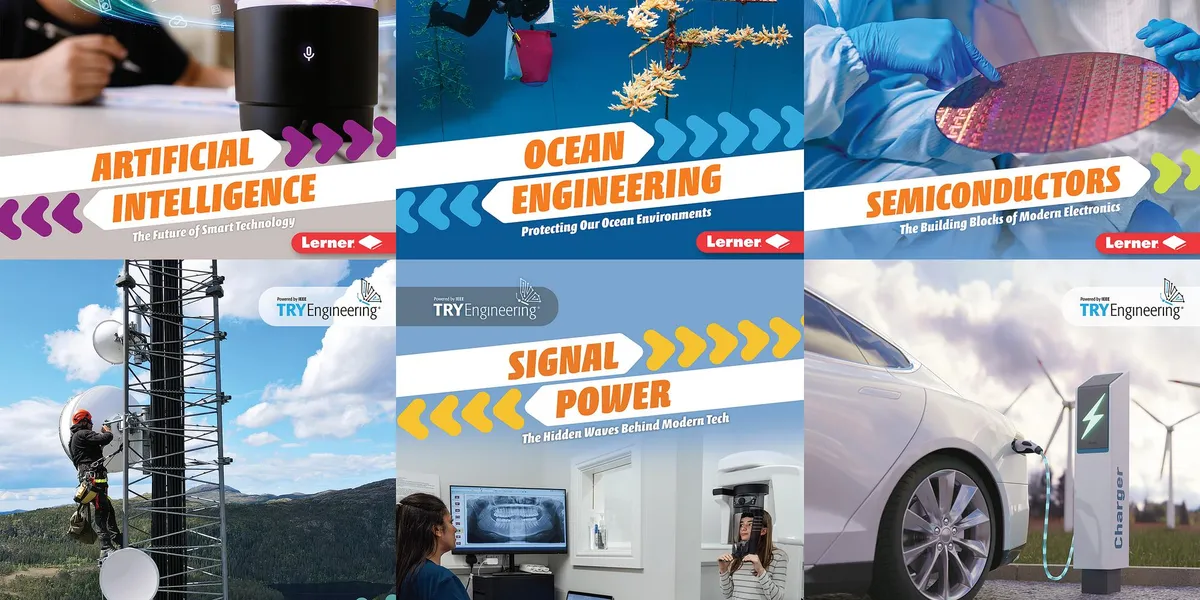

IEEE TryEngineering is dedicated to inspiring intellectual curiosity in children.
The technologies shaping our world, including in the realms of artificial intelligence, electric vehicles, and ocean exploration, are evolving rapidly. Helping young learners understand the concepts is essential to preparing the next generation of problem-solvers, creators, and engineers.
TryEngineering has introduced a STEM book series for youngsters ages 8 to 12 through the Lerner Publishing Group.
The series, Tomorrow’s Technology With TryEngineering, Powered by IEEE, makes complex topics more approachable and engaging, with each book combining age-appropriate explanations, real-world examples, and design challenges that encourage curiosity and critical thinking. The series is based on ebooks and videos available at tryengineering.org.
For the series, TryEngineering partnered with several other IEEE groups including the Communications, Computer, and Oceanic Engineering societies and the Transportation Electrification Council.
Whether used in the classroom, a library, or at home, the books can help pupils connect STEM concepts to the technologies they encounter every day, including computers and smartphones.
Six topics in the collection
Here are the books in the new collection:
Artificial Intelligence: The Future of Smart Technology explores the systems behind streaming services, search engines, and health care. Readers learn how AI works while exploring ethical concerns such as bias, deepfakes, hallucinations, and privacy. Pupils can better understand one of the most influential technologies of our time as it evolves.
Communication Technology: From Morse Code to Smartphones teaches readers about smoke signals, semaphore towers, telephones, and wireless networks. The pupils can gain an understanding of how engineers are changing communications technology through innovations such as 6G and space-based networks. The book highlights career opportunities in the aerospace and telecommunications fields.
Electric Vehicles: Powering the Future of Transportation covers how e-cars, e-bikes, e-scooters, and electrified trains are transforming the way people travel. Readers can discover how hybrid and fully electric vehicles operate and how the batteries that power them work. They also can learn about the roles engineers play in developing smarter transit systems.
Ocean Engineering: Protecting Our Ocean Environments highlights the vital ecosystem role played by the world’s oceans, which require careful stewardship. play in our ecosystem. Readers can learn how engineers study the underwater world using submersibles and floats, how they address pollution, and how they protect marine environments.
Semiconductors: The Building Blocks of Modern Electronics focuses on the technology behind nearly every electronic tool we use. Microchips power smartphones, computers, and countless other products, all thanks to semiconductors. Readers can learn about insulators and conductors, how microchips are manufactured, and why semiconductor engineering is a fertile field for innovation.
Signal Power: The Hidden Waves Behind Modern Tech explores how engineers analyze and manipulate signals to make technologies work more effectively. Whether it is a phone call reaching the correct person despite background noise or a medical device monitoring a patient, signal processing plays crucial roles in modern life. The book introduces different wave types, the signal processing workflow, and careers in the field.
The book series can help children understand the technologies shaping the world around them while encouraging them to think like engineers and innovators. By connecting STEM concepts to real-world applications, the series can make learning more meaningful and engaging.
The Tomorrow’s Technology With TryEngineering series is available through Amazon, Bookshop, and Lerner. More about the collection may be found here.
From Your Site Articles
Related Articles Around the Web
>
Nvidia adds a Sentry hardware monitoring design to its AI agent safety platform. See what OpenShell offers now and what IT teams still need to verify.
The post Nvidia Adds Hardware Monitoring Design to AI Agent Safety Platform appeared first on TechRepublic.
>

While some retailers, like Amazon (and Adidas, apparently!), are blocking AI agents from making purchases on users’ behalf on their respective platforms, e-commerce platform Shopify has moved in the other direction.
On Monday, the company announced that browser-based AI agents can now complete purchases on Shopify merchants’ sites, extending their capabilities beyond just searching for products and adding items to carts.
Shopify previously supported WebMCP for its storefronts and carts, allowing browser-based AI agents to comb through a Shopify retailer’s inventory, search for products, and add them to a cart. The addition of WebMCP support for checkout, including Shop Pay, means these agents can now read the checkout screen, update it, and submit the transaction with the buyer’s authorization, without relying on screenshots or scraping webpages, the company said.

This update introduces three new tools — get_checkout, update_checkout, and complete_checkout — that allow agents to inspect a checkout, change things like the customer’s address or delivery option, and then place an order after the buyer authorizes it.
The feature is rolling out to all eligible Shopify merchants, said Gil Greenberg, a staff product manager who works on agentic commerce at Shopify, in a post on X.
Shopify already offers a hosted Model Context Protocol (MCP) server, which allows agents to work server-to-server. The proposed standard WebMCP, meanwhile, is designed for agents that work inside the buyer’s browser. Both leverage Shopify’s Universal Commerce Protocol (UCP), which provides a common way to search for and discover products, build carts, and check out.
Top AI agents like Muse and Instinct already have direct partnerships with Shopify for agentic commerce. The Instinct partnership was announced today.
“If your agent is operating in the buyer’s browser, use WebMCP tools provided on storefront and checkout to efficiently complete order placement, instead of navigating HTML built for humans,” Greenberg wrote on X. “These WebMCP tools provide structured and efficient APIs, purposely designed — via UCP — to ensure accurate commerce facts, required disclosures, and handoff requirements.”
When you purchase through links in our articles, we may earn a small commission. This doesn’t affect our editorial independence.
>

Tesla is pushing back the reveal of its redesigned, second-generation Roadster once again, this time due to a forecast of severe weather.
Originally slated for October 1 in Waco, Texas, the event is being pushed to October 15, Tesla said.
“We’ve been tracking the weather closely with local meteorologists, but given the severe conditions predicted & because this event can only be held outdoors, we’ve made the difficult decision to reschedule,” the company wrote in a post on X.
The event presumably needs to be held outdoors because Tesla has been working on integrating cold gas thrusters from SpaceX that are supposed to make the Roadster fly in some capacity.
This reveal has been delayed many times before, and Musk has pushed it for months altogether before this scheduled date. At one point, Musk even planned to hold the event on April Fools’ day of this year. He said during Tesla’s annual meeting in 2025 — the same one where he was awarded a $1 trillion pay package — that an April Fools’ day event would offer him “some deniability” if it got delayed again.
“Like, I could say I was just kidding,” he said at the time.
Tesla first showed off its concept of a second-generation Roadster in 2017 at an event where it debuted the Semi, the company’s electric big rig. The new-look roadster was supposed to be the first supercar the company designed from the ground up, as the original Roadster, which got the company its start in the early 2010s, was largely based on the Lotus Elise.
At the time, Tesla promised the new Roadster was just a few years away. It collected $50,000 deposits from prospective customers of the car, which had an estimated base price of around $200,000. Some people even paid the company $250,000 to reserve one of 1,000 “Founders Series” versions of the supercar.
The project languished for years, until Musk reportedly tasked the Tesla team with redesigning the second-generation Roadster, and committed to the idea of using the SpaceX thrusters.
The promise of something outrageous like a flying car hasn’t been enough to tame critics of Musk and Tesla. Last year, OpenAI CEO Sam Altman wrote on X that “7.5 years has felt like a long time to wait” for his own new Roadster, though Musk claimed Altman had gotten a refund.
Much like the Roadster will be at this event, the ship date for the vehicle is up in the air. Musk himself has said he expects it to take a year or more before the new Roadster goes into production after it is finally revealed.
When you purchase through links in our articles, we may earn a small commission. This doesn’t affect our editorial independence.
>

Robbie Savage: Forest Green manager allowed to speak to other club amid Peterborough links

Paramount, State AGs Brush Off WB Merger Settlement Concerns

Lewis Ferguson: Rangers dream remains but Bologna exit ‘was never close’
-

 movies4 months ago
Search For Canadian TV Actor Stewart McLean Now Homicide Investigation
-

 Fashion9 years ago
These ’90s fashion trends are making a comeback in 2017
-
Fashion9 years ago
According to Dior Couture, this taboo fashion accessory is back
-
Fashion9 years ago
Model Jocelyn Chew’s Instagram is the best vacation you’ve ever had
-
Fashion9 years ago
Emily Ratajkowski channels back-to-school style
-
Fashion9 years ago
9 Celebrities who have spoken out about being photoshopped
-

 Anime4 months ago
Rurouni Kenshin: Hokkaido Arc Manga Takes 1-Issue Break – News
-

 Anime3 months ago
HIDIVE to Stream English Dubs for The World Is Dancing, The Forsaken Saintess and Her Foodie Roadtrip in Another World, The Dangers in My Heart: The Movie Anime – News