
Tech
OpenAI Codex vs Claude Code: The Better AI Coding Agent Depends on More Than Benchmarks

Codex and Claude Code split the latest coding-agent benchmarks on performance, cost, speed, and deployment controls.
The post OpenAI Codex vs Claude Code: The Better AI Coding Agent Depends on More Than Benchmarks appeared first on TechRepublic.
>

When Igor Dobrianskyi looks at a car dealership lot, he sees a wasted opportunity.
“Millions and millions of used cars are sitting on parking lots, depreciating and losing value,” Dobrianskyi said in a recent interview, adding that there are 76,000 dealerships in the United States. “At the same time, there are people who need a car for a few months, but the options are actually very limited and expensive.”
Dobrianskyi’s new startup, MyMonthlyCar, aims to connect both sides of that equation through an online platform that offers flexible month-to-month rentals from local dealerships. MyMonthlyCar was selected for the 2026 Startup Battlefield 200, a cohort of promising early-stage startups that have earned a spot to exhibit at this year’s TechCrunch Disrupt. This year’s TechCrunch Disrupt will be held October 13 to 15 in San Francisco.
MyMonthlyCar, which is registered in Delaware and based in Florida, was co-founded by Dobrianskyi; Kostiantyn Gitko, who is chief product officer; and CTO Vadym Zotov. All three are from Ukraine, said Dobrianskyi, who moved to the U.S. with his wife and young daughter after the Russia-Ukraine war began.
MyMonthlyCar does what its name suggests, with one twist. The startup only rents used cars on a month-to-month basis; no short-term options here. But it does give dealerships the chance to offer customers a rent-to-own option.
“So we don’t bring them only customers to rent on a monthly basis, we basically bring them the clients who potentially can buy this car as well,” he said.
MyMonthlyCar doesn’t charge dealerships to list cars on its website. Instead, MyMonthlyCar charges dealers 10% of each transaction. It also charges the customer a separate 10% fee.
The idea for MyMonthlyCar stems from Dobrianskyi’s previous experience in the industry. The founder owned a car rental company in Ukraine, but the lack of financing options there limited his ability to scale. In 2016, he launched a peer-to-peer car marketplace called SizeCar, where owners rent their cars to other drivers, much like Turo does today. SizeCar eventually spread to 40 European cities.
The startup has signed on seven dealerships to test the service and is working with an insurance broker to finalize its own insurance program, which will let customers choose among different types of coverage.
“Insurance is the key for this business, and you need to have your own insurance as a platform,” he said, noting that the No. 1 question from dealers was about insurance and liability coverage.
Despite its early-stage status, the founders have bullish projections for the startup. They plan to sign on 100 dealerships with 2,000 monthly rentals and $300,000 in revenue in the company’s first year of operation, which will kick off later this year once the insurance program launches. Over the next five years, the goal is to generate $42 million in revenue, Dobrianskyi said.
The startup has yet to raise venture capital and is currently bootstrapped. But Dobrianskyi said the plan is to raise a seed round, with the funds helping the company hire more developers to build out the platform, including an AI tool to help dealers identify which cars are best to rent out at any given time.
To check out MyMonthlyCar the other startups that are part of TechCrunch’s Battlefield competition (as well as to network with the folks funding them), join us next month at Disrupt.
When you purchase through links in our articles, we may earn a small commission. This doesn’t affect our editorial independence.
>

Amazon Web Services released an open-source decision model inspired by TypeSafe’s Jev, with AI developers increasingly seeking intelligence that is more suited to computer automation than frontier LLMs.
Amazon’s Strands Decider 2B, released the same week OpenAI announced a similar offering, is a high-speed, low-cost way to sort between pre-decided options and deliver a measure of how confident it is in its choice. The model is fully open-sourced, available now, and small enough to run locally.
Amazon distinguished engineer Marc Brooker came up with the project after seeing Jev and trying to build his own take on such a model. The homebrew project was successful enough—it briefly reached the top spot on the Jevbench ranking for models of its size—that Amazon engineers cleaned it up and released it as an offering from their Strands Labs, an organization developing new tools and protocols for deploying AI agents.
Brooker says the need for a tool like this emerged in conversations with AWS customers, whose agentic workflows didn’t always require the capability or cost of a fully-featured LLM all the time.
“What originally piqued my interest in this class of models was that they make a perfect decider for a workflow step— ‘what is the next thing for me to do here, based on where I am?’” Brooker told TechCrunch. He said it offers customers “a workflow step that can be structured in a way that is more reliable, thanks to the confidence scores, thanks to the closed domain of answers, [and is] lower latency, potentially lower cost.”
Like other decision models, Strands Decider is built on the “torso” of an LLM, in this case Qen3.5-2B, but instead of generating text, it delivers calibrated choices. TypeSafe named their model Jev after the economist William Stanley Jevons, with hopes of invoking his theory that the falling cost of something—like computer intelligence—can, in fact, increase its demand.
The fact that dozens of similar models have been produced by researchers since TypeSafe debuted its idea shows the wide interest, but also raises the question of how valuable they can be. Brooker suggests that the challenge will be in optimizing the model’s speedy decision-making without compromising its intelligence.
“There is a very careful balance to be found where you want to push its performance on accuracy and calibration on these kinds of tasks, without degrading its performance on understanding different languages, on having the kind of knowledge it has, which is what makes it general purpose and interesting and useful,” he told TechCrunch.
Still, he doesn’t necessarily expect the frontier labs to dominate the space, especially since, with smaller markets, the cost to build something interesting is in the hundreds or thousands of dollars.
For their part, TypeSafe executives say they are keeping their heads down and improving future models.
“I get that people think it’s a gold rush, but they might be underestimating the difficulty of making the models actually smart,” CEO and founder Diogo Almeida told TechCrunch, saying that for now, he didn’t see real competition for his company emerging yet.
“The current batch seems more like ML people wanting to implement a cool architecture than a team deeply dedicated to making intelligence useful.”
When you purchase through links in our articles, we may earn a small commission. This doesn’t affect our editorial independence.
>
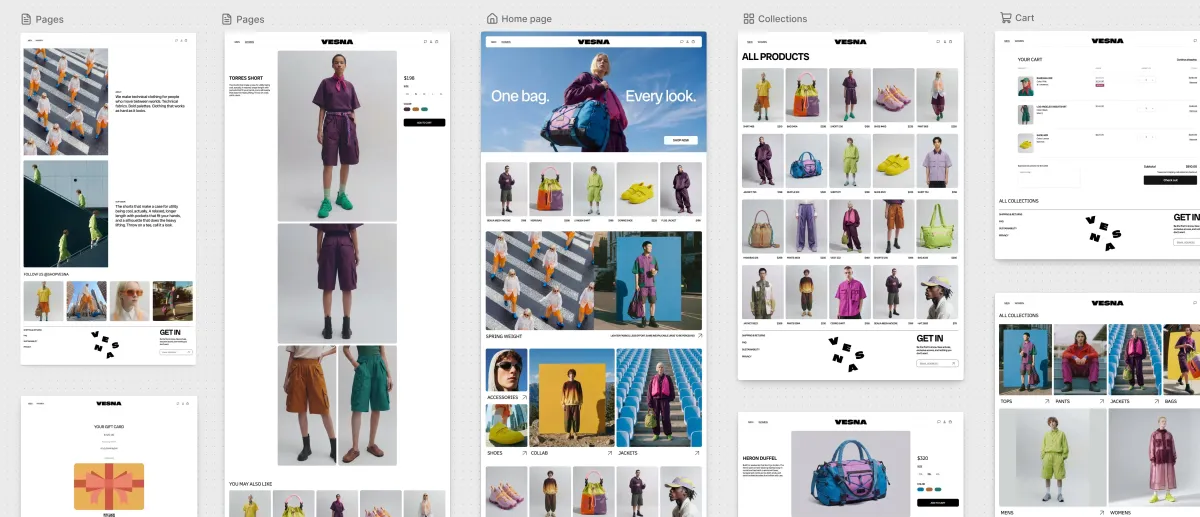
Shopify introduced a new site-building tool Thursday called Canvas that lets merchants set up their Shopify store by chatting with AI. While Shopify already offered a fairly capable no-code builder before Canvas, it involved editing a selected theme by rearranging modular sections and blocks. Deeper customizations, however, would require editing code or bringing in a developer.
Now, with Canvas, merchants simply chat with Shopify’s AI agent, Sidekick, to create their site. As the AI makes changes, Canvas displays the results in real time, allowing merchants to see how the store looks overall as it comes together or zoom in to focus on certain details.
Notably, this isn’t a static preview, but the real code behind their store being rendered, according to Shopify. That means merchants can test the page’s full interactivity and animation, and view pages as they’d appear across different screen sizes. Sidekick also takes screenshots of the work so it can see the same thing the merchant sees as the site updates.
Canvas’s launch is part of a broader shift toward a future where building a website no longer requires coding it directly. It joins numerous other AI-powered site-building tools from companies like Wix, Squarespace, Webflow, and Framer, alongside vibe-coding platforms like Lovable and Replit.
Merchants can still click on individual elements to make changes directly, if they choose. But more likely, they’ll just tell Sidekick in a chat what they want to do.
Sidekick itself is not new, as it’s already been used to write code, build apps, customize themes, and make other edits. But it had yet to be pulled together into a full site-building product like Canvas, where users can see the entire store at once and zoom and pan around while making updates to the site’s actual files.
To make this work, Shopify gave Sidekick the ability to work directly with the theme’s files and simplified the theme architecture so the store’s structure, logic, and design would be easier for Sidekick to understand and change.
The product is still in its early days, so there are areas where it will need to expand and improve. However, Canvas could make becoming an online seller more accessible to those who don’t have the budget for developers and designers, or the time to learn to code.
When you purchase through links in our articles, we may earn a small commission. This doesn’t affect our editorial independence.
>

Aaron Sorkin on The Social Reckoning and A Few Good Men on Broadway

How to watch Phillies vs. Braves: Game 3 TV channel and streaming options for October 1

This startup wants to turn idle user car inventory into rental revenue
-

 movies4 months ago
Search For Canadian TV Actor Stewart McLean Now Homicide Investigation
-

 Fashion9 years ago
These ’90s fashion trends are making a comeback in 2017
-
Fashion9 years ago
According to Dior Couture, this taboo fashion accessory is back
-
Fashion9 years ago
Model Jocelyn Chew’s Instagram is the best vacation you’ve ever had
-
Fashion9 years ago
Emily Ratajkowski channels back-to-school style
-
Fashion9 years ago
9 Celebrities who have spoken out about being photoshopped
-

 Anime4 months ago
Rurouni Kenshin: Hokkaido Arc Manga Takes 1-Issue Break – News
-

 Anime3 months ago
HIDIVE to Stream English Dubs for The World Is Dancing, The Forsaken Saintess and Her Foodie Roadtrip in Another World, The Dangers in My Heart: The Movie Anime – News