
Tech
The full Disrupt 2026 breakout session agenda revealed


TechCrunch Disrupt 2026 lands at Moscone West in San Francisco on October 13-15, bringing together 10,000+ founders, investors, operators, and tech leaders for three days of ideas, connections, and conversations about what’s coming next. Register now, save up to $100 off your pass, and get a second at 50% off.
Some of the most practical conversations won’t happen on any of the industry stages. Disrupt’s breakout sessions are built to go deeper and give you the mic to ask your burning questions to the leaders. Each 50-minute session combines expert insight with audience Q&A, giving you more room to unpack a problem, challenge assumptions, and leave with ideas you can actually put to work. The room capacity is limited, and attendance is first come, first served.
This year’s lineup gets into the questions founders and operators are dealing with right now: How do you build with AI agents? Where will value accrue as AI shifts from training to inference? What does physical AI really mean? How do you run a better fundraiser? And how does AI change the way you grow companies and teams?

Get into the room, get your questions answered, and make the connections that’ll spark your next move in the ecosystem. Save up to $100 on your pass and 50% on a second. Bring a group of four-plus to save more and get more insights. If you’ve recently been laid off, get a $75 Expo+ Pass before they run out.
The complete Disrupt 2026 breakout session agenda
Get to know the sessions and tech leaders shaping the conversation on the Disrupt agenda.
What Is Physical AI, Anyway?
Susan Schofer, Partner and Chief Science Officer, SOSV HAX; and Duncan Turner, General Partner and Managing Director, SOSV HAX
Sponsored by SOSV
AI is moving beyond software and into machines that need to perceive, reason, and act in unpredictable environments. Schofer and Turner break down what actually qualifies as physical AI, why building it requires a different playbook, and what investors are looking for in companies trying to define the category.
Outnumbered Either Way: How an Engineer and an Architect Run Their Jobs on Agents
Steve Androulakis and Sachin Malhotra, Members of Technical Staff, Anthropic
What does an AI-agent workflow look like when the people using it build AI for a living? Anthropic’s Androulakis and Malhotra show how they run multiple Claude agents in parallel, delegate real engineering work, review output, recover when agents get things wrong, and make agents part of their everyday jobs.
How to build AI we can trust
Robbie Goldfarb, Co-founder, Forum AI
As AI takes on more consequential work, accuracy alone isn’t enough. Drawing on experience spanning misinformation, online safety, and work with foundation-model labs, Goldfarb explores how expert human judgment can become scalable evaluations — and what it will take to build AI systems people can actually rely on.
The Inference Economy: Why AI’s Next Trillion Dollars Won’t Look Like Its First
Hagay Lupesko, SVP, AI Cloud, Cerebras Systems; and Rudina Seseri, Founder and Managing Partner, Glasswing Ventures
As frontier models become increasingly commoditized, AI’s economics are shifting from training toward inference. This session looks at where defensibility comes from when the model itself isn’t the moat, why latency is becoming part of the product, and what those changes mean for infrastructure decisions, startup economics, and what investors will look for next.
Building Then vs Now
Dr. Rumman Chowdhury, CEO and Co-founder, Humane Intelligence; Payal Kadakia, Founder, ClassPass; Cassie Kozyrkov, Founder, Kozyr; and Holly Ransom, CEO, Emergent
Sponsored by Signify Business Cash World Elite Mastercard by Wells Fargo
The fundamentals of building a company may not have changed, but the tools certainly have. Leaders spanning AI, data, entrepreneurship, and strategy examine how founders can use AI to make better decisions and move faster — while understanding where bias, judgment, and the human side of company building still matter.
Best Practices for Running a Successful Fundraise: From Preparation to Investor Engagement
Speakers to be announced
Sponsored by Fidelity Private Shares
A successful fundraise starts long before the pitch. This interactive session takes founders through the process from both sides of the table, covering investor targeting, relationship building, outreach, maintaining momentum, cap tables, data rooms, and due diligence. Come away with practical ways to run a more organized and effective raise.

From Founder to Investor: The Next Act – What Happens After You Win?
Bruce K Lee, CEO and Founder, Keebeck Wealth Management; and Abhi Tiwari, Co-founder and General Partner, Blank Ventures
Building and funding a company requires one mindset. Becoming an investor requires another. Lee and Tiwari explore what happens when entrepreneurs move from raising capital to allocating it — and why founders may want to start thinking about their post-exit strategy long before an exit actually happens.
Breaking Into Space: The AI Builder’s Opportunity
Dr. Brian Cameron, Interim Chief Technology Officer, The Aerospace Corporation; Bosco Lai, CEO, Little Place Labs; and Shawn Sloan, Corporate Fellow for Artificial Intelligence, The Aerospace Corporation
Sponsored by The Aerospace Corporation
Space may look like a specialist market, but many of its problems will feel familiar to AI builders: huge data streams, autonomous decisions, real-time processing, and complex agent systems. This session maps those capabilities to real space applications and shows founders where new commercial and government opportunities are opening up.
Fundraising Mistakes That Will Kill Your Round, and How to Avoid Them
Dr. Irena King, Founder and CEO, Surgicure Technologies; Dr. Richard Munassi, Accelerator Managing Director and Chief Strategy Officer, Tampa Bay Wave; Ashley Paston, Partner, General Catalyst; and Emily Zhen, Principal, HealthQuest Capital
Sponsored by Tampa Bay Wave
Great companies can still run bad fundraising processes. This session gets into the mistakes that derail rounds, from positioning and preparation to investor strategy and execution. Expect practical lessons, real examples, and a clearer framework for taking your next raise from the first pitch through to close.
Building a Growth Engine in the AI Era: Lessons from a Bootstrapped Unicorn
Patrick Burke, Managing Director, Hostinger
Sponsored by Hostinger
AI is compressing the distance between spotting an opportunity and acting on it. Using examples from Hostinger, Burke explores how startups can identify underpriced distribution channels, shorten the loop between market signals and product launches, experiment faster, and put agentic marketing workflows to work to drive growth.
Physical AI Isn’t a Model Problem. It’s an Execution Problem.
Ethan Batraski, Partner, Venrock; Ivan Poupyrev, Founder and CEO, Archetype AI; and Ian Rountree, General Partner, Cantos
The real physical AI opportunity isn’t simply understanding the world — it’s acting in it. Builders and investors explore the execution layer between perception, decision, action, and verification, and why the companies that can reliably close that loop could become some of the most durable businesses in industrial AI.
Talent as the Operating System: How High-Performance Teams Scale in the AI Era
Nomi Khedawala, Senior Technical Program Manager, Reddit
AI can change how work gets done, but companies still depend on people, trust, and execution. Khedawala explores how leaders can build stronger alignment across teams, spot breakdowns before they become bigger problems, and create systems that support accountability and sustainable high performance as organizations scale.
Go deeper at Disrupt 2026
The industry stages show you where technology and the startup market are heading. The breakout rooms give you the chance to get closer to the problems — and the people solving them.
With limited capacity and first-come, first-served access, these are sessions worth adding to your Disrupt schedule early.
TechCrunch Disrupt 2026 takes place October 13-15 at Moscone West in San Francisco. Register now to save up to $100 before doors open, plus get 50% off a second ticket for your co-founder, colleague, partner, or peer. Save even more with a group of four or more. Laid off? Grab your $75 Expo+ Pass before they run out.

When you purchase through links in our articles, we may earn a small commission. This doesn’t affect our editorial independence.
>

How clean is the air in your workplace? That’s the question Tanvi Thombre and Lakshya Saraf began investigating when they were engineering students who worked in their university makerspace.
In fact, Thombre said via email that, while working in the space, they were “unknowingly exposed to toxic fumes from laser cutters, 3D printers, and soldering irons,” but they didn’t realize it until her best friend fainted and had to go to the hospital.
After that, Thombre said, “We began investigating indoor air pollution and realized it was an invisible but dangerous health risk — especially in schools, offices, hotels, salons, and any commercial buildings where air-conditioning prevents windows from being opened.”
Those issues persist even when a building is equipped with air purifiers, as their makerspace was. The problem, according to Saraf, is that although purifiers are good at cleaning out particulate matter like dust and pollen, they are less effective at removing toxic gases such as carbon dioxide, formaldehyde, and benzine (many of which are classified as volatile organic compounds, or VOCs — chemicals that evaporate easily into the air).
Thombre said that VOCs are linked to chronic disease and “sick building syndrome,” a condition in which occupants experience health effects and discomfort after spending time in a building, even though no specific cause or illness has been identified. She also pointed to Harvard research showing that improving indoor air quality improved cognitive function and productivity.
That’s why the pair is targeting toxic gases in the workplace with their startup Greenairy, which will be at this year’s TechCrunch Disrupt as part of the Startup Battlefield 200.
Greenairy’s approach centers on building plant towers that are supposed to draw in air, break down toxic gases, and then release the purified air. As Saraf put it, “A plant in a pot cleans air slowly. But, when we change the conditions around the plant, it cleans air much faster and better than these conventional methods.”
Sara also said that while some air purifier filters can remove “a narrow range of VOCs,” those filters need to be changed frequently to be effective. In contrast, plants are “a natural solution, no harmful byproducts are formed, and no filter replacement is required.”

Greenairy has already conducted short-term pilots at locations around Singapore. Saraf said that in the startup’s own testing using RESET-certified air monitors, it compared three offices: one with Greenairy plant towers, one that had a medical-grade ionizer (a device that uses an electrical charge to make dust and other particles clump together and fall out of the air), and a third with a HEPA air purifier that traps very small particles.
“Our tower had the lowest VOC levels and removed VOCs the fastest,” she said. “The office staff also grew fond of the natural ‘fresh’ aroma of the tower and the natural vibe it brought.”
Thombre added that they saw an “immediate” improvement within regular office hours, with a 50% reduction in both the daily VOC average and peak levels. She said the results improved even more “as the plants and microbes mature and the gases are prevented from accumulating.”
Greenairy has also had its results validated by the German testing and certification firm TÜV SÜD and will be publishing them soon. (Results are available upon request in the meantime.) The pair plans to begin large-scale manufacturing after the results are certified.
The startup’s founders are currently based on opposite sides of the world, with Saraf in Berkeley, Calfornia, and Thombre in Singapore. It’s an arrangement that Saraf said “works well at this stage,” allowing one founder to focus on testing in Singapore while the other can fundraise in the Bay Area.
“If things go to plan, both of us will be in Singapore by the first half of 2027,” she added. “That’s when we expect to launch our first mass-produced towers and install them for our first customers” in Singapore.
Join us next week in San Francisco to learn more about the company and the dozens of other teams pitching to VCs at Disrupt.
When you purchase through links in our articles, we may earn a small commission. This doesn’t affect our editorial independence.
>
Tech
CIA officer admits to creating fake top secret government program to steal over $190 million, including gold bars
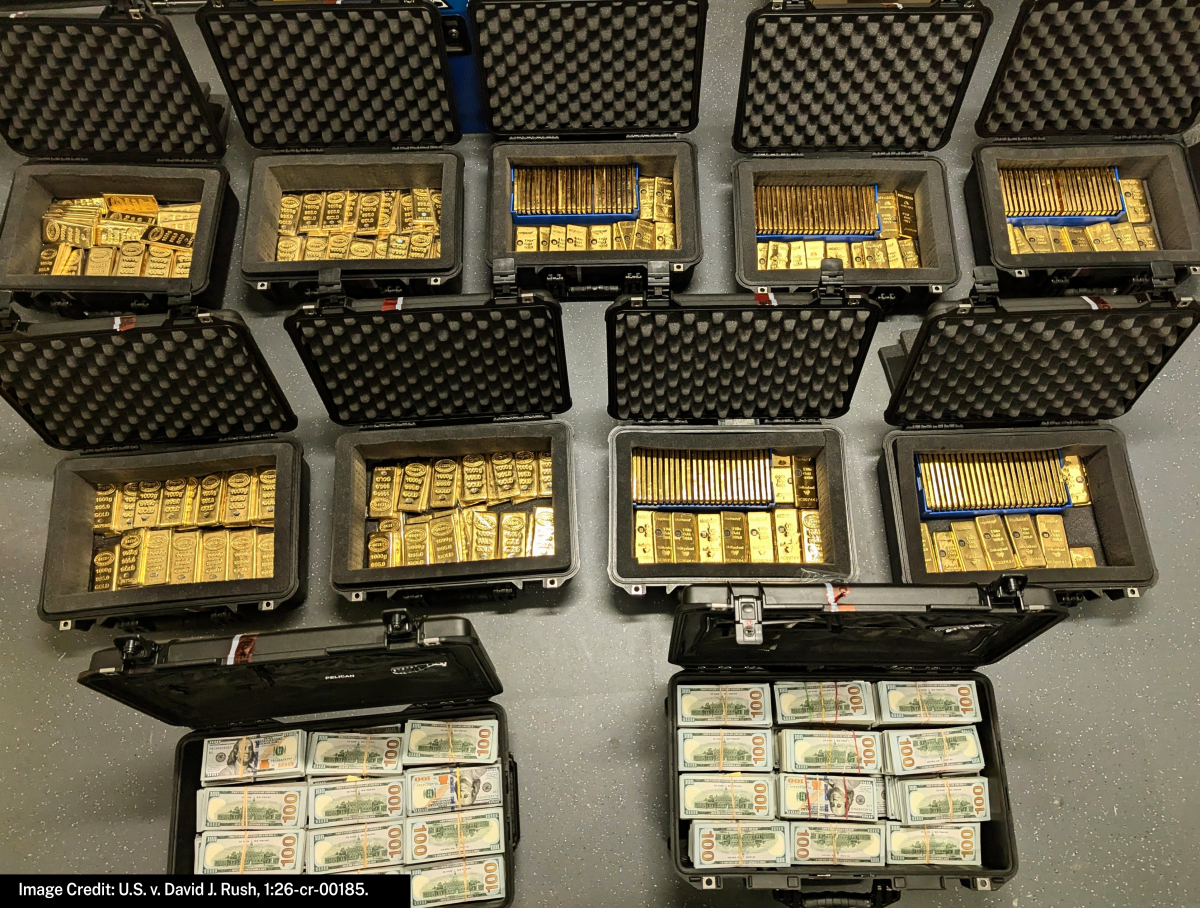
A now-former officer with the Central Intelligence Agency has pleaded guilty to stealing almost $200 million, including hundreds of gold bars, as part of a fraudulent scheme masquerading as a top secret government program.
The U.S. Department of Justice on Tuesday confirmed that David J. Rush, a Virginia resident, admitted to one count of wire fraud linked to running the fabricated operation and defrauding the government while he was a CIA officer. In a statement, prosecutors said that Rush lied about his education and military experience to gain a position at the CIA, and used his access as an employee to set up the top secret and highly compartmentalized program with the intention of using it to funnel U.S. government funds into his possession.
During his arrest, law enforcement found more than $46 million worth of gold bars in Rush’s house linked to the long-running fraud scheme, along with cars, watches, and over $2 million in cash.
The plea deal means that Rush escapes trial, as much as the U.S. government likely avoids having to explain in open court how Rush evaded vetting scrutiny to join the U.S. intelligence agency, and how actions went undetected for more than a year.
Rush was until recently a senior CIA officer, who according to earlier reports worked for a division of the CIA since 2010 that develops hacking tools and techniques for carrying out espionage. Per court filings, Rush had significant authority over government intelligence programs and spending.
Over the course of 2025, Rush used his position to fabricate a so-called special access program, which are surveillance or intelligence-gathering operations so sensitive that only a few people are read into them. Special access programs, or SAPs, require special clearance that not even the most cleared individuals in government are granted access to. According to The Washington Post, Rush constructed the compartmentalized program under the guise of a fake “continuity of government” plan, aimed at keeping the government functioning in the event of a war, natural disaster, or some other destructive catastrophe. As part of the scheme, Rush used the program and fake government contract to trick an unnamed defense contractor into buying large amounts of gold that Rush then pocketed.
According to The Post, the case astounded officials as Rush’s duties at the CIA involved work with one of the government’s “most sensitive intelligence-gathering programs,” with details so sensitive that only a few senior U.S. intelligence officials and lawmakers know of its existence. The Post withheld details of that program from publication as its disclosure could “jeopardize ongoing intelligence-gathering operations.”
Court filings said that by virtue of his position, Rush “effectively acted as his own approving official, enabling him to expend substantial amounts of United States government money without meaningful scrutiny.”
Rush is scheduled to be sentenced in late January 2027 and faces up to 20 years in prison.
When you purchase through links in our articles, we may earn a small commission. This doesn’t affect our editorial independence.
>

Meta announced Wednesday that it took action against 33.2 million pieces of child sexual exploitation content on Facebook and Instagram in the first half of 2026. At the same time, the company is rolling out new AI tools to find ads and accounts that may be used to secretly direct people to illegal child abuse material.
More than 97% of the content Meta acted on was found by its systems before users reported it, the company said. In India, Meta acted on 5.3 million pieces of child sexual exploitation content during the same period, with more than 98% detected before users reported it.
Meta said its latest AI tools are aimed at people using ads that look harmless to send users to illegal content outside Meta’s platforms.
The company has introduced a new large language model (LLM) system to detect what it calls “signposting.” This refers to ads that may look normal but are suspected of directing users to illegal content or other harmful activity elsewhere online. Meta says this is a tactic it has recently seen bad actors use as they continue to change their methods to avoid detection. While the ads themselves may not contain illegal material, they can still act as a gateway to websites hosting child sexual abuse material.
Because of this, Meta said it’s now looking at where an ad sends users, and not just what the ad contains. The company can use this information to block websites or other destinations that break its rules and take action against the accounts behind them.
Meta is also using additional AI-driven scans to find child exploitation content that earlier systems may have missed. The company said it will continue adding new signals as it learns more about how these networks operate.
Another new tool is a “red-teaming AI agent” that tests Meta’s own safety measures. It looks for weaknesses that bad actors could use to get around the company’s protections. Meta said this could help it find new methods of abuse before they become more common.
Additionally, the company is improving its systems for finding people who return to its platforms with new accounts after their previous accounts have been removed.
The new measures come as Meta continues to face pressure over the safety of children on its platforms. The company has faced lawsuits and criticism from lawmakers over the risks its social media services may pose to young users. In August, Meta reached an agreement to pay up to $18 billion to settle a child safety lawsuit involving 29 U.S. states, addressing concerns regarding the protection of children online.
Meta has introduced several child-safety features this year, including parental controls for Meta AI, pre-teen accounts on WhatsApp, and alerts for parents when children search Instagram for self-harm content.
In September, WhatsApp added more controls for parents. They can limit how teenagers use Channels, control who can see their status updates, and decide who can add their children to groups. Parents can also choose to receive notifications about certain group activity.
When you purchase through links in our articles, we may earn a small commission. This doesn’t affect our editorial independence.
>

Sony Pictures Entertainment Launches Crunchyroll Storyworks, Aiming To Boost Japanese Anime
Fantasy football intel: Could the Patriots' RB picture get murkier?

Box Office: ‘Resident Evil’ Zach Cregger’s Highest Grossing Ever With China
-

 movies5 months ago
Search For Canadian TV Actor Stewart McLean Now Homicide Investigation
-

 Fashion9 years ago
These ’90s fashion trends are making a comeback in 2017
-
Fashion9 years ago
According to Dior Couture, this taboo fashion accessory is back
-
Fashion9 years ago
Model Jocelyn Chew’s Instagram is the best vacation you’ve ever had
-
Fashion9 years ago
Emily Ratajkowski channels back-to-school style
-
Fashion9 years ago
9 Celebrities who have spoken out about being photoshopped
-

 Anime4 months ago
Rurouni Kenshin: Hokkaido Arc Manga Takes 1-Issue Break – News
-

 Anime3 months ago
HIDIVE to Stream English Dubs for The World Is Dancing, The Forsaken Saintess and Her Foodie Roadtrip in Another World, The Dangers in My Heart: The Movie Anime – News