
Tech
Uber is spending $2.3B to get into catering


Uber is buying a catering company called ezCater, as it continues to grow the types of services available through its Uber Eats division. It’s an all-cash transaction valued at $2.3 billion.
Billed as a “leading U.S. platform for catering and workplace meals,” ezCater is a marketplace for businesses that need large meals, like an Expedia for catering. The company was founded in 2007 and has become a business that generated over $2.5 billion in gross bookings over the last 12 months, according to Uber. It’s a huge exit for a company that was bootstrapped for seven years before raising its first $4 million round in 2014.
Dara Khosrowshahi, Uber’s CEO, billed the acquisition as a way for restaurants to find new, larger customers. “Catering is a big business, and can be a huge revenue stream for restaurants,” he said in a statement. “With Uber’s reach, we can bring that experience to millions more customers and help restaurants win more of these valuable orders.”
The acquisition is the latest in a run of moves by Uber to grow its food delivery business. The company is also in the process of buying Delivery Hero for $15 billion, and it’s investing in (and partnering with) drone delivery companies like Zipline and Flytrex.
>

How clean is the air in your workplace? That’s the question Tanvi Thombre and Lakshya Saraf began investigating when they were engineering students who worked in their university makerspace.
In fact, Thombre said via email that, while working in the space, they were “unknowingly exposed to toxic fumes from laser cutters, 3D printers, and soldering irons,” but they didn’t realize it until her best friend fainted and had to go to the hospital.
After that, Thombre said, “We began investigating indoor air pollution and realized it was an invisible but dangerous health risk — especially in schools, offices, hotels, salons, and any commercial buildings where air-conditioning prevents windows from being opened.”
Those issues persist even when a building is equipped with air purifiers, as their makerspace was. The problem, according to Saraf, is that although purifiers are good at cleaning out particulate matter like dust and pollen, they are less effective at removing toxic gases such as carbon dioxide, formaldehyde, and benzine (many of which are classified as volatile organic compounds, or VOCs — chemicals that evaporate easily into the air).
Thombre said that VOCs are linked to chronic disease and “sick building syndrome,” a condition in which occupants experience health effects and discomfort after spending time in a building, even though no specific cause or illness has been identified. She also pointed to Harvard research showing that improving indoor air quality improved cognitive function and productivity.
That’s why the pair is targeting toxic gases in the workplace with their startup Greenairy, which will be at this year’s TechCrunch Disrupt as part of the Startup Battlefield 200.
Greenairy’s approach centers on building plant towers that are supposed to draw in air, break down toxic gases, and then release the purified air. As Saraf put it, “A plant in a pot cleans air slowly. But, when we change the conditions around the plant, it cleans air much faster and better than these conventional methods.”
Sara also said that while some air purifier filters can remove “a narrow range of VOCs,” those filters need to be changed frequently to be effective. In contrast, plants are “a natural solution, no harmful byproducts are formed, and no filter replacement is required.”

Greenairy has already conducted short-term pilots at locations around Singapore. Saraf said that in the startup’s own testing using RESET-certified air monitors, it compared three offices: one with Greenairy plant towers, one that had a medical-grade ionizer (a device that uses an electrical charge to make dust and other particles clump together and fall out of the air), and a third with a HEPA air purifier that traps very small particles.
“Our tower had the lowest VOC levels and removed VOCs the fastest,” she said. “The office staff also grew fond of the natural ‘fresh’ aroma of the tower and the natural vibe it brought.”
Thombre added that they saw an “immediate” improvement within regular office hours, with a 50% reduction in both the daily VOC average and peak levels. She said the results improved even more “as the plants and microbes mature and the gases are prevented from accumulating.”
Greenairy has also had its results validated by the German testing and certification firm TÜV SÜD and will be publishing them soon. (Results are available upon request in the meantime.) The pair plans to begin large-scale manufacturing after the results are certified.
The startup’s founders are currently based on opposite sides of the world, with Saraf in Berkeley, Calfornia, and Thombre in Singapore. It’s an arrangement that Saraf said “works well at this stage,” allowing one founder to focus on testing in Singapore while the other can fundraise in the Bay Area.
“If things go to plan, both of us will be in Singapore by the first half of 2027,” she added. “That’s when we expect to launch our first mass-produced towers and install them for our first customers” in Singapore.
Join us next week in San Francisco to learn more about the company and the dozens of other teams pitching to VCs at Disrupt.
When you purchase through links in our articles, we may earn a small commission. This doesn’t affect our editorial independence.
>
Tech
CIA officer admits to creating fake top secret government program to steal over $190 million, including gold bars
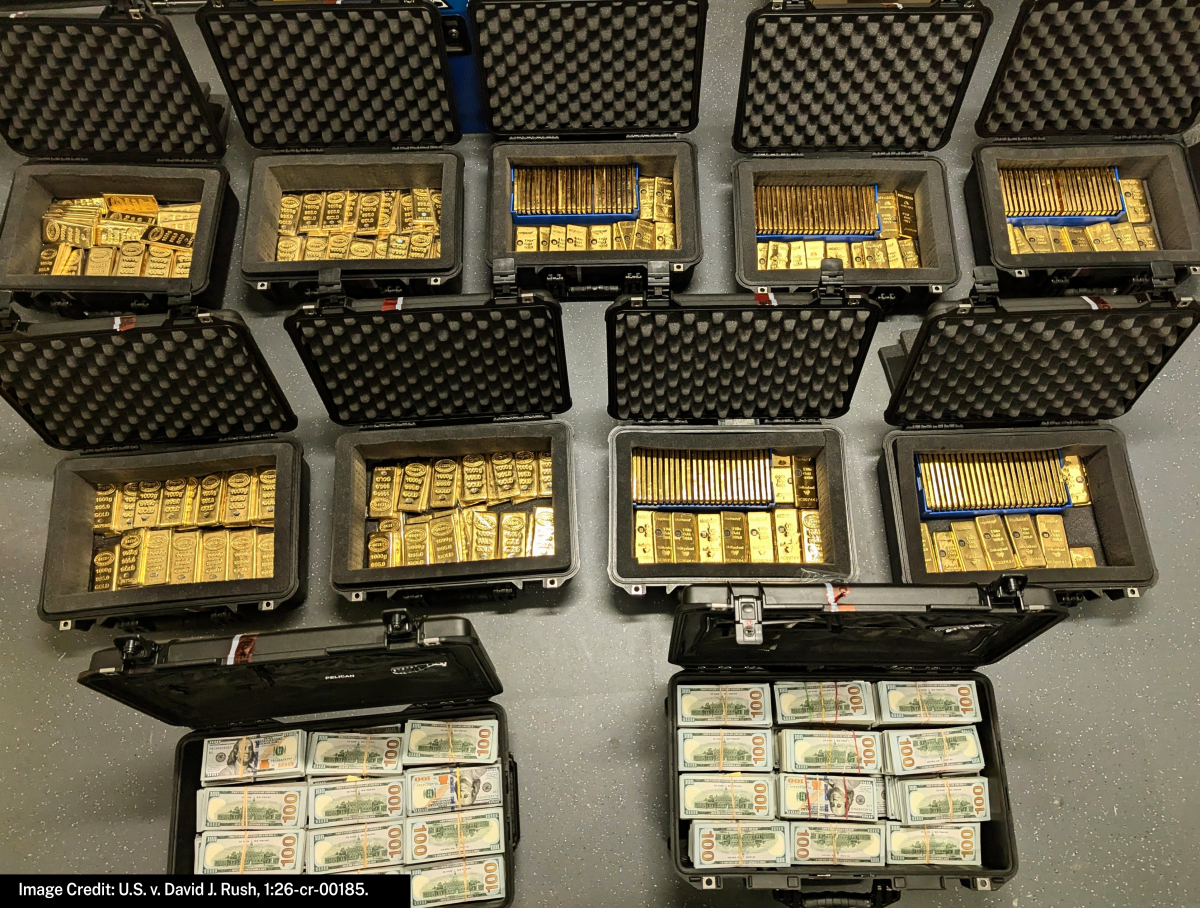
A now-former officer with the Central Intelligence Agency has pleaded guilty to stealing almost $200 million, including hundreds of gold bars, as part of a fraudulent scheme masquerading as a top secret government program.
The U.S. Department of Justice on Tuesday confirmed that David J. Rush, a Virginia resident, admitted to one count of wire fraud linked to running the fabricated operation and defrauding the government while he was a CIA officer. In a statement, prosecutors said that Rush lied about his education and military experience to gain a position at the CIA, and used his access as an employee to set up the top secret and highly compartmentalized program with the intention of using it to funnel U.S. government funds into his possession.
During his arrest, law enforcement found more than $46 million worth of gold bars in Rush’s house linked to the long-running fraud scheme, along with cars, watches, and over $2 million in cash.
The plea deal means that Rush escapes trial, as much as the U.S. government likely avoids having to explain in open court how Rush evaded vetting scrutiny to join the U.S. intelligence agency, and how actions went undetected for more than a year.
Rush was until recently a senior CIA officer, who according to earlier reports worked for a division of the CIA since 2010 that develops hacking tools and techniques for carrying out espionage. Per court filings, Rush had significant authority over government intelligence programs and spending.
Over the course of 2025, Rush used his position to fabricate a so-called special access program, which are surveillance or intelligence-gathering operations so sensitive that only a few people are read into them. Special access programs, or SAPs, require special clearance that not even the most cleared individuals in government are granted access to. According to The Washington Post, Rush constructed the compartmentalized program under the guise of a fake “continuity of government” plan, aimed at keeping the government functioning in the event of a war, natural disaster, or some other destructive catastrophe. As part of the scheme, Rush used the program and fake government contract to trick an unnamed defense contractor into buying large amounts of gold that Rush then pocketed.
According to The Post, the case astounded officials as Rush’s duties at the CIA involved work with one of the government’s “most sensitive intelligence-gathering programs,” with details so sensitive that only a few senior U.S. intelligence officials and lawmakers know of its existence. The Post withheld details of that program from publication as its disclosure could “jeopardize ongoing intelligence-gathering operations.”
Court filings said that by virtue of his position, Rush “effectively acted as his own approving official, enabling him to expend substantial amounts of United States government money without meaningful scrutiny.”
Rush is scheduled to be sentenced in late January 2027 and faces up to 20 years in prison.
When you purchase through links in our articles, we may earn a small commission. This doesn’t affect our editorial independence.
>

Meta announced Wednesday that it took action against 33.2 million pieces of child sexual exploitation content on Facebook and Instagram in the first half of 2026. At the same time, the company is rolling out new AI tools to find ads and accounts that may be used to secretly direct people to illegal child abuse material.
More than 97% of the content Meta acted on was found by its systems before users reported it, the company said. In India, Meta acted on 5.3 million pieces of child sexual exploitation content during the same period, with more than 98% detected before users reported it.
Meta said its latest AI tools are aimed at people using ads that look harmless to send users to illegal content outside Meta’s platforms.
The company has introduced a new large language model (LLM) system to detect what it calls “signposting.” This refers to ads that may look normal but are suspected of directing users to illegal content or other harmful activity elsewhere online. Meta says this is a tactic it has recently seen bad actors use as they continue to change their methods to avoid detection. While the ads themselves may not contain illegal material, they can still act as a gateway to websites hosting child sexual abuse material.
Because of this, Meta said it’s now looking at where an ad sends users, and not just what the ad contains. The company can use this information to block websites or other destinations that break its rules and take action against the accounts behind them.
Meta is also using additional AI-driven scans to find child exploitation content that earlier systems may have missed. The company said it will continue adding new signals as it learns more about how these networks operate.
Another new tool is a “red-teaming AI agent” that tests Meta’s own safety measures. It looks for weaknesses that bad actors could use to get around the company’s protections. Meta said this could help it find new methods of abuse before they become more common.
Additionally, the company is improving its systems for finding people who return to its platforms with new accounts after their previous accounts have been removed.
The new measures come as Meta continues to face pressure over the safety of children on its platforms. The company has faced lawsuits and criticism from lawmakers over the risks its social media services may pose to young users. In August, Meta reached an agreement to pay up to $18 billion to settle a child safety lawsuit involving 29 U.S. states, addressing concerns regarding the protection of children online.
Meta has introduced several child-safety features this year, including parental controls for Meta AI, pre-teen accounts on WhatsApp, and alerts for parents when children search Instagram for self-harm content.
In September, WhatsApp added more controls for parents. They can limit how teenagers use Channels, control who can see their status updates, and decide who can add their children to groups. Parents can also choose to receive notifications about certain group activity.
When you purchase through links in our articles, we may earn a small commission. This doesn’t affect our editorial independence.
>

Ben Affleck and Matt Damon’s Artists Equity Launches Indie Label

Regina Hall Joins Jennifer Aniston In ‘Naughty’ Comedy
Greatest Division Series ever? Plus: Dodgers-Braves takes a turn
-

 movies5 months ago
Search For Canadian TV Actor Stewart McLean Now Homicide Investigation
-

 Fashion9 years ago
These ’90s fashion trends are making a comeback in 2017
-
Fashion9 years ago
According to Dior Couture, this taboo fashion accessory is back
-
Fashion9 years ago
Model Jocelyn Chew’s Instagram is the best vacation you’ve ever had
-
Fashion9 years ago
Emily Ratajkowski channels back-to-school style
-
Fashion9 years ago
9 Celebrities who have spoken out about being photoshopped
-

 Anime4 months ago
Rurouni Kenshin: Hokkaido Arc Manga Takes 1-Issue Break – News
-

 Anime3 months ago
HIDIVE to Stream English Dubs for The World Is Dancing, The Forsaken Saintess and Her Foodie Roadtrip in Another World, The Dangers in My Heart: The Movie Anime – News