
Tech
Tony Fadell on why the first wave of AI gadgets failed — and what comes next


When Tony Fadell takes the stage at the inaugural MIT Future Fest, he projects a slide with three images of once-hyped AI devices that have already been discontinued: the Rabbit R1, the Humane AI pin, and the Limitless pendant.
“These were kind of the ‘Gen 1’ AI products, and because of my background, these companies called me and asked me to help them,” Fadell said. “I didn’t.”
It’s no surprise that these companies want Fadell’s advice. He’s credited as the “father of the iPod,” a co-creator of the iPhone, and the founder of Nest, the smart thermostat company acquired by Google.
“You have to really understand what you’re trying to do, what pain you’re trying to solve,” he said. “In each of these cases, each one of them didn’t meet any kind of need — it was just interesting technology for geeks, and you’re like, ‘Okay, that’s neat, but it doesn’t really apply to my life.’”
These early AI devices promised the convenience of having a personal assistant, but didn’t actually work that well. Even if they did, most people have never had an assistant and know how they would use — or grow to trust — a personal robot helper.
“It’s less than 0.01% of the world population that has ever had a human [assistant] do anything, and so when [companies] say, ‘Oh, we want an assistant,’ that’s a bunch of people who have assistants saying it,” he said. “Most consumers don’t even know what an assistant is.”
Fadell goes on to explain to those of us in the 99.99% that hiring a trustworthy personal assistant isn’t as straightforward as pulling the most promising resume out of a pile of applications.
“It took me a couple of years first to understand how best to utilize [an assistant], and then to trust them with the most sensitive data, and have them be an agent where they’re setting up meetings with people and working with my bank,” he said. “I understand we have this vision of the future, but there’s a lot of steps to get the general consumer and even the general business on this path.”
It’s hard to talk about the struggles of building trust in your personal assistant without sounding a bit entitled, but Fadell has a point. When you hire a human assistant, you’re not giving them your bank account login on day one. We’re heading into a world where anyone can have a personal AI assistant, but these tools are only valuable if we can trust them to be completely secure.
At this point, establishing trust with an AI assistant seems even harder than relying on a human. Meta recently launched Muse, its all-purpose AI assistant, but users have reason to be wary. A security researcher quickly found a serious vulnerability in Muse after launch, and a recent 404 Media report states that some Meta employees discovered security issues that prompted multiple teams to embark upon a “mad dash” to fix these problems before launch, working overtime.
“Trust and safety are going to be paramount with anything that we turn over to some kind of intelligence,” Fadell said. “The only company I could see right now — maybe one other — is Apple who could do this. Apple has all the hardware, they have all the chips, they have all the pieces, but they don’t have all the AI stuff.”
Even if it’s not Apple that ultimately produces the stickiest AI agent, Fadell predicts that a successful agent will have to operate on-device only, both for the sake of privacy and to keep the tech lightweight.
“When you’re hearing all of these things about, ‘Oh, data centers are going to conquer the world,’ … I don’t believe it,” he said. “I’ve seen this before. I’ve seen this play out in the internet days and what have you. We have so much power on the device now, and even more compute, and they’re still battery operated.”
By keeping sensitive data on-device, rather than transmitting it through the cloud, Apple has garnered trust from users to share their biometric data through features like Face ID. As Fadell notes, Apple seems to have more goodwill with consumers than its competitors when it comes to privacy, but unlike other top tech companies, Apple doesn’t have a world-class AI model of its own — the new Siri AI runs on custom-built versions of Google’s Gemini.
While Apple lags in proprietary AI, it is leaps ahead in hardware. Fadell theorizes that companies like Meta and OpenAI are turning their attention toward gadgets because they don’t have billions of devices in circulation like Apple does.
“It’s because they don’t have access to the sensors on your phone. They’re like, ‘Oh, we’ll need video,’ and you have to check, ‘Yes, I’ll give you video.’ Then they say, ‘Well, we need audio.’ Check. ‘We need your GPS location.’ Check. And before you know it, it becomes a list of 20 things or more than you have then allowed them to have,” he said. “So what do they do? They go and make a device with all that stuff in it without a screen… and then they just Bluetooth or Wi-Fi into your phone and then back up to the web, or into a 5G network, so they can get all the sensor data.”
Given his history creating the iPhone and iPod, it might seem like Fadell is still looking at his former employer through rose-colored glasses. While he may give Apple credit where due, he hasn’t been shy to call Apple out when he thinks they’re messing up.
When an audience member asks about the luck involved in finding product-market fit, Fadell points out that it’s more difficult for startups to manufacture that luck, since a failed product can spell the end of the company.
“Because it’s a startup, you get one shot,” he quipped. “It’s not like Apple with the Vision Pro.”
When you purchase through links in our articles, we may earn a small commission. This doesn’t affect our editorial independence.
>

When Justin Kosmides co-founded Bloom in 2023, his goal was to create a savior for the mobility industry. He had seen many e-bike and e-scooter companies fail because of an inability — or an unwillingness — to outsource some of the hardest problems, like logistics, manufacturing, or building a supply chain. He wanted to convince survivors and new entrants to let Bloom handle that work for them.
Then Donald Trump got re-elected and started shotgun-blasting tariffs on dozens of countries, partially to jump-start U.S. manufacturing. This accelerated a hardware scene that was already heating up in this country and, suddenly, it was more than just mobility companies looking to beef up their domestic supply chain. Robotics startups, drone-makers, and many more started to pop up.
That was an opportunity for Bloom, which is based in Detroit, but to tackle it, the startup had to partially reinvent itself. Instead of performing some of those harder, behind-the-scenes tasks, which was a big part of the original plan, Bloom shifted to a pure marketplace model, in which it connects buyers and sellers. It’s now focused on making, essentially, supply chain AI agents that Bloom’s customers use to find specific types of suppliers, parts, or manufacturing and engineering services.
The reinvention slowed Bloom’s fundraising plans. But the company has now made over 2,000 matches for more than 140 companies, and it wants grow faster. In an interview earlier this year, Kosmides, who is Bloom’s CEO, said his startup is like AI-driven version of Alibaba did in China, where it created a marketplace for contract manufacturers.
Investors are finally buying in. On Wednesday, Bloom announced a $3.6 million seed round led by SNAK Venture Partners, a marketplace-focused investment firm. Also joining were Flyover Capital (an early stage investor that focuses on flyover states), and deep tech firm Mana Ventures. Local backers included Detroit Venture Partners, Invest Detroit Ventures, and the Michigan Outdoor Innovation Fund.
Kosmides, sounding relieved, said in the interview that he’s “excited to be done with fundraising and get to back to building.”
No, then yes
SNAK first met with Bloom in April of last year, in the early stages of this reinvention. So early, in fact, that the firm passed on the chance to invest in the startup’s pre-seed round.
“We liked the founder and the thesis and passed anyway: we wanted to see more traction,” the firm wrote in a blog post. “We said so plainly and kept tracking the company.”
Bloom kept in touch with SNAK as it worked through becoming a more software-focused startup. By May of this year, Bloom had made as much revenue in five months as it did in all of 2025. SNAK also said the number of memberships on its platform had grown fivefold “with low churn,” meaning few customers were canceling.
“This is meant to reiterate that for us, a pass on pre-seed is not always a pass forever. We are fortunate to have a super focused thesis that allows us to track a small set of interesting early stage companies and build a relationship over time,” the firm wrote.
Kosmides said the fundraising scene has been a bit ruthless for startups like Bloom. Proving your value to investors in a world where the leading AI models keep improving can be an uphill battle.
“To find investors to actually write a term sheet, not follow one, is getting harder and harder,” he said. “That’s just this new era that we’re in, with everyone trying to figure out what’s real and what’s not, what to invest in.”
Bloom did court other term sheets, Kosmides said. But SNAK, which was founded by longtime retail executive Sonia Nagar, is “who you want in your camp” to “build a hopefully category-defining marketplace for mobility, and drones, and all this hardware.”
Matchmaking and discovery
Bloom’s platform handles both sides of a supplier relationship. Some customers use the platform to post contract opportunities, while others use it to bid on those opportunities. Bloom handles quoting, booking, and payment all on its platform, and it now helps match companies with suppliers that can do contract manufacturing, assembly, design and engineering, freight, warehousing, repairs, and even hazardous-materials shipping.
“Our friends at the parts marketplaces like Fictiv, Xometry, MacroFab and others are really good yesteryear marketplaces for finding one particular part,” Kosmides said. “But when you’re XYZ Drone Company, or an electric motorcycle company, and you need to find a provider that meets all these requirements have them all bid on this opportunity, that’s a lot more complicated than finding a CNC part.”
Making this system work well is a big part Bloom’s reinvention, and it involved ingesting a lot of data about each provider on the platform. A lot of that was public data — how a company describes itself on its website, for instance. But around 30-40% of that data is coming directly from the companies, Kosmides said. Add in the data being generated as the startup onboards more customers and makes more matches, and you have Bloom’s edge, he said.
“You can build the craziest model for scraping data but you would never get to that accuracy,” he said. “We started with manually booking services, and then built in layers and pieces and understanding as we built up the provider network, as we built out more and more transactions, and so it’s only getting better and better.”
Kosmides believes this is all a better way to strike up supplier relationships, and that it also makes it easier for startups to get off the ground. But he also thinks Bloom’s platform will help create opportunities for small manufacturers who may not have big marketing budgets or sales teams.
He gave an example of one Michigan-based contract manufacturer that, until it started working with Bloom, was taking on odd jobs like refurbishing Nest thermostats and Bird scooters, or working with Chick-fil-A displays. That same company is now bidding on drone assembly contracts.
“The ability to discover, and the ability to do matchmaking, that is what I think is truly missing” from U.S. manufacturing, he said. “That just doesn’t exist electronically.”
When you purchase through links in our articles, we may earn a small commission. This doesn’t affect our editorial independence.
>

Healthleap, a startup building an AI platform that reads patient records to identify patients at risk of undiagnosed illnesses, has raised $38 million in seed and Series A funding, TechCrunch has exclusively learned.
The financing includes an $8 million seed round co-led by Sequoia Capital and First Round Capital, and a $30 million Series A led by Hummingbird Ventures. The company is not disclosing its valuation.
Founded in South Africa in 2022 by siblings Jemima and Josiah Meyer (pictured above), the startup initially offered a clinical nutrition tool Jemima had built for dietitians. But the company later pivoted and built a more general-purpose platform that aims to identify patients admitted to hospitals who may be suffering from conditions like malnutrition or delirium that aren’t often identified early enough, CEO and co-founder Josiah Meyer told TechCrunch.
“A patient’s chart holds two kinds of data. Labs, weights, and vital signs sit in structured fields, but the most telling signs sit in clinicians’ written notes: poor appetite, recent weight loss, muscle loss, trouble swallowing. Our developing approach is extracting affirmative or negated mentions of these clinical concepts in an easily extensible and scalable way,” Josiah said.
The company’s platform is currently deployed in more than 50 hospitals, where it screens patients for conditions such as malnutrition and delirium, he said. The startup has also built programs to identify aspiration pneumonia, pressure ulcers, and risk of readmission for congestive heart failure, which Josiah said are undergoing further clinical validation.
To find patients that may be at risk of an illness or were undiagnosed, Healthleap plugs into a hospital’s electronic health record system and uses language models to pull information from written notes, such as references to recent weight loss or difficulty swallowing. That analysis is then fed into its risk models, alongside structured information such as lab reports and vitals to surface patients who may need a closer look. The company notes that its software doesn’t diagnose patients, only highlights items for additional review.
“Each night, we analyze every adult inpatient’s record: lab results, vital signs, weights, medications, diet orders, diagnoses, clinicians’ notes, and more,” Josiah explained. “Each morning, we write a risk score into the care team’s existing workflow with a dashboard accessible that holds additional information about the patients’ trends.”
Malnutrition likely served as a useful starting point for Healthleap, as it’s a condition that often goes undiagnosed and can adversely impact patient recovery in a variety of ways. Research suggests 20% to 50% of hospital inpatients are malnourished, and some studies have linked malnutrition with longer stays, impaired wound healing, infections and other complications, as well as higher morbidity and mortality.
Josiah said Healthleap has grown from three hospital partners to more than 50 over the past year, and its customers now include Penn Medicine, Cedars-Sinai, Intermountain, Houston Methodist and Emory Healthcare. Revenue has grown more than 10x over the same period, he said, though he didn’t disclose specifics.
The startup sells three-year contracts priced according to a hospital’s licensed bed count, and also uses an outcome-based pricing model. “We use the hard ROI that the hospital finance team validates and attributes to us as the measurable ROI. Based on that, we contractually ensure that we deliver multiples of the contract price. To date, every customer has seen a 5x hard ROI or more, in some cases over 20x annual total ROI,” Josiah said.
At the Hospital of the University of Pennsylvania, Healthleap says its malnutrition program resulted in $23.8 million in annualized financial impact, of which $6.3 million came from additional reimbursement and $17.5 million from shorter hospital stays.
Healthleap plans to spend the fresh cash on engineering, product, sales, and customer success as it adds support for identifying more conditions. Meyer said the company ultimately wants to cover more than 40 major health conditions and expand into outpatient and home care.
When you purchase through links in our articles, we may earn a small commission. This doesn’t affect our editorial independence.
>
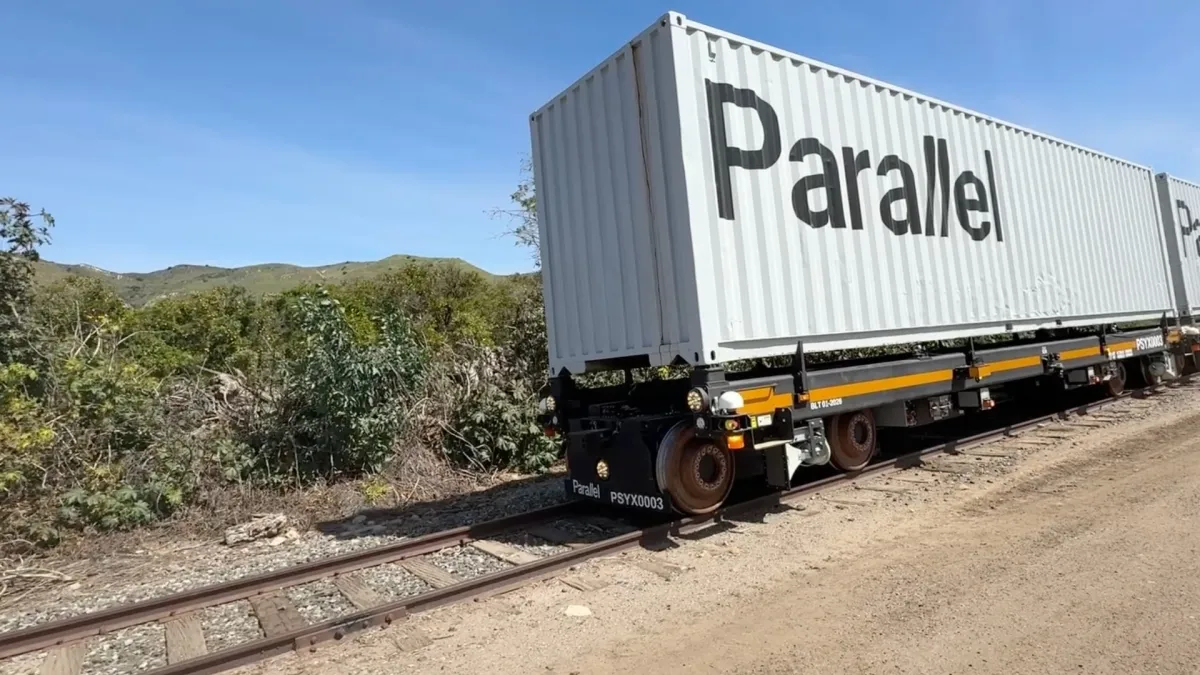
The railroad industry was one of the first to disrupt how the world worked with technology, but lately, innovation in freight railroading has amounted to little more than longer and longer trains.
That has led many railroads to abandon shorter routes, ceding a chunk of the $1 trillion surface freight market to trucking companies. But as diesel prices reach record highs, some of those very trucking companies are going bust, leaving a hole in the market. Recently, at least 16 trucking companies went bankrupt over only a few weeks.
Parallel Systems might have a way to keep freight moving while allowing railroads to recapture market share. The startup has developed a rail vehicle capable of moving over several tons of freight as far as 500 miles without an operator. If the company can scale production of its Panther vehicles, it stands to make railroads profitable over short hauls once again.
“Less than 500 miles is hard for railroads to do competitively,” Matt Soule, co-founder and CEO of Parallel Systems, told TechCrunch. “Our technology allows them to take some of that trucking, and it’s for the public’s benefit.”
Because it runs on railroads, Parallel’s vehicle doesn’t contribute to traffic congestion, and because it’s battery powered, it doesn’t pollute. To scale manufacturing of its third-generation vehicle and speed the commercial rollout, Parallel Systems has raised a $100 million Series C led by AVP, with participation from Hillspire, Agility Global, Cobalt Capital, Anthos Capital, Congruent Ventures, Riot Capital, and Collaborative Fund.
Soule and his co-founders started Parallel Systems in 2020 after years at SpaceX, where they designed rocket avionics systems.
Parallel’s vehicles can travel either independently or in platoons, which tend to be shorter than typical trains. It’s an approach that bucks the prevailing strategy used by railroads, known as precision railroading: As the railroad industry has matured, investor pressure has driven companies to build longer trains and operate them on fixed schedules, which helps spread some costs like labor across more freight.
As railroads have pulled back from smaller routes, trucking companies have stepped in. Today, some 60% of freight trips in the U.S. are under 500 miles, and trucking companies handle a majority of those.
But more trucks on the road means more congestion, and nowhere is that more apparent than at ports. “If you ever go to the Port of Savannah, you see the truck lines coming in and out of the port — it’s insanity,” Soule said.
Unlike traditional train cars, Parallel’s vehicles don’t have couplers, instead forming uncoupled platoons that move down the rails. The coupler-free design means that, once a platoon reaches a train yard, the vehicles can split up without needing human intervention. And after the Panther is cleared to operate on a section of track, its sensors monitor the rails to ensure the track ahead is clear of obstacles.
Trucking companies have been intrigued by Parallel, despite the fact that the startup is claiming part of a business they currently own. Drayage companies, which move freight short distances, make money for each load they deliver, but they don’t get to charge more when a truck gets stuck in a traffic jam, even at a port where such congestion is common. By moving freight closer to a customer’s door, Parallel allows trucking companies to make more deliveries per day. “They want certainty, they want to be able to move,” Soule said.
Parallel obtained approval a year-and-a-half ago from the Federal Railroad Administration to operate near the Port of Savannah in Georgia, where it has been operating on 160 miles of track to prove the safety of its system.
“We’ve been verifying all the safety controls and operating practices that are best evaluated in a real-world setting with a path toward our first commercial payload coming up very soon,” Soule said.
When you purchase through links in our articles, we may earn a small commission. This doesn’t affect our editorial independence.
>

Two icons, a glorious farewell and a potentially bitter ending

Bloom raises $3.6M to become the ‘Alibaba’ of American manufacturing

‘My Undesirable Friends: Part II — Exile’ Review: Julia Loktev’s Doc
-

 movies5 months ago
Search For Canadian TV Actor Stewart McLean Now Homicide Investigation
-

 Fashion9 years ago
These ’90s fashion trends are making a comeback in 2017
-
Fashion9 years ago
According to Dior Couture, this taboo fashion accessory is back
-
Fashion9 years ago
Model Jocelyn Chew’s Instagram is the best vacation you’ve ever had
-
Fashion9 years ago
Emily Ratajkowski channels back-to-school style
-
Fashion9 years ago
9 Celebrities who have spoken out about being photoshopped
-

 Anime4 months ago
Rurouni Kenshin: Hokkaido Arc Manga Takes 1-Issue Break – News
-

 Anime3 months ago
HIDIVE to Stream English Dubs for The World Is Dancing, The Forsaken Saintess and Her Foodie Roadtrip in Another World, The Dangers in My Heart: The Movie Anime – News