
Entertainment
Michael Kosta Calls Out Daily Show Crowd for Groaning at Morbid Joke


>

Alfonso Cuarón and Jonás Cuarón shared their thoughts on the future of the theatrical experience, teased a few details of upcoming projects and discussed Korean cinema during their first visit to Busan International Film Festival (BIFF) today.
BIFF is hosting both a special IMAX screening of Gravity, the Oscar-winning movie that the father and son filmmakers co-wrote, and the Asian premiere of Jonas Cuarón’s most recent film, Campeon Gabacho, the story of a Mexican immigrant in New York, which premiered at this year’s SXSW.
“I believe that the theatrical experience will keep on existing, and I hope so because I love the theatrical experience, but I think it’s going to coexist with more forms,” said Alfonso Cuarón, a four-time Oscar winner for Gravity and Roma.
“And I’m very pleased about that, and I’m also very afraid,” he continued. “But I want to learn from the new generation about how they take this new world and turn it into into art, and that’s at the end of the day what I’m putting my focus on.”
Cuarón said he’s already learned from his son, despite initially trying to dissuade him from a career in cinema: “When he was growing up, I consciously pushed him away from studying or getting involved in film. We went to the movies together and he shared my love of cinema, but I told him I can’t encourage you to study film.”
After he took that path anyway, Cuarón said: “it was very refreshing to see that he was developing a language so different from mine. Selfishly, it was a language I could learn from.
“From his first film, that was all done with still photography, and then his second film Desierto, when I read that script, I said I wanted to write something like that. So I feel in many ways, he has pushed me in my own language to explore further. He has a deep belief in audiences and a deep belief in the power of of film.”
Continuing the theme of appealing to audiences, Jonás Cuarón shared his love of genre cinema and the fact that he’s currently working on a script for a horror movie: “I like the way genre connects with an audience, like with the audience here yesterday for Gravity, you could see they were really stressed out for Dr. Ryan Stone. And horror is a really great genre in that sense of connecting with the audience. It’s similar to comedy; that when you see a horror you really get a communal reaction.”
Both father and son expressed an appreciation for Korean cinema. Jonás Cuarón said: “Something in Korean cinema that really connects with me, and that I’ve always tried to do in my films, is bringing in social semantics, but under the guise of genre and particularly also with humour.
“A lot of movies that I really respect from The Host and Parasite, to recent Korean films like Hope and No Other Choice, they all share what I love about cinema, which is that they talk about social issues but connect with the audience through genre, and a sense of humor that I really connect with.”
Speaking with Korean director Yeon Sang-ho (Colony, Paradise Lost) later today in a masterclass, Alfonso Cuarón noted how failure can be an important component in success: “I have way more projects fall apart than the projects I made; and perhaps they could be considered as failures, but thanks to those failures, I managed to do some other films that were well received in one way or the the other.”
Busan International Film Festival is taking place October 6-15 at Busan Cinema Center and multiple venues across the city. The festival’s industry platform, Asian Contents & Film Market (ACFM), kicks off on Saturday, October 10 and runs until Tuesday, October 13.
>

>
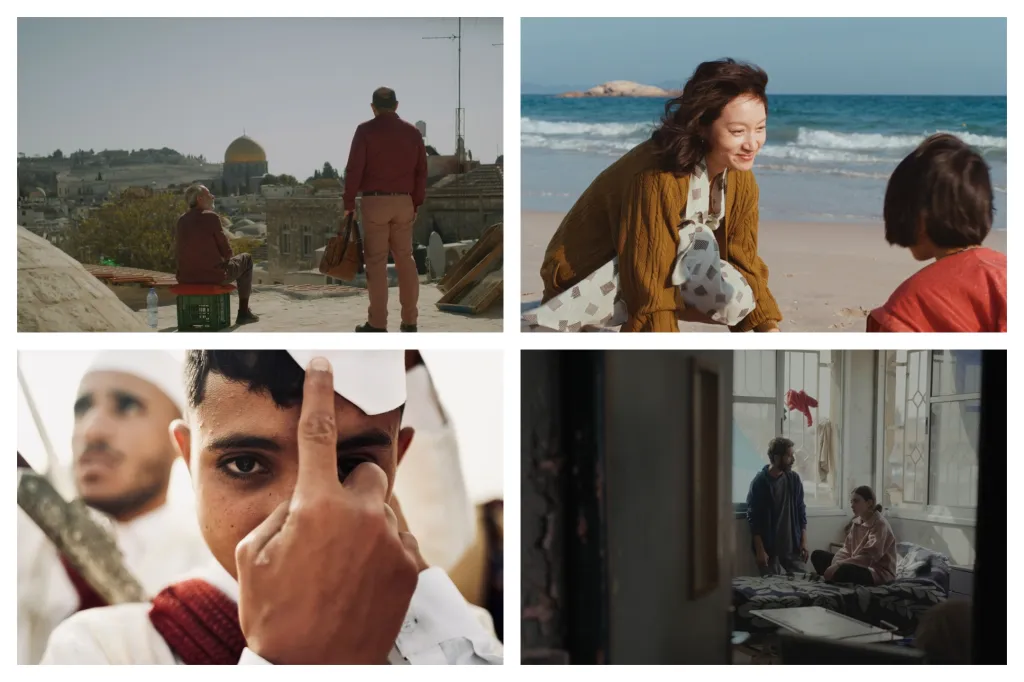
Qatar’s Doha Film Festival (DFF) has unveiled the International Feature Film Competition lineup for its second edition which is due to take place this November.
The fifteen titles include Hosam Abu Dan’s Gaza-shot drama Thirteen in Gaza, a coming-of-age drama about a motherless thirteen-year-old living with her father in a Gaza displacement camp without privacy or protection. It won the NETPAC Award in Toronto in September.
It is among four Palestinian films in competition alongside Muayad Alayan’s Venice–selected Conversation with the Sea about a Palestinian man caught in the crosshairs of Israeli bureaucracy over a social security debt for his son who drowned in the Red Sea some two decades previously.
They also include Rabab Khamis’ documentary Sama, which will world premiere in the festival. It revolves around a ten-year-old girl who collects plastic and cardboard in Deir al-Balah in Gaza to sell as fuel and help sustain her family.
Mohanad Yaqubi’s Revolutionaries Never Die, taking its cue from 113 reels of films preserved by Lebanese filmmaker Jocelyne Saab, will also compete. It won the Special Jury Prize in the Filmmakers of the Present competition at Locarno over the summer.
They are among 11 films in the main competition supported by the Doha Film Institute (DFI), which oversees the festival.
The unveiling of the selection is a sign that the DFI is confident the event will go ahead in spite of regional instability caused by the U.S.-Iran-Israel war.
Qatar is a key mediator in indirect talks between the U.S. and Iran, at the same time as negotiating directly with the latter for a regional non-aggression security framework.
Further titles from the Arab world include Concrete Land by Asmahan Bkerat, following an Afro-Palestinian Bedouin family on the outskirts of Amman as luxury villas close in around them. Filmed over eight years, the filmmaker’s debut feature premiered in the Semaine de la Critique at Locarno.
Moroccan director Tala Hadid will present Bardi, about the centuries-old equestrian tradition of Tbourida, which premiered in the Currents section at the New York Film Festival.
As previously announced Yemeni Scottish director Sara Ishaq’s The Station, set against the backdrop of a women-only petrol station in war-torn Yemen, both opens the festival and competes.
Out of sub-Saharan Africa, Cameroonian director Auguste Bernard Kouemo competes with House of the Wind, which debuted in the Venice Film Festival’s Orizzonti sidebar winning its Special Jury Prize and the Lion of the Future for a Debut Film.
Also out of the region, is My Semba by Hugo Salvaterra. It follows three orphaned siblings in Luanda who fight for dignity through faith, fury and verse. The film won the Feature Film Competition Award at the International Film Festival Innsbruck.
Asia is represented by Thai director Sompot Chidgasornpongse’s 9 Temples to Heaven, about a family which visits nine temples in a single day in the hope of keeping their grandmother alive. The film debuted in Cannes Directors’ Fortnight. It went on to win Best Director and Best Actor in the Asian New Talent Award at the Shanghai International Film Festival and is Thailand’s submission for the 99th Academy Awards.
Also out of Asia are Zou Jing Cannes Critics’ Week Fipresci-winner A Girl Unknown, about a girl abandoned at birth who passes between three families, and Rafael Manuel’s Filipiñana about teenage tee-girl at a Manila country club who begins to uncover the violence beneath its manicured lawns.
The latter film won the World Cinema Dramatic Special Jury Award for Creative Vision at Sundance and is Philippines submission for the 99th Academy Awards.
Further contenders include Chilean director Manuela Martelli’s The Meltdown, which premiered in Cannes Un Certain Regard and is Chile’s 99th Academy Awards entry, and Alessandra Sanguinetti’s The Illusion of an Everlasting Summer, following two cousins on the Argentine Pampas through the photographer’s lens over 25 years. It won the Golden Leopard in the Filmmakers of the Present competition at Locarno.
Rounding out the selection is Tin Castle by Alexander Murphy follows an Irish traveller family, two parents and ten children, threatened with eviction as they fight to preserve their way of life in an old caravan.
“This year’s features competition reflects great ambition. The 15 films from across the world are united by the courage, imagination and urgency of their filmmakers. Each has travelled a remarkable journey, and it is deeply meaningful that Doha is a part of that journey, ensuring that these powerful works are seen, shared and remembered,” said Fatma Hassan Alremaihi, CEO of Doha Film Institute and Director of DFF.
The competition will feature a jury of five industry experts who select winners in Best Narrative (with prize money of US$75,000), Best Documentary (US$50,000), Best Artistic Achievement for feature narrative or documentary (US$45,000), and Best Performance (US$15,000) categories. A certificate of Special Mention will also be presented to a feature narrative or documentary.
The festival expands on the DFI’s long-running family-focused festival of Ajyal which ran for more than a decade during the same period.
Alongside the DFI, key partners on Doha Film Festival include Katara, Media City Qatar, Film Committee and Visit Qatar.
The festival will unfold from November 19 to 27.
>

Premier League football shirts made by workers on £1 an hour
Kyrie Irving says calf strain delayed return to Mavericks: 'I had to take my time to heal'
Six games, six very different challenges facing Man United and Michael Carrick
-

 movies5 months ago
Search For Canadian TV Actor Stewart McLean Now Homicide Investigation
-

 Fashion9 years ago
These ’90s fashion trends are making a comeback in 2017
-
Fashion9 years ago
According to Dior Couture, this taboo fashion accessory is back
-
Fashion9 years ago
Model Jocelyn Chew’s Instagram is the best vacation you’ve ever had
-
Fashion9 years ago
Emily Ratajkowski channels back-to-school style
-
Fashion9 years ago
9 Celebrities who have spoken out about being photoshopped
-

 Anime4 months ago
Rurouni Kenshin: Hokkaido Arc Manga Takes 1-Issue Break – News
-

 Anime3 months ago
HIDIVE to Stream English Dubs for The World Is Dancing, The Forsaken Saintess and Her Foodie Roadtrip in Another World, The Dangers in My Heart: The Movie Anime – News