
Entertainment
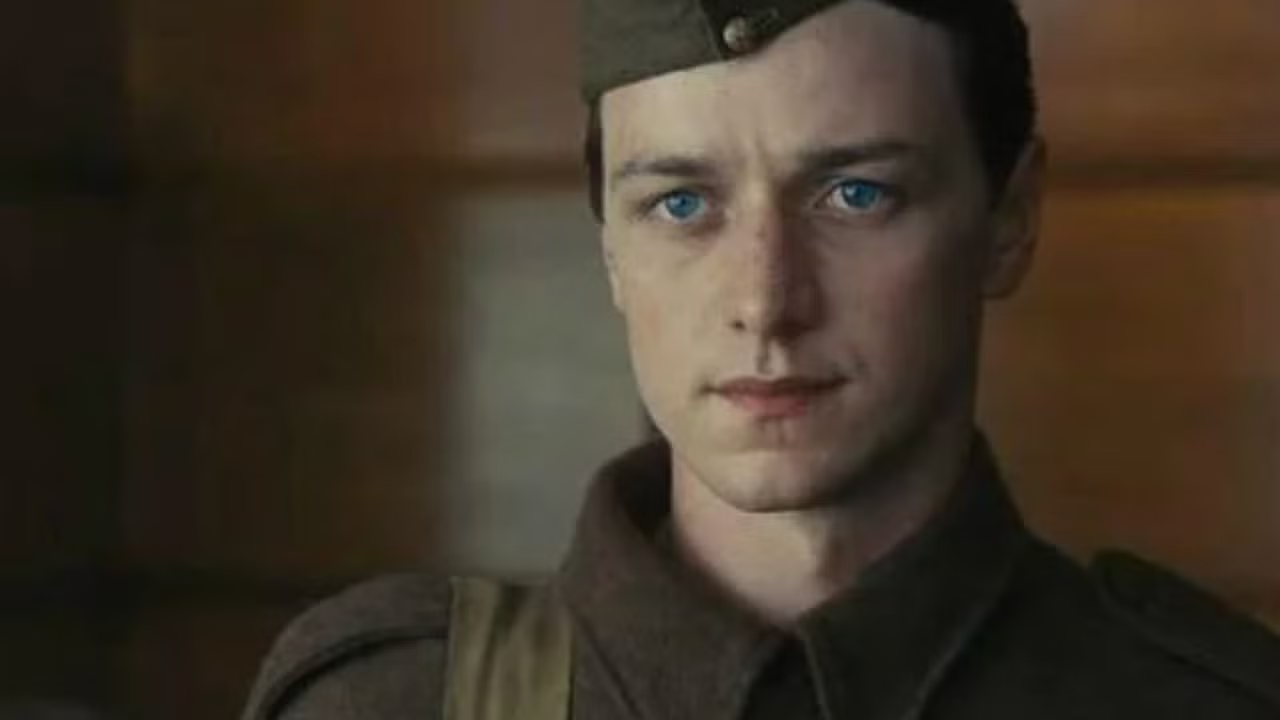
James McAvoy Remembers Being Bullied Shooting Band of Brothers

>
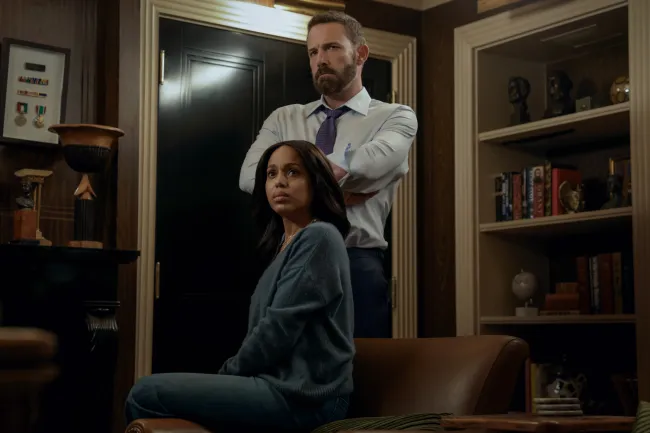
There’s a very fine art to doing cityscape b-roll and establishing shots. “Insecure” is great at it. “Hacks” is really good at it, too — in no small part because DP Adam Bricker and his longtime collaborator Charlie Panian perfected the art on “Chef’s Table.” The handoff to a drone for a haunting wide shot in “Adolescence” at the end of a 40-minute oner is kind of legendary.
Unfortunately, the more versatile the technology gets — the easier it is to achieve landscape-spanning vistas, awe-inspiring angles, and epic sweeps of scope — the easier it is for shots that should pack a punch to come across as flat and plastic as an empty takeout container run over by a bus. Even when Gillian Anderson is driving that bus, to belabor the metaphor, there’s only so much cinematography can do to involve viewers in a story if its visual style looks perilously close to a SmartTV screensaver.


It’s not necessarily the fault of director of photography Robert Elswit that the cinematography of “Animals,” which I’ve been alluding to, is so anonymous. As Stephen Sondheim teaches us, (forgettable) content dictates (forgettable) form. Given how many streamer films and true-crime docs are being quickly turned around online, though, it’s worth pausing to note that the returns on drone photography are worse right now than the price of diesel.
But a better world is possible. There are ways to use drone photography so that it counts. IndieWire spoke with DP Jeff Hutchens, who began his career as a photojournalist before transitioning to documentary and feature cinematography, about how his work avoids some of the worst clichés drones make so easy.
Sweeping a drone over a sun-drenched location is a big temptation, especially when a story beat needs a sense of scale or landscape. It’s fairly economical, logistically, to do. But for Hutchens and his team on Showtime’s “Murder in Big Horn,” embedding viewers in the story had to meld with emotional resonance that pushed the story just as far forward — and he found the right way to do that by leaning into on-the-ground limitations.

“The land on a lot of those reservations is so important, and the whole history of it plays such a huge role in how everything has unfolded to this day. You want to have some sense of the landscape. But that part of Montana is pretty flat, and it’s a little hard to get [height] and get perspective,” Hutchens told IndieWire. “What we decided to do was put the camera on a full, heavy-lift drone, take it up 400 feet, and use it as a tripod up there.”
By limiting what the drone photography would do — avoiding the easy, sometimes overly smooth movement that didn’t read as fast as it used to five years ago anyway — Hutchens found completely different, surprising, and resonant visuals that felt kin to the stories the show was documenting.
“With these static landscapes, we really looked at some of these dissonant shapes and lines and things that were cutting through the terrain out there,” Hutchens said. “You don’t want it to feel like, ‘OK, here comes another drone shot.’ It’s way overused. I think any time you can tweak a tool, at least, that is commonplace and work with it in a way that is a departure from what’s expected, I think that helps.”
However, cinematographers always need time and encouragement to get inventive with commonplace tools, especially in the documentary world where Hutchens does so much work. Almost all documentaries, he thinks, would prefer to be doing more verité footage, but it’s very hard to get networks to pay for the time and attention and mountain of footage that requires. “It’s really tricky to get commissioned work done that way,” Hutchens said.

But it’s all the more important, as fellow documentarian John Wilson makes clear in his latest feature, “The History of Concrete.” Wilson takes a swipe at drone photography in the film itself when he talks about receiving default-mode drone footage of a 3D-printed concrete Starbucks and the implications of it refusing to be subtext.
“There’s a sameness to the way that a lot of drone-heavy stuff looks and you can tell that it’s filler,” Wilson told IndieWire. “And I just find that’s not a great relationship to have with imagery. You’re using it almost, like, an artificially intelligent thing could make, you know? It doesn’t have this human element to it as much, and you are relying on this machine to get you this shot that is, ultimately, just screensaver material.”
Sometimes the mechanical, inhuman feeling of technological tools is an intentional choice — “Severance” DP and director Jessica Lee Gagné set that show’s template to give the camera inside Lumon HQ a smooth, mechanical, surveillance feel, for reasons the series makes clear. But drones can, when used at just the right moment and not overused, also carry deep, human emotions.
That’s exactly what cinematographer Matthew Lewis achieves at the end of the second episode of “Adolescence,” with a drone handoff that brings the camera from the school the police are investigating to the crime scene/memorial where the murder took place. ”A real concern of mine was that the camera had its own personality and that it would start making decisions that didn’t feel connected to the motivations of our characters,” Lewis told IndieWire about the series.

But Lewis said justifying camera movements through human mannerisms and tics also made the drone the episode’s poignant exhale. “It’s impressive to do a sequence with loads of stunts if it’s an action scene,” Lewis said. “There’s this constant relief and release of, you know, there’s an explosion, that justifies why we’re still here. There’s a gunshot, so that explains why we’re still here. It’s in the downtime and in the pauses and in the restful moments, where you think you should rest, but you can’t, and you don’t know why — that’s what’s interesting.”
It’s also what is most human, and doing the human thing, rather than the easy thing, may be the healthiest thing going forward. “There is a lot of fear around what are [filmmakers] useful for in this landscape, you know? If we are creating this robotic imagery via stuff like drones, then it’s like we aren’t that different from the machines in certain ways,” Wilson said. “You should, I think, take a bit more care to have things feel like they were made by a human.”
Drones can be a part of that, but not by mindlessly speeding along the LA River like in “Animals.”
>
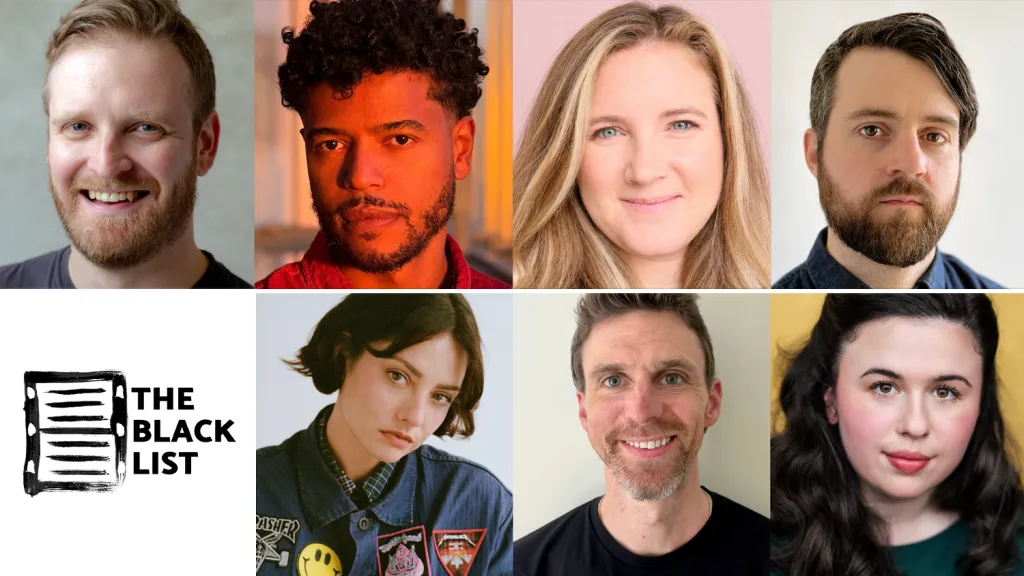
EXCLUSIVE: The Black List has named the six writers and projects chosen for its 2026 Writers Lab. They are Elton de Almeida (A Mark of Kin), Yasmin DeWinter (Guillaume), Scott Leddy (Nightwatch), Marcelle Pallais (One Last Summer), Alexander Seltzer and Kyle Jutkiewicz (Depths) and Emma Taylor Stock (Denial).
The program, now in its 13th year, provides creative mentorship and professional support to promising feature writers as they further develop their selected project during a weeklong workshop in Ojai, CA.
The Black List’s Annual Lab program supports two distinct cohorts: writers and filmmakers. The Writers Lab focuses on developing feature scripts to be sold in the studio system and/or used as voice samples. The Projects Lab, which will be announced in November, offers writer-directors the chance to develop a screenplay that they intend to direct.
During the Lab, each writer will develop their screenplay through peer workshops and one-on-one sessions with working professional screenwriters, including returning mentors Travis Braun (One Night Only), Stephany Folsom (Toy Story 4, The Lord of the Rings: Rings of Power), Katie Silberman (Set It Up, Don’t Worry Darling), Victoria Strouse (Seekers of Infintie Love, Finding Dory) and Christina Hodson (Birds of Prey, Bumblebee).
Black List Annual Lab alumna Savion Einstein (A Cuban Girl’s Guide To Tea and Tomorrow) will also join as a session mentor. After the lab concludes, the writers cohort will participate in a yearlong support program involving monthly meetings with screenwriters, agents, managers, producers, and executives.
“We’re excited to welcome the latest cohort of screenwriters to the Black List Lab fold. At a time when the industry can seem particularly challenging and harder than ever to break into, we’re thrilled to be able to support projects that make us excited to go to the movies. These writers are bringing distinctive voices, bold points of view, and stories that deserve to be heard to the Lab and we’re privileged to be able to give them space to take risks, challenge themselves, and build community with other writers, in Ojai and beyond,” said Megan Halpern, Black List SVP.
Submissions for the 2027 Labs are now open on the Black List website.
Previous Black List Lab alumni include Claire Ayoub (Empire Waist), Minhal Baig (We Grown Now), Tom Dean (Carolina, Caroline), Gia Gordon (Law and Order), Danny Hogan (The Pitt), Jimmy Keyrouz (Broken Keys), Dagny Looper (The Resort), Alexandra Qin (ThirstyGirl), Michelle Steffes (For When You Get Lost), and Jason Young (The Magic Flute).
Learn more about the 2026 Writers Lab projects, and the creatives behind them, below.
2026 Writers Lab Projects:
Elton de Almeida – A MARK OF KIN
Haunted by her family’s tragic past, a cunning scammer seeks revenge on the uncle who abandoned her decades ago — only to be trapped by a demonic curse that feeds off her bloodline.
Yasmin DeWinter – GUILLAUME
Paris, 1898. Two American brothers walk into a brothel. The others pulls a knife. Within the hour, they owe a madam five thousand francs they don’t have. Their ship sails at dawn. The elder just had a seizure in a piss-soaked allegy – and if anyone finds out, he loses his wife, his childen, and his name.
Scott Leddy – NIGHTWATCH
In the midst of an apparent nuclear attack on NATO and the US, a communications blackout with the President places the Defense Secretary in the hot seat on America’s Doomsday Plane, but with the minutes ticking down, a comms expert discovers an anomaly that could change everything.
Marcelle Pallais – ONE LAST SUMMER
A restless, sharp-witted teen aching for meaning and adventure escapes to a wealthy beach town, only to be pulled toward a charming boy and his family’s deadly secret. Adapted from NORTHANGER ABBEY by Jane Austen.
Alexander Seltzer and Kyle Jutkiewicz – DEPTHS
Trapped aboard a US nuclear submarine, a former priest turned navy engineer must stop a demon-possessed Soviet defector before she turns the Cold War hot.
Emma Taylor Stock – DENIAL
When a health insurance giant denies their bestie’s cancer treatment, three friends attempt to approve the claim themselves. But their plan spirals when they accidentally kidnap the CEO and must expose his fraud to save themselves.
>
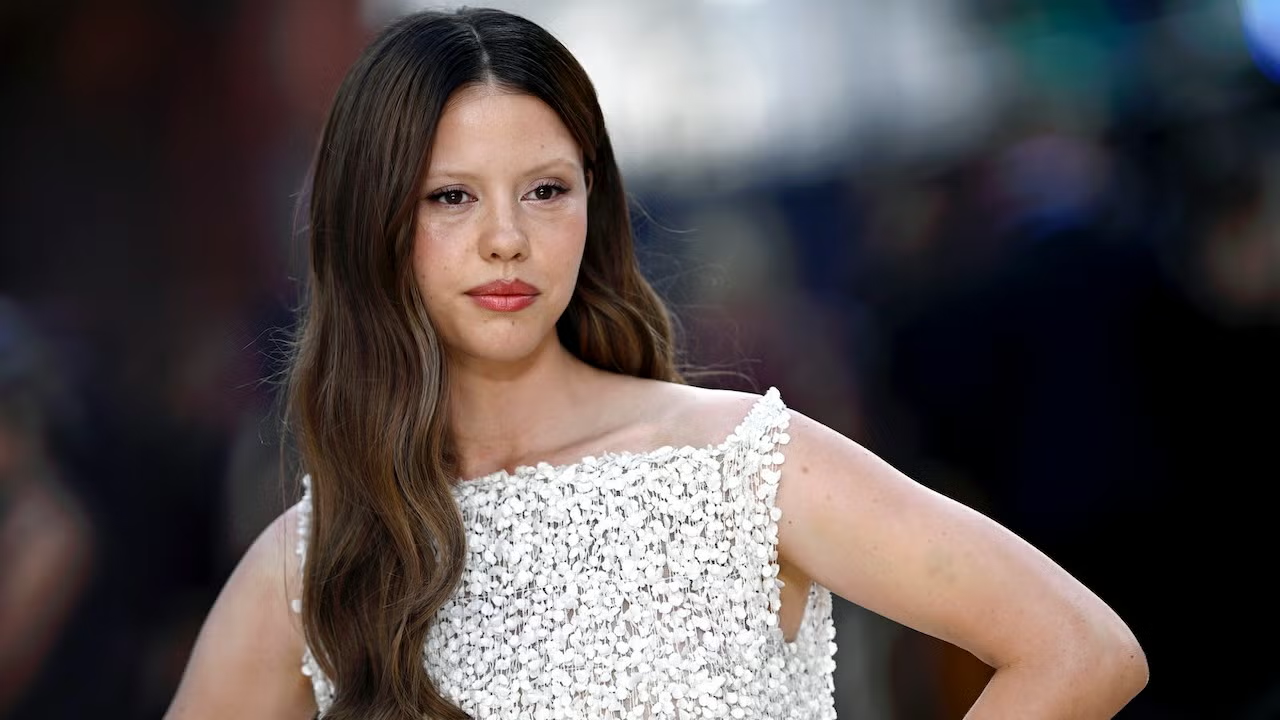
Mia Goth isn’t even on Instagram, but she was still forced to file a complaint with the social media platform after an AI image of the actress went viral amid recent news of her divorce from Shia LaBeouf.
After Goth filed for irreconcilable differences last week, an Instagram account called @miagoth_ shared an image of the star wearing a shirt that read: “My Ex Is My Biggest Fan.” Despite the picture being AI-generated, a number of news outlets referenced the photo as Goth seemingly making a statement about LaBeouf — especially considering the page itself was blue check-verified.
“Mia Goth does not have ownership of, nor does she engage in social media on any platform. We have filed multiple complaints with Instagram to remove the verified fan account which continues to post counterfeit, AI images of Mia Goth,” a representative for Goth told The Verge on Tuesday. “The fact that this fan account meets Instagram’s criteria to qualify for a ‘blue check’ is disconcerting on a fundamental level. Beyond that, it is incomprehensible that Instagram evidently prioritizes the dissemination of forged and manipulated images over the protection and integrity of a public figure’s likeness.”
TheWrap has reached out to Goth’s team for further comment.
Of course, this is far from the first instance of its kind. In 2024, Scarlett Johansson was “shocked” that Sam Altman of ChatGPT created an AI voice that sounded “eerily” like her after she declined to voice the system herself. The actress voiced an AI named Samantha in the 2013 film “Her,” which likely sparked Altman’s idea to have her voice ChatGPT. Altman re-upped his offer for her to officially lend her voice to his product after the Sky demo was already out.
OpenAI, however, denied using Johansson’s voice. “We believe that AI voices should not deliberately mimic a celebrity’s distinctive voice — Sky’s voice is not an imitation of Scarlett Johansson but belongs to a different professional actress using her own natural speaking voice,” the company said in a statement at the time. “To protect their privacy, we cannot share the names of our voice talents.”

>
Bears' Montez Sweat suspended 2 games for violating performance-enhancing substance policy
Google Sheets Canvas Builds Mini-Apps From Prompts: How It Works

‘Animals’ Makes Drone Shots Look Forgettable — They Don’t Have to Be
-

 movies5 months ago
Search For Canadian TV Actor Stewart McLean Now Homicide Investigation
-

 Fashion9 years ago
These ’90s fashion trends are making a comeback in 2017
-
Fashion9 years ago
According to Dior Couture, this taboo fashion accessory is back
-
Fashion9 years ago
Model Jocelyn Chew’s Instagram is the best vacation you’ve ever had
-
Fashion9 years ago
Emily Ratajkowski channels back-to-school style
-
Fashion9 years ago
9 Celebrities who have spoken out about being photoshopped
-

 Anime4 months ago
Rurouni Kenshin: Hokkaido Arc Manga Takes 1-Issue Break – News
-

 Anime3 months ago
HIDIVE to Stream English Dubs for The World Is Dancing, The Forsaken Saintess and Her Foodie Roadtrip in Another World, The Dangers in My Heart: The Movie Anime – News