
Entertainment
The Bay Theater to Reopen in Palisades Village Thanks to Paramount


>

Katie Zacharia made her debut as Donald Trump‘s new White House press secretary on Tuesday with a very short briefing that nevertheless offered a bit of breaking news as well as a lot of praise and thanks for her new boss.
“I have wanted to work for him for a very long time,” she told reporters, crunched into the tight briefing room space of the West Wing.
The briefing lasted less than 15 minutes, as she took only a handful of questions before noting that the president would soon be speaking to reporters as he departed for three-day midterm campaign swing. But there were some laughs of surprise among reporters, caught off guard at the abrupt end to the briefing.
As short as it was, she did breaking some news. Asked about the fate of Kimberly Guilfoyle, the former fiance of Donald Trump Jr. who is now the U.S. ambassador to Greece. Zacharia said, “We have asked Ambassador Guilfoyle to resign.” In a bombshell story last week, The Wall Street Journal reported on a message that Guilfoyle sent to a Trump donor, asking him to wire $100,000 directly to American Express to pay off her bill. The donor had been seeking her help accessing administration officials. Her attorney has challenged the authenticity of the messages, per the Journal.
Zacharia was not as well known to the press corps as were other candidates floated following the departure of Karoline Leavitt in August. Under Trump, the job has become much more about playing to an audience of one, which was apparent as she started her briefing by referring to his rally in Youngstown, OH, on Monday night.
“The arena was overflowing with enthusiasm as thousands came out to support President Trump, as well as special guests Jake Paul and football legend John Gruden,” she told reporters, perhaps as a way to counter social media posts of rows of empty seats at the event. At his first appearance as Trump’s first press secretary in 2017, Sean Spicer called in reporters to insist that the new president’s inaugural crowd size was record setting.
She also made clear that, at least for the next few weeks, her job will be to tout, defend and amplify Trump’s record, as she ran through a list of accomplishments amid the president’s sagging approval numbers. At one point, she compared average annual earnings under Trump to that of Biden, reflecting White House efforts to point to economic data while polls show the president way underwater on issues like inflation.
>
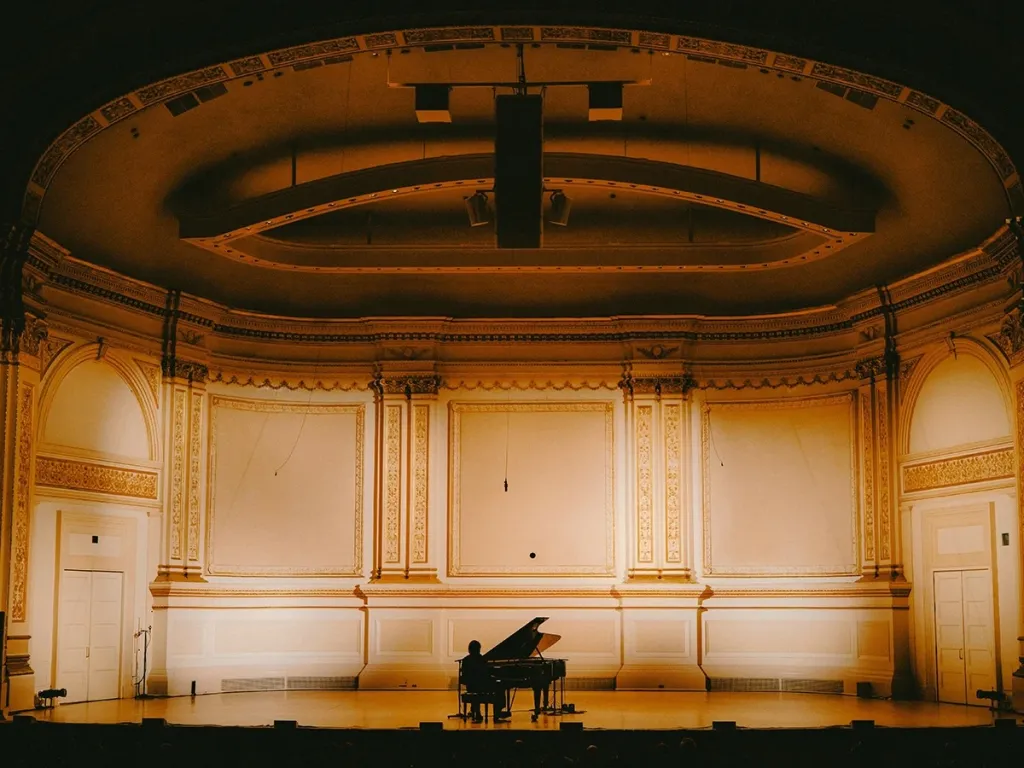
Every auteur’s favorite side hustle is the music video, and Paul Thomas Anderson is no exception. But where the likes of Martin Scorsese like to go bigger when they make a full-blown concert movie, PTA runs in the opposite direction. Jonathan Demme is a big influence here, inevitably, but Cameron Winter At Carnegie Hall doesn’t bear the slightest resemblance to the latter’s 1984 Talking Heads doc Stop Making Sense. What it does look like is his extraordinary 1985 promo for New Order’s The Perfect Kiss, perhaps the only reason one would ever mention Powell and Pressburger and MTV in the same breath.
Though Winter’s esoteric music is an acquired taste, PTA’s film — working in partnership with Benny Safdie — offers a tremendous sense of occasion. Carnegie Hall seats well over 3,000 people, but this intense performance film gives life to the old saying about feeling alone in a crowd. Using warm 35mm color stock to capture the old-fashioned, almost music-hall ambience of the venue, Cameron Winter At Carnegie Hall makes both the grandeur and the intimacy of the event; in stark contrast to the raucous crowd scenes of, say, the recent Oasis movie, PTA captures the audience as both a blurry mass and a sequence of highly focused individuals, each experiencing their own kind of communion with a musician who doesn’t speak to them or even turn to face them.
Winter, 24-year-old frontman with a New York rock band called Geese, is a self-confessed admirer of Leonard Cohen and Bob Dylan, which is abundantly clear from the outset. With the odd nod to the fire and brimstone of Nick Cave at his most religious, the show is simply one man and a grand piano, which somehow came as a shock to a woman sitting three rows from the front at its second screening at the London Film Festival (she left after the second song had barely begun). The stark simplicity of the sound, given the sprawling, almost classical nature of the songs, sometimes make the film surprisingly hard to follow — are we watching a full set or just one long song cycle? — and if it weren’t for the informed applause of an audience in the know, it would be hard to tell where one song ends and the next one starts.
Like its subject matter, PTA doesn’t really seem to care whether you’re enjoying yourself; much like Winter’s lyrics — which contain humdingers like “Names are donuts on the sea” — so much of Cameron Winter At Carnegie Hall is about interpretation. The camera is always finding ways around the artist, sometimes examining him with the forensic disinterest of a doctor, the next close up and in his face like an adoring fan. Winter remains slippery and impervious throughout, and when he makes his one and only act of showmanship — pretending to leave the stage after 30 minutes — it’s hard to know whether this is a joke or then start of a panic attack that has thankfully subsided.
The show and encore, which take up a little over an hour, are bookended by scenes of concertgoers filling the room and then emptying it. What happens in between is an interesting interrogation of the highly personal nature of art, how it happens and the neurological ripple effect it causes in a roomful of like-minded people. But is it any good? If that’s your main criteria, Cameron Winter At Carnegie Hall is not for you.
Title: Cameron Winter At Carnegie Hall
Festival: London, New York
Director: Paul Thomas Anderson
Distributor: Mubi
Running time: 1 hr 11 mins
>
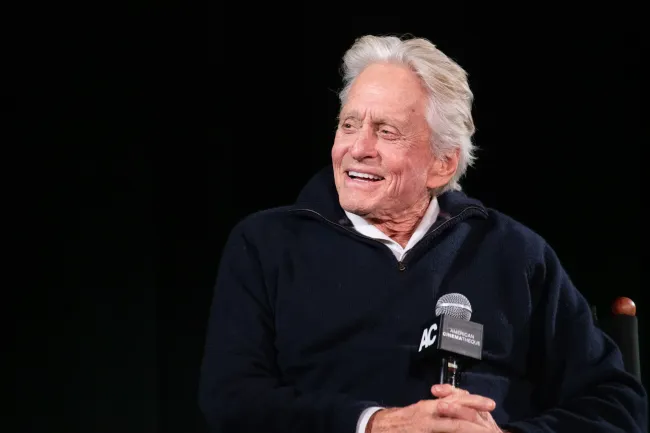
Last Saturday, the American Cinematheque hosted a Michael Douglas marathon to celebrate the release of the actor/producer’s new memoir, “One Helluva Ride.” After audiences spent the day at the Egyptian Theatre watching “Romancing the Stone,” “The War of the Roses,” and “Falling Down,” Douglas joined me on stage for a lively career conversation. The marathon then resumed with a screening of David Fincher‘s “The Game.”
The film that kicked off the day, “Romancing the Stone,” also yielded some of Douglas’ best stories. The 1984 action-comedy-romance made Douglas a movie star, but when he acquired Diane Thomas’ script as a producer, he didn’t intend to play dashing adventurer Jack Colton. “I was a big producer,” Douglas said, reflecting on winning an Oscar for producing “One Flew Over the Cuckoo’s Nest.” “I’m a studio film producer, but I’m a TV actor.”


At the time, Douglas’ main claim to fame was starring in the television cop drama “Streets of San Francisco,” in an era when actors rarely crossed over from TV to movies. Even though Douglas became a major player in Hollywood after producing two successful films, “Cuckoo’s Nest” and “The China Syndrome,” the studios wouldn’t sign him as a leading man. “I produced this movie called ‘Starman’ with Jeff Bridges,” Douglas said. “I would have liked to have played that part, but I was not approved. Jeff was.”
For “Romancing the Stone,” Douglas offered the role to Clint Eastwood and Burt Reynolds, but they both passed because they saw Jack as a second lead behind the heroine, Joan Wilder. He then went to Paul Newman, Robert Redford, Sylvester Stallone, and other actors approved by the studio — all of whom told him no. Ultimately, Douglas knew one actor wouldn’t say no to him, so he cast himself in the part, and the studio had little to do since everyone on their list had passed.
They also didn’t have high expectations for “Romancing the Stone” to begin with. “I remember the big picture they were all betting on was ‘Rhinestone,’ with Sylvester Stallone and Dolly Parton,” Douglas said. “Romancing the Stone” was a negative pickup for the studio, meaning Douglas was on the hook as producer for cost overruns, but also that he was left largely alone during the shoot. Working with director Robert Zemeckis, who had made two critically acclaimed but commercially unsuccessful pictures (“I Wanna Hold Your Hand” and “Used Cars”) and was one flop away from director jail, Douglas and co-star Kathleen Turner created a classic.
The studio didn’t see it that way when Douglas screened the first cut for them. “They did not like it,” Douglas said. The studio provided extra money for reshoots, not realizing that Douglas had already spent everything he was entitled to because the cost reports hadn’t come back from Mexico yet. “They committed to the reshoot, and then they found out, ‘Holy shit, they’re not under budget, they’re over budget.’” Douglas, Zemeckis, and Turner scrambled to shoot some new material that fleshed out the two main characters and added some comedy, and the result was Zemeckis’ first hit as a director and Douglas’ as a leading man.

Inevitably, the studio wanted a sequel, which led to one of the most stressful experiences of Douglas’ career, the 1985 release “The Jewel of the Nile.” The trouble began early, when Douglas spoke with Kathleen Turner about bringing her back. “Kathleen and I were carrying on during ‘Romancing the Stone,’” Douglas said, referring to an affair they kept secret for over 40 years until he revealed it in his memoir. “When the movie ended, I went back to my wife Diandra, and we ended our romance. Then, Kathleen became a huge star.”
When Douglas approached Turner about reteaming for “Jewel of the Nile,” she was newly married and filling her dance card with exciting projects like Francis Coppola’s “Peggy Sue Got Married” and the Steven Spielberg-produced comedy “The Money Pit.” When Turner told Douglas she planned to do the latter picture, not a “Romancing the Stone” sequel, he reminded her that the first film’s contract gave him an option on her services for a second movie.
Turner’s solution was to hire infamous litigator (and Donald Trump mentor) Roy Cohn to represent her in a legal battle with Douglas. Douglas ultimately won the case, but realized he had a major problem as he headed to Morocco for the production. “I thought, ‘Now I’ve got to go make this sequel with a woman who hates my guts,’” Douglas said.
A disgruntled costar was the least of Douglas’ problems. 10 days before the movie began shooting, a plane crash killed several of Douglas’ friends and collaborators, including his AD and production designer. “Because of the technicalities in Morocco, I couldn’t get the bodies out of the country,” Douglas said. “So at the hotel I have cast and crew arriving to start the movie, and three widows grieving in the bar, waiting until I can get their husbands out. And my leading lady is there under duress, looking at me like I’ve gotta watch my back or she’s going to kill me.”
Ultimately, Turner came around and became a trusted collaborator once again — she even reunited with Douglas for “War of the Roses” and the Netflix series “The Kominsky Method.” But Douglas’ problems on “Jewel of the Nile” were far from over. Once again, he was working under a negative pickup deal with the studio, which meant he was responsible for the bank loan that paid for the movie, a loan Fox would repay upon delivery. When the Moroccan authorities tried to shake down the production for two million dollars, this became a problem.
“We had three days left of shooting, and the Moroccan health department came to my office and said, ‘I’m sorry to tell you, but we’re going to have to quarantine the company for six weeks,” Douglas said. “We think one of your crew members has hepatitis.” When the health department asked for two million bucks to make the problem go away, Douglas saw he was being extorted — and when he called the studio for assistance, they made it clear it was his problem.
A call to the U.S. Ambassador in Morocco didn’t help. “He said, ‘Now you know the difference between a democracy and an autocracy,’” Douglas said. Frantic and worried he’d have 110 cast and crew members from around the world stranded in Morocco, Douglas talked with his brother Joel, who was working on the movie, and they came up with a solution. A member of the production team stole a stamp pad from the local customs inspector and stamped everyone’s passports — but the question remained: how to transport them and all their equipment out of the country without the government catching on.
“I found a Russian cargo plane and chartered it out of Paris,” Douglas said. “ Then, I called the customs department, and the guy came down to the desert, and I gave him a little envelope and thanked him for all his help. And he had helped a lot.” Douglas then asked the customs official for one last favor: to make the little airport in Ouarzazate, where they were shooting, “an international airport for about two hours.” With one call from the customs official to the control tower, Douglas plan to flee Morocco with his cast, crew, and equipment was underway.
“Everything just kept going up into this plane,” Douglas said. “The Chapman crane, the costume truck, the camera truck…and it was too hot to take off.” Because of the weather, Douglas and his team had to sit on the tarmac for an hour and a half, fearing the whole time that the Moroccan authorities would catch on to their plan and show up to quarantine or arrest them. “Finally it cooled off, and that’s how I got out of Morocco.”
Michael Douglas‘ new memoir “One Helluva Ride” is now available from Grand Central Publishing.
>
Broncos insist they can do more to help Bo Nix. But QB has to help himself, too

New White House Press Secretary Debuts With A Very Short Briefing
How the U.S. *can* beat Spain. Plus: What 'Ted Lasso' got wrong
-

 movies5 months ago
Search For Canadian TV Actor Stewart McLean Now Homicide Investigation
-

 Fashion9 years ago
These ’90s fashion trends are making a comeback in 2017
-
Fashion9 years ago
According to Dior Couture, this taboo fashion accessory is back
-
Fashion9 years ago
Model Jocelyn Chew’s Instagram is the best vacation you’ve ever had
-
Fashion9 years ago
Emily Ratajkowski channels back-to-school style
-
Fashion9 years ago
9 Celebrities who have spoken out about being photoshopped
-

 Anime4 months ago
Rurouni Kenshin: Hokkaido Arc Manga Takes 1-Issue Break – News
-

 Anime3 months ago
HIDIVE to Stream English Dubs for The World Is Dancing, The Forsaken Saintess and Her Foodie Roadtrip in Another World, The Dangers in My Heart: The Movie Anime – News