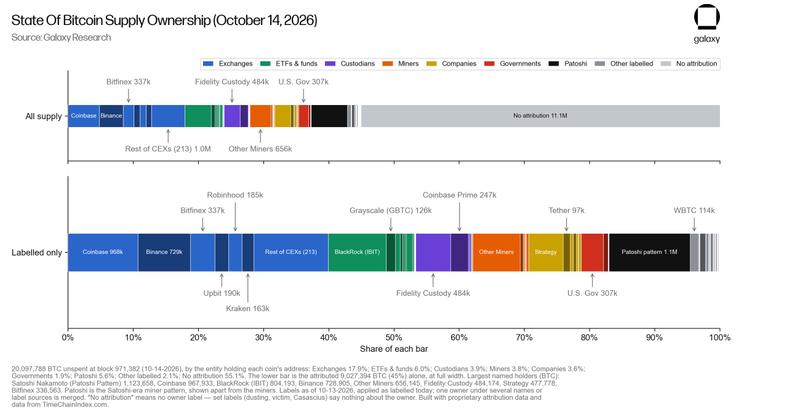
More than half of all bitcoin in existence cannot be linked to any known owner — even after years of Wall Street buying. According to Galaxy Research, about 11.1 million bitcoin, roughly 55% of the roughly 20.1 million mined, sits in addresses the firm cannot attribute to an exchange, fund, government or other known entity.
Bitcoin (Credits: CoinDesk)
The finding, reported by CoinDesk, cuts against a common assumption about how crypto markets have changed. Bitcoin is no longer a fringe asset, and institutional adoption has grown sharply through exchanges, funds and custodians. Yet blockchain data still leaves most of the supply unattributed — a reminder of how much of the market remains outside the neat categories analysts use to track it.
Over 11 Million Bitcoin Has No Known Owner: What Galaxy Research Found
Galaxy’s October snapshot classifies bitcoin holdings by whether they can be tied to a known holder. The unattributed bucket is by far the largest: 11.1 million coins, against a total mined supply of about 20.1 million. That means that for most bitcoin, researchers can see the coins on the blockchain, but they cannot say with confidence who controls them.
Galaxy’s head of research, Alex Thorn, interprets the figure as evidence that self-custody remains widespread. In his view, a large share of bitcoin — possibly even most of it — is still held by individuals who keep control of their own keys, rather than entrusting coins to an exchange or fund. That reading, if correct, suggests retail investors have been in this market for years and have not simply handed their holdings over as institutions arrived.
It is an appealing story, but it comes with an important caveat, and Galaxy’s own summary states it plainly: the unattributed total may also include lost coins, unidentified institutional holdings, and assets spread across complex custody arrangements. A coin that cannot be linked to a known owner is not necessarily a coin held by an everyday investor.
Why “Unattributed” Does Not Mean “Owned by Individuals”
Some bitcoin is almost certainly inaccessible. Coins whose owners lost their private keys, or whose early holders are no longer around, still sit on the blockchain and will always look unattributed. Others may belong to institutions that simply have not been identified by researchers, or to entities using custody setups that deliberately obscure ownership.
That ambiguity is built into how Bitcoin works. The blockchain records transactions, not identities. Analysts can cluster addresses and link some of them to known exchanges or funds, but the rest remains a grey area — visible in amount, invisible in ownership.
What the data does show clearly is that institutionalisation has not swallowed the market whole. Despite the growth of funds, ETFs and corporate treasuries, a majority of supply still sits outside the identified institutional footprint. Whether that supply is mostly individual self-custody, lost coins, hidden institutional holdings, or a mix of all three is something the data alone cannot settle.
For readers following crypto markets, the takeaway is therefore narrower — and more interesting — than a simple headline. Bitcoin’s ownership remains far more dispersed and opaque than the Wall Street narrative suggests, and the largest single category in Galaxy’s snapshot is not an exchange, a fund or a government. It is “unknown.”
Also Read: Bitcoin Slips Under $80,000 as Traders De-Risk Ahead of Fed Meeting and Strategy and Strive Face Balancing Act Between Bitcoin Buying and Preferred Stock Dividends
Source: CoinDesk — read the full story there.