
Tech
Elon Musk’s Tesla Optimus Timeline: Robots Targeted for 2027 Launch

Tesla’s Optimus robot production reportedly increased in 2026. Here’s what to know about Elon Musk’s 2027 sales target, manufacturing challenges, and rollout.
The post Elon Musk’s Tesla Optimus Timeline: Robots Targeted for 2027 Launch appeared first on TechRepublic.
>
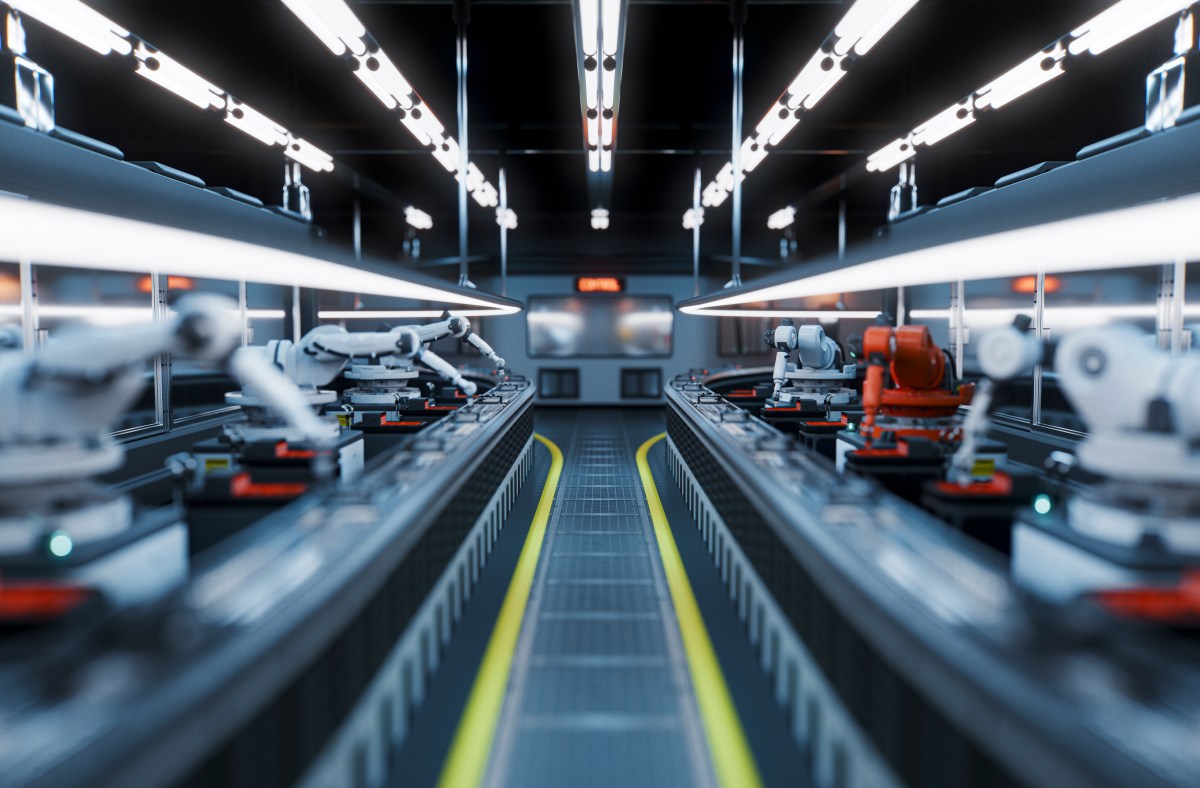
In most factories, automation is fixed: robots and machines are programmed for one specific task and product. Changing a line means reprogramming and physical retooling, or swapping out equipment, which can take weeks or months. San Francisco-based Industrial Next says it’s changing that.
The startup, which presented today on the Startup Battlefield stage at TechCrunch Disrupt 2026, builds AI-driven, self-contained robotic stations powered by proprietary foundation models that connect vision, task context and motion. The company says this lets a production line be retooled in minutes rather than weeks without traditional programming. The goal is to let manufacturers automate complex and delicate tasks that traditionally require human labor.
The company announced on stage that it’s partnering with BMW Group Technology Office to evaluate Industrial Next’s AI-powered dexterous manipulation for manufacturing.
Industrial Next was founded in 2021 by Lukas Pankau and Allen Pan, both of whom previously worked at Tesla. Pankau served as a lead electrical architect at Tesla before moving on to Waymo. Pan led Tesla’s autonomous factory efforts and later became a chief architect at autonomous driving company Neolix.
The pair came up with the idea for Industrial Next while working together at Tesla. Pankau’s first encounter with Pan was literally tripping over him as Pan was asleep on a factory catwalk after pulling an all-nighter. Although the two didn’t get along at first, they soon realized they shared an obsession with getting things done and had complementary skills.
After years of watching cutting-edge vehicle and self-driving technology get held back by decades-old factory equipment, the founders realized that manufacturing needed to be rebuilt.

“We had all these fancy things that we could do on cars. I could run machine learning algorithms to design a car for me. But I couldn’t figure out how to program a robot, and this was pretty common for engineers at Tesla,” Pankau said. “You had this massive divide, right? You had people who are really good at what they’re doing–designing cars and designing self-driving systems–and then you had them effectively stumped at the factory looking at this equipment from the 1980s. And so we started rethinking what this should look like using the technology that we have today and using everything that we know today.”
The two kept thinking about their frustrations with industrial equipment even after moving on to their next jobs. They stayed in touch, often reminiscing about the machines that never functioned the way they wanted, and eventually decided they could do better.
“I was at Waymo at the time, kind of bored out of my mind because I was missing that pace of Tesla,” Pankau said. Pan, he added, was in a similar position at Momenta, a developer of self-driving systems in China. Pan recalled their conclusion: “We’re like, we’re not getting any younger, and we’re still obviously passionate about it. We still keep complaining about industrial technology. Like, this is three years later, we should start the company.”
Pankau notes that traditional industrial robots are typically programmed to perform highly specific, repeatable tasks. As a result, even a small change in the process or product can cause the robot to fail or trigger costly downtime, which forces manufacturers to simplify their products for repeatability.
Making robots truly flexible presents a different challenge. They need enormous amounts of training data and, unlike AI models trained on the internet, robotics lacks the vast datasets needed to teach machines how to perform complex physical tasks.

“We can make robots do all these cool things like dance around, because there’s data for that, but we can’t make them assemble high-precision things,” Pankau explained. “This is where we’ve made a lot of progress on using simulated environments to do these high-precision and high-dexterity tasks. The secret sauce for the robots that we have is that we have given them an understanding of the process in general, but we build that understanding using an extremely high-fidelity simulation engine that is close to the real dynamics to where we can let the robot do these kinds of high precision tasks almost without seeing the parts at all.”
In other words, the robots practice in a highly detailed virtual world that closely mimics real-world physics. Industrial Next’s robotic stations can be reconfigured, combined, and redeployed across product lines. New tasks are taught through simulation and demonstration, rather than hard-coded scripts.
Pankau explained that some of the startup’s workstations are already used in making one of the world’s most popular smartphones. They handle tasks that manufacturers had tried and failed to automate for years, such as threading a delicate flex cable and snapping a tiny connector cap into place. (He wasn’t at liberty to disclose the customer.) He also described a “film peeling” station, where their AI-powered robots strip protective film off camera modules and buttons at or above human speed with 100% accuracy, even when moved to a new phone model and production line they have never seen.
“We started this company because that is the kind of performance that we wish we had at Tesla, where we were bypassing robot stations because we couldn’t program them effectively enough using traditional technologies,” Pankau said. “Now we want to take this to more complicated tasks than just building a phone. We ultimately want to take this to building a full car end-to-end without any human touching ever.”
To check out more of the Startup Battlefield — along with a slate of established founders and VCs whose takes on the industry you won’t want to miss — join us at Disrupt, happening this week in downtown San Francisco.
When you purchase through links in our articles, we may earn a small commission. This doesn’t affect our editorial independence.
>

Cerebras Systems CEO and co-founder Andrew Feldman thinks the AI doomer narrative isn’t doing the industry any favors. At TechCrunch Disrupt 2026, the AI chipmaker exec quipped that “some of the leaders in the AI world maybe shouldn’t be allowed to talk in public.”
He’s referencing the negativity now spreading around the dangers of AI, from models breaking containment to AI insiders debating the percentage chance that AI may kill all of humanity by the end of the decade. The argument has become so mainstream that Anthropic CEO Dario Amodei was recently parodied in a skit on Saturday Night Live, where the fictional character summed up the discourse, saying, “We do not condone what we are doing.”
Feldman, however, thinks the promise and potential that go hand-in-hand with AI developments are getting overlooked. He thinks AI leaders should spend more time telling people that AI could lead to a world where your grandkids will “never meet anybody who dies of cancer,” for instance, even if they have concerns about AI risks.
Clearly, Feldman has a vested interest in AI being successful, as the company’s customers include big names working with the technology, like OpenAI, Block, Figma, pharmaceutical giant GSK, and Lovable.
However, he’s pragmatic about weighing the tradeoffs between risk and reward.
“I don’t think there are powerful technologies that don’t come with the challenge of ‘what happens when powerful technologies are in the hands of bad people?’ I think you can’t make one and not have the other,” Feldman said during his interview at Disrupt.
“I think what we have to say is that this technology is powerful,” he added. “We have to be thoughtful about it. We have to regulate it reasonably,” he added.
The chipmaker CEO also suggested that some of the negativity around AI has to do with how the data center industry has approached the new buildouts created by AI demand.
“As an industry, we weren’t super good for the past few years at working with local communities, particularly in the U.S. We — the industry — didn’t do what others have done in the power industry in oil and gas. They didn’t work with the community. They didn’t engage the community as they should have, and that was a problem,” Feldman said.
He compared the NIMBY-ism — “not in my back yard!” — of what’s going on in the U.S. with other countries, naming Brazil, Canada, Finland, Iceland, Norway, Mexico, and Sweden as markets where they’re encouraging companies to build data centers.
Feldman also wasn’t concerned that efficiency improvements would create less demand for his chips, or those from other companies competing with Nvidia, as Cerebras is.
“We can do our job as hardware vendors to make our compute more efficient, and then the model makers can do improved work in making their models more efficient to achieve the same goals. All of this has to come together to make meaningful strides forward,” he noted.
When you purchase through links in our articles, we may earn a small commission. This doesn’t affect our editorial independence.
>
Apple’s Mac shipments fell 11.3% as global PC shipments dropped 20.1%. Explore IDC’s figures and what they mean for IT budgets and hardware upgrades.
The post Apple Mac Shipments Fall 11.3% as Global PC Market Drops 20%, IDC Says appeared first on TechRepublic.
>
‘Once Upon A Time In Harlem’s David & Liani Greaves: Doc Talk Podcast
How to watch Avalanche vs. Stars: TV channel and streaming options for October 13

Industrial Next wants factory robots to switch tasks in minutes, not weeks
-

 movies5 months ago
Search For Canadian TV Actor Stewart McLean Now Homicide Investigation
-

 Fashion9 years ago
These ’90s fashion trends are making a comeback in 2017
-
Fashion9 years ago
According to Dior Couture, this taboo fashion accessory is back
-
Fashion9 years ago
Model Jocelyn Chew’s Instagram is the best vacation you’ve ever had
-
Fashion9 years ago
Emily Ratajkowski channels back-to-school style
-
Fashion9 years ago
9 Celebrities who have spoken out about being photoshopped
-

 Anime4 months ago
Rurouni Kenshin: Hokkaido Arc Manga Takes 1-Issue Break – News
-

 Anime3 months ago
HIDIVE to Stream English Dubs for The World Is Dancing, The Forsaken Saintess and Her Foodie Roadtrip in Another World, The Dangers in My Heart: The Movie Anime – News