
Entertainment
Viva Carmen Review: Sébastien Laudenbach Spins Bizet’s Tragic Opera

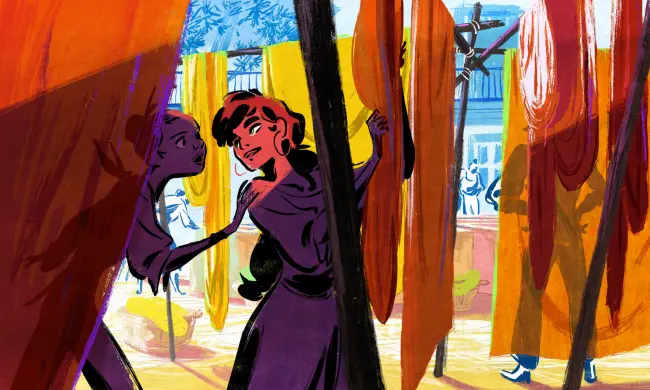
Feature-length animation has largely become a merciless and exacting thing, every frame invested with such a fortune’s worth of pre-determined purpose that there often isn’t any room left over for the audience to move around the images for themselves. These films used to implore our imaginations to fill the space between each cel, but the ones they make now are as seamless and inviting as the blades of a helicopter — watch from a safe distance, keep your hands to yourself, and try to enjoy the ride.
And then are the films of French animator Sébastien Laudenbach, whose expressionistic linework is so colorful and free that his characters look more like aura readings than people, and whose stories — even the darker ones — betray none of the burden that was required to bring them to life. His 2023 gem “Chicken for Linda!,” for example, was a modern-day musical adventure about a girl named Linda who really wants chicken for dinner. It rules.


A swooning and sketch-like distillation of Georges Bizet’s “Carmen,” Laudenbach’s new feature obviously takes on a slightly heavier subject than his previous work (including his 2016 debut “The Girl Without Hands,” which is about a girl without hands), but it retains the same blitheness of spirit. Like the director’s earlier films, it would almost seem to have been made on a whim if not for how self-possessed it feels in the telling, just as its characters — their thick black outlines filled with ever-changing swatches of color — would threaten to blend into the backgrounds if not for how clearly Laudenbach defines their feelings.
And the feelings are naturally intense in “Viva Carmen,” which shrinks Bizet’s opera down to a bite-sized snack that (older) kids should be able to follow and enjoy. The French-language film begins in Spain circa 1820, when Antonio, the blind knife-sharpener, returns to Seville to the great delight of local brigands and soldiers, whose blades have grown dull in his absence. He arrives with his sensitive tween apprentice Salvador (voiced by “Anatomy of a Fall” breakout Milo Machado-Graner) in tow, the boy coming home for the first time since he was a child. He doesn’t remember Carmen (voiced by Camélia Jordana), the beautiful Romani woman whose green eyes he spots in the darkness by a river one night, but perhaps he wasn’t so attuned to such things when he was a child.
Alas, whatever crush Salvatore may or may not be harboring for Carmen is soon eclipsed by a more urgent impulse, as Antonio — who can see the future of a knife as he sharpens it — discovers that a strapping young soldier named José will eventually stab Carmen with his dagger, a fate that his naive assistant inevitably sets into motion by trying to prevent it. And why not? José had never even met Carmen when the prophecy was foretold. But love is the only force more powerful than death, and woe to those who get in its way.
Like much of the story in this movie, the coup de foudre that sparks between Carmen and José is condensed to a degree that makes Bizet’s opera feel positively nuanced in its depiction of lust, but the speed at which things develop here — soundtracked by the jaunty clatter of castanets — reflects the velocity of the emotions at work, as well as the difficulty of holding onto hope in a world that feels like it’s careening towards disaster. Laudenbach and co-writer Santiago Otheguy also recognize that kids only have so much time for romance, and rewardingly choose to divert a large portion of the movie’s attention to a character named Belén instead, a street-tough Seville girl who serves as a bridge between the naivete of Salvatore’s fantasies and the unyielding reality of Carmen’s future (she’s also a total badass with a bolo, which “Viva Carmen” takes full advantage of during its few but fantastic action scenes).
Together, Salvatore and Belén sow a sweet friction into the film’s relationship between the dictums of fate and failure, especially as they allow “Viva Carmen” to emphasize how Seville’s community of lost children might respond to the bloodshed in their midst. The mishegoss between and Carmen and José still drives the plot of course, just as it shapes the story’s rhythm; Laudenbach uses it as an excuse to riff on Bizet’s “Habanera” in the first of the film’s two musical numbers, and later — in a scene crucial to this adaptation’s emphasis on female agency and the folly of impinging upon it — to stage a moonlit bonfire that unites Carmen’s friends in song, the animation distilling these women into pure feeling with a clarity that mocks the literalism of “Inside Out.” But the doomed lovers are largely relegated to the background here, as Laudenbach reframes the opera’s star-crossed romance for its impact on the kids who are forced to watch it unfold.
“Viva Carmen” is still packed to the gills with more plot than it can handle, but the film sings — sometimes literally — through its details. The shadows that flicker across the walls of a narrow alley as Belén fights off some witless soldiers. The way that Antonio’s carving stone turns the entire screen slate gray, the sparks from José’s knife popping off like shooting stars. The sunset that anachronistically melts into a Monet painting, pointing forward to the beauty that will survive the sadness to come.
“Fate is fate,” one character laments. “It sucks.” That may be the case, but the future will always remain unfinished in our own time, a fact that Laudenbach’s mutable animation — which appears to be unfinished itself, the colors always looking for cracks in the lines around them — more vividly brings to life than his film’s script ever could. For all of her well-earned cynicism, Belén will come to appreciate that past isn’t always prologue; that today’s failures don’t necessarily doom us to the tomorrow they seem to anticipate. “They say a person is never truly dead if you still think about them,” someone consoles her. And the same, this entrancing spindle of a movie suggests, might also be true of hope.
Grade: B+
“Viva Carmen” premiered at the 2026 Cannes Film Festival. It is currently seeking U.S. distribution.
Want to stay up to date on IndieWire’s film reviews and critical thoughts? Subscribe here to our newsletter In Review by David Ehrlich, in which our Chief Film Critic and Head Reviews Editor rounds up the best new reviews and streaming picks along with some exclusive musings — all only available to subscribers.
>

EXCLUSIVE: Indie publisher Spiegel & Grau has teamed with The Black List to bring its full catalog of frontlist and backlist fiction and nonfiction books to the platform’s material discovery database, enabling industry professionals to identify and explore published books for adaptation.
The partnership is The Black List’s first with an independent publisher.
Spiegel & Grau are best known for award-winning books such as Just Mercy by Bryan Stevenson and Piper Kerman’s Orange is the New Black and recent bestsellers Beartooth by Callan Wink, The Fire Agent by David Baerwald and Margaret Renkl’s The Comfort of Crows.
Film and television adaptations currently underway from the Spiegel & Grau catalogue include Culpability by Bruce Holsinger, under development; Everything/Nothing/Someone by Alice Carrière, under development with producer Lauri Firstenberg/IF Innovation Foundation; Go As A River by Shelley Read, under development with producers Paula Mazur and Mitchell Kaplan at Mazur Kaplan Company (The Guernsey Literary and Potato Peel Society, All The Bright Places), The Boys by Katie Hafner, under development with producers Ross Katz (In The Bedroom, Lost In Translation) and Jonathan Krauss; among others.
Popular, yet-to-be-adapted Spiegel & Grau catalogue on blcklst.com include Freyja by Margrét Ann Thors; Forest Euphoria by Patricia Ononiwu Kaishian; and Out of the Sky by Matti Friedman.
Using their free Black List industry accounts, professionals in the film, television, theater, and publishing industries can now search and browse titles from the Spiegel & Grau catalogue alongside the existing resources hosted on the platform. The integration expands access to published books (including fiction and nonfiction titles) as potential IP).
Spiegel & Grau books can be found via searching by title, author, genre and other associated book information available on blcklst.com. Metadata provided by Spiegel & Grau includes additional information such as a published book’s imprint, book cover art, book description, and more.
This initiative also makes it easier for Spiegel & Grau authors to list their published books in their Black List profile quickly and efficiently, according to S&G. When Spiegel & Grau authors add titles to their Black List profiles, key project fields will be pre-populated, reducing manual entry and ensuring accurate, consistent information across the platform.
Liza Wachter, Spiegel & Grau President and Director of Film and Television, said, “This partnership opens our catalog to the film and television industry in a new way. We’re proud to be the first independent publisher to partner with The Black List.”
“As a reader, I’ve been a fan of Spiegel & Grau for most of my adult life; it is a dream to be partnering with them on this initiative, The Black List’s second with a trade publisher, our first with an indie publisher. The Spiegel & Grau catalogue will be a great resource for TV/Film industry members searching IP for adaptation,” said Randy Winston, Creative Director of Fiction at The Black List.
>

EXCLUSIVE: Jim Taylor, the Academy Award and Golden Globe-winning screenwriter known for his longtime creative partnership with filmmaker Alexander Payne on a series of lauded, darkly comedic character studies, has inked with Paradigm for representation.
Payne and Taylor first collaborated on the Laura Dern-led indie satire Citizen Ruth, following that up with the Tom Perrotta adaptation Election, a dark comedy starring Matthew Broderick and Reese Witherspoon that brought them an Oscar nomination for Best Adapted Screenplay and scored Independent Spirit Awards wins for Picture, Director and Screenplay, bringing Witherspoon her first Golden Globe nomination.
Taylor and Payne won the Golden Globe for Best Screenplay for About Schmidt, an existential dramedy whose stars Nicholson and Kathy Bates earned Oscar nominations. Two years later, the duo won the Academy Award for Best Adapted Screenplay for Sideways, the celebrated wine country dramedy starring Paul Giamatti, Thomas Haden Church, Virginia Madsen and Sandra Oh, based on the 2004 novel by Rex Pickett. The film earned Academy Award nominations for Giamatti, Handen Church and Madsen for acting, as well as Payne for directing. In addition, Taylor and Payne won a BAFTA Award for Best Adapted Screenplay.
Outside of his collaboration with Payne, Taylor is known for his creative partnership with his wife, Oscar-nominated filmmaker Tamara Jenkins (The Savages). Together, they adapted the Nick Hornby novel Juliet, Naked into the 2018 film starring Rose Byrne and Ethan Hawke.
Taylor was a producer on Payne’s 2011 film The Descendants, starring George Clooney, which was nominated for five Oscars and won two Golden Globes. Together, they’re currently adapting an Election sequel, based on Perrotta’s 2022 novel Tracy Flick Can’t Win, for Paramount, with Hello Sunshine and Bona Fide producing.
Taylor continues to be represented by Untitled Entertainment and attorney John Diemer at Goodman, Genow, Schenkman.
>

Senator Thom Tillis expresses regret for voting for several Trump appointees in his new book, but “The View” host Ana Navarro wasn’t buying it on Monday morning. So, she called the North Carolina Republican out directly to his face.
Tillis stopped by the ABC talk show to promote said book, “How to Lose Friends and Antagonize Presidents: The Trouble with Sycophants, Courage Outsourcing, and Partisan Group Think.” During the interview, the hosts pressed him on multiple votes he’s made, including voting to confirm former Fox News host Pete Hegseth as Defense Secretary, which Tillis has openly expressed regret for.
“I like you, and I think you say a lot of of truth, but you kind of break my heart,” Navarro said bluntly. “And you do it — I feel you were very inconsistent in this book because, on the one hand, you go through all of the reasons why Hegseth was unqualified. You go through all of the reasons why [Kristi] Noem was unqualified. You kept calling her like an unqualified dog killer, and yet you voted for them.”

Tillis conceded as much, and added that both sentiments remain true. But that only upset Navarro further.
“Then you regretted the Hegseth vote, but you just voted to confirm Todd Blanche who, you in the book, say you objected to the bogus investigation he reopened on James Comey and his involvement in a reparations fund for the January 6th people,” she continued. “So you know you’re voting for people who are rubber stamped and unqualified, but you keep doing it, Thom!”
Tillis doubled down in his support of Blanche in response, defending it in part by saying “in politics, you’ve got to play the hand that’s dealt you.” Tillis insisted that, based on Blanche’s experience, the man is the best fit “to try and give the president honest upward feedback.” Navarro didn’t buy that either.
“Oh come on! He doesn’t even want to look at — there’s nothing to look at when a Russian oligarch just paid for Donald Trump Jr.’s wedding,” she shot back. “And he’s saying there’s nothing here to see. So he’s not giving Donald Trump any pushback.”
“The View” airs weekdays at 11 a.m. ET on ABC.

>

Spiegel & Grau’s Catalogue Now Available On The Black List Platform
Bruins’ Fraser Minten, Mason Lohrei and the promise of upside

Screenwriter Jim Taylor Signs With Paradigm (EXCLUSIVE)
-

 movies5 months ago
Search For Canadian TV Actor Stewart McLean Now Homicide Investigation
-

 Fashion9 years ago
These ’90s fashion trends are making a comeback in 2017
-
Fashion9 years ago
According to Dior Couture, this taboo fashion accessory is back
-
Fashion9 years ago
Model Jocelyn Chew’s Instagram is the best vacation you’ve ever had
-
Fashion9 years ago
Emily Ratajkowski channels back-to-school style
-
Fashion9 years ago
9 Celebrities who have spoken out about being photoshopped
-

 Anime4 months ago
Rurouni Kenshin: Hokkaido Arc Manga Takes 1-Issue Break – News
-

 Anime3 months ago
HIDIVE to Stream English Dubs for The World Is Dancing, The Forsaken Saintess and Her Foodie Roadtrip in Another World, The Dangers in My Heart: The Movie Anime – News