
Tech
How This Former Roboticist’s Students Rebuilt ENIAC

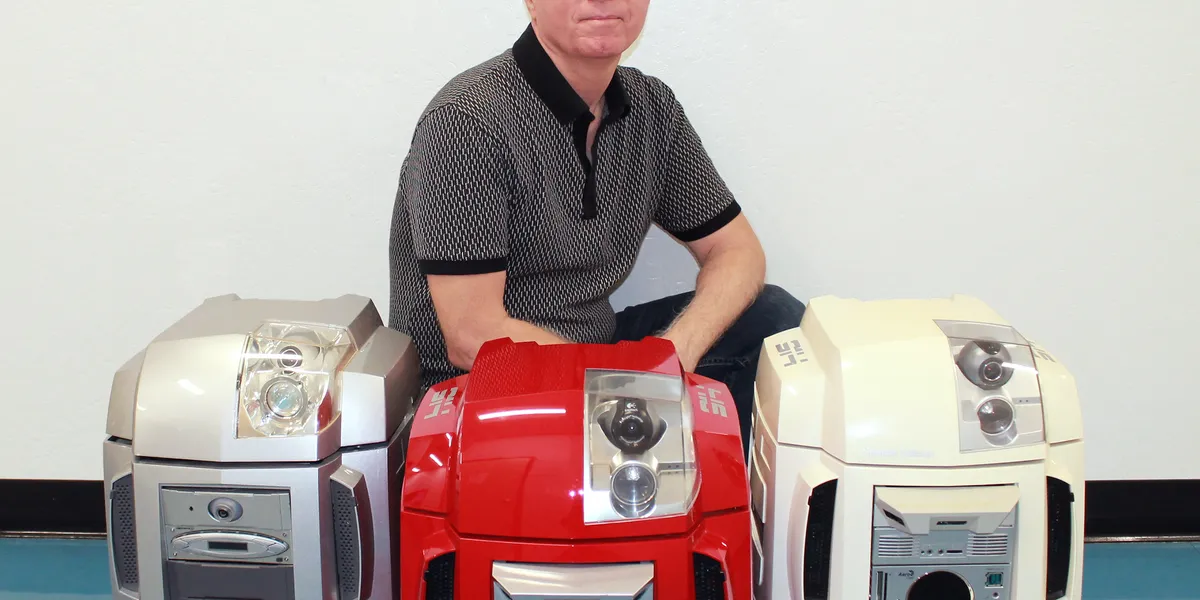
Tom Burick has always considered himself a builder. Over the years he’s designed robots, constructed a vintage teardrop trailer, and most recently, led a group of students in building a full-scale replica of a pivotal 1940s computer.
Burick is a technology instructor at PS Academy in Gilbert, Ariz., a middle and high school for students with autism and other specialized learning needs. At the start of the 2025–26 school year, he began a project with his students to build a full-scale replica of the Electronic Numerical Integrator and Computer, or ENIAC, for the 80th anniversary of the historic computer’s construction. ENIAC was one of the world’s first programmable electronic computers. When it was built, it was about one thousand times as fast as other machines.
Before becoming a teacher, Burick owned a robotics company for a decade in the 2000s. But when a financial downturn forced him to close the business, he turned to teaching. “I had so many amazing people help me when I was young [who] really gave me their time and resources, and really changed the trajectory of my life,” Burick says. “I thought I need to pay that forward.”
Becoming a Roboticist
As a young child in Latrobe, Pa., Burick watched the television show Lost in Space, which includes a robot character who protects the family. “He was the young boy’s best friend, and I was so captivated by that. I remember thinking to myself, I want that in my life. And that started that lifelong love affair with robotics and technology.”
He started building toy robots out of anything he could find, and in junior high school, he began adding electronics. “By early high school, I was building full-fledged autonomous, microprocessor-controlled machines,” he says. At age 15, he built a 150-pound steel firefighting robot, for which he won awards from IEEE and other organizations.
Burick kept building robots and reached out for help from local colleges and universities. He first got in touch with a student at Carnegie Mellon University, who invited him to visit campus. “My parents drove me down the next weekend, and he gave me a tour of the robotics lab. I was mesmerized. He sent me home with college textbooks and piles of metal and gears and wires,” Burick says. He would read the textbook a page at a time, reading it again and again until he felt he had an understanding of it. Then, to help fill gaps in his understanding, he got in touch with a robotics instructor at Saint Vincent College, in his hometown of Latrobe, who let him sit in on classes. Each of these adults, he says, “helped change the trajectory of my life.”
Toward the end of high school, Burick realized that college wouldn’t be the right environment for him. “I was drawn to real-world problem-solving rather than structured coursework and I chose to continue along that path,” he says. Additionally, Burick has dyscalculia, which makes traditional mathematics more challenging for him. “It pushed me to develop alternative methods of engineering.”
 The ENIAC replica Burick’s students built precisely matches what the original computer would have looked like before it was disassembled in the 1950s. Robert Gamboa
When he graduated, he worked in several tech jobs before starting his own company. In 2000, he opened a computer retail store and adjacent robotics business, White Box Robotics. The idea for the company came when Burick was building a “white box” PC from standard, off-the-shelf components, and realized there was no comparable product for robotics.
So, he started developing a modular, general-purpose platform that applied white box PC standards to mobile robots. “The robot’s chassis was like a box of Legos,” he says. You could click together two torsos to double its payload, switch out the drive system, or swap its head for a different set of sensors. He filed utility and design patents for the platform, called the 914 PC-Bot, and after merging with a Canadian defense robotics company called Frontline Robotics, started production. They sold about 200 robots in 17 countries, Burick says.
Then the 2008 financial crisis hit. White Box Robotics held on for a couple of years, shuttering in late 2010. “I got to live my life’s dream for 10 years,” he says. After closing White Box, “there was some soul searching” about what to do next. He recalled the impact his own mentors had, and decided to pay it forward by teaching.
Neurodiversity as a Superpower
In 2013, Burick started working in a vocational training program for young adults living with autism. The program didn’t have a technical arm, so he started one and ran it until 2019, when he was hired to be a technology instructor at PS Academy Arizona.
 Burick and one of his students assemble the base for one of ENIAC’s three portable function tables, which contained banks of switches that stored numerical constants. Bri Mason
Burick feels he can connect with his students, because he is also neurodivergent. Throughout his childhood, he was told what he wasn’t able to do because of his dyscalculia diagnosis. “People tell you what it takes, but they never tell you what it gives,” Burick says.
In adulthood, he realized that some of his strengths are linked to dyscalculia, too, like strong 3D spatial reasoning. “I have this CAD program that runs in my head 24 hours a day,” he says. “I think the reason I was successful in robotics, truly, was because of the dyscalculia…. To me, [it] has always been a superpower.”
Whenever his students say something disparaging about living with autism, he shares his own experience. “You need to have maybe just a bit more tenacity than others, because there are parts of it you do have to fight through, but you come through with gifts and strengths,” he tells them.
And Burick’s classes aim to play to those strengths. “I didn’t want my technology program to feel like craft hour,” he says. Instead, through projects like the ENIAC replica, students can leverage traits many of them share, like the abilities to hyperfocus and to precisely repeat tasks.
Recreating ENIAC
Burick has taught his students about ENIAC for several years. While reading about it, he learned that the massive, 27-tonne computer was dismantled and partially destroyed after being decommissioned in 1955. Although a few of ENIAC’s 40 original panels are on display at museums, “there was no hope of ever seeing it together again. We wanted to give the world that experience,” Burick says.
He and his students started by learning about ENIAC, and even Burick was surprised by how complex the 80-year-old computer was. They built a one-twelfth scale model to help the students better understand what it looked like. Seeing the students light up, Burick became confident in their ability to move onto the full-scale model, and he started ordering supplies.
ENIAC was composed of 40 large metal panels arranged in a U-shape that housed its many vacuum tubes, resistors, capacitors, and switches. Twenty of the panels were accumulators with the same design, so the students started with these, then worked through smaller groupings of panels. The repeating panels brought symmetry to ENIAC, Burick says, but it was also one of the main challenges of recreating it. If one part was slightly out of place, the next one would be too and the mistake would compound.
 The students installed 500 simulated vacuum tubes in each of the panels here, for a total of 18,000 vacuum tubes.Robert Gamboa
Once they constructed the panels, they added ENIAC’s three function tables, which stored numerical constants in banks of switches, then two punch-card machines. Finally, they installed 18,000 simulated vacuum tubes. In total, the project used nearly 300 square meters of thick-ream cardboard, 1,600 hot-glue-gun sticks, and 7 gallons of black paint.
The scale of the machine—and his students’ work—left Burick in awe. “By the time we were done, I felt like I was in a room full of scientists,” he says.
Previously, Burick’s students built an 8-foot-long drivable Tesla Cybertruck (“complete with a 400-watt stereo system and a subwoofer”) and he plans to keep the momentum with another recreation—maybe from the Apollo moon missions.
“I go to work every day, and I feel passionate about robotics [and] technology. I get to share that passion with the students,” Burick says. “I get to feel what it’s like to be in the position of the people that helped me. It closes that loop, and I find that really rewarding.”
From Your Site Articles
Related Articles Around the Web
>
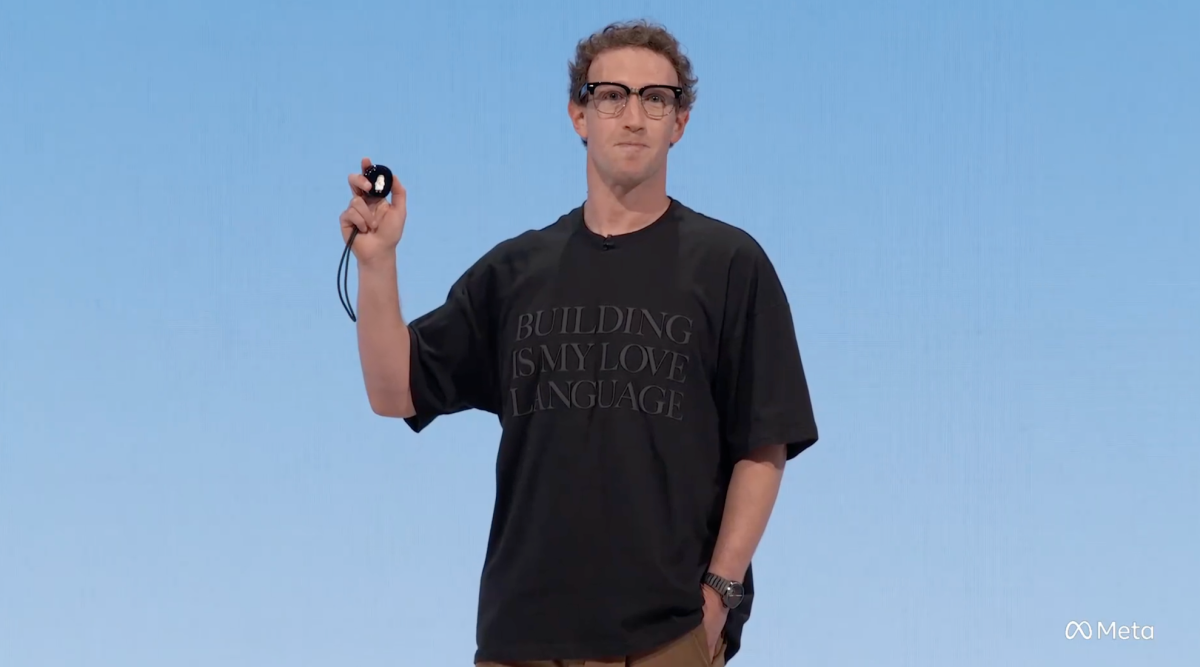
The AI amulet has become a bit of a cliché in the tech industry — devices like Friend have turned the idea of physical AI into little more than an exercise in eye-rolling for many consumers.
But that hasn’t stopped Meta from jumping into the arena with its own AI wearable, called Muse Charm, which is designed to give consumers another way to stay connected to its recently launched, and already popular, personal AI agent, Muse.
The device, which CEO Mark Zuckerberg revealed in a “one more thing” moment during the company’s annual Connect event, isn’t ready to ship just yet. Zuckerberg said his team had to “finalize laying out the components” and promised the devices would be “ready to ship in time for the holidays in December.”
The Muse agent, which is now embodied by a cute digital avatar known within the company as Jolly, lives inside the palm-sized totem that users can carry in their pockets or attach to a keychain. The device comes with a tiny screen that displays the avatar representing the agent. Users can talk to the device, which can then presumably carry out tasks on their behalf.
“We packed the whole Muse experience, including the whole real-time voice and avatar stack, into something that fits on a keychain and is always available to talk to,” Zuckerberg said during Wednesday’s keynote. “You just go ahead and tap here in the fingerprint sensor in the corner, and you can start talking without having to unlock a phone or open an app.”
Zuckerberg added: “So if you’re not wearing glasses, this is going to be by far the fastest way to talk to your Muse and to show what’s going on around you.”
Appropriate for what it offers, the gadget has a quasi-Tamagotchi feel to it — a lightweight, personality-filled device designed to keep users always connected to Meta’s software. It also feels like a relatviely low-stakes way for the social media giant to experiment with AI wearables while also offering yet another way to distribute its AI agent to the masses.
When you purchase through links in our articles, we may earn a small commission. This doesn’t affect our editorial independence.
>
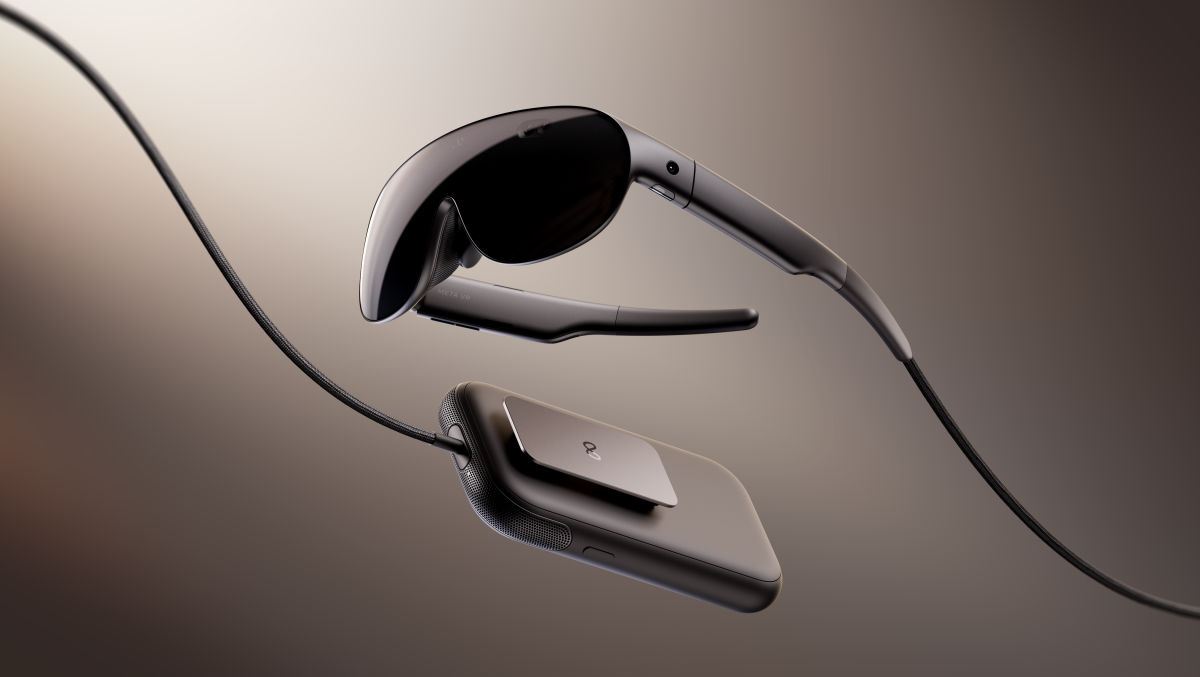
Meta is renewing its quest to make virtual reality a thing. At Connect on Wednesday, the company announced Meta VR Glasses, its newest entry into the VR market. These glasses actually seem quite promising given their substantially lighter form factor and a host of new entertainment integrations — including (allegedly) IMAX compatibility.
The company says that the glasses are five times lighter than the Meta Quest 3 — and they look much more like normal glasses than the bulky headsets that Meta previously released. Made of magnesium alloy, the glasses are powered by Qualcomm’s Snapdragon Reality Elite processor. They are powered by a computing puck, which also acts as their battery. Presumably, a user can just slip the puck into their pocket, which allows the glasses to be used on the go.
The glasses are largely entertainment-focused and come with micro-OLED panels built into the lenses, which provide a 5K Infinite Display with 37 pixels per degree, as well as Dolby Vision and support for Dolby Atmos audio. Users will be able to download and watch movies.
Perhaps one of the more unique features of the glasses, however, is that Meta is pitching them as a great way to enjoy IMAX-captured films.
Indeed, the company calls the glasses the “first IMAX Enhanced certified VR device ever.” What does that mean? Meta maintains that their glasses will be one of the only ways to experience the expanded aspect ratio that defines the distinct high-resolution viewing experience.
The glasses are also compatible with 3D experiences — and even movies that integrate a user’s physical space is integrated into their viewing experience. Meta says that it has teamed up with Disney and that, in November, Disney+ users will be able to stream specific movies — including certain Marvel movies — in 3D.
Meta says that users will be able to watch specific movies and have their surroundings “transformed with immersive environments, dynamic effects, stunning 3D visuals, and spatial audio” — essentially converting the movie into a VR gaming-type experience.
The glasses will also come with Meta AI — its automated virtual assistant — built in, which means that users will be able to talk to the glasses and automate various tasks via voice command. For instance, Meta says you’ll be able to start a movie just by asking your glasses to do so. Other ways to issue commands include hand gestures.
Meta says the glasses will be available next spring with a starting price of $1299.99.
When you purchase through links in our articles, we may earn a small commission. This doesn’t affect our editorial independence.
>
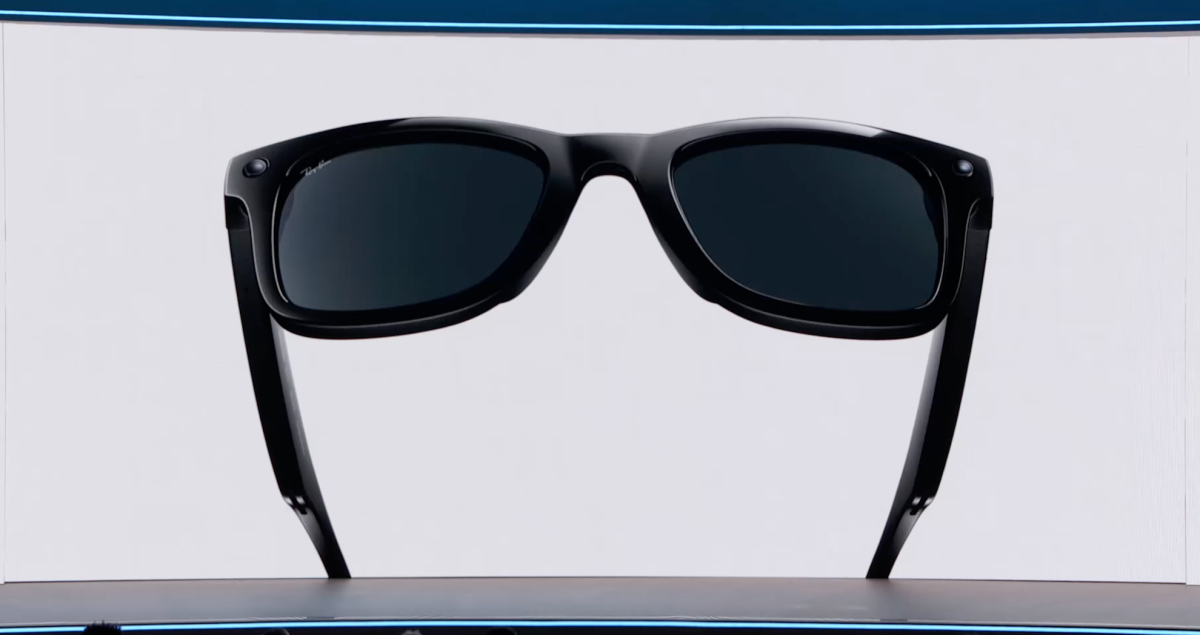
Confirming earlier reports, Meta announced its first pair of camera-free AI glasses, the clunkily named Ray-Ban Meta Audio, at its Connect 2026 conference on Wednesday. Designed to combat criticism around the more malicious use cases for AI glasses, which saw them nicknamed “pervert glasses” by some, the new devices will be audio-only, offering the ability to listen to music and podcasts, take calls, translate speech, and communicate with Meta’s AI assistant, Muse.
The glasses are designed by Meta’s partner in its AI hardware efforts, EssilorLuxottica, and will start at $349.
While Meta today offers a range of AI glasses in a variety of styles, colors, and capabilities, the audio-only glasses could help the brand recover from some of the reputational damage after critics pointed out how people, often men, were using AI glasses to record videos without subjects’ consent. Meta attempted to mitigate this issue with an update that would disable the camera if the LED light that indicated the glasses were recording was ever tampered with. However, the creepiness factor remained.
This latest device could prove to be more popular for that reason, while also providing an answer to something like Apple’s Siri-powered AirPods.
“Once you get used to high quality audio, it’s just a thing that you want all the time, right?” Meta CEO Mark Zuckerberg said during a keynote Wednesday, adding that the company after working on the idea realized it could design a whole new category of glasses around audio glasses.

Because they don’t have to house cameras, the glasses are slimmer than Meta’s other models and weigh only 43 grams. They also have adjustable temple tips, swappable nose pads, overextension hinges, and battery life of up to 12 hours on a single charge, Meta claims. With the included charging case, that battery life extends to up to 48 hours.
They’ll also come in a variety of colors and options — 23 color and lens combinations in total — and in two new styles, a retro-inspired “Clubmaster” Ray-Ban style and “Burbank,” described as more of a “classic, timeless, rectangle shape.” Like other Meta glasses, you can order them with your optical prescription as well, if needed.
The glasses will be available for preorder on October 13, the company noted.
Alongside the glasses, Meta announced its next-generation AI glasses (the ones with cameras), the Ray-Ban Meta (Gen 3). In addition to the Ray-Ban Meta Wayfarer, there will also be two new styles, the Aviator and Zena — the latter offering more of a cat-eye frame shape. These will have a 12 MP camera that supports 3K Ultra HD video, a six-mic array, and up to nine hours of battery life.
The glasses Meta launched with EssilorLuxottica will also see an expanded lineup of styles and colors as well as a new partnership with singer Lisa, which follows the company’s earlier brand partnership with Kylie Jenner. The glasses will also be roll out to more countries globally, Meta said.
All of Meta’s AI glasses will, of course, feature access to its newer personal AI assistant, Muse.
The company also teased other coming updates, including support for Dolby Atmos Capture, a feature that picks the best photo from multiple frames, an option to choose landscape or portrait modes, hearing enhancements for those with hearing loss, more detailed responses, different audio modes, customizable controls, and something called “private processing” that Meta claims will prevent the company from seeing your data.
When you purchase through links in our articles, we may earn a small commission. This doesn’t affect our editorial independence.
>

Players Championship 30: Karel Sedlacek wins first PDC Pro Tour title as furious Scott Williams throws darts on the ground after loss | Darts News

Meta made a Tamagotchi-like wearable for its Muse AI agent
Red Sox CF Ceddanne Rafaela exits first game back from IL with hamstring tightness
-

 movies4 months ago
Search For Canadian TV Actor Stewart McLean Now Homicide Investigation
-

 Fashion9 years ago
These ’90s fashion trends are making a comeback in 2017
-
Fashion9 years ago
According to Dior Couture, this taboo fashion accessory is back
-
Fashion9 years ago
Model Jocelyn Chew’s Instagram is the best vacation you’ve ever had
-
Fashion9 years ago
Emily Ratajkowski channels back-to-school style
-
Fashion9 years ago
9 Celebrities who have spoken out about being photoshopped
-

 Anime4 months ago
Rurouni Kenshin: Hokkaido Arc Manga Takes 1-Issue Break – News
-

 Anime3 months ago
HIDIVE to Stream English Dubs for The World Is Dancing, The Forsaken Saintess and Her Foodie Roadtrip in Another World, The Dangers in My Heart: The Movie Anime – News