

Entertainment
WGA Members Ratify New 4-Year Deal with Film and TV Studios


Writers Guild of America members with both the West and East branches of the guild have ratified a new contract with the film and TV studios via the Alliance of Motion Picture and Television Producers (AMPTP), the guild announced on Friday.
Over 90 percent of voting members voted in favor of the new deal, and 9.62 percent voted against it. This new deal will now be in place for four years instead of three, which was a priority for the studios, and it is effective between May 2, 2026 through May 1, 2030.
“In the face of industry contraction and runaway healthcare cost inflation, writers were able to secure a contract that returns our Health Fund to a sustainable path and builds on gains from the 2023 strike,” said WGAW President Michele Mulroney. “We could not have achieved that without a thoughtful negotiating committee led by co-chairs Danielle Sanchez-Witzel and John August, the WGAW Board and WGAE Council, and our professional WGA staff. We thank all writers who supported us during the process.”


After quickly reaching a deal earlier this month, which came as a surprise for a guild that is usually more hard-lined in negotiations, guild leadership revealed terms in which the studios would contribute a projected $280 million to the union’s health plan over the four years, which was in a dire place heading into negotiations. Among some of the other new improvements in this contract were raises to the minimum wages of 10.5 percent, better residuals, and an increase in the bonus given to writers on the top performing streaming shows. Additionally, writers won new protections for “page-one” rewrites that gives writers flexibility to explore other writing opportunities while waiting for a show to get picked up, and it expands protections for writers against having to do free work. And while there were no significant improvements for compensation for artificial intelligence, the new guild codified the prior wins made in 2023.
“Now, our Guilds will turn to the core work of enforcing the MBA and ensuring writers are paid properly for our work, as we monitor the industry trends around streaming and AI,” said WGAE President Tom Fontana. “It’s our constant engagement and vigilance between negotiations that make our unions strong.”
“The AMPTP congratulates the WGA on the ratification of its new contract, which includes historic investments in the writers’ health plan, meaningful improvements in residuals and wages, and important safeguards for their work. This deal reflects a collaborative approach that supports both writers and the industry’s long-term stability. We look forward to building on this progress to reach fair agreements with SAG-AFTRA and the DGA that support greater certainty while fostering opportunity across the industry.”
With the writers out of the way, SAG-AFTRA will resume its negotiations on Monday after having started talks back in February. The Directors Guild will then begin talks later in May.
>
Continue Reading
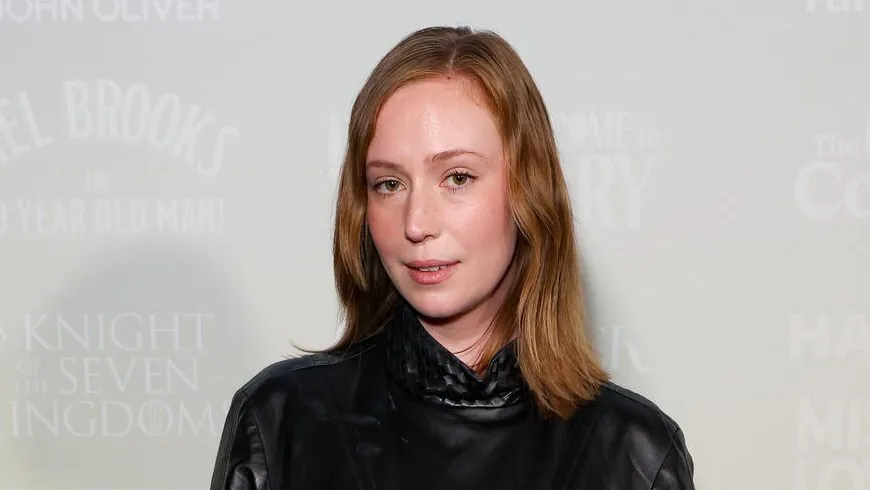
Following her arrest at a demonstration outside the United Nations General Assembly, Hannah Einbinder doesn’t want her message to get lost in the headlines.
On Thursday, the 4x Golden Globe nominee urged the United States government to “bring an end” to Israel’s attacks on Gaza after she was detained for protesting Prime Minister Benjamin Netanyahu‘s arrival at the U.N. building.
“If the pictures of my friends and me getting arrested in protest of Netanyahu’s shameful visit to New York draw attention to anything, let it be to the devastating genocidal war Israel is waging against the people of Palestine and Southern Lebanon-to the settler attacks, the home demolitions, the bombing of people as they sleep; to the crimes that happen every SINGLE day but garner almost no international press coverage,” she began in a statement on her Instagram Story.
“The US government has the power to bring an end to all of this killing, pillaging, and land theft, yet instead it chooses to welcome the butcher of Gaza with open arms. The fact that the orchestrator of all this bloodshed is roaming freely in our cities is an indictment of BOTH REPUBLICANS AND DEMOCRATS who enable and protect architects of genocide like Netanyahu,” Einbinder continued. “Let us not mistake the spectacle for the story: genocide is the headline, and it is time for it to end.”
Einbinder and Susan Sarandon were among as many as 100 anti-war protesters who were detained while blocking Bibi’s entrance to the U.N. building, where he spoke with global leaders at the U.N. General Assembly.
Also present at the demonstration were Cynthia Nixon, Elliot Page, Chelsea Manning, Sarah Sherman, Mary Beth Barone, Indya Moore and Caleb Hearon, protesting Netanyahu and the ongoing strikes on Gaza in the Israel-Hamas conflict.
“Free, free Palestine! Stop the genocide!” protesters chanted at the demonstration organized by the Jewish Voice for Peace, as well as, “Netanyahu, you can’t hide! We charge you with genocide!”
>
Was Ted Kaczynski crazy? It seems like you’d have to be to start mailing bombs across the United States, murdering three and injuring nearly two dozen more in a terror campaign that spanned decades. Of course, the Unabomber, as he’d come to be known, never accepted the characterization that he was mentally ill. That’s important background going into Netflix’s new biopic: a troubled true crime account that’s often insightful but also dangerously simplistic.
Jacob Tremblay, now 19 years old and ages away from his breakout role as the son of a kidnapping victim in “Room,” is the real draw here. But casting Russell Crowe as Dr. Henry Murray, a controversial professor at Harvard when Kaczynski was an undergrad, recalls “A Beautiful Mind” with a purpose. Both Ron Howard’s Best Picture winner from 2001 and director Janus Metz Pedersen’s latest effort examine the inner lives of extraordinarily intelligent men.


But “Unabomber” goes further, inventing a diagnosis for Kaczynski inside Murray’s experiment and turning a seriously disputed question into a tidy answer that doesn’t fit the known facts.
Squeezing the wildly complicated life of a truly frightening man who wanted to dismantle industrial society into a Netflix-ready origin story is ironic enough. And fabricating his medical history is almost amusingly reckless. Crowe’s “A Beautiful Mind,” in which he portrayed mathematician John Nash, was heavily fictionalized and, at times, pretty ridiculous, too. Critically, however, it was based on a thoroughly documented schizophrenia diagnosis.
Kaczynski, on the other hand, spoke to several clinicians after his 1996 arrest and rejected their conclusions that he had the same condition, maintaining his sanity even when mental health evidence might have helped him avoid the death penalty. Other experts disputed schizophrenia as the right diagnosis, suggesting his symptoms were better explained by a personality disorder. His ideas have continued to find an audience, a fact the movie seems unsure how to handle alongside his capacity for calculated violence.
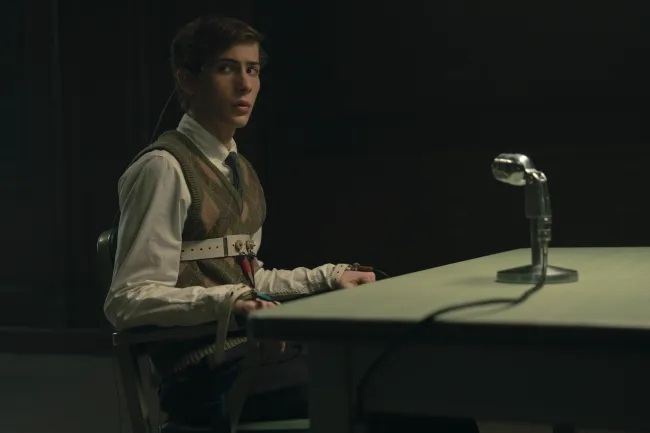
Kaczynski’s intellect brought him to Harvard, where Murray’s researchers recruited him for a study that commands most of “Unabomber’s” tortured narrative attention. Participants wrote statements of their beliefs and were subjected to a filmed confrontation in which those values came under personal attack. Kaczynski was selected in part for his score on a questionnaire measuring alienation, not because anyone had identified him as a budding radical thinker.
Obviously, when you’re dealing with a politically motivated murderer, that’s a lot to dramatize. But Tremblay proves an extraordinary fit for the slippery material, delivering monologue after monologue about abstract concepts with the blood-boiling conviction of a prodigy who, even suffering manufactured duress, is convinced he is fundamentally right. Crowe, watching from behind one-way glass and turning up in encounters beyond the study itself, gives that intensity a perfectly legible antagonist. The betrayal Murray inflicts on Tremblay’s Kaczynski is reasonably compelling, even as the film presses it into service as an explanation for everything that follows.
While “Unabomber” never quite decides whether Ted is crazy, it has much less trouble showing Murray do things that are plainly wrong. As a tender-hearted researcher, Annabelle Wallis, offers Tremblay a tender shoulder to cry on — but her sympathy is so enveloping that it becomes easier to see Kacyznski as a boy steered disastrously off course. Those scenes work emotionally; they also make the movie’s moral arithmetic suspicious. The more harm we watch the adults do to Ted, the less room the story leaves for what he chose to do to others.
In real life, there is no verified record that Murray’s team diagnosed Kaczynski with schizophrenia, much less told him so at Harvard. The “Unabomber” script nevertheless keeps trying to connect the study to its FBI procedural, anchored by a strong showing from Shailene Woodley. Co-writers Sam Chalsen and Nelson Greaves use Kaczynski’s beliefs to bridge the timelines, drawing a clear line from a student defending his worldview to a terrorist demanding an audience for it.
In life, it was Kaczynski’s writing that helped bring the manhunt to an end. His last bomb killed California forestry official Gilbert Murray (no relation to the Harvard psychologist) in April 1995. He then threatened to kill again unless a major newspaper printed his roughly 35,000-word manifesto, “Industrial Society and Its Future.” The Washington Post published it that September in an eight-page insert, with the New York Times sharing the decision and the cost. Kaczynski’s sister-in-law recognized his ideas and his brother compared the manifesto with Ted’s earlier writing and alerted investigators.
The philosophical fingerprints that helped identify him are fascinating on their own, but “Unabomber” uses them to imply that the Harvard experiment explains what he became.
His writing also outlived his arrest. After the 2017 Discovery series “Manhunt: Unabomber” brought the case back to television, Kaczynski’s anti-technology ideas found a new audience online, including young people who had discovered him through the show and its circulation on Netflix. They had reason to recognize parts of his critique: technology can erode privacy, concentrate power, damage the environment, and leave people feeling less in control of their lives. None of those observations makes his proposed destruction of industrial society wise, or his murders anything other than murders. But pretending the observations are incomprehensible gives the film an easier problem to solve than the one its subject actually presents.
That’s what makes the closing credits so strange. Over real images and audio of Kaczynski, the film lets him speak about people treating him as a cult figure. He says he would prefer to be depicted truthfully, though he is willing to become a symbol if it advances his cause. He was hardly an impartial judge of his own life, and his stated willingness to serve a revolutionary movement is chilling. Still, after using his voice to close the movie, “Unabomber” leaves its own invention about his diagnosis standing. The question of Kaczynski’s mental health remains a matter of historical and clinical dispute. This film makes it look settled precisely where the record does not.
Grade: C+
Netflix’s “Unabomber” begins streaming on September 24.
>

While Netflix has Ryan Murphy busy investigating (or flat-out making up) the motives of killers like Jeffery Dahmer, the Menendez Brothers and Lizzie Borden, the streamer has enlisted director Janus Metz to tell the story of Ted Kaczynski, the math prodigy turned reclusive murderer known as the Unabomber — also the movie’s title. But Unabomber, written by Sam Chalsen and Nelson Greaves, is not some sweeping birth-to-death survey of Kaczynski’s life. It instead focuses on a young Kaczynski’s time at Harvard University, where he participated in a brutal psychological study that, in the movie’s framing, may have helped form the anarchic worldview that eventually led to his infamous deeds.
Never mind that Kaczynski himself has said that the study, conducted by psychology professor and sometime government operative Henry Murray, didn’t have much effect on his life. Unabomber presupposes that it did, that Murray’s cruel (and later condemned) experiment in breaking down the philosophical principles of test subjects, stoked a rage — at academia, at technology, at universities — so fierce that Kaczynski later decided to enact his revenge. Perhaps not figuring that argument compelling enough on its own, the film tacks on a 1990s-set plot covering the days leading up to Kaczynski’s capture in Montana.
Unabomber
The Bottom Line
A faint sketch of a killer as a young man.
Release date: Friday, Sept. 25
Cast: Russell Crowe, Jacob Tremblay, Shailene Woodley, Annabelle Wallis, Gus Halper
Director: Janus Metz
Screenwriters: Sam Chalsen, Nelson Greaves
Rated R,
1 hour 37 minutes
Both narratives concern people prying into Kaczynski’s psyche and finding only further questions. In the 1950s, in the hallowed, lacquered-wood halls of Harvard, we watch a perspicacious boy genius — Kacyznski was all of 16 when he started college — as his intellect, his curiosity and his naiveté are weaponized against him, hardening his most radical beliefs into ideology. In the 1990s section, we observe relative lay people as they try to divine specific clues from Kaczynski’s manifesto, markers that might give away something crucial.
These twin analyses are both facile and unenlightening. The investigation arc is so boilerplate that it has an FBI agent placing a pile of documents on her desk and saying to them, “Talk to me.” The 1950s portion of the film is at least able to conjure up some mid-century moodiness, skulking around in the nervous temper of early Cold War days, as academia colluded with government agencies to buttress the country against the perceived Soviet threat. (At its best, the film calls to mind Robert De Niro’s unfairly maligned CIA origin story The Good Shepherd, which begins its postwar tale on the leafy quads of Yale.)
And yet, the ultimate conclusions of that half of the film are just as unpersuasive as everything that happens 40 years later. That’s largely owed to starchy, frequently clichéd writing. But sadly one must put some of the blame on the actor playing Kaczynski, Jacob Tremblay, who long ago escaped the confines of Room and now, at 19, has found himself in this dark mess.
His clean-cut boyish features do actually resemble Kaczynski at that age, but Tremblay otherwise has trouble evoking the volatile storms of Kaczynski’s mind. His voice cracking and eyes wide with alarm, Tremblay effectively communicates Kaczynski’s youth, but it all plays as bratty and insouciant rather than registering as the beginnings of true menace. Tremblay was a better fit for his other recent film about extremism, 2025’s Sovereign, in which his guilelessness served a more poignant purpose.
As Murray, Russell Crowe has dusted off his A Beautiful Mind professorial duds and phones in a performance of avuncular appeal masking sinister motives. We believe that Murray cares, in some way, for Kazcynski — or, at least, that he’s impressed by the student’s prowess — but not enough to stop his predatory work.
The portraiture is not very detailed beyond that. Part of the problem may be that, for the bulk of the experimentation, Murray is out of the room. Kaczynski is instead sparring with a fellow student, a haughty older boy played by the reliable Gus Halper, who did towering work as another collegiate monster in the under-seen 2016 frat-hazing thriller Goat. Had Tremblay and Crowe been given more opportunity to go toe to toe, something in the picture might have caught flame.
Instead, Unabomber trudges through its motions, toggling between grim school daze and a tediously generic FBI manhunt. In the latter part, Shailene Woodley does her best to give some texture to her rogue agent character, Joanne, but she has precious little to work with.
Perhaps cognizant of that, the filmmakers give Joanne a brief, humanizing button at the end of the film, a moment of solitude in which she has a cathartic cry as she processes all that she’s just experienced. The scene might register as thoughtful were it not such a blatant rip-off of the closing seconds of Zero Dark Thirty, in which a dogged investigator who’s finally caught her prey sheds tears of relief and exhaustion and something more ineffable. It doesn’t pack the same punch the second time around, and at the end of something so bland.
Watching Unabomber, one longs for a smarter, more sophisticated, more probing version of this same double-act. A better film about what might have radicalized Ted Kaczynski that also delineates how he was eventually captured could be startling and revealing, complicating the public idea of Kaczynski as mere renegade madman. But this film serves up only the most basic, obvious version of that — try as it might, at times, to immerse us in murky psychological depths. In the end, it has all the markings of a final paper written by a student who got all the dates right, but failed to find the real meaning behind any of the history.
>
Sports1 minute ago
Lakers' new core? JJ Redick calls Walker Kessler 'perfect fit' for Luka Dončić, Austin Reaves

movies5 minutes ago
Hannah Einbinder Speaks Out After Arrest Outside U.N.
Sports7 minutes ago
Flyers' Trevor Zegras penalized for 'improperly wearing equipment'
-

 movies4 months ago
Search For Canadian TV Actor Stewart McLean Now Homicide Investigation
-

 Fashion9 years ago
These ’90s fashion trends are making a comeback in 2017
-
Fashion9 years ago
According to Dior Couture, this taboo fashion accessory is back
-
Fashion9 years ago
Model Jocelyn Chew’s Instagram is the best vacation you’ve ever had
-
Fashion9 years ago
Emily Ratajkowski channels back-to-school style
-
Fashion9 years ago
9 Celebrities who have spoken out about being photoshopped
-

 Anime4 months ago
Rurouni Kenshin: Hokkaido Arc Manga Takes 1-Issue Break – News
-

 Anime3 months ago
HIDIVE to Stream English Dubs for The World Is Dancing, The Forsaken Saintess and Her Foodie Roadtrip in Another World, The Dangers in My Heart: The Movie Anime – News