
Anime
Welcome to Demon School! Iruma-kun Volumes 17-20 Manga Review – Review


Sharp-eyed readers (and anime viewers) already knew that there was a thirteenth student in the Misfit Class. It makes sense even if you didn’t spot the sleepy-eyed, bob-haired demon in the background: everything important in this series plays with the numbers thirteen or 666, so why would the most significant class at school have only an even twelve students? But most of the misfits themselves never even considered that there’d be a thirteenth member of the class, and that’s just how Soi Purson wants it. Or at least, that’s how his parents want it and how he’s been used to it being for most of his life.
Creator Osamu Nishi is practically giddy when she discusses Purson in her afterwords, and I have to admit that that’s half the fun of his inclusion. She’s clearly been planning for this for a long time, and seeing it finally come to fruition nearly twenty volumes in has to be exciting. But even without Nishi’s delight, Purson is a great addition to the cast. Now that we know that neither Allocer nor Keroli are actually shy and retiring, that is a slot that’s been empty amongst the many personalities hanging out in Royal One. But more importantly than checking that off the list, Purson’s a remarkably relatable character in a few different ways.
The one that speaks to me personally is that he’s the kid everyone forgets is part of the class. While the Purson family wants it that way – they’re masters of invisibility and detection evasion – Soi himself is less happy with it. If you’ve ever been the person someone suddenly turns to and asks, “How long have you been in this class?” when the answer is “since the beginning,” you’ll understand Purson’s feelings. On the one hand, being invisible is safe. But on the other, it’s very isolating, and even if you have some social anxiety, which Purson appears to at first, it can be incredibly lonely…but also scary when the spotlight suddenly shifts to you. Purson genuinely does want to be part of the group, at least in a way that’s comfortable for him, but he can’t handle everyone’s focus on him, and not just because it goes against everything his parents have ever taught him about being a Purson.
That internal conflict is another piece of what makes Soi Purson such a good character. He wants to be himself, which in large part means pursuing music, something he’s good at and enjoys. But musicians are performers, and performing means stepping out of the shadows, which he’s been told is the one thing he cannot aspire to. While the Music Festival itself is a major piece of the storyline here, for Purson it’s the backdrop for his argument with his father, who would rather see him drop out of school than participate. Once again, it’s something very relatable for many people: the first moment you realize that who you want to be and who your parents want you to be isn’t the same person.
The class’ performance of demonic standby “Lilith’s Carpet” is a major piece of this. (If any manga-onlies are reading, do yourself a favor and watch season four, episode seven to see the musical come to life.) Yes, in part that’s because Purson is one of the centerpieces as the lead musician, but it’s also in the way the misfits choose to interpret the story. According to Kalego, “Lilith’s Carpet” is about a beautiful she-demon who delights in seducing all the men who pursue her, reveling in her power. But Iruma and Purson read the tale differently. They choose to view Lilith not through Kalego’s male gaze, but as her own person. Lilith isn’t enjoying her power over men; she’s trying to cope with attention that she never asked for. Not only does this reading of the character empower Elizabetta-as-Lilith, firmly establishing her as Elizabetta rather than “a succubus” or “the sexy one,” it also allows Purson to express himself through his trumpet. Just as Lilith wants to take charge of her own life, Purson wants to find a way to be a musician and a member of his family. It’s not about how other people see him. It’s about finding a way to see himself.
Although Elizabetta doesn’t get nearly as much development as most of the other misfits, it’s important that her Lilith isn’t just an object of desire. Yes, the boys in class are attracted to her because of her physical beauty, but if you look back through the books, it’s her kindness and gentle heart that they’re really drawn to. Iruma’s greatest influence on his classmates is to see them as more than the sum of their parts – Asmodeus isn’t just powerful and snooty; he’s awkward and caring; Clara’s not just bouncy; she’s a full person with feelings – feelings that Azz inadvertently hurts, and it’s thanks to their friendship with Iruma that they can work that out. Iruma’s steadfast belief in his friends may not always look like the typical shounen “friendship is power” dynamic, but it’s central to the series nonetheless.
While the Music Festival takes up the bulk of these volumes, Nishi still takes the time to set up for what’s to come. Asmodeus, fresh off his lessons with Balam, sees Kiriwo with new, more penetrating eyes, and Poro-chan is almost certainly going to be a more serious problem than being a campy gay stereotype. For as silly as this series can get, it has a core that’s not goofy at all, and the more people who learn that Iruma isn’t a demon at all, the more dangerous the netherworld risks becoming for him.
>

©Satsuki Nakamura, Ichijinsha / Inept Villainess Project
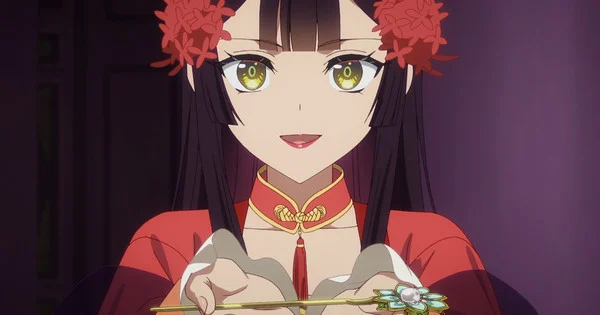
Lady Macbeth said it best: “look like th’ innocent flower,/But be the serpent under’t.” In this episode, Reirin proves that she’s no mere Pollyanna, the adorable heroine of Eleanor H. Porter‘s early 20th-century series; she’s Capitola from Mrs. E.D.E.N. Southworth’s 1859 novel The Hidden Hand. This is a young woman who knows how to survive, and given the tools of a healthy body and a terrible reputation, she’s ready to bite the unwary hand that reaches for her. She’s not going to play the Mean Girl Game the way Seika is; she’s going to catch her flies with honey and drown them.
It’s how Reirin has survived for so long – everyone believes that she’s as sweet as can be. They don’t realize the strength it’s taken her to present herself that way as her body fails her and she struggles to find ways to survive her chronic illness. She’s never been a fool, and now in Keigetsu’s body, she’s got the chance to show the steel that’s always been there. It’s not that her moves now are any less considered than they were before; it’s that she no longer has to fear collapse from standing up for herself and LeeLee. Even the crown prince has to admit that she’s remarkably alluring and attractive—the sweetness he admired in Reirin tempered with the physical abilities of Keigetsu is both confusing and attractive—emphasis, for him, on the “confusing” bit.
Keigetsu’s tarnished reputation is a major boon to Reirin at the Ghost Festival. Not only does it allow her to perform the Sogdian Whirl—an actual ancient Chinese dance based on one performed by Sogdian (a kingdom in the ancient Middle East, where Tajikistan, Uzbekistan, and other countries now are) – but to stand firm against Seika machinations. Is she behaving abominably rudely by court standards? Yes, she is. But she’s no worse than Seika herself, and by pointing out what she ought to pretend not to hear (like the Kin ladies twittering nastily), she’s forcing the prince and the rest of the court to recognize Seika’s failings as well. The Mean Girl Game of the Inner Court is meant to be played with snark and subtlety; Reirin is refusing to do that anymore.
It’s honestly amazing to watch her in action. (And to see Shin-U attempting to contain his laughter. Forget the prince, girl, go for the guard!) In terms of the visuals of the episode, Reirin’s dance stands out among the other, more staid, performances of the other Maidens with its vibrancy and mix of sharp, focused movements and large, whirling gestures. It’s breathtaking, and I have to applaud the animators for their attention to detail here. Effective choreography often relies upon where the dancers guide our focus on their bodies. Reirin’s tight hand gestures pull us in before her swooping arms and legs force our focus outward to her entire body and the space it occupies. Not only is it beautiful, but it’s also symbolic of Reirin’s new lease on life. Before, she was only those small hand movements, but now in Keigetsu’s strong body, she is at last allowed to take up space.
That’s a gift Keigetsu never realized she had. Or maybe she knew, but didn’t want it – her sobs with the prince may indicate both her pain in her new, ill body, but also that she now can cry and have someone notice and feel sympathy. The space she took up before was emotionally painful, something she was consistently punished for. Reirin wanted out, but like a cat on the wrong side of a door, Keigetsu wanted in. Nothing about her life brought her joy, and while Reirin might have been content, I don’t think we could say that she was happy.
There’s still a lot of work to be done. The court lady who gave LeeLee the hairpin apparently doesn’t exist, which means that someone’s making particularly nasty moves in the game, trying to frame the Kin ladies for something someone else is doing. Reirin is certainly not going to let that slide, and we’ve already seen that she’s not going to listen to the wishy-washy Shu consort. The other ladies had better watch out, because Reirin is now ready to take her space.
Rating:
Though I Am an Inept Villainess is currently streaming on
Crunchyroll.
The views and opinions expressed in this article are solely those of the author(s) and do not necessarily represent the views of Anime News Network, its employees, owners, or sponsors.
>

Terasawa voices Koyuki Inari in 6th episode on Wednesday
NBC Universal revealed a new cast member for the television anime of Otsuji‘s My Stepmother and Stepsisters Aren’t Wicked (Ibitte Konai Gibo to Gishi) manga (the Japanese manga and anime write the English title as: My mother-in-law and sister-in-law who don’t bully me.) on Monday. Momoka Terasawa will voice Koyuki Inari, the eldest daughter of the Inari family who becomes Miya’s friend, in the anime’s sixth episode on Wednesday.

©おつじ・一迅社/「いびってこない義母と義姉」製作委員会

©おつじ・一迅社/「いびってこない義母と義姉」製作委員会
The anime debuted on July 8 at 11:30 p.m. on TV Kanagawa, TV Saitama, and Chiba TV. The show also airs on MBS, Tokyo MX, and BS Asahi. The show started streaming on U-NEXT, Anime Hōdai, and Anime Times first in Japan starting on July 8, before streaming on other services a week later. REMOW‘s “It’s Anime” free anime YouTube channel is streaming the series.
The anime stars:
Keisuke Inoue (My Next Life as a Villainess: All Routes Lead to Doom!, Ao-chan Can’t Study!, Level 1 Demon Lord and One Room Hero) is directing the anime at NEWON. Nanami Hoshino (Hokkaido Gals Are Super Adorable!, Mission: Yozakura Family episode scripts) is in charge of series scripts, and Mutsumi Sasaki (Chaos;HEAd, Laid-Back Camp, Phantom ~Requiem for the Phantom~) is designing the characters and is also the chief animation director.
Lia performs the opening theme song “Amayadori no Shōkei” (Longing to Take Shelter From the Rain), and AVAM performs the ending theme song “Claire.”
Seven Seas publishes the manga in English and describes the story:
Fairy tale tropes are turned on their heads in this award-winning and comedic reimagining of the classic Cinderella story!
Miya is the illegitimate child of a prominent family. When her mother dies and her father’s estate agrees to take her in, she’s convinced she knows what awaits her in her new home: a life of servitude and misery at the hands of her wicked stepmother and stepsisters. Yet when she finally meets the women she expects to treat her like dirt, they actually end up being…sweet?! A hilarious and heartfelt comedy that’s sure to put a smile on your face!
The manga launched on Ichijinsha‘s Comic POOL digital manga magazine in November 2020. Ichijinsha will publish the manga’s 10th compiled book volume on August 25. Seven Seas published the eighth volume in English on June 23.
Source: Press release
>


©中村力斗・野澤ゆき子/集英社・君のことが大大大大大好きな製作委員会
Passing the initial dozen of the 100 Girlfriends means that the escalations are going to become more and more pointed. Last week’s Yasashiki was such an escalation in the specifically physical sense, while this week’s Momi Momiji is also physical, about sense, and very much her own outlandish escalation. “Physical” in that she’s a touchy subject, and “touchy” in that she likes to massage folks with…ulterior motives and, yeah, that’s her entire thing.
100 Girlfriends hits on so many other problematic propensities like middle-school girlfriends (which Momiji is another of) or age-gaps the other direction with Rentaro’s teacher or mother-in-law that it feels like it’s been a bit since the show introduced a girlfriend who was problematic purely on her own terms. Hahari, with her propensity for fetish-mining her own sister-wives-slash-daughters-in-law, was arguably the last one, which aligns with Momiji here to prompt the question: what is with this show and making the girls who are initially more implicitly bisexual into ones that would probably be arrested in a more realistic, serious story?
I mean, I know what it is. Funny-depicted predatory lesbianism has a long, storied history in anime and other adjacent media. Sometimes it’s tonally tolerable, sometimes it’s off the mark, and a lot of the time there are unfortunate implications about the motives of those who swing wider out on the Kinsey Scale. 100 Girlfriends is such a specifically outrageous screwball comedy that it would be very hard for Momiji’s dubious designs to be held to such a serious standard. Still, it’s only a little bit off-putting when she’s feeling up athletic extras she subdued with her ulterior-motive massage powers, as Rentaro himself comments on how inappropriate this might be. In that respect, perhaps that’s the journey that Momiji must go through in discovering her love for Rentaro and joining the family—now she’s part of a whole gaggle of loved ones whom she at least has more implicit consent to go to town on. More on that in a Momi-Momiji-moment.
What’s actually more notable about the obligatory initial courtship segment between Rentaro and Momiji is that it might be the least dramatic entry yet. Even Yasashiki had deep-seated fears and concerns that Rentaro had to dig up in her heart’s garden and learn to assuage. Momiji hardly has any development to delve into: she wants to massage real good, Rentaro knows he loves her and wants to help her with that, so he provides his powerfully hard body for her to go to town on. Maybe the most intense revelation Momiji undergoes in this is that she might like feeling up a guy as much as she does girls. That’s fair. We all have our bi awakenings one way or another. But it says something that Rentaro intentionally stiffening his body for this task, through the intense struggles of assisting original series manga artist Yukiko Nozawa, is more outlandish than anything he goes through with Momiji herself. Still, maybe it is notable that even the most pedestrian of love for Rentaro is enough for him to break the fourth wall. It’s a case where I really wish I had more familiarity with the original 100 Girlfriends manga to this point; how was this bit handled in that format?
And yeah, Momiji being ingratiated with the rest of the harem is similarly straightforward. Compared to the others (especially the romance that reared its head by the end of Yasashiki’s integration last week), Momiji joining genuinely feels less like a new loved one joining the family and more like a new employee joining the team. A new employee that would swiftly have a conversation with HR, but that’s already par for the course in a workplace with Hahari, I suppose. Perhaps it is Momiji’s somewhat more open sexuality that makes the situation come off this way—she’s happy to help the other girls with their tension-releasing needs. Still, she’s also very up-front about the kind of action she wants as payment. The result is, uh, rewards for everyone playing at home as well, with easily some of the most conventional fan service 100 Girlfriends has engaged in in a minute.
Momiji’s love of troubling tactile squishiness isn’t even limited to regular big-boob action; 100 Girlfriends is too advanced with too many girlfriends for that. In that respect it’s a respectable tour through all the big-brained appeal each of these ladies has brought to the table, from cute squeezable cheeks, to thighs and butts (“Let them have cake” being an incredibly localized exclamation in this case) to truly high-minded appreciations like Yasashiki’s broad back and shoulders. Momiji does not discriminate, though she does still have her preferences, hence her hardcore powering through the AT (Absolute Titty) field for the likes of Meme. And indeed it looks like her and Hahari could turn out to be a match made in Hell for each other depending on how the show proceeds.
Still, that’s pretty light on any appreciable emotional action in all this fun fondling, and even the jokes can be light beyond “Ha ha the little perverted girl is feeling other girls up.” I like when they can find some expansive twists to knead out of those tensed-up comedy muscles: Iku revealing how a masochist doesn’t want her muscle pain massaged out is a great subversion. And there’s something delightful about seeing Hakari enjoy watching her side-girl Karane writhe in soothed-tsundere agony. Branching out to find new avenues of playing in other inter-girlfriend relationships—that’s what a spectrum of attraction and action like Momji’s should be effective for. It says as much when her ultimate reward is the new experience of sucking face with a guy like Rentaro.
Still, there is a minor sense of diminishing returns as the number of girlfriends increases, and they need to cram in interactions, reactions, and getting actions across all of them. Maybe a lower-key one is enough now and then, and maybe Momiji will be someone‘s favorite as she’s found her place where she’s less likely to get the cops called on her. It’s not the most emotional or revelatory of an episode for this series or a girlfriend introduction, but maybe that’s what it needs to be in a more low-stakes instance to keep the scale of expectations tared. To say nothing of being a shot fired off to keep the rent down.
Rating:
The 100 Girlfriends Who Really, Really, Really, Really, Really Love You Season 3 is currently streaming on
Crunchyroll.
Chris has watched at least 100 anime, and really, really, really, really, really thought most of them were at least okay. You can peruse his thoughts and see which cartoon girlfriends he’s reposting art of over on his BlueSky.
The views and opinions expressed in this article are solely those of the author(s) and do not necessarily represent the views of Anime News Network, its employees, owners, or sponsors.
>

Why Andrew Haigh Calls His New Film “My Version of ‘The Revenant’”

Episode 5 – Though I Am an Inept Villainess

'Unbelievable!' – Great Britain win double gold in European relays
-

 movies3 months ago
Search For Canadian TV Actor Stewart McLean Now Homicide Investigation
-

 Fashion9 years ago
These ’90s fashion trends are making a comeback in 2017
-
Fashion9 years ago
According to Dior Couture, this taboo fashion accessory is back
-
Fashion9 years ago
Model Jocelyn Chew’s Instagram is the best vacation you’ve ever had
-
Fashion9 years ago
Your comprehensive guide to this fall’s biggest trends
-
Fashion9 years ago
9 Celebrities who have spoken out about being photoshopped
-
Fashion9 years ago
Emily Ratajkowski channels back-to-school style
-
Fashion9 years ago
A photo diary of the nightlife scene from LA To Ibiza