
Politics
The House Article | How A Secret Government Report Delayed Leeds’ Long-Awaited Trams

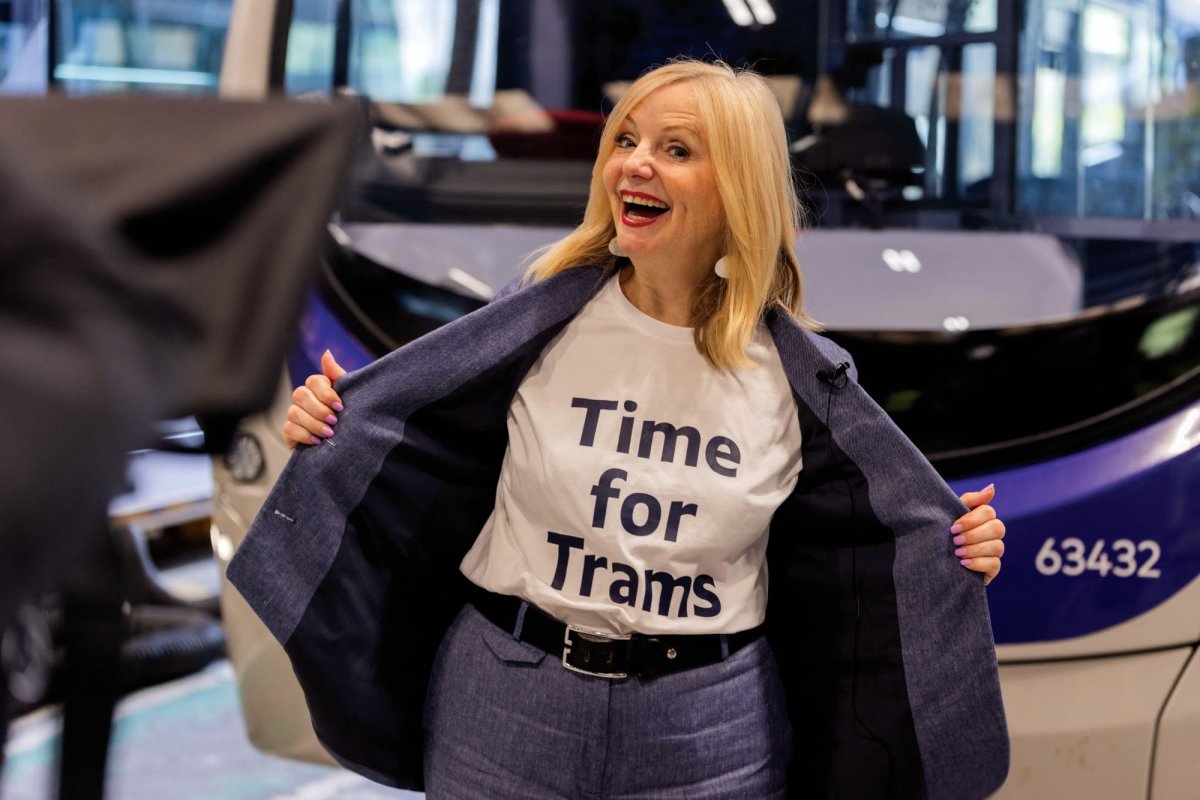

West Yorkshire mayor Tracy Brabin insists mass transit ‘will be a tram’ (Credit: Milo Chandler / Alamy)

10 min read
The long wait in Leeds for a tram network was recently extended yet again. Noah Vickers uncovers the real reasons for the latest delay
It looked as if the stars were finally in alignment. Leeds had been waiting decades for a tram network of the kind enjoyed in Sheffield, Manchester and Nottingham, and in July 2024 it looked as if one was closer than ever before.
West Yorkshire’s Labour mayor, Tracy Brabin, had just won re-election promising to start work on the scheme and her party had now taken office nationally on a mission to “forge ahead” with new infrastructure.
To top it off, Leeds now even had local MP Rachel Reeves in post as Chancellor. With £2.1bn committed to it in June 2025, the project’s future looked bright.
But just days before Christmas, an announcement was made. Brabin confirmed that following “an independent review” held in September 2025, the scheme was now being progressed at a slower pace. Instead of services starting in the mid-2030s, they will instead begin in the late 2030s.
The reason for this was that while Brabin’s West Yorkshire Combined Authority (WYCA) had previously been progressing the business case and the route planning simultaneously, they had now agreed to take a “sequential” approach by submitting the business case first.
The announcement did not make clear why the review was held, other than it being “part of the usual process for projects of this size and scale”.
And while calling the review “independent” might suggest its authors have nothing to do with those funding the scheme, it quickly emerged that the report was in fact written by the National Infrastructure and Service Transformation Authority (Nista), a joint unit of the Treasury and Cabinet Office.

Speculation mounted that the project was in trouble. Leeds has been disappointed not just by a litany of failed plans for trams and trolleybuses over the last 40 years but also by Boris Johnson’s 2021 decision to the axe the city’s High Speed 2 route.
Admitting that people in West Yorkshire have become “cynical” about such promises, Brabin insisted the new timeline would “offer certainty for the scheme”, as ministers had “committed to working with us to cut red tape and put tracks on the ground as quickly as possible”.
Tom Forth, a Leeds-based expert in transport data who has been a vocal advocate for the tram, was not convinced: “We have had about eight delays before to this type of thing in Leeds. All of the previous delays have resulted in cancellation… Maybe we’ll get a hovercraft to Mars and we’ll call it ‘West Yorkshire Tram’, I don’t know, but it’s not good.”
A Leeds Labour activist meanwhile tells The House: “Leeds residents think it’s cancelled. It doesn’t matter who I speak to. If it’s not somebody hyper-involved in local government policy or transport policy, [they think] it’s not happening.”
Both WYCA and the government have refused Freedom of Information requests for the Nista review, with the former citing an exemption to protect “the free and frank exchange of views” between officials.
The House, however, has obtained a copy and can for the first time reveal its contents. The 45-page document sets out 19 separate risks relating to the project’s governance, assurance and planning, but one key recurring theme is the extent to which WYCA is said to have allowed the scheme to be shaped “around a political agenda rather than a recognised programmatic approach”.
The review specifically refers to Brabin’s 2024 manifesto pledge to get “spades in the ground by 2028”, which is the year that she intends to stand for a third term in office.
One source who has been following the project closely says: “They were rushing so much to try and get something approved, to meet the political timescale of doing something in this mayor’s mandate by 2028. The whole point of the HS2 learning is you’re not supposed to do that, because that’s what leads you to make bad decisions.”
The review says of Brabin’s 2028 pledge: “This date has been driving the planning for WYMT [West Yorkshire Mass Transit] and while it is vitally important to drive pace into delivery and also challenge current ways of thinking, there are elements of Managing Public Money, that government needs to adhere to.
“This has generated a tension for WYMT between planning a major project in line with current Green Book Business Case Approval and seeking to achieve a manifesto pledge.
“Lessons from other major projects have identified that options appraisal for investment, robust project planning and risk management are critical ingredients for successful delivery and should not be compromised for unrealistic milestones.”
It cautions that there is a risk of “political embarrassment if there was a large disconnect between a lauded ‘spades in the ground’ date and the start of actual work” and warns that money could be wasted, saying: “The risk of nugatory spend is high.”
The likely cost of a Bus Rapid Transit mode is significantly less than for trams
In addition to concerns about staff capacity in both WYCA and the Department for Transport (DfT), the review also highlights the need for WYCA to take a “mode-agnostic” view of the project. In plain English, the government has not actually said it will fund a tram system in West Yorkshire. It has said it will fund a “mass transit” system, which might consist of trams, but might not.
The review found there was a “clear mantra” among those working on the scheme that “the term WYMT is synonymous with ‘tram’” and that “anything less than” a tram would be considered “second-class”.
Nista said that while “it may be the case that trams are the right modal choice”, the review team were “concerned that the lack of unbiased thinking about the best solution for delivering the objectives has hampered the development of an evidence-based demonstration of the most effective and efficient scheme”.
It adds: “There is a need to build the case for trams which has not been completed. This is particularly important because the likely cost of a Bus Rapid Transit (BRT) mode is significantly less than for trams and the BRT benefits:cost ratio is significantly better.”
Staff working on the project told Nista that trams “will be transformational, more resilient and more acceptable to the public” than a bus network, but Nista asserted that “the evidence for this has not yet been developed”.
Martin Hamilton, CEO of the Leeds Civic Trust, tells The House that trams would attract a higher ridership than buses, as “people who wouldn’t think about getting a bus do consider getting a tram”. He adds that as well as offering increased speed, trams would also bring wider economic benefits.
“If you look at some of the examples within the UK, but also internationally, you can see how it’s possible to use a tram route as a way of bringing brownfield sites into play in terms of housebuilding and in terms of industry along the route. It can really act as a catalyst for regeneration in a way that simply running a bus down a road just won’t do.”
WYCA has consulted on several different possible alignments for the scheme’s initial two routes.
The first would run from central to south Leeds, and could potentially call at Elland Road, the home of Leeds United. The club is expanding its stadium in a £650m redevelopment project, with LUFC director Peter Lowy suggesting mass transit could make a big difference for fans on match days.
The other route would link Leeds with Bradford, despite the fact that the two cities are already connected by train.
The House understands that, at the time of the review, WYCA’s preferred alignment for this second route involved running the tram on main roads between the two cities, because that would enable planning consent to be granted most quickly. But this would have caused significant disruption to traffic during construction, and would also not have enabled much new housing development compared with options which took the tram off-road.
A source familiar with the scheme said that by taking this approach, the mayor had been putting “political expediency in front of what’s probably in the best interests of taxpayers, bluntly”.
In a February letter, rail minister Lord Hendy told Brabin: “It is important to carefully consider the cost, effects and benefits/disbenefits of ‘street running’ vs utilising reserved track where available or running through brownfield land.”
The Nista review similarly warns that “there are risks in committing to a specific route and mode before full approval and which may not be supported by all senior stakeholders”, in addition to “the risk of nugatory spend, litigation and public embarrassment for WYCA if works are started out of sequence and there is a subsequent need for reversal”.
A WYCA source told The House no decisions had yet been made on routes.

Since the review, Brabin has refused to resile from her manifesto pledge, insisting that spades will still go in the ground in 2028, though she now specifies these will enable “preparatory works”.
WYCA’s website explains: “This will not involve laying tracks, but it will prevent issues in any new developments or on our road network that could cause problems for the project, helping to advance future delivery.”
The mayor has also doubled down on her claim that mass transit will mean a tram network, despite the review’s findings on that question. “It’s going to be a tram,” she told WYCA’s scrutiny committee in March this year, adding that the Chancellor has made clear her support for trams.
But the scheme’s business case is being submitted to the DfT, not the Treasury. Asked just a few weeks ago whether she could rule out a bus-only scheme in Leeds, Transport Secretary Heidi Alexander said that while Brabin was making the case for trams “very powerfully”, it is the DfT’s job to ensure public funds are “spent wisely”.
Brabin told the committee: “We are now in a process where we have to prove it can’t be a bus – and that’s fine, we’ll do that, because it will be a tram. My approach is, the case has been proven that light rail is a solution to connectivity in Manchester, in Nottingham, in Birmingham, in Edinburgh, in all of the cities across Europe [that have trams].”
A WYCA spokesperson told The House: “We have bold ambitions for West Yorkshire and that includes addressing long-standing connectivity issues that are holding our region back.
“Beginning preparatory construction works by 2028 has been an ambition for the combined authority for some time because the people of West Yorkshire have waited long enough for this investment. Delivery of major infrastructure projects in the UK is too slow, and in the spirit of devolution we want to innovate to deliver mass transit more quickly.
“Nista’s predecessor body, the National Infrastructure Commission, set out clearly in 2023 that Leeds needs a tram. A review at this stage of a project of this scale is completely normal, and the majority of its recommendations have already been addressed by the combined authority.”
The DfT said: “While we do not comment on details of leaked reports, the government fully supports mayor Brabin’s ambitions for a world-class mass transit system for West Yorkshire. We look forward to receiving WYCA’s initial business case for the project later this year.”
>
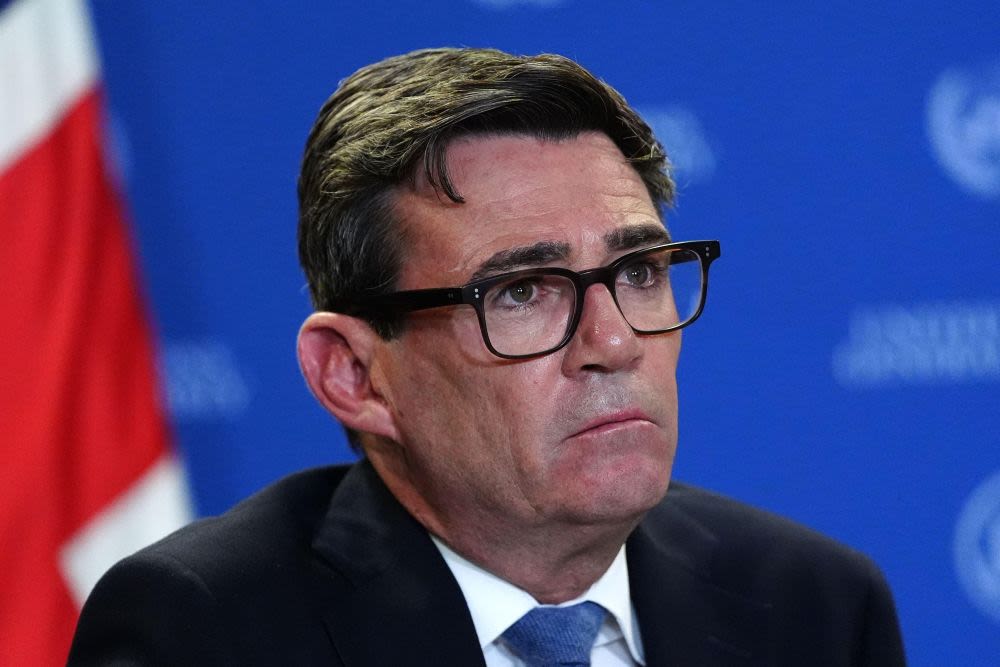
Burnham has ruled out an early election amid speculation (Alamy)
2 min read
The Prime Minister has said he can “knock dead” speculation of an early election, claiming that the move would be “self-serving politics”.
Andy Burnham’s comments come ahead of Labour Party conference in Liverpool as the party is riding high on a recent boost in the polls, widely labelled “the Burnham bounce”.
A YouGov poll published this week revealed that Labour would return the most MPs to Westminster if an election were to be called tomorrow, but would still not achieve a majority.
Burnham said that his conference speech next week would set out the “direction I want to take the country in the coming period”.
While speculation regarding the possibility of Burnham calling an early election had been swirling in recent days, Burnham was keen to correct the record.
Asked by ITV Calendar whether the next general election would be in 2029, Burnham said: “Well, yes, that’s when the next election will be. All of this speculation on an early election, I can knock that dead.”
Burnham went on to say that the public would want him to be “getting on with the job of delivering…rather than putting self-serving politics before that, which was what I would be doing if I call an election. I am not going to do that.”
In a separate interview with BBC West, Burnham said his priority was to get people “feeling a bit of hope in their lives again”, rather than “putting people back into an election cycle”.
>
Politics
Politics Home | Trade Unions Call On Burnham To End “Military Collaboration” With Saudi Arabia
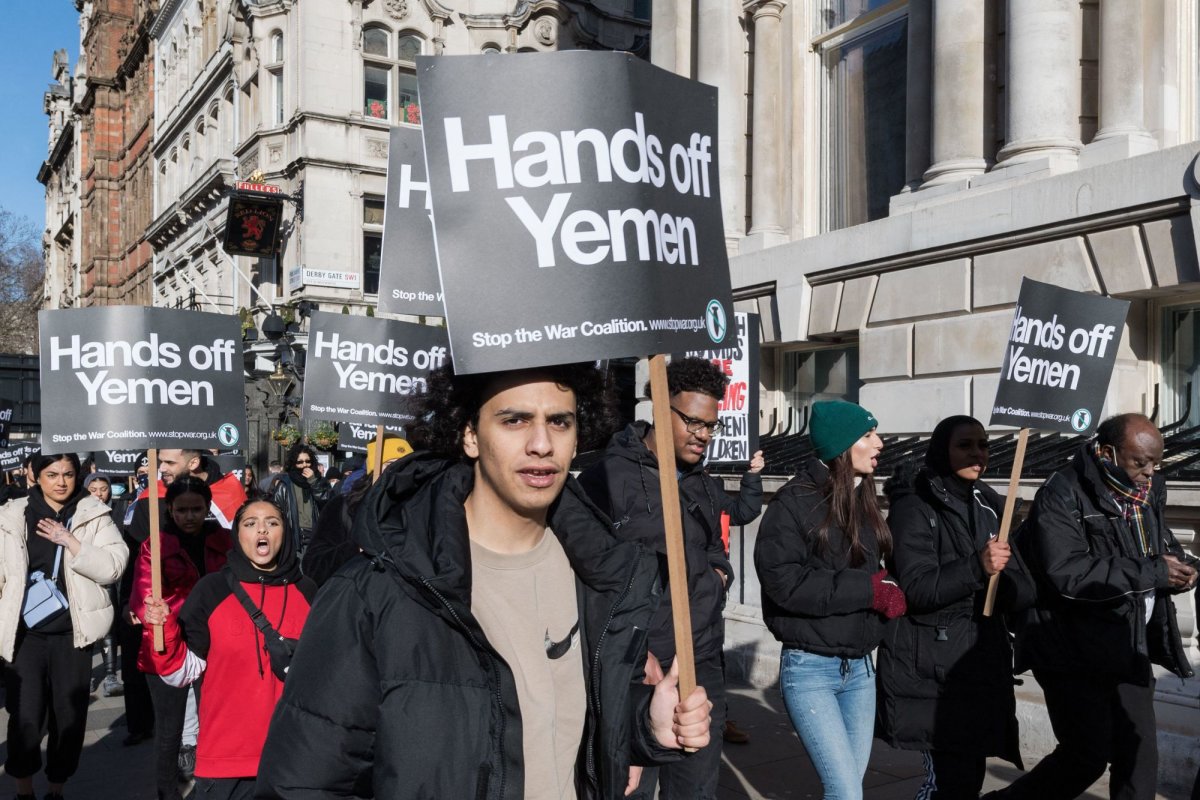

Anti-war demonstrators march against the ongoing war and humanitarian crisis in Yemen, February 2022, London (WIktor Szymanowicz/NurPhoto / Alamy)
5 min read
Exclusive: Ten trade unions have signed an open letter to Andy Burnham calling on his government to end its “military collaboration” with Saudi Arabia amid concerns over the humanitarian crisis in Yemen.
The letter, shared exclusively with PoliticsHome, criticises the UK government’s decision to provide military support to the Saudi-led coalition, which it accuses of targeting civilians and breaking international law in Yemen.
Conflict in the region has escalated in recent weeks, with Saudi Arabia claiming on Friday that it had intercepted six ballistic missiles fired by the Iran-backed Houthis.
Earlier this week, the UK government announced that it would provide additional defensive military support to Saudi Arabia, claiming “escalating tensions in the Gulf can have a serious impact at home in the UK”.
Ongoing disruptions to the Strait of Hormuz, a vital trade route, mean any attacks affect Saudi Arabia’s ability to export oil through the Red Sea, hitting prices across the globe.
Ahead of Labour Party conference this weekend, the general secretaries of 10 unions – including four Labour-affiliated unions – said they were “shocked” by the decision to increase military support, and criticised the government’s reasoning.
“Contrary to the government’s statements, the more this war expands, the more expensive our bills will get. The only way out is a diplomatic settlement to the regional war,” the letter reads.
Affiliates Unison, Britain’s largest trade union, the Communication Workers Union (CWU), Transport Salaried Staffs’ Association (TSSA) and the Fire Brigades Union (FBU), among other unions, argued that Britain “should not collaborate with a military that has repeatedly violated international law and has been central to creating one of the world’s worst humanitarian crises in Yemen”.
The letter calls for Burnham to urgently end both Britain’s military support for Saudi Arabia and the UK’s wider involvement in the Iran war “by revoking support for US air strikes launched from RAF bases”.
Burnham has argued that he agreed to help refuel Saudi jets to defend key energy infrastructure against the Houthis in a bid to keep oil flowing from the Gulf and ease economic pressures that will affect the UK.
The union signatories to the letter do not accept this justification, however.
“As the war expands, our members are paying the price. Inflation rose again in August, driven by petrol prices,” the unions said.
“Escalating this war will make our bills more expensive. If the government is serious about tackling the cost of living crisis, it must get serious about diplomacy.”
The Times reported on Thursday that ministers are drawing up plans to help poorer households with energy bills in next month’s Budget.
Khem Rogaly, co-director of Transition Security Project, the militarism-focused research centre that organised the letter, said: “Collaborating in Saudi military operations in Yemen is reckless, inflaming the regional war that started with the massive US-Israeli attack on Iran earlier this year.
“Britain should have no part in the US-led war against Iran or Saudi-led interventions in Yemen. Saudi interventions in Yemen have relied on British military support for more than a decade, leaving a legacy of war crimes and humanitarian crisis that has killed hundreds of thousands of people.”
The letter is one of the biggest organised since Burnham entered No 10 and the unions led by the signatories collectively represent more than 2.3 million workers.
The full text of the letter is below.
Dear Prime Minister,
As trade union leaders we are shocked by the government’s decision to provide yet more military support to Saudi Arabia. Britain should not collaborate with a military that has repeatedly violated international law and has been central to creating one of the world’s worst humanitarian crises in Yemen.
Providing military support to Saudi Arabia inflames the war started by the US and Israel against Iran in February, which has expanded across the region. Contrary to the government’s statements, the more this war expands, the more expensive our bills will get. The only way out is a diplomatic settlement to the regional war.
Saudi Arabia has intervened in Yemen for 11 years, with devastating results. Throughout this war, the Saudi-led coalition has repeatedly targeted civilians, breaking international law, while its air and sea blockade helped cause a humanitarian crisis that left 377,000 people dead by 2021.[i] Britain has supported this war throughout — supplying Saudi Arabia with aircraft, missiles and on-the-ground maintenance to keep its fighter jets in the sky. Earlier this year, the government approved a £468 million weapons sale to Saudi Arabia, mostly composed of missiles.[ii] These actions have fuelled a brutal war that has left Yemen in ruins. Providing military support to Saudi Arabia as the US-Iran war extends to Yemen only exacerbates regional conflict and takes us further from the diplomatic settlement that the world urgently needs.
As the war expands, our members are paying the price. Inflation rose again in August, driven by petrol prices. Energy bills will rise again in October, perhaps exceeding £2100 for the average household from January.[iii] Escalating this war will make our bills more expensive. If the government is serious about tackling the cost of living crisis, it must get serious about diplomacy.
First, we ask you to urgently end Britain’s military support for Saudi Arabia. Second, we ask you to end the UK’s wider involvement in the Iran war, by revoking support for US air strikes launched from RAF bases. These are essential steps for a cost-of-living government to take.
Yours sincerely,
Andrea Egan, General Secretary, UNISON
Daniel Kebede, General Secretary, National Education Union
Dave Ward, General Secretary, Communication Workers Union
Eddie Dempsey, General Secretary, National Union of Rail, Maritime and Transport Workers
Fran Heathcote, General Secretary, Public and Commercial Services Union
Jo Grady, General Secretary, University and College Union
Paul W. Fleming, General Secretary, Equity
Maryam Eslamdoust, General Secretary, Transport Salaried Staffs’ Association
Sarah Woolley, General Secretary, Bakers, Food and Allied Workers’ Union
Steve Wright, General Secretary, Fire Brigades Union
>
Politics
The House | Hazards Ahead: How Labour Unity Under Andy Burnham May Be Tested In The Months Ahead
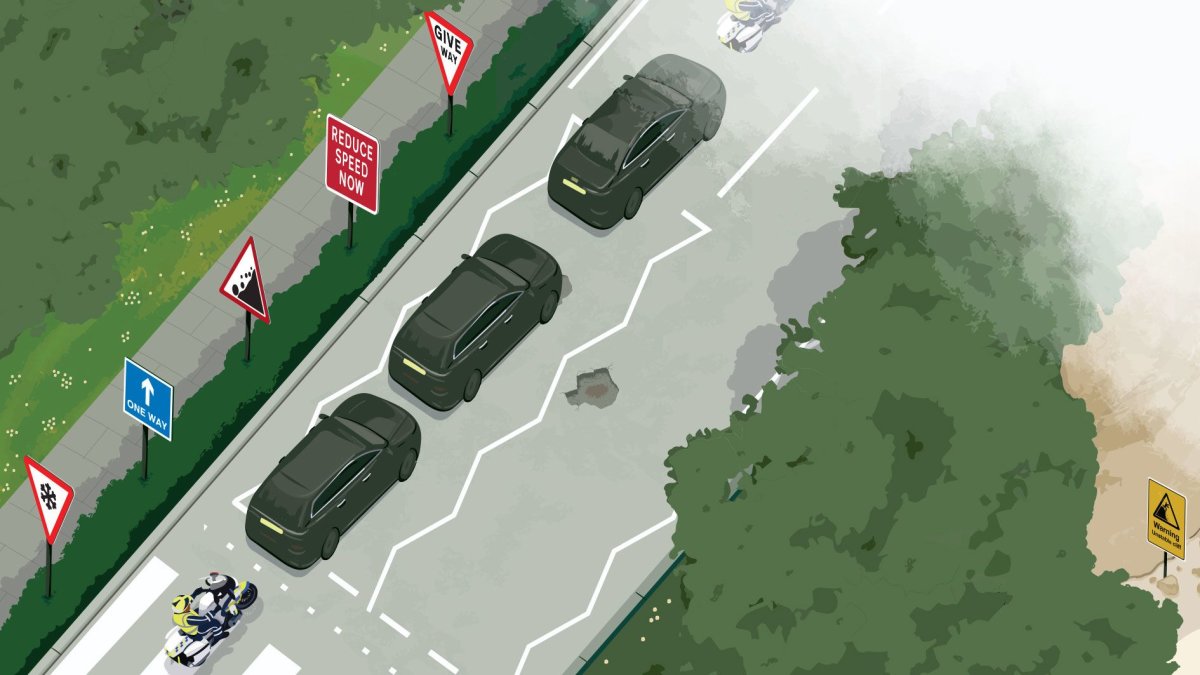
Illustration by Tracy Worrall

12 min read
The first few months of Andy Burnham’s premiership have passed in relative calm but the Labour Party’s newfound unity is about to be tested. Harriet Symonds reads the warnings on the road ahead.
Things, as they might say, can only get worse. Labour gathers in Liverpool with tails up, ahead in the polls having overtaken Reform UK. But it is in the nature of bounces that what goes up must come down, and Andy Burnham well knows that the momentum will fade.
Despite repeated public denials he is planning an early election, the Prime Minister is understood to have discussed the option with James Purnell, his chief of staff. No firm conclusion was reached, say sources.
On one level, that is unsurprising – indeed it would be odd if he hadn’t at least reviewed the possibility with his closest political aide – but it adds to the sense there is an ongoing calculation.
Although the decision will be Burnham’s alone, Labour MPs will do much to condition his thinking in the months ahead.
If he believes he can carry the party through difficult decisions – on welfare and immigration in particular – he may be more likely to wait until he can more confidently campaign on Labour’s record in government. On the other hand, if it appears he has become their captive, he may be more inclined to seek a mandate of his own.
Watching on are the dispossessed and disgruntled, ejected from government for their loyalty to Sir Keir Starmer. The revelation by Louise Haigh that Burnham’s return to Westminster had been in the works for a year has only deepened their resentment.
At the centre of this emerging group is Darren Jones, the former chief secretary to the prime minister, whose exclusion from Burnham’s Cabinet has angered MPs in the group who saw it as a serious miscalculation.
“Even now, they still don’t realise how much power Darren wields in the PLP,” warns an MP in the group. “When the wheels start falling off, they might need him.”
Jones showed his teeth when he challenged No10 claims about how much would be saved through shelving the digital ID scheme, for which he’d had ministerial responsibilities.
At the moment Jones sees himself as something of a Jeremy Hunt-like figure in the Labour Party, who can make significant interventions without undermining the government.
But he is not the only former minister to know where the bodies are buried. Some, like Olivia Bailey and Catherine Atkinson, have been elected to chair select committees which will look at policy areas they tackled in government.
MPs on ‘rebel watch’ insist they want Burnham’s government to succeed, but they have no problem being “critical friends” when it comes to some of the difficult choices ahead, especially those affecting the economy.
“The group has so much institutional knowledge of government – they have a lot to offer,” says an MP organising for the group.
They have begun meeting regularly, including for drinks at the Clarence pub on Whitehall.
Those involved describe it primarily as a support network for MPs adjusting to life outside government, but it has also become a place to connect with donors and develop longer-term policy ideas aimed at securing a second Labour term.
Burnham’s first real tests will come not in Liverpool but in the months ahead, when he will have to make tough decisions that will upset different wings of his party.
MPs are eagerly awaiting the government’s 10-Year Plan in November to provide more clues about the government’s direction of travel.
Welfare, defence, the Troubles Bill, oil and gas and plans for devolution are all issues on which the new government could face opposition from its own benches.
The economy
Burnham inherited an economy with little room for manoeuvre and will deliver his first Budget on 28 October against a backdrop of rising inflation, high borrowing costs and sharply reduced fiscal headroom. The government is facing pressure to fund defence, ease the cost of living and maintain its fiscal rules at the same time.
The government wants the Budget to be as quiet as possible. The Spending Review next year is likely to be the more significant test, particularly on welfare and defence.
Attacks on Rachel Reeves have not gone unnoticed by Labour MPs, with some saying it is “totally unfair” and warning it “will not wash”.
The group of disgruntled Labour MPs is watching closely to see whether Chancellor John Healey sticks to the fiscal rules and how he balances competing demands from defence, welfare and public services.
In a sign that the government is taking the group seriously, The House understands that Healey has asked to speak to Jones ahead of the Budget.
Meanwhile, talk of an early election is rife among Labour MPs, with some reporting contact from regional organisers that they believe could be preparation for a snap poll.
Welfare
Addressing Britain’s £333bn ballooning welfare bill will be one of Burnham’s most politically dangerous tasks. He has said he wants to reduce spending but has yet to set out in any detail how he intends to do it.
Two reports will soon land on his desk: one by former minister Alan Milburn examining youth unemployment and another by Stephen Timms on disability benefits. Milburn has already argued that the welfare system is trapping young people in unemployment and called for a tougher “working state”.
The PLP is divided over how far Burnham should go. Starmer’s attempt to cut £5bn from welfare spend last year ended in a revolt that exposed the depth of opposition on the Labour benches and started the downfall of his premiership.
Burnham faces the same fundamental dilemma: how to reduce the bill without provoking another rebellion from the left.
Some MPs want to see a credible plan to get welfare spending down, while MPs on the Labour left, including Kim Johnson, Rachael Maskell and John McDonnell, will not tolerate what they regard as “punitive” cuts.
Many of those who were involved in last year’s welfare rebellion are now in government, including the new Chief Whip Anneliese Midgley, creating the prospect of a fight within the government itself if Burnham struggles to win support.
“It will be the moderates that will end up saving Burnham when a vote comes to cut welfare,” predicts an MP on the party’s right flank.

Defence
Defence spending could provide Burnham with an equally awkward coalition of rebels. The Prime Minister has committed to spending 3.5 per cent of GDP on defence by 2035 but has so far refused to set out a timetable for reaching three per cent.
With little spare cash, reaching three per cent by 2030 would require difficult decisions elsewhere. The government has indicated that the route to the 3.5 per cent target will be set out at next year’s Spending Review.
The decision to appoint former defence secretary John Healey as Chancellor is a sign of the importance Burnham attaches to the issue.
MPs on Labour’s right want to see the government make defence a priority, particularly after Burnham declared that national security “cannot come at the expense of social security”.
The line was pre-prepared, The House understands, and while the sentiment spoke to some Labour backbenchers, others were less impressed.
“He was dreadful today. Everything I feared,” one Labour MP said following that PMQs performance on 9 September.
Healey’s decision to resign from Starmer’s government over defence spending has also given him little room for manoeuvre. Many MPs will expect him to demonstrate that his new role as Chancellor has not diluted his commitment to increasing military spending.
Tan Dhesi, chair of the Defence Select Committee, has already warned the Prime Minister that “vibes alone just isn’t going to be enough”.
Troubles Bill
New Northern Ireland Secretary Chris Bryant faces the difficult task of passing the Northern Ireland Troubles Bill, intended to replace contentious elements of the Legacy Act.
The legislation is contentious as it could expose former British military personnel who served in the Troubles to continuous unfair legal action. The government has been attempting to address those concerns while also preserving routes to justice for victims and their families.
The bill has become deeply controversial in the veteran community. Since his appointment,
Bryant has been on a charm offensive to convince Labour MPs with military backgrounds to give their support to the bill, some of whom could present powerful opposition if the government gets this wrong.
Several MPs invited for talks say the government is moving in the right direction, but key MPs remain uncertain about whether they can support the bill until they see the final amendments.
Former armed forces minister Al Carns cited the legislation as one of the reasons for his resignation in June, saying it risked failing the veterans it was intended to protect.
Immigration
Home Secretary Shabana Mahmood is facing a growing rebellion from Labour MPs on the soft left over plans to retrospectively extend the qualifying time for Indefinite Leave to Remain (ILR) from five to 10 years or more.
The size of the growing rebellion from within the PLP means Mahmood will likely end up watering down her proposals. Some MPs are calling for skilled worker visa holders to be exempt from extended settlement, allowing them to qualify in five years instead of 10.
Darren Jones sees himself as something of a Jeremy Hunt-like figure in the Labour Party
A motion calling for this move tabled by Neil Duncan-Jordan, the left-wing Labour MP for Poole, has attracted 81 signatures so far, including 42 other Labour MPs.
Duncan-Jordan argues that the proposals could make it harder to recruit workers into sectors such as social care, where there are already around 110,000 vacancies.
“The Prime Minister’s plan to reset the social care system has no chance of succeeding if we keep on with the current plans of ILR. We already have 110,000 vacancies in the sector and the threat of making people wait another five or 10 years until they reach settled status is simply unfair,” he says.
“You can’t reset social care without the workforce and to change the rules for those who are already here is cruel. The Prime Minister needs to rethink or he could be facing his first rebellion.”
Justice
The Courts Bill will be another test of Burnham’s ability to absorb pressure from his own benches.
Under proposals from the Starmer government, jury trials in England and Wales were set to be scrapped and replaced with a single judge for crimes carrying a likely sentence of up to three years. The move was justified as a bid to tackle the courts backlog, which has reached a record level of 80,000 cases.
The plans were originally put forward by former justice secretary David Lammy but faced a significant backlash from Labour MPs. Karl Turner, the MP for Hull East, was at the forefront of efforts to defeat the proposals, calling them “undemocratic” as well as ineffective in reducing the backlog.
Andy Burnham has since described jury trials as a “linchpin of a fair society”, signalling he will scrap the reform – the rest of the Courts Bill, however, is expected to remain very similar, which could be a source of frustration for some.
The extent to which Burnham reverses the Lammy-era proposals will be made clear when the bill returns on 13 October.

Devolution
English devolution is central to Burnham’s premiership. The PM has pledged to take power out of Westminster and give it to communities across England, promising “good growth in every postcode”.
There is broad support for moving power out of Whitehall. The problem for Burnham is that a growing number of Labour MPs fear their constituencies, particularly in London and the South, are being asked to surrender power and money to regional mayors.
Labour MPs representing constituencies in the South have told The House that Burnham’s ‘Manchesterism’ agenda risks being seen as overlooking other parts of the country also facing serious economic and social challenges.
London Labour MPs in particular are worried that deprived parts of the capital will be ignored. In his first intervention since leaving government, former housing secretary Steve Reed publicly warned Burnham that he “can’t make the rest of the country richer by making London poorer”.
There has also been backlash from MPs in regions that do not have elected mayors and those in rural constituencies who fear they will be overlooked.
Perran Moon, Labour MP for Camborne and Redruth, tells The House: “There’s a misunderstanding about Cornwall. We will never join a combined mayoral authority because of our national minority status. So we are at risk of being excluded from the powers and funding we need to unleash Cornwall’s economic potential.”
Burnham has attempted to head off that criticism, promising to work with Cornwall council and its six MPs on a devolution deal “with or without an elected mayor” and extending the offer to areas across England without devolved power.
The government’s decision to row back on local government reorganisation has been welcomed by many MPs who criticised the one-size-fits-all approach. But it now leaves unanswered questions over who gets power, who loses it, who gets the money and who is accountable.
Oil and gas
There is growing pressure on Burnham to approve North Sea oil and gas projects, notably Rosebank and Jackdaw. He has previously said he is “open-minded” about North Sea drilling and recognises the need to balance energy security, jobs and the transition to net-zero.
It is widely expected that Burnham will green-light Jackdaw, but the announcement has been delayed. It is thought that a decision will now only come after the Holborn and St Pancras by-election next month, amid fears it could lose votes to the Greens.
The issue has split Labour. Labour MP Henry Tufnell broke ranks back in March to publicly call for North Sea drilling, arguing it would boost economic growth, create jobs and prevent further deindustrialisation. Unions are also watching the decision closely, with Unite and the GMB in favour of drilling.
But some on the soft left of the party, many of whom are now in government, remain hostile to new oil and gas licences. Foreign Secretary Ed Miliband clashed with the Treasury over the decision when he was energy secretary.
In August, Labour MP Clive Lewis wrote a letter to the new Energy Secretary, Miatta Fahnbulleh, urging against new oil and gas licenses. He wrote on X: “Framing this as a choice between protecting the climate and protecting jobs is misleading. The real risk lies in clinging to volatile fossil fuels, which leave us vulnerable to energy price shocks.”
This new government will not be able to satisfy every wing of the party. For a Prime Minister who has promised to end the factionalism of the Starmer years, Burnham’s first real test may be learning to accept he can’t please everyone.
>
Packers' Tucker Kraft on Lambeau Field fans' booing: 'It’s not going to help us win'
NHL salary cap projected to jump dramatically for 2028-29 season

Chris Hansen Finally Saw ‘Primetime’, Still Not A Fan
-

 movies4 months ago
Search For Canadian TV Actor Stewart McLean Now Homicide Investigation
-

 Fashion9 years ago
These ’90s fashion trends are making a comeback in 2017
-
Fashion9 years ago
According to Dior Couture, this taboo fashion accessory is back
-
Fashion9 years ago
Model Jocelyn Chew’s Instagram is the best vacation you’ve ever had
-
Fashion9 years ago
Emily Ratajkowski channels back-to-school style
-
Fashion9 years ago
9 Celebrities who have spoken out about being photoshopped
-

 Anime4 months ago
Rurouni Kenshin: Hokkaido Arc Manga Takes 1-Issue Break – News
-

 Anime3 months ago
HIDIVE to Stream English Dubs for The World Is Dancing, The Forsaken Saintess and Her Foodie Roadtrip in Another World, The Dangers in My Heart: The Movie Anime – News