
Tech
Google unveils the Pixel Watch 5 with a smarter Gemini and advanced health monitoring


At its Made by Google event on Wednesday, Google will unveil the Pixel Watch 5 with a smarter Gemini experience, as well as advanced fitness and health monitoring. The new smartwatch, which starts at $399, can track blood pressure patterns and insulin resistance, as well as deliver personalized help and better sleep tracking.
Google says it’s designed the watch to deliver personalized and proactive help right when it’s needed. For example, the watch will proactively suggest relevant actions or information based on a text message’s context, like instantly pulling up a smoothie place your sister sent you.
You can raise your wrist to ask Gemini a question, handle requests like finding a nearby lunch spot with navigation, or use Gemini offline to manage timers, alarms, and workouts with your voice.
The watch will also dynamically surface timely updates right at the bottom of the watch face, like flight info, ETAs, and other helpful reminders.

As for the new health features, the tech giant says the smartwatch uses sensors and machine learning to track blood pressure patterns before they can put strain on your heart. Google says the feature was tested against 24-hour blood pressure monitors and uses an advanced waveform model trained on more than 1 billion minutes of data from over 500,000 people.
The insulin resistance feature is designed to identify changes in metabolic health that may be associated with insulin resistance and an increased risk of developing prediabetes or type 2 diabetes. The feature combines signals from sleep, heart rate, physical activity, and other health data. A large sensor model then analyzes these signals over time to identify long-term changes in insulin resistance.
Google will give users a summary of their blood pressure and insulin resistance trends every month.
There’s also a new feature that can detect a persistent drop in oxygen saturation and will contact emergency services if the watch determines that a breathing emergency may be occurring. This feature is launching in select European countries before expanding to additional regions.

Additionally, the watch’s sleep-stage tracking is 15% more accurate and there’s also a new bedtime watch face that reduces nighttime distractions. A new “Smart Wake” feature wakes users at an optimal point in their sleep cycle, while a new sleep breathing quality metric tracks minute-by-minute changes in blood oxygen levels.
As for fitness, Google says the Pixel Watch 5 delivers its most accurate GPS route tracking yet, with route mapping that’s two times more accurate than previous generations. The improved accuracy is designed to provide users with more precise workout and running data, including a closer match between your recorded route and the actual course.
The Pixel Watch 5 features the Qualcomm Snapdragon W5 Gen 2 platform and has 12% more CPU performance and 50% more RAM than the previous platform. Google says the Watch 5 is 20% faster overall.
The Pixel Watch five supports up to 40 hours of battery life and is available in new colors, including Canyon Fog and Olive. The 41mm version starts at $399, while the 44mm starts at $429. The smartwatch is available for pre-order starting Wednesday and will be available on August 20.
When you purchase through links in our articles, we may earn a small commission. This doesn’t affect our editorial independence.
>
Tech
After Microsoft threatened legal action, a security researcher publishes a new Windows zero-day bug

A security researcher has published details of a new vulnerability in the latest versions of Windows that allows hackers to gain system-wide access to the user’s device and data, despite facing a legal threat from Microsoft weeks earlier over the release of previously unknown software flaws.
The new bug, dubbed ShieldBreak, is the latest disclosure by security researcher Nightmare Eclipse, who in recent months has published details of several bugs affecting Microsoft’s products, including Windows.
According to Nightmare Eclipse’s post, ShieldBreak takes advantage of a flaw in Windows Defender, the anti-malware and security engine built into Windows. A successful attack allows the hacker to escalate their permissions from a low-level user to full access to the device and its data.
Nightmare Eclipse published the proof-of-concept exploit as a Windows app, requiring the user to run the app to exploit the bug. The bug works on Windows 10, Windows 11 (including the latest 25H2 version), and Windows Server 2025, the researcher said.
Security researcher Will Dormann verified that the bug works and that Windows Defender must be enabled for the exploit to work.
The latest exploit builds on an earlier exploit that Nightmare Eclipse developed dubbed RoguePlanet. Microsoft rolled out a patch for RoguePlanet, but Nightmare Eclipse implied that Microsoft’s fix was not sufficient and that their latest exploit demonstrates a full bypass of the earlier patch.
Microsoft has not yet released a patch for the ShieldBreak bug. A spokesperson for Microsoft did not immediately comment when contacted by TechCrunch. The bug is considered a zero-day because the software maker — in this case, Microsoft — was given no time to patch the bug before it was publicly disclosed.
The release of this new zero-day is the latest in a long back-and-forth between the security researcher and the software giant over the company’s alleged handling of their bug reports.
In a series of blog posts, the security researcher claimed that Microsoft mistreated them and did not handle their bug reports sufficiently, with the implication that the researcher had no other choice but to publicly disclose the bugs online. Nightmare Eclipse previously released several other bugs in Windows that were later exploited in real-world attacks to hack into organizations.
In May, Microsoft published a blog post threatening to take legal action against security researchers, like Nightmare Eclipse, if they released details of zero-days outside of the company’s disclosure policies. The company faced heavy rebuke from the security community, many of whom described similar experiences with Microsoft’s handling of their bug reports. Microsoft later walked back the comments in a social media post. Its original blog post remains published and unchanged.
ShieldBreak lands a day after Microsoft’s regularly scheduled monthly security patch releases, dubbed Patch Tuesday. This is the second month in a row where the number of patches has reached around 500 or so bugs driven by the company’s growing use of AI to find and weed out security flaws.
When you purchase through links in our articles, we may earn a small commission. This doesn’t affect our editorial independence.
>

AI could add to fossil fuel emissions in a less obvious way than power-hungry data centers: by making oil and gas production cheaper and more productive. New research suggests those gains could outweigh some of AI’s benefits for cleaner energy.
The peer-reviewed research in npj Climate Action modeled AI-driven productivity gains across fossil fuels and renewable energy. Across 64 scenarios, researchers estimated a net annual increase of 0.47 billion to 1.8 billion metric tons of carbon dioxide when AI improved both sectors. The results represent modeled economic effects, not measured emissions or forecasts for individual companies or countries.
The study examines what its authors call “enabled emissions”: additional emissions that can result when AI lowers costs or raises productivity in fossil fuel extraction, processing, and energy production. APAC energy companies are already expanding AI across upstream operations.
Malaysia’s PETRONAS Carigali said July 8 that it was expanding its TriCipta AI initiative with IBM and Tridiagonal.AI. The work targets surface-equipment optimization and production and maintenance decisions, while earlier tools have supported geoscience and exploration analysis.
AI efficiency could drive more fossil fuel production
Lower operating costs do not automatically mean lower emissions. AI that reduces exploration costs, improves recovery rates, or makes existing assets cheaper to operate could make additional fossil fuel production economically viable.
Australia’s Woodside provides another example of upstream AI adoption. Its Maint Intel system analyzes maintenance records and equipment performance to recommend maintenance intervals at the North West Shelf project. Woodside said testing on the offshore Angel platform cut model-processing time from five days to under two hours.
Neither deployment shows that AI has increased emissions at PETRONAS or Woodside. Both demonstrate the kinds of operational productivity gains examined by the global research. AI can also support methane detection, equipment reliability, and other emissions-reduction efforts.
AI’s electricity use creates a separate emissions footprint. The International Energy Agency expects global data-center electricity consumption to roughly double from 485 TWh in 2025 to 950 TWh in 2030. TechRepublic has separately covered grid pressure in Australia and changing power and cooling requirements for AI infrastructure. A planned 360 MW Nvidia-powered AI data center in Indonesia shows how quickly regional capacity is growing.
APAC methane cuts lag technical potential
The IEA estimates fossil fuel operations in South and Southeast Asia emitted about 13 million metric tons of methane in 2025. More than 60% came from coal, with the remainder from oil and gas. India and Indonesia were the region’s largest fossil fuel methane emitters.
Existing technology could cut methane emissions across South and Southeast Asia by more than 50%, with 60% of those reductions achievable at no net cost to producers. Under stated policies, emissions are projected to fall only 10% by 2030 and almost 20% by 2035.
China faces a similar gap. More than 90% of available methane reductions in its oil and gas sector could be achieved at no net cost, according to the IEA.
Greater operating efficiency does not necessarily reduce absolute emissions. Operators procuring AI tools should track production KPIs and emissions KPIs separately so efficiency gains are not treated as evidence of a climate benefit without a measured reduction in emissions.
Read more: Australia’s AI boom is also reshaping capital spending, with data centers accounting for a growing share of private investment as demand for compute infrastructure accelerates.
>
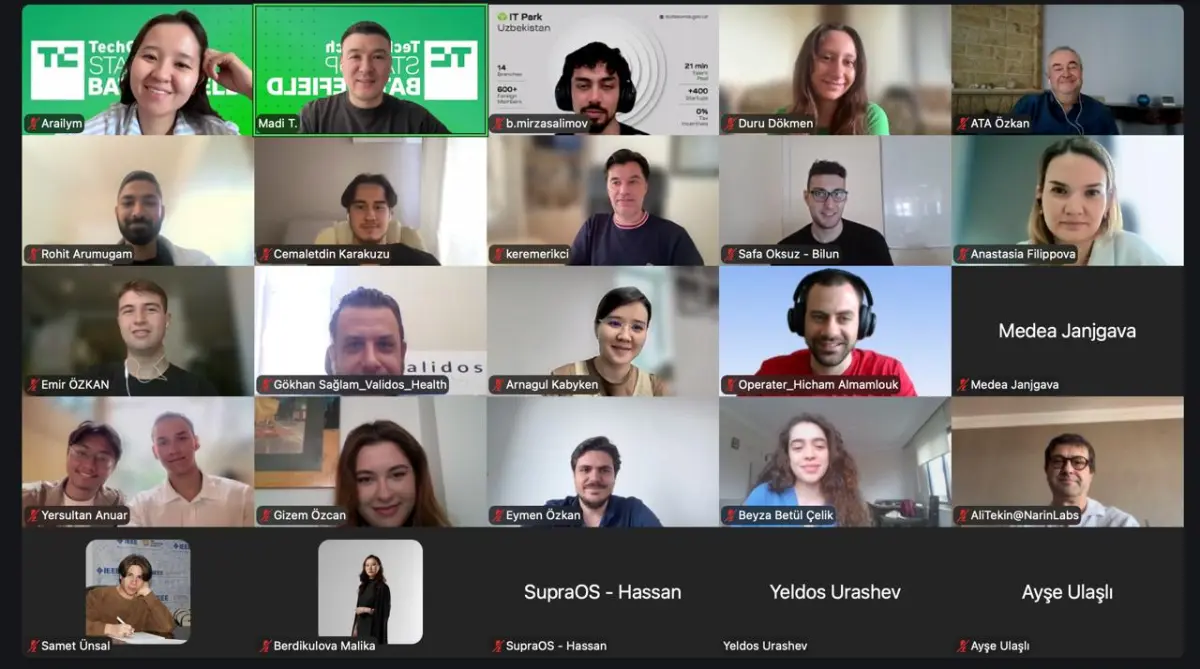
The Road to Battlefield competition, organized by Silkroad Innovation Hub in partnership with TechCrunch, Freedom Holding, Astana Hub, IT Park Uzbekistan, is now in its second year. Its purpose hasn’t changed since it launched: Give founders across Central Eurasia a direct route to TechCrunch Startup Battlefield 200 during this year’s Disrupt from October 13 – 15 in San Francisco.
“For two years now, together with our partners, we’ve been organizing Road to TC Startup Battlefield to give founders in our region a direct line to the top VCs and global ecosystems, one they didn’t have before at this scale,” said Asset Abdualiyev, founder and CEO of Silkroad Innovation Hub. “There’s a lot of talent here the world hasn’t found yet, and that’s exactly who we’re looking for, founders and ideas from every corner of the region who haven’t had their moment.”
The program’s first year, 2025, drew 485 applications from 27 countries, the largest startup pitch event the region had seen at the time. Three startups came out of it to represent Central Eurasia on the global stage: Polygraf AI (Azerbaijan/U.S.), Surfaice (Kazakhstan/U.S.), and Investbanq (Singapore/U.S.).
This year, applications jumped to 726 from 39 countries, which is up nearly 50% in submissions and a dozen more countries than last year. This is a record for the program, spanning Central Asia, the Caucasus, the Middle East, Eastern Europe, and South Asia. Founders pitched online in front of 47 judges from eight countries, drawn from top VC firms, major tech hubs, and founders who’ve scaled their own companies, alongside an AI judge, AI-Dana, as independent jury.
What makes the competition worth watching now, in its second year, is its trajectory. Central Eurasia is now producing one of the fastest-growing startup pipelines in emerging markets, and the numbers back it up.
National rounds for Road to Battlefield 2026 ran online from July 6 to 20. Twenty-two startups came out of it, and they’ll now head to a regional final on August 12. From there, judges will narrow the field to three finalists who’ll represent the region at TechCrunch Startup Battlefield 200.
Meet the Road to Battlefield finalists
Those 22 finalists are MoliyAI (Uzbekistan), Sino AI (Uzbekistan), Deepen (Uzbekistan), Fermopolis (Uzbekistan), Oqim App (Uzbekistan), Cerberus (Uzbekistan), Soup (Kazakhstan), CortexAI (Kazakhstan), Scano (Kazakhstan), 4sell.ai (Kazakhstan), WeGlobal AI (Kazakhstan), ZhanCare.AI (Kazakhstan), Kaptın Kaptın (Türkiye), Pocket eSIM (Türkiye), SeaDar (Azerbaijan), Telagri (Georgia), Admyra (U.S.), Soulward (Kyrgyzstan), Suriy (Mongolia), MVSxAI (Qatar), Looq (Japan), and Defensive Pedal (Romania).
Kazakhstan and Uzbekistan each have six startups in the regional final, a clear sign that these two now stand as the region’s largest startup ecosystems.
“We’re seeing steady growth in AI products, especially from Kazakhstan and Central Eurasia, and that tracks exactly with our vision,” said Magzhan Madiyev, CEO of Astana Hub. “This progress reflects the strengthening of our innovation ecosystem and the tremendous work being done across it. At Astana Hub, our mission is to nurture the next generation of globally competitive founders ready to scale into markets like the U.S., and it’s inspiring to see many of them take the stage, compete internationally, and move one step closer to the world’s leading startup stage.”
In fact, AI dominates the applicant pool: 609 of the 726 startups, roughly 84%, are building AI products, underscoring how quickly the technology has become the default starting point for founders in the region.
“For founders from Uzbekistan and across Central Eurasia, entering international markets is becoming part of their strategy from the very beginning, as more startups build products with the potential to compete and scale globally,” said Azamat Karamatov, CEO of IT Park Uzbekistan. “This reflects the region’s shift toward a more connected and competitive innovation ecosystem. For IT Park Uzbekistan, the priority is to strengthen the pathways that connect high potential startups with international investors, customers, expertise, and leading technology ecosystems. Road to TechCrunch Startup Battlefield contributes to this effort by giving founders from our region the opportunity to participate in TechCrunch Disrupt and the Startup Battlefield stage in the U.S., gain global exposure, build valuable international connections, and engage directly with one of the world’s leading technology markets.”
The competition’s youngest applicant is just 14, and 89 of the 726 applicants, including seven founders from Uzbekistan and Kazakhstan, are under 18. Most applicants are early stage, too: 41.6% at MVP and 38.6% pre-seed, with 14.7% at seed and 4.7% still at the idea stage.
Behind the competition is a wide network of regional partners, supported by leading regional innovation hubs and accelerators across Azerbaijan, Bulgaria, China, Georgia, Kazakhstan, Kyrgyzstan, Moldova, Mongolia, Qatar, Tajikistan, Türkiye, and Uzbekistan: Accelerate Prosperity, Activat VC, Ardventure, Bilkent Cyberpark, Bilişim Vadisi, Caucasus Ventures, CEVF, Doha Business Consulting, Future Laboratory, Future Unicorns, Global Tech Weekend Tbilisi, Hello Tomorrow Türkiye, IT Park Dushanbe, IT Park Mongolia, Khan Tengri Innovation Hub, MOST, Nazarbayev University, SABAH Angels, SABAH Fund, Silkroad Angels, Sofia Tech Park, Startup Moldova, Stanbase, StartupCentrum, and Terricon Valley, with regional media support from TheTech.
This year brought some new stakes to the table, too:
- An $100,000 investment prize pool, split $50,000, $30,000, and $20,000 across the top three finalists, is being funded jointly by Astana Hub Ventures, IT Park Ventures, and Silkroad Innovation Hub.
- The top three winners will get up to $100,000 in OpenAI API credits split the same way, while the rest of the Top 22 finalists will each walk away with $10,000 in OpenAI API credits.
“We’ve been supporting the ecosystem from the very beginning, and this year is no exception,” said Marlen Sikhayev, adviser to the president of Freedom Holding Corp. “What stands out most is how much of it is being driven by AI, solutions built right here in Kazakhstan and across our region that are no longer staying local. They’re being shown to the world, on the same stage as the biggest names in tech. That’s exactly what we set out to support when we backed this initiative, and it’s exactly what keeps us backing it.”
The three eventual winners will also get a fully paid trip and accommodation to TechCrunch Startup Battlefield 200 in San Francisco, along with access to a network of more than 1,000 founders spanning 39 countries.
When you purchase through links in our articles, we may earn a small commission. This doesn’t affect our editorial independence.
>

‘Coyote vs. Acme’ Review: A Live-Action/Animated Looney Tunes Delight

‘Cheat Fuyo’ Reveals Additional Staff, Second Teaser Promo

How to watch Cubs vs. Nationals: TV channel and streaming options for August 12
-

 movies3 months ago
Search For Canadian TV Actor Stewart McLean Now Homicide Investigation
-

 Fashion9 years ago
These ’90s fashion trends are making a comeback in 2017
-
Fashion9 years ago
According to Dior Couture, this taboo fashion accessory is back
-
Fashion9 years ago
Model Jocelyn Chew’s Instagram is the best vacation you’ve ever had
-
Fashion9 years ago
Your comprehensive guide to this fall’s biggest trends
-
Fashion9 years ago
9 Celebrities who have spoken out about being photoshopped
-
Fashion9 years ago
Emily Ratajkowski channels back-to-school style
-
Fashion9 years ago
A photo diary of the nightlife scene from LA To Ibiza