
Sports
Manchester United: What shape are club in ahead of Michael Carrick’s first full season in charge?

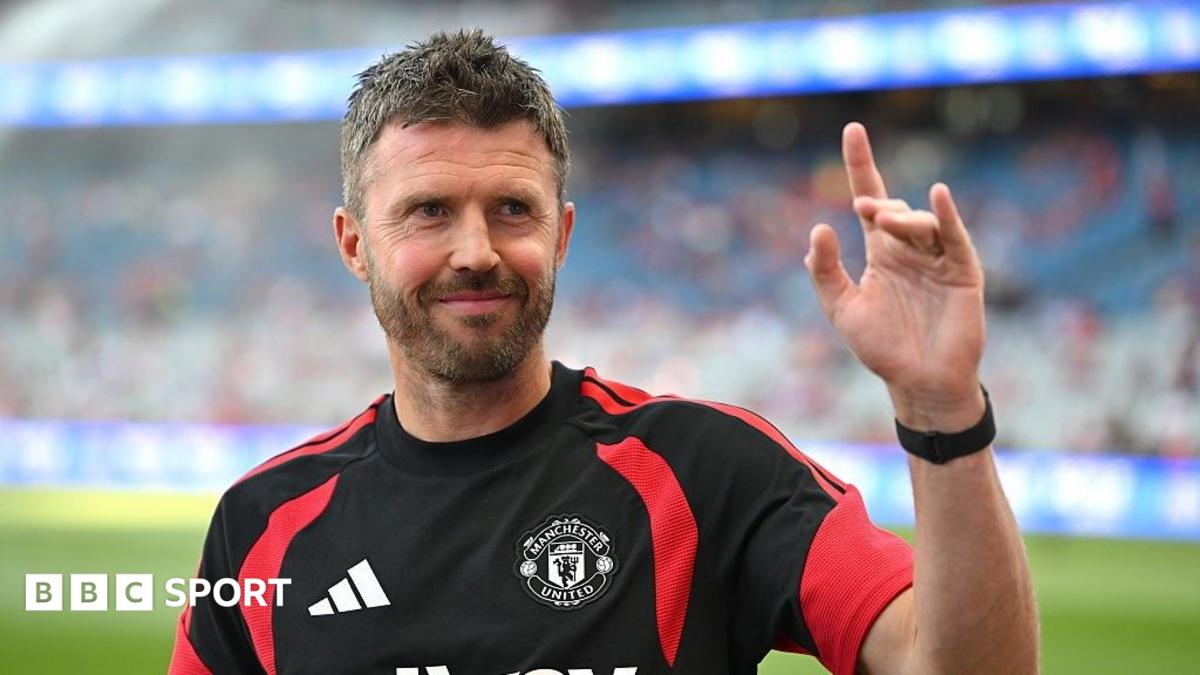
There are a lot of positives for Carrick to take from a pre-season of five weeks and six games.
Two wins, two draws and two defeats might look average, but the benefits are clear.
There is huge potential in midfielder Andrey Santos for a start. One of three players – Patrick Dorgu and Ayden Heaven were the others – to start every game, the 22-year-old, £48m summer arrival from Chelsea impressed with his ability to rotate the ball, his positional discipline and communication.
Like Carrick himself, there is an assurance about Manchester United‘s other major signing, Youri Tielemans, that should spread through the team. There are already signs his link-up with skipper Bruno Fernandes could prove productive.
It was the energised and impactful version of Bryan Mbeumo from the first half of last season that has been on view, rather than the tired one that returned from Africa Cup of Nations duty.
Heaven impressed in defence, Leny Yoro also, particularly at right-back. Amad Diallo did well in flashes when he returned from World Cup duty. The same is true of Shea Lacey, the 19-year-old academy star who clearly needs to be eased in gradually, but of whom so much is expected.
But there are issues.
Neither striker Benjamin Sesko, nor new goalkeeper Karl Darlow featured. Mason Mount, arguably the best player across the first three matches, was not involved again after being taken off as a ‘precaution’ following a blow to his foot early in the game against Paris St-Germain on 8 August.
Some players in Carrick’s squad in Poland this weekend are surplus to requirements.
Midfielder Toby Collyer filled in for Mount, but his future lies elsewhere. Club officials feel interest in him should be high.
Full-back Harry Amass was back-up to Luke Shaw, but the intention for him is also to leave, with sources feeling a loan is more likely than a permanent exit.
Of the more experienced members of Carrick’s squad, Joshua Zirkzee is hugely popular and has ability. However, he lacks consistency, or an obvious position in the squad, and Lacey was used ahead of him in the number 10 role at times.
If interest from Italy stacks up financially, it would seem to make sense for the former Bologna man to return to Serie A.
The Marcus Rashford situation needs clarity.
Sources have said the expectation is Rashford will stay at Old Trafford.
However, there remains a chance he will not, which is why Carrick and team-mates who have been asked about the England forward avoid offering a definitive judgement.
>
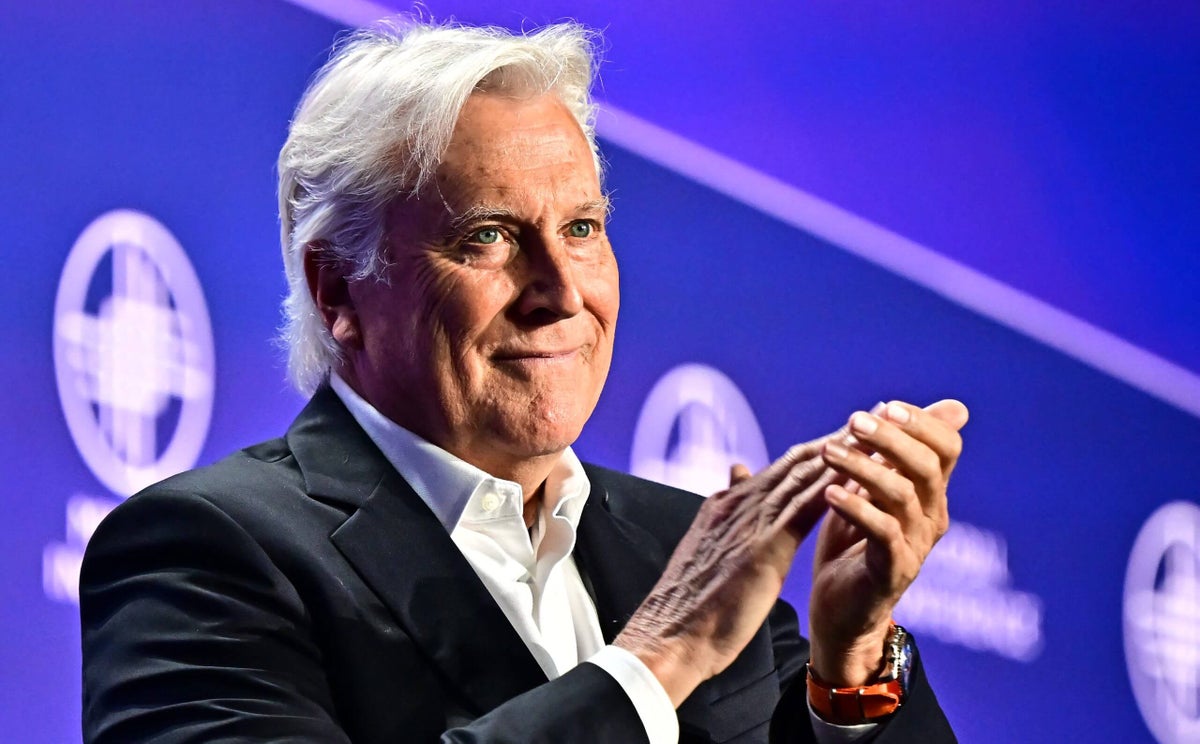
Mark Walter stood next to Donald Trump with his hands clasped and his eyes focused on the president, who spoke to a crowd about the power of the Oval Office and the “most important people in the world” who visit it.
Walter, 66, was among those visitors. So were members of the Los Angeles Dodgers, the MLB juggernaut that Walter has owned since 2012. The team was attending a ceremony in July at the White House to celebrate its 2025 World Series victory, marking the Dodgers’ second consecutive championship and third in six seasons.
During his speech, Trump hailed the Dodgers as winners and mentioned the late New York Yankees owner George Steinbrenner, whom he called a friend. “He would do anything to win. … But, you’re doing the same thing. It’s amazing, Mark,” Trump said.
Walter made a brief speech in which he thanked the president, and later presented him with an engraved World Series ring and a jersey with “Trump 47” on the back.
The event gave the public a rare look at a billionaire who has maintained a low profile for years despite running a sprawling business empire that includes some of the most famous franchises in sports.
But last week, Walter found himself in the headlines not for any team he owned but rather for one he sold, the NBA’s Los Angeles Lakers.
Just 14 months after agreeing to buy the iconic franchise, Walter agreed to sell the Lakers to former Disney CEO Bob Iger and Thrive Capital founder Joshua Kushner, the younger brother of Trump’s son-in-law Jared Kushner. The stunning deal reportedly valued the Lakers at $12.5 billion — $2.5 billion more than when Walter agreed to purchase the team. The timing of the sale has raised eyebrows not just for the brevity of Walter’s tenure as owner. Federal investigators are investigating insurance companies he owns.
Walter did not respond to messages seeking comment for this story, and federal officials at the agencies conducting the probe declined to comment.
Walter’s appearance at the White House put the owner in the public eye. The Lakers sale has now put his business empire there, too.
Long before Walter became a sports mogul, he built his fortune in finance.
An Iowa native, Walter attended Creighton for his undergraduate degree in business and earned his law degree from Northwestern. Beginning in the 1990s in Chicago, he co-founded multiple financing and investment firms, and now serves as CEO of both Guggenheim Partners and TWG Global, a holding company with investments across industries, including sports, entertainment, technology and artificial intelligence.
The Bloomberg Billionaire Index estimates Walter’s net worth at $18.3 billion, and his sports portfolio includes the Premier League’s Chelsea FC, the WNBA’s Los Angeles Sparks, the Professional Women’s Hockey League, Cadillac F1 and the Billie Jean King Cup in addition to the Dodgers and, until last week, the Lakers.
But as he accumulated such enormous wealth, he kept an unassuming public profile. His hometown paper in Cedar Rapids wrote in 2012 that many in Walter’s high school class of 1978 had no idea what he was up to until news broke that he had purchased the Dodgers. Unlike some of the NBA’s more flashy team owners, Walter was an understated figure during his occasional courtside appearances, favoring jeans and sneakers.
Recently, though, he has found himself receiving some unwelcome attention.
Bloomberg and the Financial Times reported that the Federal Bureau of Investigation seized Walter’s phone and laptop last year. A spokesperson for the FBI declined to comment.
Two of Walter’s companies — Delaware Life Insurance Company and its affiliate Clear Spring Life and Annuity — received grand jury subpoenas in February as part of an investigation by the U.S. Attorney’s Office for the Southern District of New York, the company acknowledged in a March regulatory filing. A parallel investigation is underway by the Securities and Exchange Commission, the filing noted. (The U.S. Attorney’s Office and SEC declined to comment.)
Life insurers typically invest in relatively safe and low-risk assets to provide predictable returns, and insurers are required to report transactions with affiliated businesses to regulators as a safeguard to protect policyholders and guard against conflicts of interest. Delaware Life said investigators are examining whether investments tied to affiliated businesses had been improperly reported as unaffiliated.
The company said through a subsequent internal investigation it had identified errors in how related business investments were presented in the company’s 2025 annual statement. In all, the filings show Delaware Life revised its disclosures to identify nearly $17 billion more in investments tied to related businesses, increasing its share of the company’s portfolio from about 3 percent to 42 percent.
One of the investments that appears to be caught up in the reclassified dealings was a $4.1 million loan to Dodger Tickets LLC, a subsidiary tied to the Dodgers and involved with ticketing and other business operations. Delaware Life listed that loan as unaffiliated in its 2025 annual statement. In the March filing, the same investment was listed as affiliated.
Dodgers president and CEO Stan Kasten was listed as CEO of Dodger Tickets LLC on an April 2025 business filing with California’s Secretary of State. Kasten declined to comment on the organization’s corporate entities.
As a result of the revised investments, S&P Global Ratings last month changed its outlook for Delaware Life from “stable” to “negative.” S&P at the time also affirmed its A- financial strength rating for the company.
Group 1001, the Walter-controlled holding company that owns Delaware Life and Clear Spring Life, said last month in a statement to The Athletic that it was “cooperating fully” with the U.S. Attorney’s Office and SEC investigations, and its policy was not to comment on pending governmental inquiries. Group 1001 also said it plans to “reduce and restructure certain of the investments at issue” in response to the errors, though it did not specify which investments.
“Our capital position and liquidity remain strong, and our financial strength ratings are unchanged,” the statement said. “We remain focused on delivering exceptional value and service to our contract and policyholders and their financial representatives.”
The probes related to Walter’s insurance companies are not the first time his business dealings have faced federal scrutiny. Most recently, Guggenheim agreed in 2024 to pay the SEC $15 million over “widespread and longstanding” recordkeeping violations involving employees’ off-channel communications.
Those recordkeeping rules are designed to protect investors and to allow the SEC to ensure securities laws, including antifraud provisions, are followed.
“The Commission staff’s investigation uncovered pervasive off-channel communications at various seniority levels” at Guggenheim, according to the SEC administrative order. “The investigation determined that nearly all broker-dealer and investment adviser personnel sampled had engaged in at least some level of off-channel communications.”
Walter led a consortium that purchased the Dodgers in 2012 and included Magic Johnson, Todd Boehly and Kasten as minority partners. At the time, Walter was a Chicago Cubs season ticket holder, according to the Chicago Tribune.
He told the paper he signed on to the deal to buy the Dodgers because you “don’t get two chances to buy the Dodgers.” He added: “I just saw it as a once-in-a-lifetime opportunity.”
He told the Los Angeles Times that he viewed the purchase as a legacy.
“It’s a multi-generational thing my daughters’ granddaughters will own,” he said at the time.
Kasten, a longtime sports executive, praised Walter’s leadership style, saying he closely follows the franchise but is comfortable delegating rather than micromanaging.
According to Kasten, when the two partnered for their Dodgers bid, Walter told him, “Look, Stan, I am a baseball fan, and I have a lot of opinions, and you’re gonna hear all of them, and you are to disregard all of them, because if I was making these decisions, I didn’t need you.”
Kasten said Walter has indeed given executives latitude over time, including encouragement to flex the organization’s financial muscle, resulting in eye-popping free-agent signings and investment in scouting and player development.

Walter poses with Shohei Ohtani at a news conference at Dodger Stadium. Kirby Lee / USA Today Sports
Since 2024, the Dodgers have topped all MLB teams in luxury-tax payrolls and signed megadeals with players such as Shohei Ohtani, Kyle Tucker and Yoshinobu Yamamoto, structuring some of those contracts with significant deferred payments. In August, the Dodgers surprised the baseball world by landing coveted pitcher Tarik Skubal in a blockbuster trade with the Detroit Tigers.
“Mark has continued to remind us of the value of spending a little more if it was gonna deliver a bigger ROI, to be a little bold when necessary,” Kasten said Thursday.
Kasten said he wasn’t aware of Walter’s plan to sell the Lakers, and his understanding was that the deal came together quickly.
“It was a surprise to me,” Kasten said, “but Mark’s an awfully smart guy and a savvy investor, and if this is what he thinks is best, I feel pretty confident that’s exactly what it is.”
Kasten maintained that the sale of the Lakers is not related to the Dodgers and changes are not coming to the organization. “We don’t have visibility into every other company he owns or any other company he owns,” he said.
Two years after Walter bought the Dodgers, he made a play for the NBA.
In 2014, Walter was part of a group reportedly offering $1.6 billion to buy the Los Angeles Clippers; the group included billionaire media executive David Geffen, Oprah Winfrey and Oracle Chief Executive Larry Ellison, according to reports at the time. The winning bid, however, went to former Microsoft Corp CEO Steve Ballmer, who purchased the Clippers for $2 billion, then a record for a professional basketball team.
It would take more than a decade, but Walter would land a Los Angeles basketball team.
Walter, who first took a minority stake in the Lakers in 2021, purchased the team from the Buss family in 2025 — at a then-record $10 billion valuation at the time of the agreement. The purchase made him the team’s first new controlling owner in 46 years.
Just 14 months later, the Walter period was the shortest majority ownership tenure in the organization’s history.
Walter’s purchase of the Lakers was supposed to lead them from their family ownership past into a new era of modernization. Essential infrastructure was to be bolstered, and innovative ideas regarding analytics, scouting and medical were to be assembled. To those around the NBA, the influx of capital and brain power was a formidable combination — the Lakers, who already enjoy geographic and brand-recognition advantages, were now getting a heaping of baseball’s best front office and ownership group.
But at least on the basketball side of the operation, few of those changes took hold. The bigger moves under Walter’s leadership were designed to increase profits. The Lakers conducted multiple rounds of layoffs and announced a significant increase in season-ticket prices, with some raised by more than 40 percent.
“It was a weird vibe last year,” said one well-placed league source, who spoke on the condition of anonymity because of an ongoing relationship with the team.
The Lakers also moved their G League affiliate from inside its El Segundo facility to the Coachella Valley near Palm Springs, a business decision that frustrated Lakers basketball executives because it distanced the team from its developmental players and coaches. The Lakers often utilized that arrangement, such as last season when LeBron James needed full-contact practices after returning from injury.
The business department, led by Walter’s longtime Dodger associate Lon Rosen, negotiated sponsorship deals for the Lakers’ jersey and, in an organizational first, for the Laker Girls dance team. They also added more courtside seating and relocated media members so the team could sell those lower-level seats.
The Lakers weren’t Walter’s only sports property that saw changes. The PWHL, originally owned entirely by Walter, added its first outside investors in June — reportedly $100 million from Kilmer Sports Ventures and Ilitch Companies, according to Sportico. The league finished its third season in May, and Kasten, who also serves as a PWHL executive, said in June that the infusion of cash will help “continue the momentum.” Meanwhile, the high-spending Dodgers are looking ahead to another postseason run.
David Carter, a longtime southern California-based sports-business strategist and principal of the Sports Business Group, said the timing of the Lakers sale has led to wide speculation about Walter’s motivations. Meanwhile, Kushner’s family connections to Trump sparked theories about whether the President was involved. A White House spokesperson told Front Office Sports: “This has nothing to do with President Trump or his administration.”
At this point, with few details known about the status of the federal investigation, Carter urged caution in connecting dots.
“I think we probably need to give this thing a few months for it to settle and then I think there will be an opportunity to look back in a little bit more of a sober fashion and say ‘Gosh, of course that made sense, he wanted to do it for this express purpose,’” Carter said.
Dan Woike contributed to this report.
>
FORT WORTH, Texas — Standing on the side of a practice field in late April, watching a training session for eight college defensive linemen they represent, Jacob Piasecki and Francesco Tricomi are discussing a topic they relish: people who can’t stand them.
“NFL agents have no f—ing clue how to do this,” Tricomi said.
Piasecki, 29, is the co-founder of A&P Sports Agency, an Austin-based company born five years ago at the dawn of college sports’ current era of chaos, and Tricomi, 26, is his director of operations. In just a few years, agencies such as A&P have barged into college sports like profane party crashers. They’re lamented by college coaches and general managers and resented by their NFL peers, who say they’re accountable to no one.
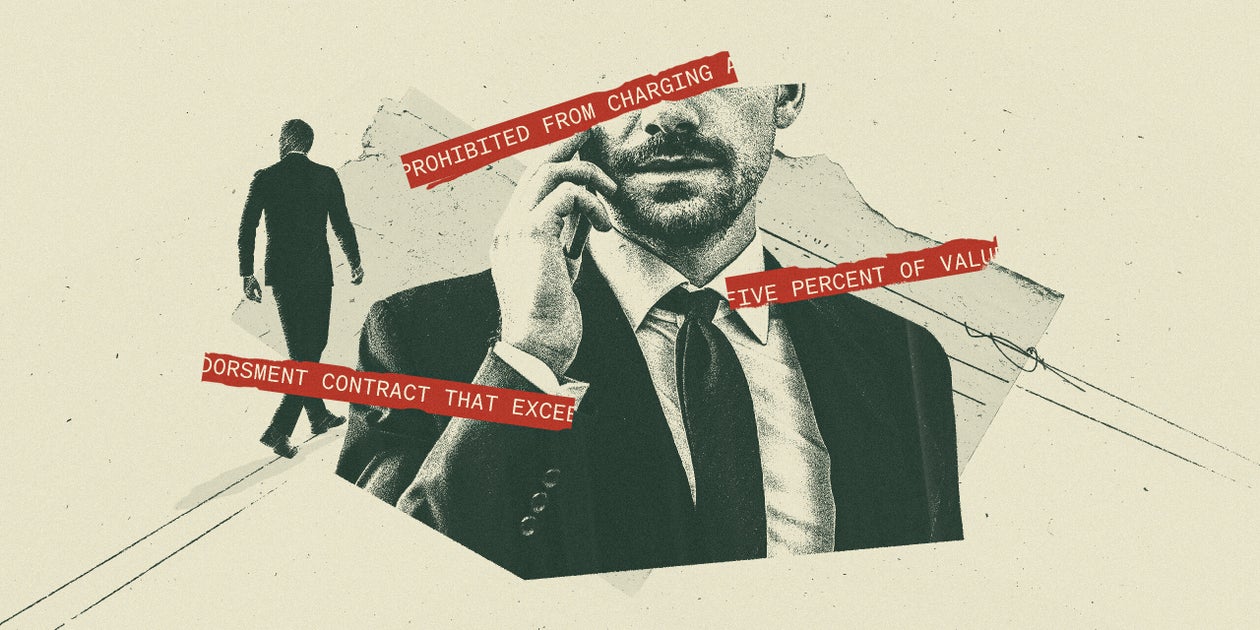
Without a central governing body or players union, NIL agents – who represent college athletes in financial deals involving revenue sharing and name, image and likeness rights that give the space its catch-all acronym – operate with little-to-no certification in an unfettered environment.
They can charge much larger fees than the 3 percent allowed by the NFLPA. Some shop players they haven’t even met. Some flood the Instagram DMs of high school prospects. Some push players to transfer who aren’t looking to transfer — so that the agency can get a cut of a new deal the player wasn’t even seeking.
Piasecki has landed on a one-word philosophy to describe the two industries — college football and athlete representation — his company helped reshape: discretionary.
“There’s no real rules,” he said. “So everybody is doing things at their own discretion.”
For those who have spent long careers representing athletes, the approach of the class of agents unleashed by NIL is maddening, if not a threat to their industry.
“You’re either an agent or you’re not,” said Buddy Baker, a longtime NFL agent. “You don’t get to just declare yourself an agent if you don’t have an expertise in this field. … Unfortunately, in this space right now, we don’t have any (oversight). People are just planting their flag and saying, ‘I am an agent.’”
“It’s bastardizing our profession, for sure,” said one longtime NFL agent, who like others interviewed for this story spoke on condition of anonymity in exchange for their candor.
“These guys, they’re not agents at all,” added another. “I’m trying to go through some handler who has no f—ing clue what my world is or what we’re doing. And he’s like, ‘How much money can you get them?’”
The 20-somethings at A&P have come to wear disparagement as a badge of honor, and there’s no denying their foothold: In the past college football transfer portal cycle, according to A&P, the agency negotiated more than $30 million in player contracts and many millions more in marketing deals.
“There’s certain things that I look for in people that even agents that have been doing whatever professional sport for 10, 15 years can’t match,” Tricomi said on the sideline of the practice field. “There’s no experience in this. That’s why we’re outperforming NFL agents in NIL right now.”
“You’re getting your ass handed to you by somebody who wasn’t even in this f—ing world five years ago,” Piasecki replied.
“If they didn’t hate us,” Tricomi added, “we were doing something wrong.”
Both Piasecki and Stefan Aguilera, three years his senior, ran businesses as undergrads at Texas A&M — Piasecki a social app for college students, Aguilera an online publication titled The Aggazine that effectively served as a marketing agency. Bars paid Aguilera to post their specials, which led to him becoming a promoter, which led to him hanging out with football players. He got them in campus clubs cover-free; they attracted more people to the clubs.
It was an Aggies tight end, Jalen Wedemeyer, who first told Aguilera about the sea change coming to college football: It would finally be permissible to pay players for use of their name, image and likeness. Would he want to help out with some marketing deals? For Aguilera, a light bulb went off. He asked Piasecki if he wanted to start a broader business representing athletes.
“S—,” Piasecki said. “I see dollar signs.”
They launched A&P on July 1, 2021, the first day college athletes could legally profit from NIL.
At first, Piasecki said, “there was no f—ing dollar signs.”
At that point, NIL reps were essentially marketing firms. Players inked deals with local businesses and promoted them on social media or in commercials. “Other agents were very dismissive,” Piasecki said. “No one took NIL seriously back then. In ’23, ’24, it was still looked down upon, as a joke.”
How we established ourselves in the NIL Space pic.twitter.com/qDtoY4VJxT
— Jacob.Piasecki (@Jacob_Piasecki_) June 27, 2023
But the world changed in June 2025 when a court ruling enabled schools to pay athletes directly through revenue sharing. The term “NIL agent” became a misnomer — most make more negotiating contracts with schools than on actual name, image and likeness deals. A&P said it negotiated $12 million in contracts in 2024. The firm said it just surpassed $30 million in 2026, including a deal for an SEC left tackle for $2.75 million.
Matt Brownstein saw the shift coming. A longtime baseball agent for CAA, perhaps the most powerful sports agency on the planet, he left for A&P in January, wanting the opportunity to shape an industry and build something new without constraints. “I know Congress is trying to get involved, but there’s really no rules to this,” Brownstein said. “And I kind of enjoy the chaos.”
Plenty have deemed it “the Wild West.” Several agents, coaches, and general managers cited the practice of pitching a player to schools before he’s even aware he’s being marketed: Self-proclaimed agents will call a program, gauge its interest, and set the price. The agents then will take that price to the player — whom they have never met — and guarantee the deal if he signs with them and enters the portal.
“Every agent is going to go after everybody’s guys,” Piasecki said. “It’s not like we have this creed where it’s like, ‘Don’t go after our players.’ Everyone is always trying to get other people’s players. I just think if your client is happy, they’re not going to explore options.”
Some stories stretch beyond lawlessness into absurdity. In early July, Noah Reisenfeld, an NIL agent with a prominent social media presence, sued the agency Young Money AAPA — co-founded by rapper Lil Wayne — for breach of contract, alleging they treated him as an employee rather than an independent contractor, and directed him to represent NFL players despite not having NFLPA certification. (In the lawsuit, Reisenfeld described himself as “a pioneer” and “passionately motivated.”) Young Money filed a counterclaim, which included allegations that Reisenfeld smoked marijuana inside a Florida home the agency rented and “left his dog’s feces all over the Property.”
Lawmakers have taken note. The Protect College Sports Act — backed by both the Big Ten and SEC earlier this month — includes a section devoted to college agents. It caps their fees at 5 percent, prevents them from signing players beyond their college eligibility and bars them from misrepresenting themselves or making false promises about future contracts.
As it stands now, a handful of states require potential agents to join a registry with minimal effort — fingerprints, an annual fee. But there is no central clearinghouse or competency standard. The result: mayhem for coaches and general managers, who often receive calls from different people claiming to represent the same player. Boston College coach Bill O’Brien said he spoke with around 75 agents during the last portal cycle alone.
The vast majority of players and their families lack the experience and savvy to navigate the subtleties of the transfer portal. Several coaches and general managers expressed concern that they may be entrusting their futures to agents with similar naivety.
“When one player comes here, he’s like, ‘Yeah, I’m talking to him and him and him,’” Nebraska GM Pat Stewart said. “They’re talking to multiple different agents to try to get advice without signing a deal with them. That becomes kind of a chaotic situation as well.”
After Colorado State changed coaches this offseason, GM Alex Collins struck a deal with one of the players who’d entered the portal. “He goes, ‘OK, I think I’m gonna fire my agent. I don’t need one now,’” Collins said. “I’m like, ‘OK, that’s not how agencies work.’”
At Boston College, O’Brien instituted an agent education program for players. He had seen too many players taken advantage of by the people hired to protect their financial interests. Reisenfeld said in a YouTube interview last year that the standard fee charged by NIL agents is 20 percent. Depending on a player’s situation, Piasecki said, A&P charges between 7 and 10 percent.
“You pay the kid 100 grand,” O’Brien said. “You say to the kid, ‘What are you paying this agent?’ And he says, like, 10-15 percent on a $100,000 contract that that particular agent didn’t do anything for. That’s crazy.”
During one transfer cycle, Virginia Tech general manager Andy Frank received an email from an agent with a list of players looking to enter the portal. One was on his roster. “We talked to the player. He’s like, ‘I had no idea he was doing that,’” Frank said. “I believe him.
“I want to be sure I’m not the guy who says, ‘Oh, all these agents are bad.’ Because they’re not,” Frank added. “There’s a lot of them that are doing a good job for their clients. … The things that really get to you is when they’re doing things that their clients don’t necessarily want or aren’t interested in.”
The lack of transparency creates other issues. Every NFL agent can look up any contract in the NFLPA’s database, effectively making the deals public. For NIL, no such reporting exists.
“There’s a guy I used to work with,” one longtime NFL agent said. “He loves NIL because he sucks as an agent, and (now) he’ll never get exposed.”
Experienced agents have had to relearn parts of their job and find new ways to approach it. One joked about buying shaving kits for high school players.
“Nothing feels right about what you’re doing,” he said. “But you’re doing it to make a living.”
This agent resisted dipping into the NIL space until a client he had signed — a player who would’ve been a top-100 pick in last spring’s NFL Draft — decided to stay in college. “So he gets a seven-figure deal and I get paid on that NIL deal, and I’m like, ‘Gosh, dude, that’s so much money. And it’s so much easier.’”
It’s late April. Piasecki lounges on a couch inside a western wear shop on the main drag of Fort Worth’s stockyards, holding a can of Montucky Cold Snack. A handful of A&P clients are perusing the merchandise — caiman skin boots, oversized belt buckles — after a day of training. A defensive end A&P steered from UNLV to Virginia asks if he can buy a belt. A defensive tackle who transferred from Texas to UConn tries on a black cowboy hat and makes finger guns in the mirror.
A videographer captures it all, footage that will later flood A&P’s social media feeds.
An NIL deal isn’t merely quick cash for an athlete; it’s a vital promotional tool for an agency. The landing page of A&P’s website features a video of former USC wideout Brenden Rice (Jerry’s son) driving a Ferrari. Its Instagram feed is dotted with videos of players shopping at Johnny Dang and Co., the famous Houston jeweler.
The glimmering pieces they’re showing off? The players don’t actually own them. A&P buys the jewelry for them to wear, then returns it at the end of their contract unless the player chooses to buy it. Rivals whisper that A&P is fooling its clients into thinking they own jewelry worth five figures.
“They can hate all day if they want,” Tricomi said. “Guys love it. We love it. A lot of them are trying to replicate it.”
A&P insists they buy the jewelry with the players’ best interest in mind: Rather than the players blowing money on expensive baubles, the agency can effectively rent it for them.
“We can scratch that itch for them so they don’t start a bad habit with all that spending,” Tricomi said. “It’s good promotion for us. That’s a whole other network. (Jeweler) Johnny Dang is like a cornerstone of hip-hop, so the kids, they love him.”
In many ways, A&P has matured alongside the industry, creating its own limits rather than testing them. A&P partnered with high-profile lawyer Tony Buzbee, another Texas A&M alum, whose firm handles legal issues and contractual details. It teamed with a financial adviser to create a “financial fitness playbook” for clients. The firm’s leaders bemoan practices such as agents selling players they’ve never met, and they say they don’t recruit high schoolers. This spring, in an expansion of their services, A&P paid for training sessions for clients, grouped by position, with well-known skills coaches. (The resulting online content juiced their recruiting efforts.) They see NFL representation as part of their future, and already they have shifted focus to help as many clients as possible reach the league.
“For us, it’s more so, what is the best fit for the player?” Piasecki said. “In combination with the money and the playing time, the scheme, the coaching staff – does it all align and get him to where he wants to be?
“As a fan, you don’t see that. As a fan, you probably think we’re the biggest assholes because we destroyed your team. We just annihilated your O-line room or your D-line room.”
It’s not just fans. In late May, Piasecki paced across a conference room in a half-filled office building by a highway on the outskirts of Austin and dialed the general manager of a Power 4 school.
“The man, the myth, the legend!” the GM answered.
Piasecki checked in on clients who played at the school, got a tip about an emerging player who needed representation and chatted about the school’s chances this fall. Then the general manager delivered some gossip.
“People have s— to say about y’all,” the general manager said. “And people try to badmouth y’all.”
As much as their business has boomed, A&P retains a degree of fake-it-till-you-make-it energy. A day after speaking with the Power 4 GM, Piasecki sends an Instagram direct message to the prospect he recommended.
“Love your game,” he writes. “I just finished watching your tape with our scouting department. Are you available to connect on a call?”
Piasecki looks up from his phone, about to say something he swears he usually wouldn’t. But time is of the essence, and Will Scott, the agent who comprises A&P’s scouting operation, is on a road trip.
“If he responds,” he says, “I’ll watch his tape.”
Back in the summer of 2021, Ohio State called its football players in for a series of meetings. The agenda was the financial opportunities now before them: endorsement deals, sponsorships, other means of revenue long barred by the NCAA. Inside the room, some started to speculate how much the Buckeyes’ most recent quarterback, Justin Fields, would have made under NIL.
“Someone mentioned $1 million,” said Zen Michalski, a freshman offensive tackle at the time. “And we were all like, ‘What!?!’”
Today, top-tier quarterbacks make up to six times that.
“I was the starting quarterback for a small Division II school,” vented one longtime NFL agent. “And NIL was meant for me to not have to pay for my cheeseburger and fries and milkshake at Grumpy’s. It’s not meant to make kids freaking multimillionaires and become a profit share.”
But, thanks in large part to revenue sharing, that’s exactly what it’s become, an arms race devoid of guardrails.
Michalski fired his first agency after it pushed him to transfer from Ohio State before he was ready. “I want to graduate first,” he told them. So he stayed in Columbus, earned his degree and helped the Buckeyes win a national championship. A year later, repped by a new agency, he took less money to sign with Indiana because he felt it was the best fit. In January, he added a second national championship.
“You have to be really, really careful,” Michalski said. “Some agents will come in and act like they want what’s best for you. They want the quickest paycheck.”
The money flowing into college sports, particularly football, isn’t slowing down. Those who saw dollar signs early are cashing in. Piasecki was back in his office the morning of May 27, hours after lawmakers rolled out the Protect College Sports Act that Congress continues to debate. He wondered whether an antitrust exemption would hold up in court if it capped athletes’ salaries without collective bargaining.
He noted that college football actually once had a salary cap of sorts — a college education, plus room and board, for every scholarship player — and for decades most every serious program in the sport circumvented that agreement through widespread under-the-table payments.
“How do you fix a system,” Piasecki asked, “when the system is based on not following the rules?”
>
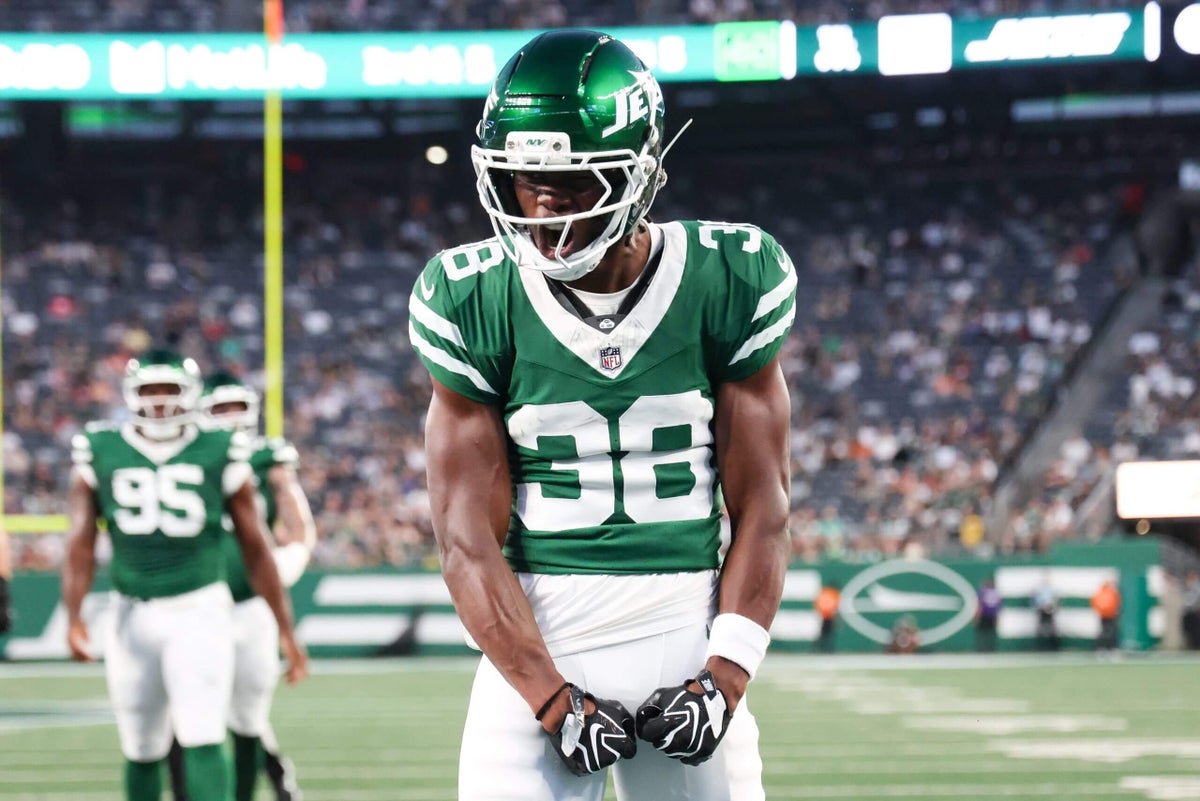
The New York Jets are through 10 training camp practices (two of them joint) and one preseason game. There’s plenty of time to get a better feel about where the roster stands, who is most likely to stick around and who is on thin ice.
Here’s a stab at the 53-man roster in the wake of Friday night’s preseason opener against the Buccaneers:
Quarterback (2)
In: Geno Smith, Cade Klubnik
Out: Bailey Zappe, Brady Cook
Klubnik showed some poise in his debut. I was surprised he didn’t get more reps since he’s a rookie, but he’ll also get plenty of reps in the last two preseason games. As for Zappe and Cook, neither showed anything to indicate they’re serious threats to push Klubnik for the backup job behind Smith (who is day-to-day with ankle soreness, by the way).
I still wouldn’t rule out Darren Mougey adding a veteran quarterback to the room at some point, but I don’t personally find that to be the absolute necessity that others might. Bringing in someone like Will Levis wouldn’t seem to do much for the 2026 Jets.
Running Back (4)
In: Breece Hall, Braelon Allen, Isaiah Davis, Kene Nwangwu
Out: Andrew Beck, Chip Trayanum, Sam Scott
Hall will be the bell-cow, and Davis’s injury makes it likely Allen will emerge as the clear-cut No. 2 option behind him. Davis will still have a role, but Allen has had a good summer (again) and looked impressive in the preseason game, especially on a 31-yard touchdown run. The Jets like Beck both for his blocking and special-teams role, so it wouldn’t be shocking if he ultimately stuck around.
The two early MVPs of Jets training camp
Zack Rosenblatt
Wide Receiver (6)
In: Garrett Wilson, Adonai Mitchell, Omar Cooper Jr., Isaiah Williams, Tim Patrick, Arian Smith
Out: Malik McClain, Caullin Lacy, Jamaal Pritchett, Cam Camper, DT Sheffield
Williams has clearly jumped ahead of Cooper on the depth chart. It’s far too early to panic, and Cooper showed some things in the preseason game that indicate his skill set is better suited for games than practices, where contact is limited. Wide receivers coach Shawn Jefferson did have an interesting quote about Cooper last week: “Omar is doing fine. I got on him because last week he had some pitfalls, and that’s being a rookie; it’s camp days. You’re not used to all the drag and the mundaneness of it. But that kid is going to be all right.”
As for the rest of the group, Patrick was playing with the backups on Friday. That usually isn’t a great indication for a veteran player, but this coaching staff does value the veteran presence he brings, and he can be useful as a blocker. There aren’t really any viable backup outside receivers currently in the room unless the Jets really believe in undrafted rookie Malik McClain, who has had some moments.
Smith’s issues with drops don’t appear to have healed with time. He had a drop on Friday that he deflected into the arms of a Buccaneers defensive back for an interception. His only shot at sticking around the roster is on special teams — and maybe the juice of being a fourth-round pick a year ago saves him.
Pritchett has played well both as a returner and receiver this summer, but I’m just not sure where his place is on the roster. Maybe a returner-needy team might be willing to trade a draft pick.
Tight End (4)
In: Mason Taylor, Kenyon Sadiq, Jeremy Ruckert, Jelani Woods
Out: Chase Curtis, Connor Hulstein
Sadiq should be back at some point in the next couple of weeks, and this tight end room will be full. I’m of the mind that Woods is safe at this point — both because of the way coaches talk about him and because he’s such a unique player. This feels like one of the best position groups on the roster — when was the last time you could say that?
Offensive Line (9)
In: Olu Fashanu, Armand Membou, Joe Tippmann, Dylan Parham, Josh Myers, Chukwuma Okorafor, Max Mitchell, Xavier Newman, Anez Cooper
Out: Landon Young, Kohl Levao, Courtland Ford, Liam Fornadel, Marquis Hayes
I have serious concerns about the state of the center position if Myers goes down. The Jets could theoretically move Tippmann back over, but he hasn’t practiced at center all summer. Newman has been the primary backup and he’s had some snapping issues. I’m not sure what quality of center will be available on the waiver wire post-camp, but it’s something worth keeping an eye on.
Cooper flashed some serious potential on Friday, albeit with the third unit. He didn’t allow a single pressure or sack in 20 pass blocking snaps and PFF had him graded as the Jets’ best offensive lineman.
Defensive Tackle (5)
In: T’Vondre Sweat, Harrison Phillips, David Onyemata, Jowon Briggs, Darrell Jackson
Out: Payton Page, Mazi Smith, Jack Heflin, Junior Tafuna, Ben Barten
Sweat was activated off the Non-Football Injury list and should return to practice in the near future, a boon considering his importance to the fabric of this defensive line. Jackson has flashed throughout the summer and could play a rotational role as a rookie even with four solid veterans ahead of him.
Both Page and Heflin have also had moments this summer and should stick around on the practice squad.
Outside Linebacker (4, plus one on PUP)
In: David Bailey, Will McDonald, Joe Ossai, Kingsley Enagbare
Out: Braiden McGregor, Kingsley Jonathan, Nathan Voorhis, Paschal Ekeji
PUP: Tyler Baron
This group has been banged up all summer, which is the main reason I nearly had McGregor sticking around yet again. Enagbare has been in and out of the lineup and Ossai has yet to practice. Bailey, if you haven’t heard, has looked like a budding star already. McDonald had a sack against the Bucs; it seems like Bailey is already drawing enough attention that it could clear the way for a nice season for McDonald.
Inside Linebacker (5)
In: Demario Davis, Jamien Sherwood, Kiko Mauigoa, Mykal Walker, Marcelino McCrary-Ball
Out: Chase Wilson, Jaden Keller
This might be the most concerning spot on the roster depth-wise. Walker has made some plays this summer — he has intercepted a couple passes in practice — but both he and McCrary-Ball are primarily special-teams players. If either Davis or Sherwood were to go down, the Jets would be in trouble here.
Cornerback (7)
In: Brandon Stephens, Azrareye’h Thomas, Nahshon Wright, Jarvis Brownlee, D’Angelo Ponds, Qwan’Tez Stiggers, Mory Bamba
Out: Tre Brown, Jordan Clark, Samuel Womack
Seven cornerbacks is a lot — maybe too many — but Bamba showed enough on Friday night that I couldn’t keep him off. Sure, it was against the Buccaneers’ backups, but he flashed some real potential and his unique blend of size (6-2) and athleticism makes him especially intriguing. Bamba had two pass deflections and only allowed four receptions on 10 targets.
“I think some of the younger DBs showed up and he’s the one that really stands out,” Jets head coach Aaron Glenn said after the game.
Both Wright and Stiggers were out, which gave Bamba reps with the second unit. Clark also played well and will push for a spot on the practice squad again.
Safety (4, plus one on IR)
In: Minkah Fitzpatrick, Dane Belton, Andre Cisco, Malachi Moore
Out: Jarius Monroe, Dean Clark
IR: VJ Payne
Belton clearly deserves to be starting over Cisco at this point. It has been a disappointing summer for Moore, who the Jets were very high on a year ago. He ran with the third-team defense on Friday and didn’t make a dent — he hasn’t stuck out much in practice either. His roster spot is still safe, but I’m not sure how much of a role he’ll have this season.
Payne was on a good track before an injury knocked him out for a few weeks. The NFL allows teams to designate two players for injured reserve prior to final cuts with a designation to return, and he feels like a candidate for one of those spots.
Special Teams (3)
In: K Jason Sanders, P Austin McNamara, LS Thomas Hennessy
Out: K Cade York
York and Sanders have gone back and forth. On Friday, York made two short field goals but the second was questionable while Sanders nailed a 47-yarder. Sanders was iffy in the joint practices but has overall been the better kicker and has a longer history of NFL production.
>

The Lakers sale and a federal probe put Mark Walter in a spotlight he never sought

In college sports’ NIL era, ‘there’s no real rules’ for agents. And some like it that way

Seven cornerbacks? New York Jets’ 53-man projection after their preseason opener
-

 movies3 months ago
Search For Canadian TV Actor Stewart McLean Now Homicide Investigation
-

 Fashion9 years ago
These ’90s fashion trends are making a comeback in 2017
-
Fashion9 years ago
According to Dior Couture, this taboo fashion accessory is back
-
Fashion9 years ago
Model Jocelyn Chew’s Instagram is the best vacation you’ve ever had
-
Fashion9 years ago
Emily Ratajkowski channels back-to-school style
-
Fashion9 years ago
9 Celebrities who have spoken out about being photoshopped
-
Fashion9 years ago
Your comprehensive guide to this fall’s biggest trends
-
Fashion9 years ago
A photo diary of the nightlife scene from LA To Ibiza