
Tech
Turn an Android Phone Into a Desktop PC: What Actually Works

A modder strapped two desktop CPU coolers to a ZTE Nubia Z70 Ultra and got The Witcher 3 running locally at 1080p on the Ultra preset.
That is about as literal as “turn your phone into a PC” gets.
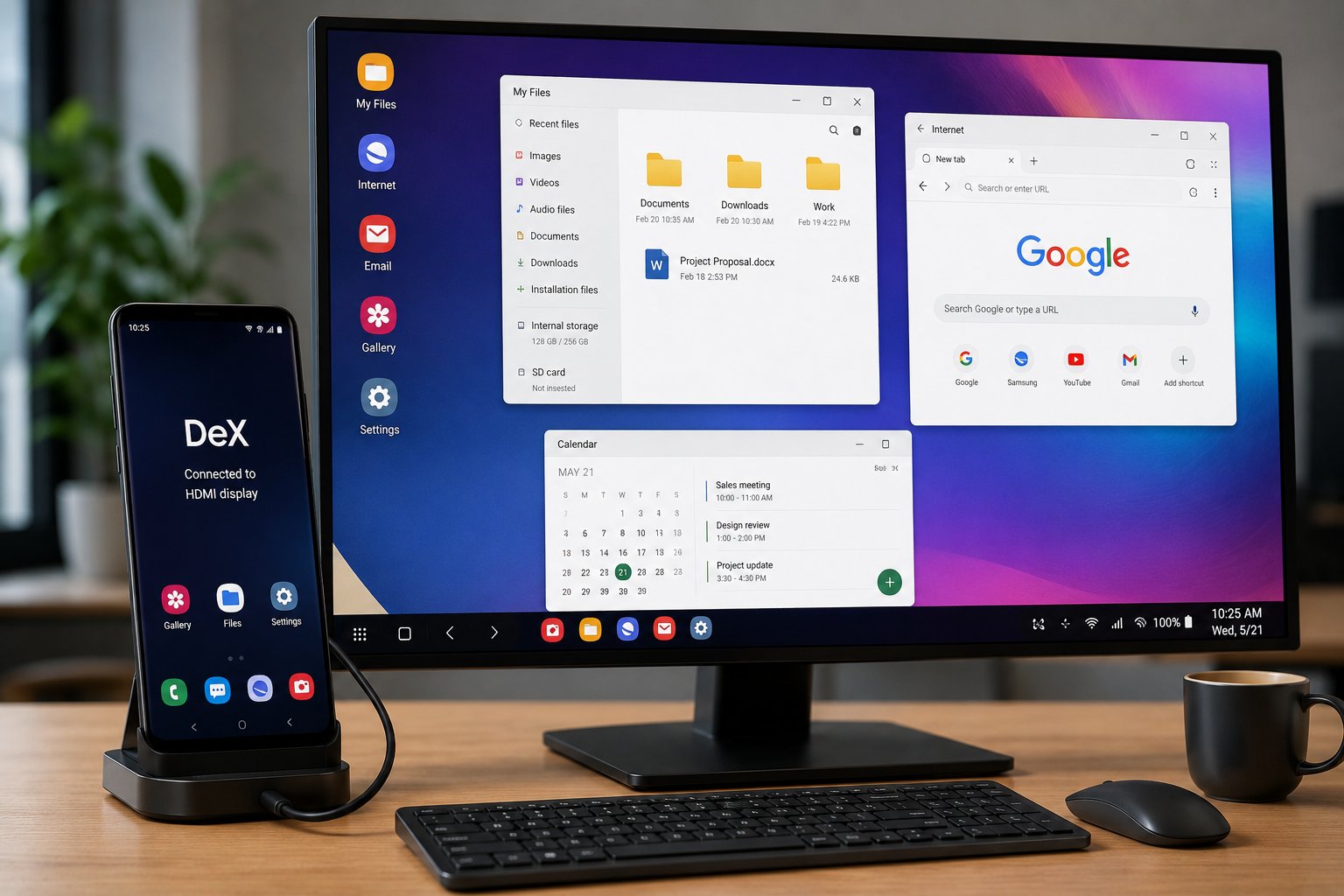
The hardware was pushed far beyond a normal handset configuration, but supported Android phones can now deliver a desktop-style setup with an external monitor, keyboard, and mouse, no heatsink sandwich required. Google brought connected-display desktop support to Android 16 QPR3, while Samsung continues to offer DeX on compatible Galaxy devices.
The ZTE mod pushes Snapdragon hard
The Nubia Z70 Ultra used in the build has a Snapdragon 8 Elite, 24GB of LPDDR5X RAM, and 1TB of UFS 4.0 storage.
According to Tom’s Hardware, the creator removed the cameras and mobile-network hardware, moved the display into a custom enclosure, and mounted desktop heatsinks around the remaining components.
The cooling paid off. In a 20-loop 3DMark Wild Life Extreme stress test, the rig posted 99% stability, with scores ranging from 6,910 to 6,980.
The creator also built an XFCE Linux desktop through Termux and used Turnip graphics drivers with Wine, Box64, Hangover, and GameNative to run Windows software locally. The Witcher 3 reportedly managed about 20 to 30 FPS at 1080p Ultra, with GPU utilization near 99%.
Those results come from the creator’s setup and have not been independently reproduced. They also depend on heavily modified hardware and an unofficial software stack.
Running Geralt at 30 FPS is impressive; managing 200 phones built that way would be a different adventure.
How to actually use your phone as a desktop
For supported Android phones, the practical setup is much simpler.
Google says connected-display desktop support reached general availability with Android 16 QPR3 on supported Pixel and Samsung devices. The phone can keep its normal screen while the monitor opens a separate desktop session with free-form windows, a taskbar, and keyboard and mouse support.
- Check that your phone supports desktop mode. Google lists supported Pixel and Samsung devices, while the earlier Pixel desktop-mode rollout shows how Android has been moving toward larger-screen workflows.
- Connect an external display. A supported phone can connect to a compatible monitor over USB-C or an appropriate HDMI adapter. Samsung DeX can also connect wirelessly to a compatible display.
- Add a keyboard and mouse. Android’s desktop environment supports physical keyboards, mice, and trackpads. Apps can open in movable, resizable windows rather than stretching the phone interface across a larger screen.
- On Samsung, launch DeX. The Galaxy S26 series supports both wired and wireless DeX. For a wired setup, connect the phone to a compatible display through USB-C or HDMI and tap Start if prompted; if the prompt does not appear, open Quick Settings and select DeX. For wireless use, Samsung’s instructions direct users to Settings > Connected devices > Samsung DeX > Connect wirelessly, then select the display and tap Start now. DeX supports resizable windows, keyboard and mouse input, and using the phone itself as a touchpad.
For managed deployments, Samsung’s Knox Platform for Enterprise can configure DeX behavior and restrict unwanted apps or features. IT teams should still test displays, docks, peripherals, and business apps on the exact devices they plan to deploy.
Samsung’s August security update patched 56 Android and One UI vulnerabilities, reinforcing the need to keep phones used as desktop endpoints within normal mobile patching and lifecycle policies.
Windows-game emulation sits outside that support model. Wine and Box64 can stretch ARM phone hardware remarkably far, but Android desktop mode and DeX are the realistic choices when reliability, management, and vendor support matter.
Also read: Google’s Pixel 11 brings Tensor G6, deeper Gemini integration, and seven years of software support.
>
Tech
Sound-powered fire protection startup gets $15M to snuff out fires before they turn catastrophic

For over a century, fire protection has been limited to water and chemicals. And while they can prevent catastrophic fires, the cleanup bills can be significant.
But maybe not for long. Sonic Fire Tech is testing a sound-powered fire protection system, which it says snuffs out fires within seconds while also sparing properties from messy water and chemical damage. The company announced Monday that it has raised a $15 million round led by the O.H.I.O. Fund with participation from Khosla Ventures. The startup previously raised a $3.5 million seed in October.
The fresh funding will help the Ohio-based startup hire more employees and run the battery of tests needed to earn approval from the National Fire Protection Association, which writes model codes adopted by fire departments around the country.
Approval typically takes about three years, but co-founder and CEO Geoff Bruder told TechCrunch he thinks that Sonic Fire Tech’s process will be “significantly shorter than that.”
Part of Bruder’s optimism stems from the fact that Sonic Fire Tech’s system doesn’t leave a mess after a fire suppression event, which should speed up the process. The tests are conducted in a lab and preparation can take hours. With Sonic Fire Tech’s system, “they don’t have to do cleanup,” he said.
That advantage in the lab could pay dividends in the real world. Commercial kitchens, for example, can face months of cleanup and restoration following a fire. Some 75% of them don’t reopen, Remington Bixby Hotchkis, Sonic Fire Tech’s COO, told TechCrunch.
Sonic Fire Tech’s acoustic fire suppression system uses a sound generator to pump inaudible sound through PVC pipes in the ceiling. When sensors in a room detect a fire, the generator kicks in and infrasonic waves, around 20 Hz, bombard the flames.
“We are the only technology that creates its own suppressant without collateral damage. False alarms are less of a concern for us,” Hotchkis said. “We deploy within seconds.”
That speedy response could stop fires before they cause significant damage, which has the insurance industry interested. The startup is in talks with insurers about whether the system will qualify for premium discounts. The insurance industry’s acceptance could speed adoption of the company’s product.
The system also shows promise when applied to lithium-ion battery fires, which are among the most challenging to put out. In the few tests Sonic Fire Tech has run so far, “we don’t put out a lithium-ion fire, but we contain it,” Bruder said. “If we’re able to keep the outer casing from lighting fire, we can potentially stop cell-to-cell spread and limit the size of the fire.”
Sonic Fire Tech is working on systems to protect the interiors of commercial buildings, kitchens, and homes, both for new construction and retrofits. The company has also been working on a system to safeguard the exterior of homes in wildfire country, though development of that has progressed more slowly as the startup waits for time at a suitable testing lab.
In addition to quicker fire suppression, Sonic Fire Tech’s system promises to lower restoration costs, if any are needed.
Today, about 500 jurisdictions mandate interior fire protection systems. But Bruder points out that 50% of home fires start in the kitchen, whether they be grease or electrical fires. Even a small Sonic Fire Tech system, focused on the kitchen, could go a long way to minimizing the risk of catastrophic house fires, lowering premiums in the process. “Sprinklers that they’re putting in now can’t handle those fires,” Bruder said.
When you purchase through links in our articles, we may earn a small commission. This doesn’t affect our editorial independence.
>
Google just made it a lot easier to make your AI creations look less, well, AI.
Gemini users will soon be able to switch off the visible watermark that stamps AI-generated images, videos and songs, according to an announcement from Google VP Josh Woodward on X.
The setting applies to content made with Google’s Nano Banana image model, Omni video model and Lyria music model. It’s rolling out first in Gemini and Google’s video editor, Flow, with support for Google Search “coming next,” Woodward said.
Once live, users will find the option under Settings > Media Watermark, per Google’s support documentation. Flip it off, and the small sparkle icon that normally sits in the corner of AI-made images and videos disappears.
The watermark is gone, but the label isn’t
Gemini-generated media will continue to contain an invisible SynthID watermark, while C2PA Content Credentials will provide information about the content’s origin. Google says these systems remain in place even when users disable the visible mark.
That distinction matters because visible labels are designed for quick recognition, while invisible systems require someone to actively check the content. Users can upload an image, video or audio file to Gemini and ask whether it was AI-generated. Gemini can detect SynthID from Google AI and inspect compatible Content Credentials, but a missing SynthID signal does not rule out content made with another company’s AI system.
Woodward said the company is trying to balance competing needs.
“We’re striking a balance here between creative control and safety: while the visible watermarks are now optional, invisible SynthID watermarks and C2PA metadata are still being used for transparency. So you can still use Gemini or Search to see if an image was AI-generated.”
The company has also open-sourced Credentio, a C++ library that lets developers validate C2PA Content Credentials locally. Google says content-credential generation and embedding capabilities are planned for a future release.
Not everyone gets the option
The feature will not be available everywhere. Google says visible watermarks will remain mandatory in countries where the law requires them.
Its support documentation also says users in India, South Korea and Vietnam will only see the setting with an AI Ultra subscription. Otherwise, visible watermarks will remain on their Gemini-generated media. Work and school accounts will not get the setting either.
Google’s approach also contrasts with the growing regulatory pressure around AI labeling. Some jurisdictions are moving toward mandatory visible labeling, while other AI companies are relying more heavily on invisible markers and metadata.
What changes for users
The decision could make Gemini more useful for designers, marketers and other creators who find visible marks distracting or unsuitable for finished work. It also reflects a broader shift in how AI companies think about labeling: instead of forcing every user to display an obvious marker, Google is putting more weight on behind-the-scenes verification.
But that comes with a tradeoff. Visible watermarks let ordinary viewers identify AI-made content instantly. Removing them means people may have to take an extra step to verify what they are seeing.
That could become increasingly important as AI-generated images, video and music become harder to distinguish from human-made work. Google is betting that invisible provenance tools can preserve that transparency without putting a visible mark on every piece of content.
For creators, that is a meaningful improvement. For everyone else, it means the AI label may no longer be sitting right in front of them.
Read more: Google is also changing how it identifies synthetic commercial content, with new AI disclosure labels for ads across Search, YouTube and Discover.
>

Anthropic chief executive Dario Amodei has a reality check for anyone expecting open-weight AI to democratize Silicon Valley: it won’t.
In an exchange on X with investor Gavin Baker, Amodei rejected the premise that policymakers face an ultimatum between concentrated regulatory control and wide open distribution.
Baker contended on a podcast and social media that Amodei has “lost the argument” on AI governance, claiming his warnings have fueled local backlashes against data centers while urging him to be a “more positive advocate for his own industry.”
Amodei responded that framing the debate as “either concentrate it in the hands of a chosen few companies and politicians via regulation or distribute it widely” represents a “false choice.” He argued that institutions can establish equitable frameworks, comparing formal rules to a legal system that protects individuals from mob justice.
According to Amodei, AI is “structurally a technology that tends to concentrate power” because of the computational demands dictated by scaling laws. Freely distributing model weights, he warned, simply shifts that dominance to whichever entities control the underlying chips and infrastructure.
Slowing down frontier labs
Amodei defended Anthropic’s policy track record, emphasizing that the startup actively designs proposals to “disadvantage (slow down) frontier AI companies while advantaging smaller competitors.”
He highlighted Anthropic’s backing of measures like California’s SB 53, which set compliance thresholds that exempt smaller enterprises below specific revenue or training cost cutoffs.
Amodei also backed tiered evaluation frameworks proposed to the White House and the Center for AI Safety (CAISI), alongside the concept of an independent, self-regulatory body similar to FINRA, originally suggested by Google DeepMind CEO Demis Hassabis.
Rethinking the public trust deficit
Addressing broader pushback against the sector, Amodei denied that his safety warnings have soured public sentiment. Instead, he framed the skepticism as a decades-old institutional trust deficit.
“I think by far the most accurate criticism of AI companies including Anthropic is that we haven’t yet delivered on our big promises to benefit the world,” Amodei wrote, adding that promising to cure cancer has become “more a cliché than it is inspiring.”
To overcome public cynicism, Amodei noted that Anthropic is accelerating internal research in biology and medicine, aiming to deliver tangible clinical advancements rather than relying on promotional spin.
The compute bottleneck reality
The debate between open-weight advocates and safety-focused frontier labs exposes a fundamental commercial reality: software accessibility does not equal infrastructure parity.
Open-weight models can give developers more control over software by allowing them to inspect, modify, and run models independently. But training and operating the most capable systems still requires substantial compute, advanced chips, and access to large-scale infrastructure.
Amodei argues that this infrastructure bottleneck limits how much decentralization open weights alone can achieve. For startups and enterprise users, that means greater software openness may still leave them dependent on a relatively small number of cloud and hardware providers.
The larger policy question is whether decentralizing access to models is enough when the physical infrastructure required to build and run frontier AI remains concentrated elsewhere.
More News: The rise of open-weight models is challenging OpenAI and Anthropic’s closed-model strategies as both companies command soaring valuations.
>
Do You Need to See ‘Superman’ Before ‘Lanterns’?

Paramount Demands $1.8B From AGs For Costs Of Antitrust Suit Over WBD Merger

Episode 19 – Daemons of the Shadow Realm
-

 movies3 months ago
Search For Canadian TV Actor Stewart McLean Now Homicide Investigation
-

 Fashion9 years ago
These ’90s fashion trends are making a comeback in 2017
-
Fashion9 years ago
According to Dior Couture, this taboo fashion accessory is back
-
Fashion9 years ago
Model Jocelyn Chew’s Instagram is the best vacation you’ve ever had
-
Fashion9 years ago
Emily Ratajkowski channels back-to-school style
-
Fashion9 years ago
9 Celebrities who have spoken out about being photoshopped
-
Fashion9 years ago
Your comprehensive guide to this fall’s biggest trends
-
Fashion9 years ago
A photo diary of the nightlife scene from LA To Ibiza