
Sports
How to watch Diamondbacks vs. Red Sox: TV channel and streaming options for August 18


The Arizona Diamondbacks will look for Gabriel Moreno to continue an 11-game hitting streak against the Boston Red Sox, on Tuesday at 7:10 p.m. ET, at Fenway Park. Ranger Suarez (4-3, 3.25 ERA) will start for the Red Sox, who are 67-58 this season and third in the AL East. Merrill Kelly (8-10, 5.11 ERA) is starting for the Diamondbacks, who are 66-60 and third in the NL West.
How to watch Arizona Diamondbacks vs. Boston Red Sox
Diamondbacks vs. Red Sox odds
- Favorite Moneyline: Red Sox -175
- Underdog Moneyline: Diamondbacks +145
- Total: 7.5
- Total Over Odds: -118
- Total Under Odds: -102
Injury reports
Red Sox
Masataka Yoshida: 10 Day IL (Hamstring), Curtis Mead: 10 Day IL (Hand), Justin Slaten: 15 Day IL (Elbow), Garrett Whitlock: 15 Day IL (Elbow), Tanner Houck: 60 Day IL (Elbow), Zack Kelly: 60 Day IL (Elbow), Trevor Story: 60 Day IL (Abdomen), Garrett Crochet: 60 Day IL (Shoulder), Roman Anthony: 60 Day IL (Wrist), Johan Oviedo: 60 Day IL (Elbow), Isiah Kiner-Falefa: 60 Day IL (Forearm), Kutter Crawford: 60 Day IL (Wrist), Triston Casas: 60 Day IL (Knee), Jahmai Jones: day-to-day (Undisclosed)
Diamondbacks
Lourdes Gurriel Jr.: 10 Day IL (Adductor), Tommy Troy: 10 Day IL (Shoulder), Ryan Thompson: 15 Day IL (Back), Drey Jameson: 15 Day IL (Hip), A.J. Puk: 60 Day IL (Elbow), Cristian Mena: 60 Day IL (Shoulder), Blake Walston: 60 Day IL (Elbow), Ryne Nelson: 60 Day IL (Elbow), Zac Gallen: 60 Day IL (Elbow), Corbin Burnes: 60 Day IL (Elbow), Andrew Saalfrank: 60 Day IL (Shoulder), Nolan Arenado: day-to-day (Neck)
Stats to know
- Boston’s Wilyer Abreu has hit 22 home runs this season. He has also tallied 67 RBIs and has scored 70 runs. In 530 plate appearances, he has recorded a .259 BA, .337 OBP and .473 SLG with a 10.6% walk rate and a 19.8% strikeout rate. He has been effective on the base paths, recording eight steals on 12 attempts.
- In 503 plate appearances, Ceddanne Rafaela is hitting .288/.325/.470 with a .796 OPS and 16 steals on 23 attempts. He has hit 16 long balls, driven in 64 runs and scored 65 times.
- Corbin Carroll has hit 18 home runs this season. He has also tallied 57 RBIs and has scored 76 runs. In 529 plate appearances, he has recorded a .247 BA, .344 OBP and .488 SLG with an 11.7% walk rate and a 21.7% strikeout rate. He has been effective on the base paths, recording 17 steals on 19 attempts.
- In 524 plate appearances, Geraldo Perdomo has hit nine long balls, tallied 43 RBIs and scored 59 runs. He is batting .245/.355/.372 and has posted a 12.6% strikeout rate and a 13.9% walk rate. Perdomo has recorded 17 steals on 26 attempts.
This watch guide was created using technology provided by Data Skrive.
Betting/odds, ticketing and streaming links in this article are provided by partners of The Athletic. Restrictions may apply. The Athletic maintains full editorial independence. Partners have no control over or input into the reporting or editing process and do not review stories before publication.
Photo: Jamie Squire, Ishika Samant, Scott Taetsch, Alika Jenner / Getty Images
>
Sports
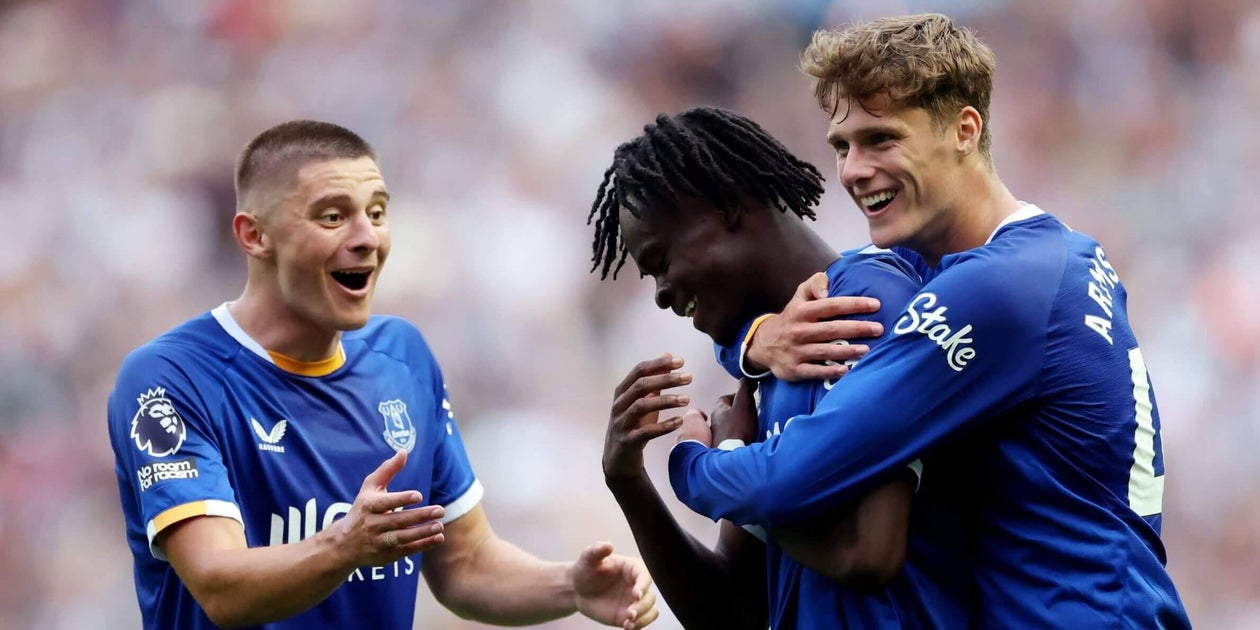
Inside Everton’s pre-season: Branthwaite’s golf sessions, schnitzel night, ‘Doucs’ pasta recipe
Everton’s Hill Dickinson Stadium, five days before the Premier League opener against Crystal Palace.
Kiernan Dewsbury-Hall is on stage at an event hosted by podcast and media company Men in Blazers, candidly discussing the lessons learned from last season — and how a first qualification for European football since the 2017-18 season agonisingly slipped from their grasp.
The club’s chief executive Angus Kinnear has since said that campaign is viewed as a “failure” by American owners The Friedkin Group in an interview with BBC Radio Merseyside. And many of those involved have spent the summer trying to understand what happened.
“I had a lot of time to think about it,” Dewsbury-Hall says. “(There were) a lot of lessons learned. The main one is never get complacent till the final whistle of the final game.
“Put in the same position again, I don’t think that we’ll be making that mistake.”
Listen to Dewsbury-Hall and you get the sense of a side ready to right some wrongs, but Everton’s manager David Moyes struck an altogether more cautious tone in a chat with Sky Sports, his first with any media this summer.
“We’ve got a long way to go and want to do an awful lot more (in the transfer market),” the Scot said.
So, how ready are Everton for the new season?
The Athletic has followed them at home, in Germany and Scotland, speaking to key figures to get a sense of how they are shaping up.
“It’s been one of the longest pre-seasons, because it usually takes maybe 10-14 days of hard sessions,” left-back Vitalii Mykolenko says of the Premier League returning one week later than usual after this summer’s World Cup.
“It’s already the fourth week of training. But it’s good for us. It’s tough, but there is nothing silly. Everything is for a purpose.”
The Ukrainian was speaking to The Athletic from the team’s Oschberghof training base in Germany’s Black Forest. The setting is lavish but remote, which is part of its appeal for clubs such as Everton.
Oschberghof is an hour from Switzerland’s Zurich Airport, boasts three renowned golf courses, and players are able to cycle down the hill to use the two pristine pitches provided by local club SV Aasen. Serie A champions Inter were visitors in July, while Spain used it ahead of their victorious 2024 European Championship campaign.
Arriving for training on day one at our base in southern Germany! 🚴♂️🇩🇪 pic.twitter.com/yyWNs4HOff
— Everton (@Everton) August 3, 2026
Like last summer, Everton started pre-season in the Scottish coastal town of St Andrews, doing double or even triple sessions, including team runs on the beach and in the town, to work on their base fitness.
It has been a very different summer to the one that preceded it out of design. Everton are aware of the commercial benefits of touring the U.S., as they did last year, but there are always compromises on those trips — valuable days lost to media commitments and travelling.
This has been a much more typical Moyes pre-season, with players quickly getting up to speed and the emphasis on making sure the squad are given valuable playing time ahead of the new campaign.
There have been changes behind the scenes. Dave Reddington has joined permanently from AFC Wimbledon as a set-piece coach, a role that had been vacant since Charlie Adam’s summer 2025 departure, following a successful ‘trial’ at the end of last season.
That was considered an essential appointment given the importance of set pieces in the Premier League in recent seasons, with the process led by Moyes.
Everton’s head of sports science Jack Nayler left, with Moyes appointing former West Ham United colleague Nick Davies at the end of last season. Daniel Ransom, who worked with technical director Nick Cox at Manchester United, has been brought in as the club’s first head of performance lifestyle, a role that focuses on wellbeing, psychology and helping players achieve peak performance.
Five signings have been made, with midfielders Hayden Hackney and Christian Norgaard identified for their leadership and ability to play through the lines, something that has been a priority this summer. Filling the leadership void left by club captain Seamus Coleman’s departure has also been at the forefront of key figures’ minds.
Hackney, who has spent much of pre-season at the base of midfield in a 4-1-4-1, has been tasked by Moyes with dropping deep to pick up the ball from the defence and overloading the opposition there and when he breaks forward.
While the versatile Merlin Rohl has impressed as a makeshift right-back in pre-season, and has spent periods training there, a new signing in that position is considered a priority before the September 1 deadline.
Other changes are more subtle. “The gaffer changed a lot (when he came in),” Mykolenko says. “But he has quite a similar plan (now) as far as I can see. Maybe just longer sessions.”
There is frustration at how last season panned out. Coaches Billy McKinlay and Leighton Baines are tasked with analysing performances and feeding back to Moyes, before he decides how to proceed.
The cheap concession of a quick goal to Erling Haaland, shortly after Everton went 3-1 up against Manchester City in May, is still seen as one of several key moments, with Moyes’ side squandering two key points that night.
“The first two parts of the season, we did well,” Mykolenko says. “But the last seven games, I don’t know what happened.
“(We conceded) some silly goals at the end of the games. We were in a situation where we were safe, had no pressure. We could have finished in Europe.

Everton were frustrated with how last season ended (Chris Brunskill/Fantasista/Getty Images)
“You have to switch on until the end. Speak with your team-mates, be together. This is the most important.
“But I will not sit in my room and cry about it. It’s a good (learning) experience to have for the future.”
There were some moments for down-time and team bonding over the summer.
In Germany, a group led by Jarrad Branthwaite and Nathan Patterson hit the golf course. Mykolenko and midfielder Carlos Alcaraz played padel, while ping-pong tables and a darts board were installed at the hotel. Evenings were spent playing the game Wolf, which is similar to the television show The Traitors and became a staple of England’s Euro 2024 thanks to players such as Jude Bellingham and Trent Alexander-Arnold.
First-team chefs Tom Kenton and Neil Bradbury laid on a team barbecue one evening and there were trips to a local hut on site for traditional German food, including schnitzel, along with an Italian restaurant where players could choose from one of three options pre-selected by Kenton and Bradbury.
Due to the heat, which at times rose to more than 30C (86F), players were given high-carb slushies to help their recovery between sessions. Small tubs of ice cream were available on one night of the trip to aid their recovery.
Kenton and Bradbury, who worked with England at the World Cup, liaise with hotel chefs far in advance of trips, as well as head of nutrition Stephen Long. Ingredients are sourced locally by agents working for the club and hotels, but Bradbury also took produce to Germany.
Sessions are often longer and more intense than in the regular season, so there is an emphasis on refuelling. Kenton and Bradbury, who travel everywhere with the team, monitor eating habits with Long. Kenton used to challenge players to eat 500 grams of pasta, while rice pudding is a common dessert the night before matches.
“The big work is done the day before (a game),” he says. “We always have a live pasta station. And we keep that the same everywhere we go as it’s so important that the players have familiarity.
“We have a few odd pasta combinations, and we name them after that person. They’re all very similar. The favourite one still is the ‘Doucs’ (after Abdoulaye Doucoure’s time at the club from 2020-2025). It’s a bechamel sauce, a Cajun spice, pesto, chicken, and a small bit of cheese.

Abdoulaye Doucoure’s influence is still felt in Everton’s pasta dishes (Alex Dodd – CameraSport via Getty Images)
“We’ve got lads who never played with him asking for it. Even the guys from England love that as well. Jack Grealish had the ‘Coleman’, and that was basically a ‘Doucs’, but with some chorizo.
“On the day, it’s topping up energy and glycogen levels. If it’s an evening kick-off, what you’ll eat that morning will help you out. But if it’s a 3 o’clock midday kick-off, what you’re eating on the day is not going to do very much.”
Most players stick to the same routine no matter the kick-off time. And the chefs have learned every order by heart.
“Jordan (Pickford) has his same pre-match meal no matter what,” Kenton says. “Whether it’s early or late, he’ll still have Weetabix, salmon and scrambled egg on toast. Merlin (Rohl) is going to have bolognese for breakfast.”
Post-match food often depends on the result.
“They sit there and punish themselves if we lose,” says Kenton. “But when we win, they’ll eat it all.
“It’s making them eat something and stuff that you can just grab there. Your post-match food is a bit of controlled junk food, something like a lean burger with some bread, to get carbs into the system. It starts their recovery off.”
Three storylines to watch ahead of this season
George Edwards and Rachael Tinde
Pre-season has been intense, and the sense in camp is that there is scope for tangible growth this campaign.
“We can improve in all areas,” says Mykolenko.
“I would love to play more interesting football this season. Maybe some people will say it wasn’t good enough, but for the first 30 games, we played interesting football and people enjoyed it.
“Hopefully people will want to watch this football. Because sometimes football can be boring and you don’t want to watch it.”
The 27-year-old, who signed a new long-term contract in June, believes the summer signings will help.
“Merlin is in very good form,” he says. “He can play everywhere, it’s incredible.
“Tyrique (George, who joined permanently from Chelsea for £18million after his loan) didn’t play a lot last season, but he came off the bench and he improved our team. When he goes inside, he can finish in the top corner. He’s been good this summer and hopefully will improve this season.”
He highlights Hackney, meanwhile, as the “best player in the Championship last season” and someone he hopes can also “make an impact”.

Hayden Hackney has been tasked with bringing the ball forward from deep (Christian Kaspar-Bartke/Getty Images)
George is one of a host of young players to have caught the eye. The 19-year-old midfielder Harrison Armstrong has advanced his claim for more regular minutes this summer, while there is a belief that striker Thierno Barry and winger Tyler Dibling are starting to properly adapt after their arrivals last summer.
Left-back Adam Aznou is another to have impressed in camp.
“We’re quite different,” Mykolenko says. “I’m more defensive and without the dribbling skills. He’s less physically strong but good on the ball and I like it.
“He came from Spain and didn’t play a lot. But I can see he’s improving, from last summer to this summer.
“He’s young. He needs some confidence. Hopefully he will help us.”
Soon we will see if they are ready. The final game, a 1-1 draw against Lille, saw a positive Everton performance, but they could not turn their dominance into more goals. They recorded wins against Dundee (4-0), Hamburg (2-1) and Newcastle United (3-1), losing to Stoke City (1-0) and Stuttgart (3-1). They also drew 0-0 away at Championship side Bolton Wanderers.
While the performances were broadly positive — and it is hard to read too much into pre-season — there are gaps that need to be filled with the new campaign just days away.
“We’re super excited, super positive,” Dewsbury-Hall said at the Men In Blazers event. “The lads have come back very sharp. We’re bubbling along nicely.
“It’s very competitive. There’s a lot of good players and that’s what you want in a squad. I’m quite confident.”
>
Sports
How Hull City play: Direct and robust, but can they outrun their worrying underlying numbers?

With the Premier League getting underway later this week, The Athletic is tactically profiling the three promoted sides. We started with Coventry City, followed up with Ipswich Town, and today it’s play-off winners Hull City under the microscope.
Once again, Hull City head into a season battling the odds.
With pundits, fans, and computer simulations filling out their Premier League predictions, there is an overwhelming consensus that the Tigers will be relegated, with most expecting them to finish bottom.
The fact that they are even listed on the ballot is a testament to their remarkable turnaround under head coach Sergej Jakirovic, who inherited a club in turmoil when he took charge last summer. Hull had narrowly avoided relegation to League One, surviving on goal difference on the final day, and were serving a transfer embargo that limited them to free transfers and loan dealings.
Against this testing backdrop, Jakirovic guided Hull to an incredible promotion, defeating Middlesbrough 1-0 in May’s play-off final after finishing sixth in the regular campaign.
Here, The Athletic examines Jakirovic’s tactical approach as Hull brace themselves for the rigours of Premier League football for the first time since 2016-17.

Sergej Jakirovic’s pragmatism has helped Hull return to the top flight (George Wood/Getty Images)
A direct, robust style
Under Jakirovic, Hull typically line up in a 4-2-3-1 formation. They used the system 35 times last season, but more important than formation was their approach: Jakirovic shifted Hull away from a sometimes sterile possession game towards a more direct, aggressive style. The graphic below fleshes that out, with Hull averaging just 2.6 passes per sequence while recording a ‘direct speed’ (how fast the ball moved straight upfield) of 1.53 metres per second, the eighth-highest in the league.

This more robust approach may not be Jakirovic’s preferred vision for how football should be played, but he is not a dogmatic idealist. Instead, he tailors his approach to the players at his disposal. “My football philosophy is to adapt as soon as possible to the team, to develop them,” he said at his unveiling. “I like attacking football, but we need such a profile of players.”
Jakirovic’s style is a natural fit for the squad, particularly after Hull signed centre-forward Oli McBurnie on a free transfer last summer, arguably the division’s signing of the season.
McBurnie is something of a throwback; a physical target man who relishes gritty duels and aerial battles. Watch how often he starts a game by barrelling into a full-back with the ball nowhere in sight. Hull completed 24.8 long balls per game last season, the third-highest in the league, with the majority aimed towards McBurnie.
Along with providing a regular supply of goals — McBurnie scored 17 times in the regular season, the second-most in the division, behind Swansea City’s Zan Vipotnik (23 goals) — he gives Hull an effective, if fairly blunt, creative outlet, also laying on eight assists. Even when he does not win the initial header, his physical presence creates loose balls, so Jakirovic instructs his quicker, more diminutive attackers such as Joe Gelhardt and Mohamed Belloumi to swarm around him and pounce on those second balls.

Ollie McBurnie’s physicality is one of Hull’s main weapons (Ben Stansall/AFP via Getty Images)
Second balls and counterattacks
Hull’s prowess at mopping up second balls is not limited to McBurnie or advanced areas. It is a hallmark of their harrying, bustling approach across the pitch, with Jakirovic frequently stressing their importance in press conferences. Pouncing on loose balls while opponents are disorganised gives Hull the perfect platform to counter, an area in which they excelled last season. They scored 12 goals from Opta-defined ‘fast breaks’ (counter-attacks), second only to Preston North End, with Jakirovic calling his side the “best in transition in the league” after the play-off final.
Once Hull break, they often look to hit the wings immediately, with no Championship side completing more switches of play than their 111 last season. Many are directed towards Ryan Giles, their attack-minded left-back, who regularly pushes forward on the overlap and provided eight league assists last season (illustrated below).

“The plan was if we take the ball in the midfield area, immediately we switch the side or we play forward,” Jakirovic said after Hull’s 4-2 win over Derby County in February.
Defensive vulnerabilities
Promoted sides are almost always forced to play with less of the ball, so Hull’s low-possession, counter-attacking style should, in theory, be better suited to the step up than a more expansive approach. But despite SkillCorner data showing that Hull spent a greater share of time in a ‘low block’ than any other Championship side last season, they were leaky at the back, conceding 66 goals, more than any promoted side in the past 15 seasons.
And the underlying numbers suggest it could have been a lot worse. Hull’s expected goals conceded stood at 82.5 last season, better only than bottom-placed Sheffield Wednesday. On average, Hull’s opponents scored 0.34 fewer goals than expected per game, with no side across Europe’s top five leagues benefiting more from wasteful opposition finishing. Premier League opponents are unlikely to be so forgiving.

It is little surprise, then, that Hull have prioritised defensive reinforcements this window. Senegalese centre-back Nobel Mendy has arrived from Rayo Vallecano for a club-record fee (undisclosed, but higher than £20m), while 18-year-old Australian ball-playing defender Lucas Herrington joined from Colorado Rapids for $23million (£17m). They also brought in Konstantinos Tzolakis from Olympiacos, the standout goalkeeper in the Greek Super League last season.

Can goalkeeper Konstantinos Tzolakis help shore up Hull’s defence? (Dimitris Kapantais/SOOC/AFP via Getty Images)
Part of Hull’s defensive frailties stemmed from their inconsistent press, which often lacked full commitment, leaving large gaps for opponents to exploit. In the play-offs, Jakirovic tightened things up with a back five, doubling down on Hull’s counter-attacking strengths and picking his moments to press higher up the pitch. This pragmatic approach could serve Hull well, particularly in the opening weeks as they adjust to the intensity and attacking quality of the Premier League.
Ultimately, irrespective of the tactical approach they adopt, Hull face a huge challenge to survive. The graphic below shows each squad’s market value, as estimated by German website Transfermarkt, with Hull cast far adrift.

Even with recent additions, the quality of Hull’s squad remains far below the Premier League standard. But Jakirovic has forged a side that embraces the underdog role, one that produces its best football when its back is against the wall. They’ll need to.
>

When David Jackson woke up in hospital and saw he was still wearing his rugby boots, he knew something terrible had happened. He just didn’t know what.
He turned to the familiar face sitting next to his bed and asked what had happened.
But the answer — that he had had a seizure on the pitch after clashing heads with a teammate in training, which had also led to a bleed on the brain — was not the first time he had heard the devastating news. Nottingham Rugby Club’s physio, who was at his bedside, had already told him many times.
His short memory had gone.
Doctors told him if he decided to play on the next blow to his head could kill him.
At 31, during a 12-year professional career, he had racked up 316 senior appearances for the club he joined aged six, scoring 971 points, including 102 tries – the fifth highest in Nottingham’s history. Rugby was his life. But he had played his last game. He plunged into despair.
Newly married, both he and his wife Catherine had to come to terms with a life now changed, one where everyday tasks were difficult. He would break down in tears at a supermarket because choosing which yoghurt to buy was overwhelming, hanging the washing became exhausting. “We went through a very dark time for a very long time,” he tells The Athletic.
The couple needed help to understand what was happening inside Jackson’s brain, but they didn’t know where to turn.
Thirteen years after his accident, Catherine is still by his side and Jackson, now a strength and conditioning coach, wants to help those who have suffered similar brain trauma, to let them know there is help out there and raise £1 million ($1.35m) for two charities, Headway UK and Head for Change, that offer such support.
Which brings us to Bristol, a city in the west of England where Jackson is in the process of breaking a world record.
Here, in a sleepy suburb just outside the city along the banks of the River Avon, Jackson is in the process of running his 81st consecutive ultramarathon, surpassing the men’s record which stood at 80. But this isn’t where he stops — the challenge he has set himself is 100 ultramarathons in 100 consecutive days.

Jackson is consuming about 7,000 calories a day. (Harvey Gibson)
The unusually hot British summer has made the challenge even more demanding, resulting in Jackson soaking his clothes in cold water every morning to keep cool. Since he started running in May, the UK has experienced five heatwaves and record-breaking temperatures during a summer that is on course to be the hottest on record. Last week, on day 76 and amid the fifth heatwave, was his toughest yet, he posted on Instagram. It was the first time during the challenge, he wrote, that he “didn’t really have the energy to finish the day.” But he carried on and made it through.
There has also been the enormous amount of calories to consume daily, too — 7,000 a day split into seven small meals cooked by his wife in the campervan he is travelling across the country in.
Breakfast is typically overnight oats with nut butters and nut seeds consumed 30 minutes before he starts running at 7 a.m. At every 10km, he will then take a food break, and at the end of each day he’ll drink a protein shake and eat a meat stew. During the first few weeks he had lost 10 percent of his body weight. His toenails are still intact, however. For now.
“Obviously, I am putting my body under a lot of stress so I have to eat nutrient-rich food to help me recover and avoid inflammation,” he says.
Pausing 28km into his world-record run in Bristol, Jackson explains the symptoms he experienced after his head injury: “The supermarket was an example of autonomic nervous system dysregulation, symptoms of a brain injury. My brain was inflamed and you can’t make decisions. You struggle to function.
“Fatigue is a really bad one. Your brain’s trying to shut itself down almost, to try to recover, so you can’t do normal things like choose a yogurt or answer a question, or watch TV. You can’t read a book or have the light on, it hurts your eyes. Catherine took me back to hospital because my symptoms were getting worse but they said there was nothing they could do.”
In recent years, the long-term impact of brain injuries in professional sports, especially rugby union, soccer and football, has been put under the spotlight but Jackson says his motivation is beyond sport.
Originally, Jackson’s plan was to run two marathons a day for 100 days, but that challenge became logistically impossible so instead he has been running 50km a day at 25 locations across Wales, Scotland and England around a 10km circuit at each venue.
A few months into his challenge, he has grown an impressive beard, a homage to Forrest Gump, a character in the the eponymous Oscar-winning movie who set off running across the U.S. and attracted a group of devoted runners who followed him on his spur-of-the-moment feat.
Jackson has had company along the way, too. So far, over 700 people have joined him at various points, including former rugby teammates and opponents.
“The thing that’s made this special is the people that have come and run with us,” he says. “Some are old teammates I’ve not seen for 20-odd years. England international George Martin ran his first ever 10km with us.
“Others are complete strangers who have travelled three hours to reach us just to come and run 10km because it resonates for them.
“Of those 700, I am not sure we have had anyone with a brain injury from sport but certainly brain injuries from car accidents, from falling off a horse, from falling off a roof, from lots of different activities.
“Every day 500 people in the UK go to hospital having suffered a brain injury. It is about ensuring they know there is support and how to access it afterwards.”

Jackson is running to raise money for two charities, Headway UK and Head for Change. (Harvey Gibson)
By the end of his 81st day Jackson had run over 4,000km. When he finishes his challenge, he will have run 8,450 km, the distance from London to Los Angeles.
He has been running for approximately seven hours per day and doing so in a loop, partly to allow people to join him but also to help with the mental stress.
“When you know exactly where you’re going, where there is a hill, what’s around the corner, it’s more of a safety signalling for your nervous system, so it’s less stressful,” he explains.
“It could be deemed as boring, but you’re not gonna quit because of boredom. You’re gonna quit because of getting injured or getting ill, so the boredom is comforting, actually.
“Catherine and I said at the start the two things that could stop me are getting injured or getting ill.
“I did pick up an injury on day 14 — a tendon issue in my leg — and that was very tough, but Catherine just told me as long as I can still put one foot in front of another I had to keep going, and I managed to walk for a few days to get through it.”
Later that day, after another 22km, Jackson and his entourage of runners emerge at Bristol Bears Rugby Club. The world record has been broken, though it is still awaiting verification. He celebrates in front of the cameras by pouring a cold can of Guinness over his head before enjoying a shower and a burger and chips cooked by the club’s chef.
For the next 18 mornings, he will emerge from his campervan, which has been driven around the country by Catherine, to do it all over again.
“People ask why, if the record was 80 ultramarathons, am I doing 100,” he says. “But isn’t 100 a nice round number?
“My body will recover once these 100 days are over, but some people don’t recover from a brain injury and they need daily support.”
>

Inside Everton’s pre-season: Branthwaite’s golf sessions, schnitzel night, ‘Doucs’ pasta recipe

Fallon Pokes Fun at Trump’s Friendship With Kim Jong Un: ‘Their Bellies Bump’

Love Is Like a Cocktail’s Crystal na Yōsuke Launches Romantic Comedy Manga – News
-

 movies3 months ago
Search For Canadian TV Actor Stewart McLean Now Homicide Investigation
-

 Fashion9 years ago
These ’90s fashion trends are making a comeback in 2017
-
Fashion9 years ago
According to Dior Couture, this taboo fashion accessory is back
-
Fashion9 years ago
Model Jocelyn Chew’s Instagram is the best vacation you’ve ever had
-
Fashion9 years ago
Emily Ratajkowski channels back-to-school style
-
Fashion9 years ago
9 Celebrities who have spoken out about being photoshopped
-
Fashion9 years ago
Your comprehensive guide to this fall’s biggest trends
-
Fashion9 years ago
A photo diary of the nightlife scene from LA To Ibiza