
Anime
Episode 1174 – One Piece (2026-)


© Eiichiro Oda/Shueisha, Toei Animation
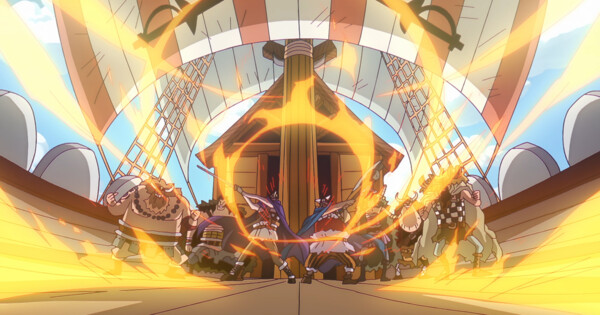
Episode 1174 of One Piece manages to surprise with its quality despite having no real surprises up its sleeve.
I was gripped by this one from start to finish. I don’t know if I can fully capture why, either. In theory, this was more of all the same things we already had going on over the past few episodes. The monsters are rampaging. The kids are walking. The Holy Knights are bad. The giants are desperate. There’s very little novelty to be found, and the reactions are all pretty predictable in the grand scheme of things. And yet I found myself completely caught up in the drama of it all.
The first half of the runtime really sells the monstrous nature of the nightmare creatures. It’s a very deft bit of cinema and pacing to make a mystery that we more or less solved from the jump still seem compelling to the audience as it is unravelled for the crew. It’s just good dramatic irony to have Usopp, Nami, Brook, and Jinbei trying to discern what exactly is going on as the steady drumbeat of doom ratchets up. The anime team did a great job making this feel like a protracted siege, with all the shots of the Elbaph warriors scrambling to fight back. Those moments of the wounded leaning against buildings or the wild shots against the draugr’s shield while a defense was hastily assembled are all really good.
The back half’s juxtaposition added to the sense of drama. Again, conditions haven’t changed much for the youngsters. But watching Saul try to suss out how to help the kids was agonizing. This is especially true because Saul is more than willing to sacrifice himself to protect them and endure any pain, but the nature of the thorns is such that even that is not an option. Oof. The shot of the Holy Knights calling Saul pathetic while he tries to save the kids twists the knife.
The grand return of Brogy and Dorry is all the more uplifting after that. It’s hard not to cheer alongside the warriors of Elbaph as our two favorite giants deliver a double home run swing laser beam from the deck of their longship. The sequence where the cartoonish monsters are banished by the Hakoku Sovereignty mega-beam is expertly done, vibrant and colorful in equal measure. Having a big attack to end the episode is nothing new for One Piece, but just like with everything else, it’s handled so well it’s hard to complain.
Rating:
One Piece is currently streaming on
Crunchyroll.
The views and opinions expressed in this article are solely those of the author(s) and do not necessarily represent the views of Anime News Network, its employees, owners, or sponsors.
>
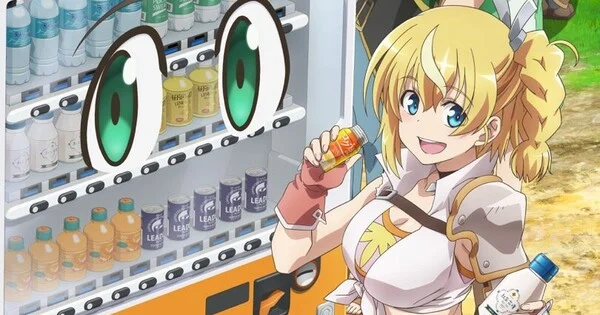
I said this before, and I’ll say it again, even if it has been said a million times by now: wow, did I ever underestimate the HELL out of this anime! How is a show this absurd, this wacky, this asinine, become such an insanely good sleeper hit? I remember first hearing about it way back when and avoided it like the plague, thinking it was an example of anime going too far. Now I’ve seen the whole series, plus rewatched several episodes at random. And let me tell you, this third and final season is fun, fun, fun. I was rooting for Boxxo, Lammis, and the rest of the gang until the very end.
In a sense, you’re getting more or less out of this season what you got out of the last two seasons. Boxxo, Lammis, Hulemy, and others go through the world’s strata in an effort to defeat the Netherlord. The environments are absurd. The characters are absurd. Boxxo’s transformations are absurd, and become more powerful in scale. He transforms into binoculars, safes, that one Deftones album (I kid), and an even bigger vending machine that can break the back of a giant sea monster. And get this, he eventually transforms into a giant garage filled with cars! And that’s not even mentioning all of the transformations he goes through at the very end! There’s no end to Boxxo’s ridiculous transformations, and I love how the show constantly tries to one-up itself. Just guessing what Boxxo would turn into next was a quarter of the fun for me.
Speaking of Boxxo, you must love his upbeat personality. His relationship with Lammis is the heart of the show, and it’s as adorable as ever. You can also feel the amicability he shares with Hulemy, and even the new shell girl Pity. One scene where Pity and Boxxo are kidnapped and locked in prison has Boxxo take precious care of Pity by adorning the jail cell with enough flowery decorations and cushy blankets to stave off even the slightest bit of discomfort for Pity. It’s cute, and you can tell Boxxo’s trying to be as nurturing as an all-purpose vending machine can be. I also admire how optimistic Boxxo is in the face of grimness, like when the Netherlord lays waste to Boxxo in a cave and buries him alive for four days. I’ve (obviously) never been buried alive, but I’ve seen that one scene from Kill Bill. Being buried alive is one of the most claustrophobic, mind-breaking, messed-up experiences one could endure. So how does Boxxo handle it? He decorates his confinement space with flowers and chills in nonchalant peace while he waits to break out. I respect this guy’s patience and optimism immensely.
This final season sticks with the same idea of everyone going through different adventures after adventure in episodic format. The characters hit the beach, escape from a prison, and go to a cave where they drive in a straight line for over twenty-eight days. There are random encounters with a wizened, wish-granting dungeon master, a giant stone dog-beast that emerges from the ocean like Godzilla, and an evil sorceress whose dub voice sounds more Auto-Tuned than T-Pain. The animation and art are limited, but so what? The world is so random and wild that it doesn’t matter. The randomness might make weary viewers think that the events are made up as they go along. They aren’t. It’s that the show revels in its ridiculousness so much that it can conjure randomness on such a whim that you end up buying it. It runs on the “sure, why not” logic similar to Adventure Time and rolls with it. If you could already sink your teeth into an overpowered vending machine, talking bear creatures sporting letterman jackets, vegetables that run on two legs, a giant, anthropomorphized field dude, and a girl whose back can carry objects so heavy that not even Arnold Schwarzenegger in his prime could lift, then you can handle whatever this anime dishes out.
Alright, maybe one complaint. I don’t think Kerioyl’s subplot is handled well. Spoilers, but remember how in season two, we find out that Kerioyl’s son was cursed and crystallized, and that made him side with the Netherlord and therefore confirm all of Boxxo’s initial suspicions of him? Well, now at the start of season three, Kerioyl’s son is uncrystallized off-screen, and we’re given a slapdash explanation as to why. And then after disappearing for a few episodes, Kerioyl, his son, and their crew suddenly come back to switch sides, and Boxxo accepts Kerioyl’s apology like *snaps fingers* that. I know this is anime, and we’re used to seeing bad guys become good guys, but isn’t Boxxo being a little bit too forgiving for his own good? Why go trusting this man again, when you didn’t trust him before, and were proven right not to in the first place? Oh, and then Kerioyl’s son gets magically uncursed out of nowhere. It’s like the show is doubling down on its this-is-a-wacky-and-random-world-and-therefore-we-don’t-have-to-explain anything-ness to the point where Kerioyl’s story feels disjointed and awkward.
If I may backtrack on my words a bit, I’ll admit: reading my preview guide entries on this show makes me cringe a bit. I liked the show, though you can tell I had not soaked myself in it yet. I called the show meandering, and I even said that Hulemy was “just there” in season one (seriously?!). No, this is a show about spectacle, and while you should care about consistency and how the plot unravels, I felt way too laser-focused on character and plot complexities. Rewatching and recapping the first two seasons, and then watching the third in one binge made me realize the error of my ways. No, none of the characters are that complex, and yes, maybe some of their personalities and stories could have been handled better. Who cares? They’re all likable, and they all have heart. Plus, those little character moments are just the icing on the cake. The joy of this anime can be found in the lengths it goes to make the unbelievable believable. Vending Machine is an anime that is absurd without being mindless, smartly layering heaps of delightful weirdness that grow bigger and better with every passing episode. If it’s all about the journey and not the destination, then the nonsense of Vending Machine‘s final season is guaranteed to give you a trip you won’t forget.
>

© 2026 Shirow Masamune/KODANSHA/THE GHOST IN THE SHELL COMMITTEE
If an artificial intelligence truly became sentient and alive, how would we know? The Puppet Master itself poses the question to its captors, as it taunts them, “You don’t even have a definition of what life is.” Episode seven adapts most of manga chapter nine, which includes much of creator Masamune Shirow‘s signature esoteric musings on the nature of existence and consciousness. For viewers unprepared for such an onslaught, this may be a challenging watch. Mamoru Oshii used the concepts and imagery from this chapter to build his entire 1995 movie around, so structurally it’s not totally foreign to those familiar with that interpretation of the franchise. Science SARU‘s version delves far deeper into the metaphorical weeds, offering startlingly inventive interpretations of some of Shirow’s most famously obtuse manga panels.
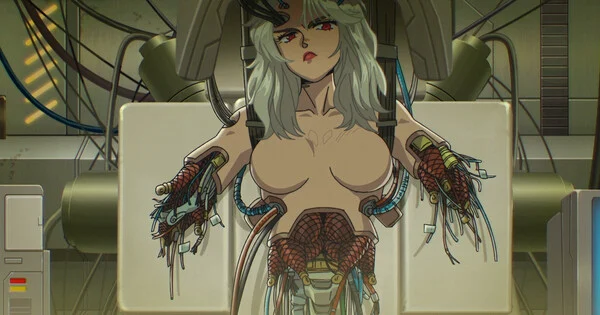
Before we get to that point, the first half of the episode begins as a fairly standard Ghost in the Shell setup – someone remotely hijacked Megatech Inc’s autonomous production plant’s machinery, built themselves a top-of-the-range android body, downloaded bespoke operating software into its synthetic brain, and it scarpered. Section 9 retrieves the rogue droid, and during the dismantling process, they discover that the droid seemingly contains a ghost, a marker of independent life. Said ghost is identified as previously foreshadowed uber-hacker the Puppet Master.
While Section 6’s Nakamura and freaky multi-fingered Dr. Willis (who movie fans will recognize from their almost identical roles in the 1995 film) claim that they disposed of the Puppet Master’s original body, forcing their host to migrate their consciousness elsewhere, the Puppet Master declares there will be no body, as they are neither human, nor an AI, but something completely different: a new form of intelligence, born within the net itself, a being of pure information.
With the Puppet Master’s formal introduction, we transition to Shirow’s true purpose for his story. Not merely another sci-fi police procedural, it’s a deeply considered work that explores the nature of consciousness, of personhood and transhumanism (written before it was trendy). After Section 6’s botched heist of the Puppet Master’s body, as Motoko Kusanagi desperately dives into its damaged, deteriorating mind, she experiences something that can only be described as transcendental.
Science SARU‘s background artists are really made to put in the overtime with this episode, with Kusanagi’s surreal odyssey into fractal mindscapes a fascinating and abstract tour de force of visual design. I wondered how on earth anyone might manage to animate Shirow’s dense panels full of technobabble and strange, alien concepts, but somehow they managed admirably.
It’s difficult for someone like me, raised in a Western culture, to fully parse Shirow’s thought processes here. His cosmology is deeply indebted to various streams of Eastern philosophy, like Buddhism, Taoism, etc. Even if the individual words and sentences from the script sound like nonsense, the overall combination of visuals and story progression helps to communicate the overall gist of his thesis. Kusanagi has stumbled onto what may be the next step in the evolution of consciousness, as the Puppet Master escapes the confines of the physical network to access something deeper, higher, and more fundamental to reality. Her limited senses can perceive it only as light, and as her emotions become overwhelmed, she glimpses an angelic vision.
We’re left on something of a cliffhanger. The movie uses a version of this scene essentially as its climax, yet we have another three episodes to go. I know from the manga that there’s a lot more of this challenging material ahead, and that may alienate more casual viewers. This episode still has plenty of other lower-brow moments to entertain us though, from Batou’s deranged cackling as he crashes his car into another vehicle, to Kusanagi’s irritated expression as she’s claimed by Megatech as one of their droids, to Aramaki’s comedy pratfalls as a laboratory explodes around him. One of the things I love about this adaptation is how expressive and cartoony all of the characters are, which leavens the heavier material.
Once more I am left deliriously happy by Science SARU‘s wonderfully playful yet respectful take on the original manga. I await their adaptation of the final few chapters with great interest.
Rating:
The Ghost in the Shell is currently streaming on Prime Video.
The views and opinions expressed in this article are solely those of the author(s) and do not necessarily represent the views of Anime News Network, its employees, owners, or sponsors.
>
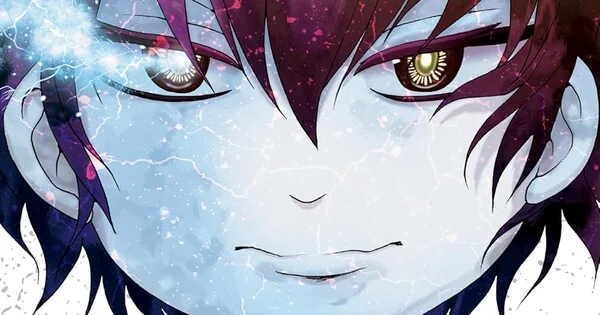

Manga creator Rensuke Oshikiri is best known in the West for ’90s video game nostalgia-packed rom-com Hi Score Girl, which was adapted into a successful anime series back in 2018. Yet his career spans several decades and many other titles, of which only two others – supernatural horror Sayuri, and the recent superpower sci-fi Geniearth, have made the transition to English-language editions. I was offered the opportunity to grill Oshikiri-san not only about Geniearth but also about his entire manga career.
Your latest manga to receive an English-language edition, courtesy of Titan Manga, is the five-volume series Geniearth, which originally ran in Weekly Shōnen Champion between 2021 and 2022. It’s comparatively very violent and action-packed compared to your previous manga Hi Score Girl. Do you ever worry that your readers may not follow your work to a different genre?
Rensuke Oshikiri: My work spans a wide range of genres — comedy, horror and romance — and I’m fortunate to be able to work across such a diverse spectrum. I have a habit of drawing whatever I feel like ‘watching’ at any given moment. You could say I’m an omnivore, you know what I mean?
Geniearth is a work in which my violent tendencies exploded to the hilt. Worried that readers might not be able to keep up? Don’t be silly. The first reader was me, followed by Mr Matsuoka, who became the editor in charge of this work. We prioritized the fact that the two of us enjoyed it first and foremost.
Hi Score Girl is a 1990s-set romantic drama with a big focus on arcade games, whereas Sayuri is a dark, intense supernatural thriller-revenge tale. Obviously these are very different from one another, and from Geniearth. Do you make a conscious decision to switch genres? How do you decide what kind of series your next series will be?
OSHIKIRI: I’m a manga artist capable of drawing in a wide variety of genres. To put it more simply, I get bored easily. There’s no way I’d draw another horror story straight after drawing one. When you’re walking, do you put your right foot forward, then put it forward again straight after? That’s exactly how much I want to try my hand at all sorts of genres.
Mind you, when I walk, I am the sort of person who puts my right foot forward, then my right foot again, and then my right foot yet again! It’s a bit of a laugh, isn’t it?
Starting my next series is a bit of a journey for me. It’s just that I’m not very good at going far — even though I’d really like to go to Yufuin in Kyushu, I end up settling for the hot springs in nearby Atami.
Compared to how I used to be, I find myself drawn only to things close at hand, so I really want to do something about this habit of taking the easy way out!

©押切蓮介/SQUARE ENIX・ハイスコアガールⅡ製作委員会
With its oppressed mutant minority with mysterious superpowers, Geniearth shares some foundational aspects with American comic classics like X-Men. Are you a fan of that kind of superhero comic? And if so, do you have any favorite story arcs or creative teams? Did you watch or enjoy any of the X-Men or other Marvel movies?
OSHIKIRI: Of course, I’ve watched almost the entire Marvel series, and I’ve also thoroughly enjoyed loads of foreign TV series featuring superpowers.
HEROES, The 4400, The Boys… the list goes on and on! I absolutely love storylines where heroes use their special powers to take on unjust villains. After all, everyone has a hero inside them. When I watch heroes in action in these shows, the hero inside me starts to stir. But don’t you think all the characters in my own work have a rather menacing look in their eyes?
They certainly don’t look much like heroes, do they! Which means that perhaps what lurks within me isn’t a hero, but a villain! Oh dear, that’s a bit of a problem!
One of Geniearth‘s main characters is a boy who accrues physical power from bad karma generated by others. In practice, this means he entices others to bully and abuse him, only for him to build up power and beat them to a pulp later. The fantasy of a victim standing up to their bullies one day is a potent one. Was this concept based on any personal experience?
OSHIKIRI: I’ve never actually been bullied myself, nor have I ever bullied anyone. But when I see bullying scenes in films or TV dramas, it really makes my blood boil, doesn’t it?
In my case, my tolerance for unreasonable evil is extremely low. That’s why I so strongly hope for a reversal of fortune in my stories. It might be a bit over the top in places, but I want my readers to relate to the plot twists that give me such a sense of catharsis.
Another of Geniearth‘s characters is a boy who can alter his body to acquire the characteristics of any herbivorous animal, such as a gazelle or an elephant. If you had this ability, what animal attributes would you most like to try out?
OSHIKIRI: Come to think of it, there was a character like that, wasn’t there!
He’s such a pure soul that he transformed himself into the herbivore he loved, but I’m a simple bloke, so I’d just transform myself into a carnivore without a second thought! That’s true… maybe a great white shark? That bloke’s really cool, both in appearance and temperament.
If I could get my hands on that massive jaw, I’d do anything. If I had to be greedy, I’d go for a Megalodon. Yeah, I might just want to be a shark.
Although you’ve had a lengthy career in the manga industry, authoring many different series, so far only three of them (Hi Score Girl, Sayuri, and Geniearth) have been translated into English. Are there any of your currently untranslated works you’re particularly keen to see receive an English-language edition?
OSHIKIRI: I’m really sorry that I’ve only been able to bring three works to you all overseas. We were just talking about bullying earlier, so perhaps Misumisō? This is also a story about a girl who’s been bullied, who coolly fends off her bullies.
If you’re looking for something as violent as Genius, then perhaps Flame Eyes or Yuyami Special Attack Squad. But the one I really want to see reach you all in English is Granba!
Like Sayuri, this is a story where an old woman plays a starring role! It’s the tale of an old woman fighting a desperate battle all on her own against hundreds of monsters in a life-or-death situation. However, Granba is a cursed work — I was actually told by a bookshop, ‘Please don’t draw such self-indulgent manga ever again.’
Hi Score Girl is the series you’re known best for in the West. I know I’m speaking for many of your fans when I say we’d love for an English-language version of your currently publishing sequel/spinoff Hi Score Girl DASH. Do you know of any plans to license this in English?
OSHIKIRI: I’m really pleased that Hi-Score Girl seems to be going down well with people overseas too!
I really hope the sequel, Hi Score Girl DASH, gets released in English as well! There doesn’t seem to be any talk of an English version at the moment, but I’m desperate for it to come out as soon as possible.
I’m still getting direct messages from overseas fans asking, ‘Aren’t you going to release a sequel to Hi-Score Girl yet?!’
I get so many that I can’t reply to each one individually, which is a real shame. Among them, there was even one passionate fan who hurled abuse at me, shouting, ‘Why haven’t you released a sequel yet, you bloody bastard!’
I was tempted to block, delete, and report them as spam, but I held back and am now earnestly hoping for an international release!
Once again related to Hi Score Girl: You feature a great many fantastic arcade games in the manga. Do you still have an interest in video games, and if so, what kind of games do you like to play now? Any recommendations?
OSHIKIRI: I’m a gaming enthusiast through and through! I’ve been holding a game controller since I was two! Honestly. And I still can’t seem to leave the world of gaming behind. Lately, I’ve been hooked on Factorio!
That’s a really good game. Then there’s Dead by Daylight, the Dark Souls series, and for fighting games, Street Fighter 6, I suppose. I’m starting to give up on SF6 because I just can’t win.
The game I bought yesterday was Reanimal! I really love horror games too; just the black packaging alone caught my eye. That’s how much I love horror games! I like them even more than the ginger pork my mom makes!

© 2015 OSHIKIRI RENSUKE, GENTOSHA COMICS INC.
Sayuri is an incredibly dark, chilling story about a family’s tragic experience in a haunted house. The second half of the story is particularly striking, as it becomes much more of a revenge-focused tale than a simple horror. The character of Granny is unique. Were there any real-life or fictional inspirations for her character? Was your own grandmother that terrifyingly formidable?
OSHIKIRI: Unfortunately, my grandmother had already passed away by the time I was born. The grandmother in Sayuri is actually based on my own mother. She was the first to express her anger when watching films where people are killed by spirits for no good reason. As my mother used to say, ‘Horror films are a lost cause’!
Don’t you think films and TV dramas from overseas tend to have characters who ultimately stand up to senseless supernatural phenomena, ghosts and demons? I absolutely love that fighting spirit! In contrast, in Japanese horror, the characters are often defeated without a chance to fight back. It’s as if the typically Japanese traits of being shy and reserved are directly reflected in the way the films unfold, isn’t it? Watching Japanese horror films end in a bad ending, as if they were stuck on a single, mindless loop, felt like I was having a nightmare!
But it was my mom who pointed out to me—who’d always taken that for granted—that ‘Japanese horror often ends in defeat’. And that’s why I set about writing Sayuri.
My mom, you say? My mom is a woman with a will as strong as a vengeful spirit, and she’s always giving me a proper telling-off. Even now, at 46, she still gets angry if my shoes aren’t lined up properly when I take them off – it’s a right pain! But it was my mom who showed me the way to live a pure life. She also taught me the strength of life. It was my mom’s teachings that led to the idea of fending off even evil spirits!
Are there any themes common to your works that are most important to you, and do you have anything in particular you’d like to impart to your fans in the English-speaking world?
OSHIKIRI: The one thing that runs through all my work is an emotional explosion! Whether it’s against unjust evil, evil spirits, or even love—it doesn’t matter. In any case, I’m always, always visualizing that emotional explosion as I draw. People—not just Japanese, but people overseas too—must be harboring bombs in their hearts, don’t they? But we can’t just let those bombs go off however we like, can we? There’s common sense, rules, and laws in the world, so we can’t just let them explode however we please.
That’s precisely why we have films and novels. And the same goes for manga. First of all, I set off a massive explosion with the bomb I’ve been holding back within my work. Then there are people who enjoy it and empathize with it. I want to keep setting off bombs in my work for their sake!
>

‘Insidious: Out of the Further’ Review: Time to Kill This Franchise?

Kane Parsons, Kevin Mayer, Tilly Norwood Booked For Zurich Summit 2026

How to watch Mariners vs. Brewers: TV channel and streaming options for August 19
-

 movies3 months ago
Search For Canadian TV Actor Stewart McLean Now Homicide Investigation
-

 Fashion9 years ago
These ’90s fashion trends are making a comeback in 2017
-
Fashion9 years ago
According to Dior Couture, this taboo fashion accessory is back
-
Fashion9 years ago
Model Jocelyn Chew’s Instagram is the best vacation you’ve ever had
-
Fashion9 years ago
Emily Ratajkowski channels back-to-school style
-
Fashion9 years ago
9 Celebrities who have spoken out about being photoshopped
-
Fashion9 years ago
Your comprehensive guide to this fall’s biggest trends
-
Fashion9 years ago
A photo diary of the nightlife scene from LA To Ibiza