Connect with us

Sports

England Test squad: Who will face New Zealand?

Published

on

Spin bowling was the area of England’s Ashes masterplan left most exposed in Australia. After asking Shoaib Bashir to learn on the job, England then turned to batting all-rounder Will Jacks for four Tests, with predictable results.

In that sense, Jacks is the man in possession, and the battle to be England’s number one spinner has appeared to be wide open.

There would be an irony in England ignoring Bashir, who was picked for Test cricket when he could not get a game for Somerset, and now could be left out despite playing regularly for new county Derbyshire.

Jack Leach remains probably the most reliable spinner in the country, while leg-spinner Mason Crane is bowling well for Glamorgan eight years after he won his only England cap. Nottinghamshire left-armer Liam Patterson-White, Sussex off-spinner Jack Carson and Northants all-rounder Calvin Harrison are all respected in county cricket.

Perhaps it is time for England to invest in Rehan Ahmed. In 2022, Ahmed was an original Bazball pick when, at 18, he became the youngest man to play for England.

He has hovered on the fringe of the England team since, with none of his five caps coming at home or as the sole spinner.

As a young leg-spinner, Ahmed will have times when his bowling goes off the boil, but he also has an X-factor. Root and Bethell are reasonable options if England need a spinner to hold an end.

With six first-class hundreds, Ahmed is an ideal number eight, meaning England would never have to worry about the tail-end batting as they rotate their seamers. When Stokes retires, Ahmed could move up the order as England’s all-rounder.

Leicestershire’s Ahmed is currently at the Indian Premier League, though his Delhi Capitals face a battle to reach the latter stages. England have also shown that an IPL stint is not a barrier to Test selection.

With England at a low ebb, Ahmed would bring some mystery, exuberance and excitement.

>

Continue Reading

Sports

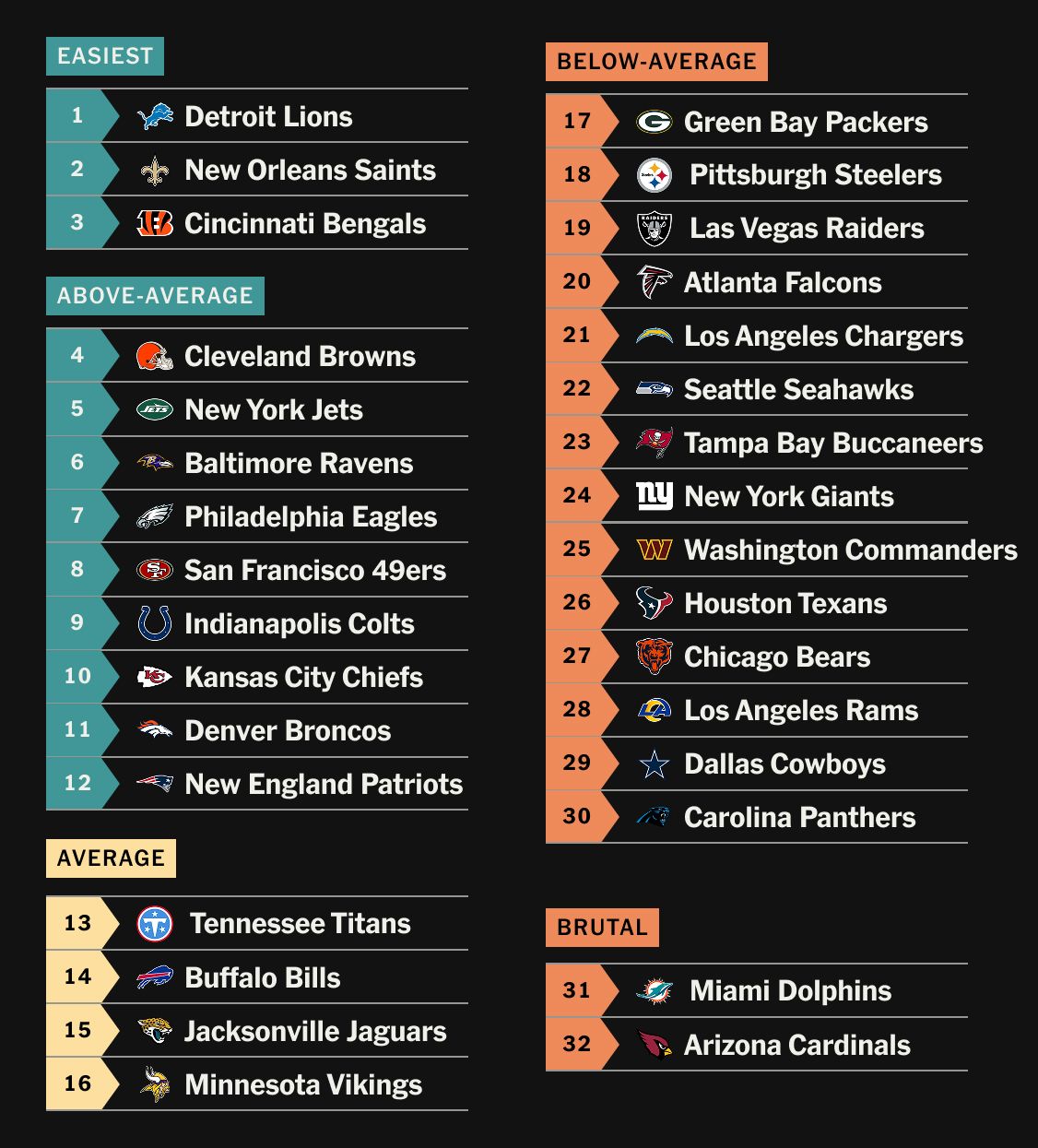
Ranking 2026 strength of schedule before schedule release this Thursday

Published

on

How much does opponent quality matter?

Reading that question likely resulted in your gut saying, “Of course opponent quality matters a lot, you idiot.” Though impolite, that would be an acceptable response.

That’s because I didn’t have space for the real question here: Do strength of schedule rankings matter … when they’re calculated in May? 


Inside: Ranking 2026 strength of schedule for all 32 teams. Plus: why an A.J. Brown trade must wait until after June 1 and solid referee news. Let’s go.


This article is from The Athletic’s NFL newsletter. Sign up here to receive it directly in your inbox.


Does strength of schedule matter?

At first blush, definitely not. Around this time last year, teams were glad to have the Patriots, Jaguars, Panthers or Bears on their schedules. Those teams had won fewer than 30 percent of their combined games in 2024 … and then they made 2025’s playoffs with a combined record of 46-22.

A similar thing happened in 2024, when the Commanders, Chargers and Vikings surprisingly became favorites in nearly every matchup.

So when you see these strength of schedule rankings by Sharp Football — based on opponents’ projected win totals — you should remember they won’t end up perfect.

(Quick aside: You might be wondering how anyone could tabulate this without having 2026’s schedule. That’s because we already know each team’s opponents, thanks to the NFL’s formula that my colleague Saad Yousuf masterfully explained hereWe just don’t yet know the orders of those opponents, which the NFL will publish on Thursday at 8 p.m. ET. Got it? Good.)

So does any of this matter, if opponents will all be better or worse than they were last year? Absolutely. First, schedule-release videos are always amazing. There’s also this:

  • At this time last year, the 49ers, Patriots and Saints were expected to have the league’s easiest schedules. All three would beat their Vegas win-total expectations.
  • Meanwhile, the Giants, Browns and Lions projected to have daunting schedules. Look what happened! The Lions shockingly missed the playoffs. The Giants won fewer games than expected. The Browns barely beat their 4.5-game win total, thanks to shocking upsets in Weeks 17 and 18.

So yes, the schedule matters, but only so much. It’s part of why I’m optimistic Detroit, Cincinnati and New Orleans will overachieve this season. As for Miami and Arizona, well, at least the 2027 quarterback class is strong. We’ll have more on the schedule in Friday’s newsletter.

As for what else is happening well before Week 1 …


Two big storylines during quiet months

One of the coolest experiences of my life was attending my first NFL game as a reporter. I was green and uncertain, but Mike Jones graciously took me under his wing. It’s very hard to visit a locker room after a playoff loss and get players to talk. It’s even harder to ask difficult questions. Mike does both exceptionally well.

I learn from Mike often, including today. He published the biggest upcoming checkpoints for this offseason. Three of note:

May 18: A decision from Aaron Rodgers. The Steelers’ voluntary offseason practices start next week, giving the 42-year-old a chance to confirm he’ll be back to work. He’s been scheduled to visit Pittsburgh, so we could get answers soon. But last year, he didn’t commit until June, so don’t hold your breath.

June 2: A potential A.J. Brown trade. His future is likely in New England. Our beat reporter Chad Graff has written that a trade from the Eagles “feels like a foregone conclusion.” The only holdup is contract-related, as Zach Berman and Chad explain in this story:

💬 “If Brown were traded before June 1, the Eagles would absorb a salary-cap hit of $43.4 million, per Over the Cap. A trade after June 1 would count $16.3 million against the 2026 salary cap because the Eagles could split the cap hit over two seasons.”

May 31 NEVER: Replacement referee training. Or more accurately, not this year. I’ll explain that next.


Referees strike (a deal)

I waited for a special moment to get that GIF into this newsletter. That meant two years and 466 newsletters of patience. But it’s all worth it for what I’m about to type.

The NFL agreed to a deal with the referees’ union, meaning no replacement refs. Mike has that story too, explaining that the league and the NFL Referees Association finalized a seven-year collective bargaining agreement. It ensures veteran officials will work every game of the coming seasons.

The alternative was disaster. Zak Keefer shared horror stories from 2012, when the league last tried using replacement officials. “You were wondering if (officials) were coming out to get autographs,” said Norv Turner, then the Chargers coach.


Extra Points

👀 Jauan Jennings, Viking. Minnesota added the former 49ers receiver on a one-year deal worth up to $13 million. The 28-year-old immediately becomes the team’s best blocking wideout and a third weapon for Kyler Murray.

📓 Value picks. Nick Baumgardner shared his biggest bargains from Day 3 of the draft, and I’m wondering whether Bryce Lance, brother of Trey, could be the Saints’ best rookie receiver.

💴 The Jets made Breece Hall the third-highest-paid running back, with a three-year extension worth up to $45.75 million. Details here.

▶️ Thursday’s most-clicked: Ted Nguyen’s nine best offseasons, including the Cowboys and 49ers.


📫 Enjoyed this read? Sign up here to receive The Athletic’s free NFL newsletter in your inbox.

Also, check out our other newsletters.

>

Continue Reading

Sports

PWHL playoff game between Montreal and Minnesota postponed due to illness

Published

on

Montréal Victoire forward Lina Ljungblom makes a save on a shot from Minnesota Frost forward Taylor Heise during a playoff game as others crowd around the net

The Montreal Victoire and Minnesota Frost were scheduled to play Game 5 on Monday night, with the winner advancing to the finals. Bailey Hillesheim / Icon Sportswire via Getty Images

MONTREAL – Monday night’s decisive Game 5 of the PWHL semifinals between Montreal and Minnesota has been postponed due to “player safety concerns related to illness,” the league announced just hours before the scheduled puck drop.

“The decision was made following consultation with medical personnel and in accordance with the league’s commitment to the health and wellbeing of players, fans, staff and all those involved in the competition,” the league said in a statement. “A rescheduled date for the game will be announced as soon as medical guidance determines it is appropriate to resume play.”

The league did not disclose the nature of the illness, nor did it reveal how many players were sick. However, the league said, “Medical assessment determined that the symptoms are not consistent with hantavirus.

All tickets for the game will be honored for the rescheduled date.

This story will be updated.

Connections: Sports Edition Logo

Connections: Sports Edition Logo

Connections: Sports Edition

Spot the pattern. Connect the terms

Find the hidden link between sports terms

>

Continue Reading

Sports

SEC commissioner Greg Sankey talks CFP expansion, conference championships and the football calendar

Published

on

BIRMINGHAM, Ala. — SEC commissioner Greg Sankey was seen as the driving force in one postseason expansion: the NCAA Tournament. Now that it’s official, the ball may be in Sankey’s lap, or at least his conference’s lap, on the College Football Playoff.

“I’ve become an easy target over the years,” Sankey said.

And as he wraps up his 12th year as commissioner, Sankey is preparing for a key few weeks, when the conference’s direction on a number of key issues will be discussed: its preference on the CFP, the future of the football conference championship game, and the desire by a number within the SEC to make their own rules.

Sankey spoke for an hour Monday at the Associated Press Sports Editors Southeast Regional meeting at the Alabama Sports Hall of Fame. Here are the five most noteworthy things Sankey weighed in on:

1. Playoff size: 16 or 24?

This time last year, Sankey and the SEC were the swing vote between competing 16-team ideas: the Big Ten’s desire for multiple automatic bids for conferences, and everyone else’s preference for five conference champions plus 11 at-large bids. The SEC sided with the latter, and the result was no agreement, and a third year of the 12-team field.

Now, it appears support has swung towards the Big Ten’s 24-team idea, and the SEC may be the holdout. So the question may be whether the SEC will hold firm or whether there’s enough support within the conference to agree to a 24-team field.

That’s a discussion that will be held within the conference, Sankey said, including over the next few weeks at SEC spring meetings. And key to that in his mind is whether it will enhance or harm the importance of the regular season.

Sankey indicated they’ve done research to show a 16-team playoff would not diminish the regular season. Sankey called a 24-team field an “unknown.”

“There are a lot of ideas out there that have to be supported with analysis and information, not speculation,” Sankey said. “And with something as important as a regular season in football, hey, if you can build the regular season and build the postseason through expansion in a different way, awesome, let’s get to that. But let’s understand that.”

The expansion to 12 has as much as tripled the number of teams that began November with playoff hopes, by Sankey’s estimation. A concern for Sankey is whether expansion would reach a point where teams would rest key players in regular-season games.

“That has to be fully understood (in any expansion),” Sankey said. “At any level of expansion, there will be games that didn’t matter that will matter. But there’s another side to that coin.”

2. Future of SEC championship

The momentum is certainly on the side of getting rid of the SEC championship, with Alabama athletic director Greg Byrne voicing the view of many when he said in early April the game has “run its course.” Georgia coach Kirby Smart, whose team has won the last two SEC championship games, said he would be fine getting rid of it if the Playoff field expanded to 24.

Competitively, it does make sense. Financially, it’s more complicated. The game always gets big TV ratings and, with other revenue, brings the SEC an estimated $50 million per year, perhaps more.

Sankey didn’t talk money Monday. He focused instead on what the Playoff model will look like. Essentially, he reiterated the SEC championship is not dead — it just depends.

“We haven’t picked the model. There are plenty of models out there, utilizing right now we have contracts (for conference championship games),” Sankey said. “If the model changes, we’ll have to answer the questions differently.”

Asked how important keeping a championship game would be in deciding the future Playoff model, Sankey smiled and said it was a question he wouldn’t answer.

3. NCAA Tournament backlash

Sankey has, over the last few years, been the face of the unpopular push to expand the NCAA basketball tournaments. That wasn’t because Sankey was alone, but because he speaks publicly more than other commissioners. It finally happened last week, with both men’s and women’s tournaments going to 76 games next season.

That will give eight more at-large spots to SEC teams such as Auburn and Oklahoma, which were among the final teams out of the men’s field this March. But critics say it will water down the tournament, lessen the importance of the regular season, and risk the popularity of the tournament itself, which is geared around people filling out a clean 64-team bracket.

Sankey was asked if expansion was necessary.

“Did I think it was necessary?” Sankey said, repeating the question. “Necessary would convey it’s do or die. So in that vein, no.”

Sankey referred to 10 SEC teams making this year’s men’s tournament, and 14 the year before.

But then he also referred to two of his teams just being on the outside. He said his view is the top 50 teams should be in the tournament. Given the number of mid-major and low-major conference champions that get bids, Sankey felt expansion gets them to those top 50.

He also pointed to instances of teams going from the First Four round in Dayton and making runs, even to the Final Four. The expansion by eight teams will create “another Dayton,” as Sankey put it.

“The apple cart is not being burned, upset and thrown down the hill and discarded. It’s a bit of change,” Sankey said.

4. Calendar: AFCA call to end season around Jan. 8

Future national championship games are scheduled to end in late January, including Jan. 25 this season. Many in the sport would love to roll that back: The American Football Coaches Association said last week it prefers the season end the second Monday in January.

That statement, which also included calls for “maximizing” the playoff field and getting rid of conference championship games, caught Sankey by surprise.

“The press release in particular was kind of disappointing,” Sankey said. “I had seen (AFCA executive director) Craig (Bohl) a couple weeks ago. I know he has my cellphone number. But it would’ve been nice to have a conversation about the rationale for their statement and maybe the rationale for some of those decisions.”

As for the calendar, Sankey pointed to the Army-Navy game being on the weekend after conference championship games. And there’s also going head-to-head with NFL games, which Sankey said he’s discussed with NFL commissioner Roger Goodell.

“If you’re going to compress the schedule, you’re going to have some of those issues,” Sankey said.

5. SEC making its own rules

There remains internal discussion — and external desire — about whether the SEC should make and enforce its own rules on issues such as tampering. That stems from a continuing frustration with the slowness in NCAA investigations, or rules not being enforced at all. That includes against the SEC’s own teams, with Ole Miss under investigation after Clemson accused it of tampering.

Sankey pointed to when the Big Ten, with whom the SEC had seeming sympathy on this issue, sent a letter asking the NCAA to suspend tampering rules given the changes in the environment.

“We didn’t send a letter, but our communication was you need to fix the definitions of how they’re applied before you start running down the road from an enforcement standpoint, and do that quickly. That hasn’t happened,” Sankey said. “You’ve heard some of our campus leaders say we should set our own policies. … Does that continue to occupy people’s minds? Absolutely.”

>

Continue Reading

Trending

Copyright © 2017 Zox News Theme. Theme by MVP Themes, powered by WordPress.