
movies
‘Marty, Life Is Short’ Review: Lawrence Kasdan’s Martin Short Doc


The tone of Lawrence Kasdan‘s Marty, Life Is Short, a 101-minute tribute to and celebration of Martin Short, is captured in the final minute before the closing credits.
First, Jiminy Glick, Short’s latex-buried alter ego, scoffs at the mere idea of a documentary about Martin Short.
Marty, Life Is Short
The Bottom Line
A sad and funny portrait and love story.
Airdate: Tuesday, May 12 (Netflix)
Director: Lawrence Kasdan
1 hour 41 minutes
“They’re making a documentary on literally every human being that existed,” says the reliably buffoonish Glick, who in this instance is far from incorrect. Kasdan’s Netflix documentary overlaps with so many different recent docs, including clip-heavy showcases for Steve Martin, Chevy Chase and all things Saturday Night Live, that one can imagine his biggest hurdle was avoiding accidentally getting a different documentary’s crew in the back of his shots.
Just seconds later, Kasdan closes with title cards in loving memory of Short’s longtime collaborator Catherine O’Hara, who appears throughout the documentary, and his daughter Katherine, who does not.
It’s a whiplash emotional response, from giddiness to gravity, that typifies the journey Kasdan traces in Life Is Short and one that has typified Short’s life, marked by triumph and spikes of personal tragedy.
I’m sure there’s a dry, professionally distanced documentary to be made about Short’s career, his varied professional arc and his myriad achievements, but Life Is Short mostly isn’t that documentary.
As Kasdan and Short discuss, they have a lengthy personal relationship, and the director approaches this project much more as a curious and affectionate friend than a rigorous scholar of Shortology. This, in turn, leads to a documentary that’s much less Martin Short: Versatile Comic Genius and much more Martin Short: Lovably Damaged Celebrity Party Host. The initial sense that this might be selling Short’s gifts, well, “short” passes in a hurry. “Martin Short” seems to be a state of mind, one that isn’t as remote and inaccessible as you might think from the outside, and one we would all benefit from tapping into.
Marty, Life Is Short is, as much as anything, a documentary about not being defined by failure or tragedy.
“I would say my career has been 80 percent failure and I think those are pretty good odds,” Short says early in the documentary. Later, he ups that number to 90 percent. Recounting wisdom that Short gave him, John Mulaney quotes a “98 percent” failure figure. That’s not the way I think of Martin Short’s career, but if you actually go through his credits…he isn’t wrong.
Kasdan and Short’s relationship dates back to Cross My Heart, a Kasdan-produced romantic comedy that I think of as successful because it was all over HBO in the late 1980s, along with Three Amigos and Innerspace. I think of all of those movies as hits, but they were not, nor were Pure Luck, Three Fugitives, Captain Ron or Clifford. (There are clips from Mumford, which Kasdan directed and Short co-starred in, but they don’t discuss that collaboration. I do not think of Mumford as a hit.)
But if you live with enough joy and pick your projects based upon characters you want to play and people you want to work with, maybe the failures don’t linger in the same way as they might for somebody whose work-life balance teeter-totters toward the “work” side. And milking the joy out of every moment of the “life” side makes it easier not to dwell on the bad things that happen. And surely Short’s ledger has enough sad data points — a brother and both parents died within an eight-year period in his youth, his wife of 30 years died in 2010, his daughter died earlier this year — to predominate, except that they appear not to. (Neither O’Hara’s death nor the death of his daughter are discussed in the documentary.)
As a documentary subject, Short occasionally spends more time goofing off about the process than being serious, forcing Kasdan to use more reflective, probably more staged, conversations that Short has had over a career as a ubiquitous talk show guest. What Kasdan gets more frequently is Short happily re-enacting a breakfast that he explains he’s already eaten or extending his on-stage bantering with Steve Martin into the makeup trailer on Only Murders in the Building.
What’s odd is that even when he’s kidding around, Short doesn’t exactly come across as being “on” for these conversations, especially since we know from those decades of ubiquitous talk show appearances how manic and unpredictable an “on” Martin Short can be. He’s just good-natured and good-humored — a contrast to the variably prickly approaches his Three Amigos co-stars took to the directors of their recent docs — trying to balance snarky asides and personal recollections. Here, it’s like Kasdan is the guest and Short is endeavoring to make him comfortable.
The better stories from Short’s past often come from those who are closest to him, including Eugene Levy, Andrea Martin and O’Hara, who recount anecdotes going back to college, the astonishingly star-packed original Toronto cast of Godspell, SCTV and more. An even more rounded picture is delivered by people as differently related to Short as his son Oliver, his brother Michael and the A-list ensemble on his Christmas party and summer lake cottage invite list, a group that includes Tom Hanks, Steven Spielberg and more.
The home movie footage from those gatherings is astonishing, capturing both Short as zany host and Short as general facilitator of zaniness — including a priceless moment in which Short and Hanks recreate the last scene of Butch Cassidy and the Sundance Kid, filmed by Spielberg as the overqualified master of the camcorder.
Short’s stories and the stories captured in the home movies are, amount, more than anything, to a love story, focused on a relationship with Nancy Dolman that lasted from that 1972 Godspell production — featuring Short, Levy, Martin, Victor Garber, Gilda Radner and Dave Thomas, it will be the subject of its own upcoming documentary — until 2010. As was also the case with Judd Apatow’s recent Mel Brooks two-parter and its treatment of the Brooks/Anne Bancroft marriage, Kasdan’s film emphasizes the nourishing value of a special relationship over the devastation of loss. While Short is, in many ways, indisputably remarkable, his love story is presented as at once special and fundamentally ordinary. And his life and career are treated the same way.
That’s why the one-two punch of the Jiminy Glick joke and the double-dedication hits as hard as it does. Kasdan includes material that touches on the origins of Short’s comic voice — there’s a repetition to how the documentary treats his youthful biography that I found perplexing — and the voices of characters like Glick and Ed Grimley, but it isn’t a dissection of the professional life of a wacky actor. Some viewers might wish for more of that, honestly, but there’s a quiet and effective potency to the story that Kasdan wanted to tell.
>

Another hockey book adaptation has entered the chat.
Netflix is currently building out its cast for the series adaptation of Hannah Grace’s Icebreaker book that kicks off the Maple Hill series. This in addition to their show The Sticks that is also currently in the works.
For everything we know about Netflix’s Icebreaker book adaptation so far, read on.
When will Netflix’s Icebreaker series adaptation come out?
A release date has not yet been set. The show has begun to assemble its cast.
Who will lead the Icebreaker show at Netflix?
Daisy Jelley (Poser, How To Have Sex) will portray Anastasia “Stassie” Allen, and Connor Simos (Subversion) will portray Nate Hawkins in the college hockey drama series.
Who else is in the cast of Netflix’s Icebreaker adaptation?
Gabriel Tierney (Rivals, Enola Holmes 2), Auliʻi Cravalho (Moana), newcomer and professional athlete Peter Berry, Chaneil Kular (Best of the Best, Sex Education), Devin Craig (Sex Lives of College Girls, Maize) and Aidan Shaw (We Were Liars, Heated Rivalry, Finding Her Edge) have joined the ensemble cast.
Tierney will play Aaron; Cravalho will portray Lola; Berry is Robbie; Kular will play JJ; Craig will portray Henry and Shaw is Russ.
What is Hannah Grace’s Icebreaker book about?
Stassie is a transfer athlete gunning for Olympic gold. Nate is the campus star chasing the NHL. When an accident forces their teams to share one rink, Anastasia Allen and Nate Hawkins collide—and discipline gives way to obsession, because the only thing more dangerous than wanting to win is wanting each other.
Who else is behind Netflix’s Icebreaker series?
Jade Halley Bartlett (Road House, Doctor Strange in the Multiverse of Madness, Miller’s Girl) created and executive produced the series. Amanda Lasher (Gossip Girl, The Bold Type, Togetherness) serves as showrunner, writer and excutive producer. Grace also executive produces along with Alex Cooper, Matt Kaplan and Mina Lefevre for Cooper’s Unwell Productions.
>

One of the biggest executive questions about Paramount following its pending acquisition of Warner Bros. Discovery — who will lead streaming — may have been answered.
Cindy Holland is leaving Paramount where she was Chairman of Direct-To-Consumer since the Skydance-Paramount merger having served as an advisor to Skydance CEO David Ellison prior to that. She announced her departure in a company memo, which you can read below.
The move leaves HBO’s Casey Bloys as the likely streaming head of the combined Paramount-WBD.
“Cindy is one of the most exceptional executives in our industry — a force of nature whose impact on Paramount over the past year has been significant,” Paramount CEO David Ellison said. “Under her leadership, P+ reached new heights, Pluto TV underwent its most significant transformation in a decade, and we strengthened our content and sports portfolio – all while the business exceeded the ambitious goals we set. Just as importantly, she built an exceptional team and a strong foundation for the future. Cindy has been a trusted partner to me and so many others, and I couldn’t be more grateful for her leadership, her relentless drive and everything she’s done for our company.”
Here is Holland’s memo:
When I joined David’s team in January 2025, we proceeded to set three goals: i) advise on the Warner Bros. Discovery acquisition, ii) integrate and transform Paramount+ & revive Pluto TV, and iii) build an unparalleled team in this industry. In just over 12 months, I’m proud to say we accomplished all three and it’s been a joy to work closely with all of you.
Together with the Product team, we drove significant strategic and organizational change across DTC — building a new foundation for growth on both services, while investing in greater depth and breadth of programming and delivering strong revenue, profit, and subscriber growth for the division.
As David readies for the next phase of his vision, we’ve discussed my role and the future of the combined businesses. David is optimizing for HBO stability as we move into this next chapter, and I fully support that. I know this team has the leadership and expertise to manage through the transition and the next phase of the company, and to this end today will mark my last day here.
As I reflect on my time here and all that we’ve built together in this short time, what stands out most to me is this team. I have never been more proud of a group of people. What we’ve accomplished together is remarkable — landing quarter after quarter while navigating extraordinary uncertainty and change with resilience, focus and ambition. We grew Paramount+ to an all-time subscriber high, delivered the best retention in the service’s history, and drove double-digit growth in both engagement and revenue. We built an extraordinary content pipeline, greenlighting more than 40 new and returning series and setting all-time records with Landman, the most-watched series in Paramount+ history, and Dutton Ranch, the service’s biggest original series debut ever. We transformed live sports into a powerful streaming growth engine, securing landmark agreements with UFC and Zuffa Boxing and expanding our WNBA and UEFA Champions League rights – with UFC Freedom 250 becoming the largest-ever audience for an exclusive live event on Paramount+ and UFC 329 setting a new platform record for peak concurrent streams for an exclusive live event. And we undertook Pluto TV’s biggest product transformation in a decade, dramatically increasing registered viewing and VOD consumption while delivering strong financial performance across the business. These are extraordinary accomplishments – but what makes me proudest is how we achieved them: together, with an unwavering commitment to our audiences, our creative partners and one another.
I joined Paramount because I believe in these businesses, and because I believe wholeheartedly that the combination of Paramount and Warner Bros. Discovery serves the best interests of artists and audiences worldwide. I’m looking forward to seeing what you all accomplish together in this next, momentous chapter.
Cindy
>
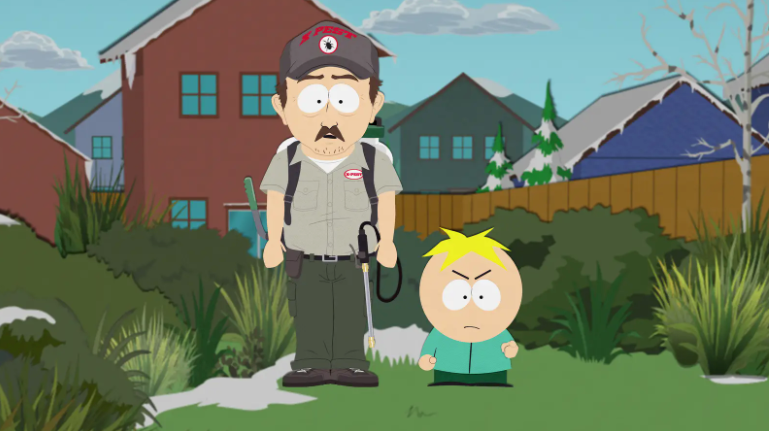
While President Trump was holding a press conference at the White House this morning and extolling the AI-related work of Meta’s Mark Zuckerberg, Nvidia CEO Jensen Huang, Anthropic’s Dario Amodei and SpaceX’s Elon Musk, a promo for tomorrow night’s South Park episode dropped. It was less salutary.
Here’s the logline for Episode 6 of Season 29: “Butters is unhappy with the data centers that the billionaires are building in our backyards.”
The clip opens with an X-Pest exterminator guy ringing the doorbell at Butters’ home.
“I understand you’ve got some billionaires in your back yard,” he says.
“Yeah, there’s more of these stupid billionaires every day!” replies Butters.
The first image from the episode (see it above) shows Butters in what appears to be his back yard with the X-Pest exterminator guy, who has strapped on his tank of poison and has his sprayer wand at the ready.
The topic of data centers is a hot one across the country and especially in Hollywood, where unions and workers worry about job displacement and writers and directors express concern over what it might do to their art.
Among the biggest players in the data center land rush is, of course, Oracle CEO and Paramount-WBD deal financier Larry Ellison. South Park airs on Comedy Central, which is owned by Paramount. As in the past, the show’s creators are seemingly not afraid to bite the hand that feeds them.
Mark Ruffalo and others have decried the introduction of “really profoundly scary technology” into Hollywood and how AI might impact media outlets soon to be owned by Ellison and his son David.
“Larry is a classic Oligarch,” wrote Ruffalo. “They are crushing workers and consolidating the wealth of the world for their own power and concentrated dominance.”
Paramount, for its part, responded by accusing Ruffalo of using “antisemitic tropes” in his argument, especially when linking the Ellisons’ studio acquisition to Oracle’s work with the Israeli military.
>

Amy Poehler Hilariously Presses Andrew Garfield on Method Acting

Man City guilty: Premier League club knew of independent commission’s verdict in the summer – Paper Talk | Football News
Another Phillies postseason, another painful round of 'what-ifs' about the bullpen
-

 movies4 months ago
Search For Canadian TV Actor Stewart McLean Now Homicide Investigation
-

 Fashion9 years ago
These ’90s fashion trends are making a comeback in 2017
-
Fashion9 years ago
According to Dior Couture, this taboo fashion accessory is back
-
Fashion9 years ago
Model Jocelyn Chew’s Instagram is the best vacation you’ve ever had
-
Fashion9 years ago
Emily Ratajkowski channels back-to-school style
-
Fashion9 years ago
9 Celebrities who have spoken out about being photoshopped
-

 Anime4 months ago
Rurouni Kenshin: Hokkaido Arc Manga Takes 1-Issue Break – News
-

 Anime3 months ago
HIDIVE to Stream English Dubs for The World Is Dancing, The Forsaken Saintess and Her Foodie Roadtrip in Another World, The Dangers in My Heart: The Movie Anime – News